

Part One
Memorie.al / My life have already reached its crescendo and, like an airplane, it is coming in to land on the runway of its final phase. The age of 70 is a heavy weight for formulating thoughts with the expressive charge and clarity needed for the subjects I target. My Durrës – the Durrës of my birth, the Durrës where my parents are buried, the Durrës of my relatives, friends, and companions – I view it without wavering or daring to change a single comma from its early, or rather, traditional popular orientations. Many things have changed. High-rise buildings have been constructed. Streets and squares have been transformed. Durrës has grown and expanded. Newcomers have even created the figuration of “New Durrës.” An Albanian-speaker, not raised in Albania, once asked me: “Where is the ‘Durrës of the Sea’?” He was referring to the beach.
I walk the streets of my birthplace and, in my imagination; I hear the cries of a baby born in August 1951. I see the traces of his childhood, youth, formation, and maturity. The numerous buildings constructed both with and without criteria, tend to make this ’51-er lose his memory. I stop and seek to move the gears of memory, which are still powerful. I want to remember. I want to dig. I want to display once again, as if in a different time, early tableaus with the names of people long gone from this world, but also of streets, places, and traditional meeting points. I love this kind of history now more than ever. For I believe that in this way, I draw closer to the memory of my parents, to the people I long for on my street, in my neighborhood, and in my city.
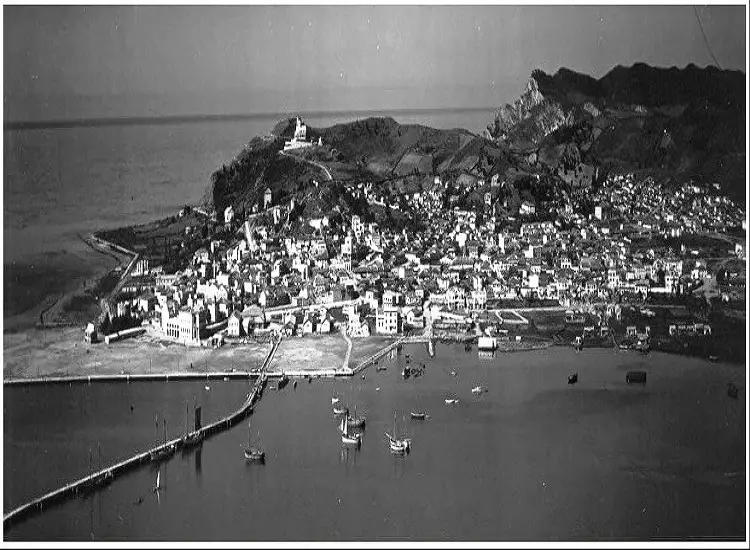
When I was very young, I couldn’t have imagined that I would record the images I need now more than ever. They are images of my life, but also of our lives. It is that simple life, somewhat poor, and perhaps with a few sorrows and troubles, but very sweet, very beautiful, very dear, very precious. I have looked for old photos. I found something, but not exactly what I wanted. I have filled in the rest myself, but from the present time. Today, it is hard to find a view that reminds you of tradition without a car in front of it. The city has changed, but it can hardly change our memory.
Together with you, reader – the motivator of my creativity – let us walk, touch a bit of our past, and re-emphasize many old names. Even though the year 2021 has begun to bite and distance itself from the first days of its long 12-month start. Decisions have been made, documents have been drafted, and signs have been placed on every street corner, yet we continue just as before. When asked where a certain street, workplace, or other institution is located, we immediately react with the old and traditional names. This remains a powerful force of habit, but also because many of the new names assigned do not convince people. They feel more relieved when they simplify things with the former names, which the collective memory has no intention of letting slip away.
In this “super extra” material, we will deal with the majority of names that old residents – and perhaps even those who moved to Durrës long ago – are accustomed to using for orientation in their daily lives. Such writings are exhausting and always leave something incomplete for the general public to fill. But what matters is the unwavering certainty of the citizens not to sway from the old names, even though today’s Durrës has changed and is changing radically compared to the past.
“Sefer Efendiu,” Public Baths, “Topana Well,” The Court, Workshops, The Orphanage
“Sefer Efendiu,” or as said in the Durrës dialect, “Sefer Efeniu,” is the most typical street in the memory of Durrës locals. A legendary street, rich in history, with giant figures of action, patriotism, culture, and civility, of sports and civilization, of work and construction, of resistance and the most poignant history of our Durrës. “Sefer Efeniu” street feels to me like Durrës itself. I don’t frequent it often now. My heart, somewhat tired and repaired from serious damage, cannot handle the uphill climb. The last time I climbed it was when I was weakened by the passing of the mythical Ruf Kazazi. He is the grandson of the famous warrior, patriot, erudite, dreamer, and transformer of nature, Sefer Kazazi, as “Efendi” was given to him as a title at the beginning of the last century.
It is this “Efeni” (the Durrës-made Albanianization) who settled on this hill and turned it into a place where nightingales sang. The story of Sefer Kazazi honors us all. After graduating from the Military Academy in Istanbul, he was appointed commander of Turkish troops at the Mostar Bridge in Bosnia and Herzegovina. In one of the most preferred venues of the Turkish military elite, he began singing an Albanian song. But a Turkish colonel told him: “Dirty Arnaut, Albania does not exist!” That was all Sefer needed to draw his sword and behead the threatening Turk. He was sentenced to death. Gold provided by his family and the intervention of their friend Gani Toptani, who served at the court of Sultan Hamid, influenced the pardon of his life.
Life imprisonment in Chad, Africa, was the lighter sentence he was given. He escaped and came to Durrës, for which he had been consumed with longing. He bought the hill that bears his name and turned it into a blooming garden. He dug wells, planted fruit trees, and transformed it into a flourishing orchard. He gifted land to residents and made this area very famous – a fame it enjoys even now. This pride of the Durrës people will never fade. Here was born the renowned footballer, Panajot Pano. Here is the residence of Sefer Efeniu’s grandson, the unforgettable Ruf Kazazi, and other famous names such as: Abdulla Duma, Shazivar Gruda, Fatos Muço, Bernardina Qerraxhia, Burhan Truma, the Kapexhiu swimmers, and other well-known families like: Nova, Ferra, Rubjeka, Xheneti, Kuqi, Rrogozhina, Kollaku, Xhaxhiu, Reçi, Jasini, Vogla, Pusi, Kapllani, Gjepali, and many, many others.
“Topana Well” (Pusi i Topanasë) is hundreds of years old. It is a value of research, history, and culture. But Durrës locals feel relieved when they say that what you are looking for is near “Topana Well” or near the city court. Before “Sefer Efeniu” street, on the left side when moving towards the city museum, there used to be a row of pastry, milk, and boza workshops. Adding to this the former location of the public bath (opposite the city court), we are dealing with popular landmarks used by the people of Durrës. Even the collective memory has not removed a comma from tradition.
The Mausoleum, “Stani” Street, “Moisiu” Hill, “1 Qershori” Kindergarten, The Haznedars
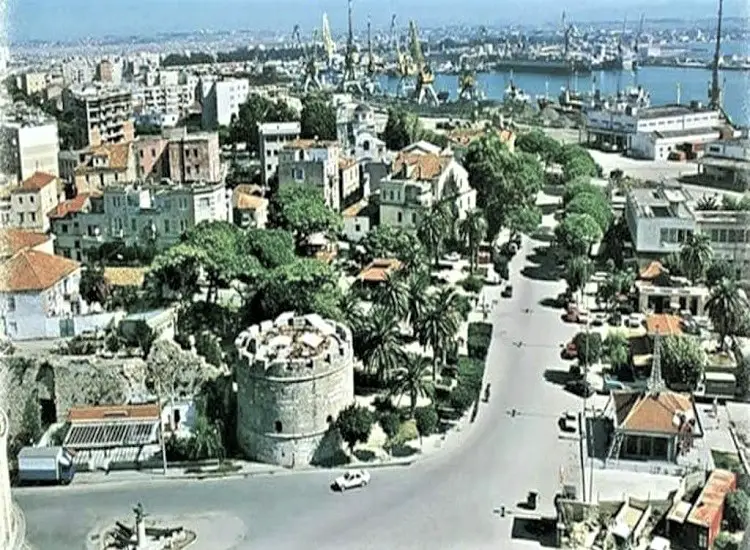
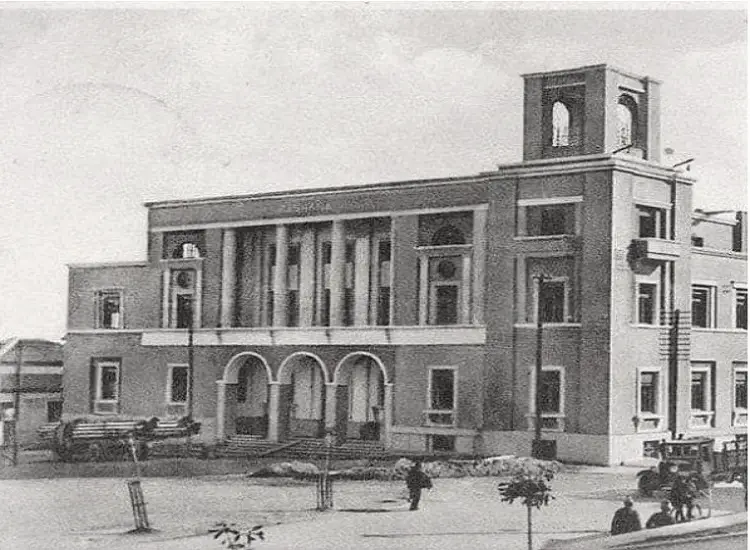
Durrës, of course, was what it is today, neither in surface area nor in the number of inhabitants. it was much smaller in these two indicators, yet surprisingly, the locals do not give up on their past. They have mandates from several generations who no longer live, but they also touched that “custom” in their childhood and do not abandon it today. We start with the War Mausoleum, which is shortened to the word “Museum.” This location encompasses the entire area, including the bars and gardens nearby, the pedestrian and vehicle crossing points, and the respective turns towards the hospital, the police directorate, or in the opposite direction from the court, the District and Prefecture, the Palace of Culture, the “Shamia” (The Scarf building), and the City Hall.
Don’t even bother – hardly anyone will understand if you tell them where “X” street is. Near the museum lies the famous “Stani” (The Sheepfold) street, a characteristic street with a downhill slope that brings back deep nostalgia. This street, since the early age of my generation and even further back, was used as a return path when passing high above Currila, crossing Vila Hill, walking near “Moisiu” Hill, and touching the asphalt right at the museum. And this descending road, so full of longing, is called “Stani” street.
The meaning of this word is simply “the sheepfold.” A place where livestock was raised and bred. According to Nasta, our friend from the well-known Martika family, she reminded me of many fold-keepers who are part of the city’s history and its early residents. Among these, we remember well-known surnames: Martika, Kulja, Teodori, Bihiku, Arapi, Zaka, Heba, Prifti, Lito, Unçi, Lepuri, Pizha, Driza, Shima, Mima, Koraqi, etc. Near the center of “Stani” street, the greenery of a dominant hill appears. It is the very famous “Moisiu” Hill. One of the oldest families of Durrës, in traditional form, has been settled there for a long time. The family of General Spiro Moisiu, or the well-known doctor Koçi, is branches of the same trunk. My fellow Durrës locals use “Moisiu” Hill as a traditional orientation point.
The “1 Qershori” (June 1st) Kindergarten and the Haznedars are two other references. “1 Qershori” is my kindergarten; it is the kindergarten of many generations. The earthquake that struck cracked the walls of our kindergarten, but it did not move the memories – those memories that relate to the very life of the city. Near the kindergarten is a place very well known to the people of Durrës. It is the house where the Haznedars have lived and continue to live. A quiet clan of hardworking and refined citizens. A dominant surname, like their history itself. A clan with broad marital ties and deep-rooted friendships connected too many families in Durrës. The “1 Qershori” kindergarten and the Haznedars are famous in the orientations of locals and even newcomers.
Ferra’s Fountain, Tod Trungu, The Warehouses at the Old Police Station, The Hide Depot
No one thinks to remember the name of the street when it comes to passing through the block of houses near the former “Naim Frashëri” school (today “Eftali Koçi”). Immediately, in the language of a local, the response is short: “Ferra’s Fountain” (Çezmja e Ferrës). The meaning is a literal application of the words. According to the area’s residents, this was a part of the city filled with thorns and briars in times past. Its clearing apparently constitutes the very history of the area and has become a distinguishing mark. Also interesting is the reference to an individual’s house, by the name of Tod Trungu. Apparently, his house was located on the outskirts of a then-compact Durrës. He was treated as the farthest point. Several generations have changed, but what remains unmoved even today – and indeed tomorrow – is the expression “at Tod Trungu’s house,” to explain to locals the direction they should take.
Near this “Tod Trungu” is the other explanation of the old police building and the fruit and vegetable warehouse. Despite being altered by disfiguring constructions, they remain active landmarks where Durrës locals give each other directions. Don’t waste your breath mentioning the street name; the person you meet will almost certainly shrug and say, “I don’t know where that is.” Opposite the road leading to “Ferra’s Fountain,” there was once a hide (leather) depot. How fresh its name remains even now.
“New Neighborhood,” “Nako Spiru” Sports Park, The Sports Palace, “Shijaku’s Building,” “The Dovanas”
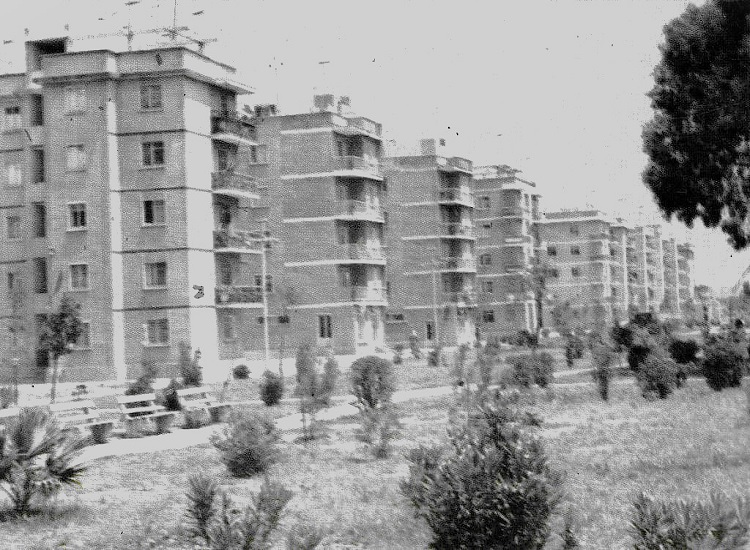
Durrës is “fragmented” by popular territorial divisions. Many names have been removed. Many names have been established by documents and decisions. But the simple people remain the same. Even though the currency change happened in 1964, almost all of us still do our accounts in “old lek” and are unlikely to move from this position for a long time. “Lagja e Re” (The New Neighborhood) is very well known in Durrës. The Roma who arrived there are said to be an old ethnicity in Durrës. But their housing had become a problem. It took powerful popular actions for this neighborhood to truly become “new,” with buildings and infrastructure. Two powerful formulations exist here: first, at the lime shop, at Isuf Xhymerti’s; and second, at the Roma area in “Lagja e Re.”
The famous “Nako Spiru” Sports Park also remains an active boundary; although it has been transformed and repurposed, it lives vividly in the memory of Durrës locals. I have presented the exterior view where the offices of the “Lokomotiva” Sports Club and the District Sports Committee used to be. The employees of this administration were giants of sports. I remember: Dhimitraq Goga, Milorad Jeremiq, Dilaver Cara, Tom Gjiri, Mustafa Çelkupa, Anesti Petani, Lluka Prifti, Rexhep Bagoji, Fatmir Shyti, Petrit Kërtusha, Ruzhdi Demiri, finance chief Milto Spiro, Serie Verzivolli, Drita Mustafa, etc. I also want to mention the workers who left a legacy, like Fatime Kumini, Halit Struga (the bald one), Uncle Frone, etc. I long for them.
Similarly, the Sports Palace for indoor games remains an emblem of local meeting points. Beside this sports palace stands the “Shijaku building” as a testament to memory – the center of old Durrës merchants of the same surname, who dealt with the milling of bread grains. The “Shijaku” building is an archive in itself. Early on, there was even a fish restaurant there. On the side of this building, where Tirana Bank is now located, a new Durrës-style formulation emerged: “21-15,” the price of a coffee and a cognac.
After jumping a bit in distance, you encounter another famous name: The Dovana Buildings. One, somewhat in miniature, is at the former agricultural exhibition, and the other, larger, is in the space where Raiffeisen Bank is now. The “Dovana Building” – so close to our orienting spirit. The Dovanas are a very well-known family in Durrës. Skilled merchants. The most prominent among them were the famous goalkeeper Niko Dovana, whose name was given to the city stadium, and the writer and translator Alfons Dovana.
The Flour Factory, The Power Plant, Hotel “Durrësi,” Gastronomy, Fermentation, Kadri’s Shop
We come to another traditional grouping. We walk through the streets of Durrës. As the first years of my life appear, on the giant screen of my memory – which still operates with sufficient capacity – names emerge where we have fixed the location of our movements. The Flour Factory. Even in the photo we present, the word “Silos” has not been removed. There were two of them that ground grain. They have been in the possession of local merchants since the 1920s. Nearby is the Electric Power Plant (Centrali), so often cited by residents. The history is well known – from a few hours of light a day in the 1950s to the payments, sectors, and the “current” (electricity) directorate in Durrës.
We “jump” a bit in distance. And we are faced with the well-known hotel named after the city, “Durrësi.” Once, it was also the directorate of NTUS. Very commonly used in the local vocabulary for determining location. Opposite the side of this hotel lies the former “Gastronomi” (The Gastronomy building). What an echo it had when it was built! It even functioned as a self-service center. Based on the Russian model, all food units were concentrated there – from bread, meat, and dairy to groceries. So many memories! The famous 52-lek bread was sold here, along with “qahi,” buns, cornbread, etc. And beyond this surprise, the Gastronomi also became a place where meetings were set or various routes were defined.
We move on. We take the direction from today’s “Flagship” and “Blue Star.” It was the giant building of Tobacco Fermentation. Durrës was an active and important center for cigarette production and tobacco manipulation. And opposite this fermentation building remains untouched the well-known, famous, and charming “Kadri’s Shop” (Dyqani i Kadriut), linked to the name of an emblematic salesman in Durrës. So many meetings of citizens, newcomers, and locals were set here. Even now, the tradition continues, and it seems to me as if Kadri Ngjela will remain forever alive in memory.
“Pranvera,” “1 Maji” Garden, the Post Office, “Kumini” Street, “The Bidulas’ Oven”
“Pranvera” (spring) Square became particularly well-known after the change of systems. Apparently, the starting point was a cafe-bar with the attractive name “Pranvera.” Being a center where pedestrians intersected and a stopping point for taxis, various vehicles, and urban lines, locals brought it into their focus. And when you said “let’s meet at Pranvera,” it was clear to anyone. “Pranvera” Square replaced the early orientation point of the “Old Market” (Merkata e vjetër). This market had points for trading fruits and vegetables from state trading enterprises, but it was also the farmers’ market. An original market, accompanied by water sources with Oriental ornaments. The location of this market remains very fresh in our memory.
Almost adjacent to the old farmers’ market, facing each other, stand the Central Post Office of Durrës and the famous “1 Maji” garden, which has now been replaced by a giant building, permanently cutting off the chances of returning it to a green zone. But the “1 Maji” garden remains an unquenchable longing for the people of Durrës, for our childhood and youth, and even for that of our ancestors. The Central Post Office has also become a necessity, frequently referred to as a meeting point.
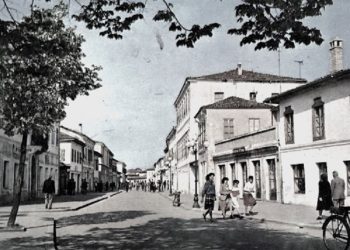
And we come to the famous “Kumini” Street or alleys, a road that almost every Durrës local mentions all the time. An alley that serves as a very important connecting hub for passing from the Tivari house to emerge on the main road near the Bllacas, “Sefer Efeniu” street, the city court, and the former public bath. I will mention only a few surnames, apologizing to the others. This road begins with the Kovaçis, the family of Remzi Tivari, goes deeper past Kost Loni, the Curris, the Bushi sisters, and finally to the Çumashis. I have presented three views of this road on this occasion, which, according to information I have gathered, relates to works of clay, “kumi” (fine sand/soil), bricks, and other ceramic works. Beneath the foundations, there are traces of “kumi.”/Memorie.al
To be continued in the next issue