By Ilia S. Karanxha
Part Two
Memorie.al / The name of Dora d’Istria held an honored place since the period of the Albanian National Renaissance and have remained untouched to this day. Both during her lifetime and after her death, laudatory writings, studies, or monographs highlighting specific or complex aspects of her life and work have been plentiful in Albania, as well as in other countries – particularly Romania, Greece, Italy, France, and elsewhere. Her fame spread rapidly across Europe and, soon after, across the ocean. During her visit to the USA in the summer of 1880, she was received with special honors; during her meeting with the prominent American writer Henry Longfellow (1807–1882), he pledged to her that he would write a poem about Skanderbeg.
In her polemics against war, several articles and studies were published: ‘War’ (Athens, 1870), ‘Men’s Politics and Women’s Politics’ (Constantinople, 1871), ‘War and Women’ (New York, 1870), ‘War’ (Florence, 1871), ‘Religion and War’ (Athens, 1870; Constantinople, 1871), ‘The Alabama Claims’ (Athens, 1871; Constantinople, 1871), and ‘Peace and Civilization’ (1882).
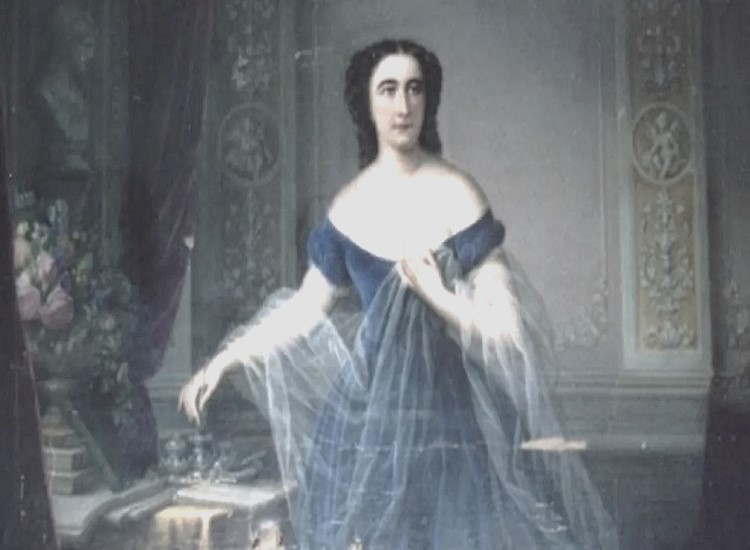
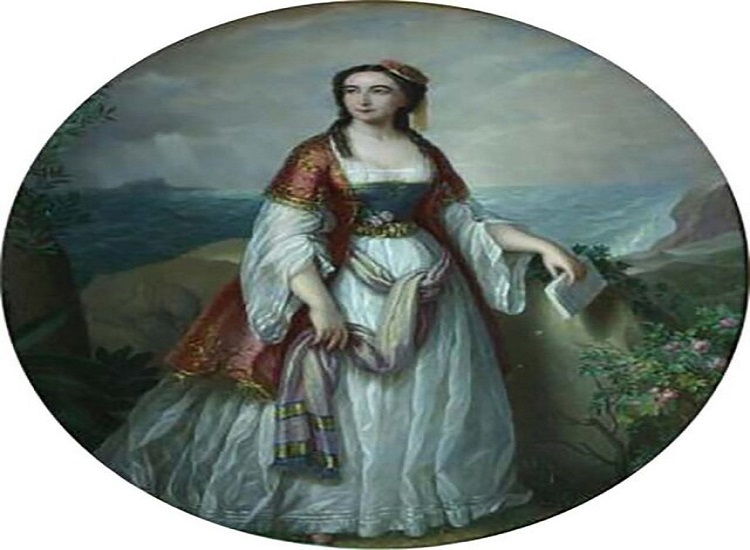
In the fourth section dedicated to political economy and agriculture, we can note, among others, the writing: “The American Social Science Association” (1871). The fifth section of Cecchetti’s bibliography is dedicated to Elena Gjika’s writings on various art figures, such as Giovanni Dupré (Athens, 1870), a prominent sculptor in Florence who is said to have created a bust of Dora d’Istria. This is followed by a study on Greek Artists (1871) and a description of a visit to the Museum of Felice Schiavoni. This painter was the author of many portraits of Elena Gjika that we inherit today, occasionally collaborating with the Parisian painter Adolfo Salmon.
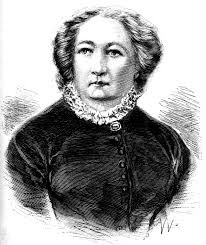
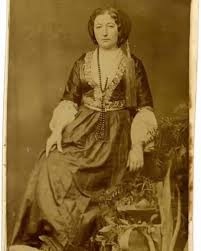
In almost all biographies dedicated to Dora d’Istria, her contribution as a painter and her participation in exhibitions is emphasized; however, to date, it has been impossible to demonstrate a work created by her own hand. Regarding the writing “A Summer on the Banks of the Danube,” Cecchetti tells us it was accompanied by a drawing from a painting by Dora d’Istria titled: View from Borcea – Romania. This article, published in the magazine ‘Illustration’ (Feb 9, 1861), indeed contained this drawing, but besides the well-known portrait of Dora d’Istria, we also found three other graphics illustrating her writing, two of which are signed by other authors.
Cecchetti refers to similar information regarding the writing “The Cretan Insurrection,” published in the same magazine on January 10 and 26, 1867. The collection we were able to browse lacked these dates; however, regarding this fact, Cecchetti writes that: several drawings of the encampments of the Kandia insurgents, taken from photographs sent by the author, were printed there. Are these drawings created by Dora d’Istria herself? Or did she simply take the photographs? Despite these limited reports, Dora d’Istria made it a habit to often accompany her writings with illustrations, many of which are paintings or graphics.
In October 1870, she settled in Florence, and by 1871, she began purchasing the land surrounding her house to establish her garden. According to Prof. Dr. Demetrio Bargellini, the project was designed by one of the most prominent architects in Paris. Thus, as can be seen, Dora d’Istria’s relationship with art remains an unwritten chapter.
Returning to Cecchetti’s bibliography, the sixth part deals with political articles, listing 13 writings. Among those that had the most resonance are: “On the Brotherhood of Latin Peoples and Their Work in the Development of Humanity” (1856); “Response to the Greek Deputy Who Came from Trieste to Venice” (1867); “Letter to the Legislative Chamber of Athens” (1867); “Response to the Committee of Epirus-Thessaly-Macedonian Women” (1867); and “Panhellenism” (1867).
The seventh and eighth parts are dedicated to history and travels. In total, there are 50 publications of various natures, indicating Dora d’Istria’s exceptional commitment in this direction. Among the writings or studies that were also published as separate works, we can note: “Women in the Orient” (Zurich, 1860), “The Albanians in Romania” (Florence, 1873), and “The Heroes of Romania” (Florence, 1887), published under the care of P. Mantegazza. Notable articles or studies from this period include: “The Ionian Islands” (1858), “The Hellenic Nation According to Historians” (1860); “The Serbian National Insurrection According to Folk Songs” (1868), “Women in the West” (1860–1861), “Vasiliki” (1868 and 1869), “The Klephts of Modern Greece” (1868), “Women in India” (1871), “Rome the Capital” (1871), “Asia and the Asians” (1871), etc.
Among her historical works are the studies on the Bushatllinj of Shkodra (1868) and Ali Pasha Tepelena (1870), both under the common title “The Muslim Albanians,” published in the magazine “Nuova Antologia of Florence.” Regarding the Gjika family, she wrote extensively in the study “The Albanians of Romania,” which, after being published in the magazine “Europea” (1871–’73), also appeared as a separate volume translated into Italian under the supervision of B. Cecchetti himself (1873). Immediately upon the book’s release, the first reviews were published in the magazine “Cornelia” (August 16, 1874) by C.F. Gaba.
A summary of studies dealing with this issue was recently published by Kristia Maksuti (2001). This work touches upon the origin of this family, for which Elena specifies that the Gjikajs are of Albanian descent, thereby dismissing all hypotheses that attempted to divert the family’s origin. However, she remains reserved in fixing exactly which area of Albania her family is from and the reason why the Gjika ancestors moved to Asia Minor. On this matter, she writes:
“When the impenetrable clans of Albania are better known, historians may better trace to which of them the ancestors of the Gjikajs belonged. Until now, it is known that among the Kelmendas – one of the most prominent tribes of Ghegeria – the Gjokajs (Giocai) are found; and since Gjoka and Gjika are certainly identical names, it could be conjectured that the Gjikajs descend from the tribe of Kelmend, who are traditionally held to be of Venetian origin.”
The work “Excursions in Rumelia and Morea” (Zurich, 1863), which also discusses the Albanians of Greece, was exceptionally well-received by the public. Parts of it began to be translated and republished in various periodicals; however, in Constantinople, its publication in Greek translation in the magazine “Evridiki” was interrupted by order of the Sultan.
Among her travel descriptions, the work that first made her famous in Europe was “German Switzerland” and the ascent of the Mönch (Paris, Geneva, 1856), which was translated into English and German, while in 1857–’58, a revised and expanded edition appeared in French. Today, not everyone agrees that Dora d’Istria actually reached the summit of the Mönch, as one of the guides refused to sign the testimony she published in this work. Regardless of these modern debates, the work caused a great sensation at the time, and Elena skillfully used her artistic mastery to draw the attention of all Europeans.
Many writings of this nature followed: “Italian Switzerland” (1856), “Ticino” (1856), “Lugano” (1856), “Ascent of San Salvador” (1859), “Landscapes and Gifts from Italian Switzerland” (1860), “A Walk on the Shores of Lago Maggiore” (1864), “Excursions in Tuscany” (1868), “The Gulf of Spezia” (1867), “Memories from Canton Ticino” (1867), “An Excursion Through Italy” (I. A Walk in Pompeii; II. Montenero; III. Florence, 1869), “A Gift from Spezia” (1869), “A Pilgrimage to Dante’s Tomb” (1869), “Venice 1867” (1870), “The Alps” (1870), “Pegli” (1872), “The Gulf of Rapallo” (1873), “The Venice Carnival” (1867), etc., all of which were welcomed by many readers, for whom geographical descriptions were very much in fashion.
The ninth and tenth parts of Cecchetti’s bibliography include romances and various writings. Among them, we find the writing “Albanian Sketches” (“Esquisses albanaises”) published in the magazine ‘Grèce’ of Athens in January and February 1868. Cultivating diverse interests, Dora d’Istria did not set aside her great passion for gardening and rare decorative trees. This began from the moment she settled in Florence (1870) and continued until the end of her life. A special work for this purpose was dedicated by Prof. Dr. D. Bargellini (1887), director of the Botanical Institute of Florence, who focused on describing the 60 most unique trees grown under Dora d’Istria’s own care, which gave the garden a magnificent charm and which, in the words of Prof. Bargellini himself, “honor our city, and Her, who collected and cultivated them with such love and wisdom.”
On Saturday, November 17, 1888, at 6:00 PM at No. 10 Leonardo Da Vinci Street (“Villa Istriana”) in Florence, Princess Dora d’Istria died prematurely at the age of 60, after an illness from which she had suffered for years. Her final wishes in her holographic will (January 9, 1886) were for the funeral to be a simple civil ceremony and for her body to be cremated at the Trespiano Cemetery (Florence), where her urn is kept to this day. Even in death, she displayed a high act of civilization and outstanding humanism, writing: “I give to the school for the deaf-mute my house and my gardens located at No. 10 Leonardo da Vinci Street and Viale Militare.”
The National Institute for the Deaf-Mute was located on that very same street and had begun its life two years before Dora d’Istria wrote this wish in her will. On the other hand, she did not fail to reward her family members from her wealth, and even her devoted gardener who remained faithful to her throughout her life. After several years, the Institute’s administration decided to sell “Villa Istria” and the surrounding garden, until in 1932, passing from hand to hand, these properties were demolished to make way for new buildings.
The renowned philologist and orientalist A. De Gubernatis, regarding one of his first meetings with Dora d’Istria, would write:
“I did not know her as Princess Elena of Romania, but from the choirs of hymns to her Greek beauty that resonate around me – hymns of princes and fishermen, poets and critics, of harsh Sarmatians and pleasant Latins – I must admit that this is not a contrived beauty, of a pale Diana, of a withered flower, but rather of a strong and hidden flame, always bright and always full of life…”!
Romanians, Albanians, Greeks, Slavs, and Latins treat and respect Dora d’Istria as their tireless fellow citizen because she made her pleasant, sensitive, vivid, and elegant voice ring out in the West for the benefit of all: for the Orient, and then for the Latins, she explained the qualities of the Germans, Scandinavians, Flemish, and Anglo-Saxons, so that progress would not remain the privilege of only a few peoples… (Magazine “Contemporanea Nazionale Italiana”, Turin, April 1869). Following Gubernatis’s valuable thought, there is nothing left for us to say about this princess except that she was one of the first pioneers of a United Europe. /Memorie.al