
Part Three
Memorie.al / For some, it might seem like something astonishing: a martyr who is also the first record-breaker of a nation’s sports! In truth, within this title or these eight words, everything is as natural as it is true. Although it is only now being proven through this first-time narrative of this year, 2018. It is strange how it has been possible that until today – in 2018 – this truth has remained unknown, unrecognized, and unrecorded. And yet, we should not be surprised. History in Albania and sports history in particular, still moves far too slowly, like something secondary, filled with endless untruths, naive tales, and the distribution of even unmerited affirmations. It reaches a point where an honest professional historian must incessantly correct the brutal conduct of unconscious writers who, surprisingly, continue to fill the pages of newspapers.
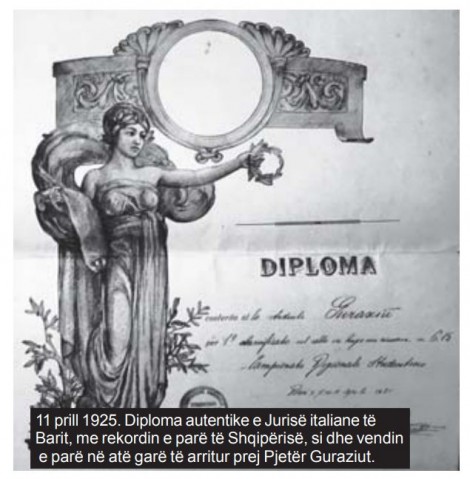
At a time when the world record was 7.76 m, held by the American Robert LeGendre. We are not aiming for that comparison. But 6.15 m by an Albanian, at a time when track and field in Albania had not yet stepped onto a track or a runway, must today be considered nothing short of extraordinary. This was the year of athletics for Pjetër Guraziu from Shkodra, Albania, who indeed, given the collection of diplomas possessed by the Guraziu family, appears to have been a multi-event athlete. He holds winner’s diplomas in the high jump, the 100-meter dash, and even the 3000 meters. By 1925, Albania had determined its first record-holder, even before championship athletics had arrived on its soil.
It would take another four years for this to happen. It would thus take that long for Albania to reach its First National Track and Field Championship: September 2, 1929. The surprise is that we are one year prior to June 6, 1930 – the official founding of the organization that would be called the “Albanian Youth” National Entity (Enti Kombëtar “Djelmnia Shqiptare”). It is this Entity that, on August 20, 1929, began organizing the National Championships starting with athletics. The Director of the Entity, Prof. Giandomenico De Marchis, who would play a leading role in the organization of our national championships in the 1930s, declared meanwhile:
“We have the honor to inform you that according to the order of His Majesty, the King of the Albanians, Zog I, by decree, on September 2, 3, 4, 5, and 6 of this year, there will be held here in Tirana, on the aforementioned days, the first Track and Field Championship Games organized by this branch. The games in question will take place at the Shallvare field.”
This was the announcement. A great historical announcement, because it concerned the first sporting championship organized by Albania, precisely one year before the National Football Championship (1930). Track and field is the pioneer of Albania’s National Championships. And as I have written long ago, it was a truly Western organization given the modest conditions of the young Albanian state, only 17 years after its independence. It was a First National Track and Field Championship that filled Tirana with its posters and was held under the “high patronage of Princess Myzejen.”
And there was a collection of trophies: rare and elegant cups for individual and team winners that adorned press advertisements as they were showcased before the start of the Championship. The Minister of Education, Hil Mosi, dealt with this Championship personally. Ten years earlier, in 1919, he had been the main organizer and founding chairman of what is known to this day as the “Vllaznia” Society of Shkodra, from which today’s “Vllaznia” descends – that cultural-sporting society which in 1920 had organized the first athletic race in Albania, a small marathon through the streets of Shkodra, won by a man named Kol Gjoni.
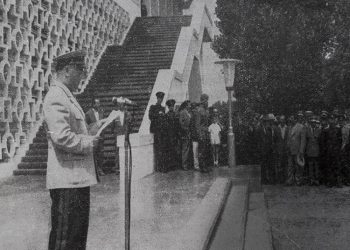
Undoubtedly, this athletic sensibility of the prominent patriot, now a minister, played a primary role in this organization of the National Track and Field Championship. Thus we arrive at September 2, 1929, at Tirana’s “Shallvare.” A brilliant ceremony for the time. Line-up. Parade. National Anthem. The presence of Princess Myzejen, and the moving speech of Prefect Rexhep Jella. Albania had founded not just its first Track and Field Championship, but exactly what we said at the start of this historical narrative: the founding of the National Championships of Albania for all sports.
I am not mistaken when I say that it is the most historic founding date in the entire life of sports in Albania. And there appears the first champion of the Championship, as well as the first national record in the history of Albania. This occurred in the high jump by the well-known Prof. Peter Andoni of Elbasan with 1.68 meters, an all-around athlete since his days at “Robert College” in Istanbul. It is precisely this man who connects across time with our character, Pjetër Guraziu. Andoni is the man who almost dominates Albania’s first Championship. Champion in the high jump, the long jump, as well as in the pentathlon and decathlon.
He is the only one to snatch four gold medals as Champion of Albania! And we single out the event of “our” protagonist – the long jump. Andoni was declared National Champion with a result of 5.97 meters, which until today, after I have exhausted myself in the archives, we have accepted as the first long jump record. This means exactly 18 centimeters less than Guraziu’s record (6.15 m) in Bari in 1925. Now, it seems as if today, after nearly a century, we are inviting the two record-holders to a virtual race that “takes place” more between documents and written pages of history than on the jumping runway.
Even from a distance, between the professor of “Robert College” in Istanbul, Peter Andoni, and the Doctor of Economics from the University of Bari, Pjetër Guraziu, their virtual duel naturally begins and ends with our story, which we will conclude below with the historical correction of this record, unknown until today. Some 4-5 years ago, in a historical piece on track and field, I listed these names:
Llazar Miha, Ragip Lohja, Sabit Çoku, Prof. Peter Andoni, Mehmet Gjakova, Vasil Alarupi, Simon Todoshi, Jorgji Koja, Prof. Taho Shkreli, Prof. Adem Karapici, Qamil Abazi, Irfan Gjinali, Ferid Beshiri, Vladimir Shuteriqi, Prof. Ibrahim Dizdari, Mitat Aranitasi, Ahmet Karini, Muhamet Agolli, Rexhep Maçi, Ahmet Duhanxhiu, Hysen Kusi, Prof. Behxhet Jolldashi, Qazim Dervishi, Dr. Bahri Kopliku, Ahmet Taibi, Zeqir Sulejmani, Dr. Isuf Dashi, Andrea Çani, Shaban Ahmeti, Dr. Naim Vreto, Qazim Keçiçi, Prof. Xhevdet Skilja, Dr. Ndoc Gera, Aleko Turtulli, Koço Kaftani, Azbi Tepelena, Fetah Fara, Rexhep Shpendi, Andon Terova, Petraq Leka, Ndoc Paci, Muharrem Toptani, Shuk Radoja, Kapllan Dervishi, Av. Sandër Kraja, Shadan Toptani, Ymer Sharra, Prof. Elez Maha, Isa Meta, Kristo Isak, Prof. Alush Lleshanaku, Muharrem Musa…
All were participants in the first Track and Field Championship of 1929, but many also in the 1930 edition. Champions, runners-up, and “bronze” medalists, as we might call them. But one name escaped me: Pjetër Guraziu. In 1929, he was still in Bari, but in 1930, he was a participant in the Second National Track and Field Championship of Albania. This was revealed to me by a review of my old archive. And the long jump event for this Championship was almost entirely of the “Shkodra brand.”
In fact, it was the duel of Qazim Dervishi vs. Pjetër Guraziu. The champion was the universal founder of Albanian sports, Qazim Dervishi, with 6.04 m, while the runner-up was Pjetër Guraziu with 5.93 m. They left in third place none other than the man with the distinguished name, Selman Stërmasi. And a great surprise: the runner-up Guraziu went on to participate in the discus throw, where he ranked third.
Then, he left for last his participation in the 4×100 meter relay where, together with Luigj Shala, Luigj Radoja, and Sandër Kraja, they won the title of Champions of Albania. Thus, quite suddenly, after discovering Pjetër Guraziu as Albania’s first long jump record-holder and the 1930 runner-up in the same event, we also find Pjetër Guraziu as a Champion of Albania in the 4×100 meter relay. A complete athlete, record-holder, and champion of his country. And as the years take their toll, he leaves the track and runway, but not the activities of the sporting world. Now in new functions…!
From the book I wrote about the sporting life of the extraordinary Dr. Vasfi Samimi, I extract these lines: “…On August 13, 1935, at the general meeting of representatives of out-of-school sporting and artistic societies, based on Article 382 of Education, the Federation of Sporting and Artistic Societies was founded in Tirana under the name ‘Vllaznija Shqiptare’…! Under the mature and progressive leadership of Mirash Ivanaj, the ‘Vllaznija Shqiptare’ Federation was greatly strengthened, and its role in reinforcing the national championships of football, athletics, swimming, and cycling would lay the foundations for a more perfect sporting organization…!”
Meanwhile, the Albanian Sporting Federation, and after it ‘Vllaznija Shqiptare,’ founded the Albanian Technical Arbitral Council, which held in its hands the entire technical-organizational leadership of Albanian sport. If we were to compare it with the types of organizations in today’s sporting movement, we would say without hesitation that the Albanian Technical Arbitral Council (KTASH) was a kind of Committee of Physical Culture and Sports, which dominated post-war Albania for many years…! The first newly founded KTASH consisted of the English organizer of the Albanian gendarmerie, Lt. Colonel Oakley Hill, Luigj Shala, Eqrem Stërmasi, Dr. Pjetër Guraziu, Dr. Vasfi Samimi, and Telemak Nushi.
This was, so to speak, the second sporting life of Dr. Pjetër Guraziu. In this case, too, he was a founder. One of the six founders of sports management in Albania. Each more distinguished than the other. Each more intellectual than the other. Later, when the post-war era arrives – which would take his life at the peak of his maturity, skills, and national contributions – he would again be in sporting leadership roles, albeit less so. The Balkan Games of 1946 – a European-level undertaking for Albania, we might say – had to have his presence.
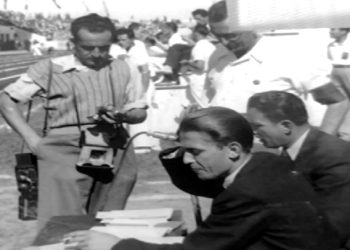
Pjetër Guraziu sat on the governing jury of the races and matches alongside prominent foreign Balkan figures such as Juan, Tucan, Lupan, Hristof, Sherbo, Brancev, Nesku, and Fiork, as well as his distinguished Albanian colleagues. Guraziu, then, but also Zajmi, Karapici, Skilja, Hila, Naqi, Lisi, I. Dizdari, Domini, Maha, Rama…! The Balkan Games must have been Pjetër Guraziu’s final parting from his sporting life in service to the fatherland. He would have six years left before his extraordinary life in service to his country ended tragically.
Now, being convinced that this story told here can by no means have a happy ending, when one thinks of the tragedy in which the martyr Pjetër Guraziu would end, we are closing by seeking some kind of solace in the compelling weight of sporting history. In this case, we place the name of the martyr and record-breaker Pjetër Guraziu on the pedestal of a history that is rare to us. And everything becomes quite simple, although again the chronological boundaries of Albania’s national record in one of the most spectacular track and field events, the long jump, will belong to the city that gave birth to Pjetër Guraziu: Shkodra.
The city that, just as it had gifted Albania its first sporting society (“Vllaznia” 1919), its first athletic race (1920), and its first Cycling Tour (1925), had also sanctioned its first sporting record-holder (Pjetër Guraziu, 1925). The chronological history of the Albanian long jump record is indeed very original and always filled with sensational turns.
A history that until today we thought began with Peter Andoni – 5.97 m in 1929 – but now, thanks to the authentic documents of the great Albanian sportsman Filip Guraziu, son of the martyr Pjetër Guraziu, we discover the first record-breaker of Albanian athletics, indeed the first record-breaker for all of Albanian sport.
It is 6.15 meters on April 11, 1925, in Bari, Italy. This is the foundation. This is the start. An “errata corrige” will be made by placing the second record-holder, Peter Andoni, at 6.16 meters in 1930. And later the others who follow, with Selman Stërmasi, and then by a peak record for the time, that of Sabit Çoku with 6.58 meters. For sporting Albania, a full 21 years had to pass until 1956, when a 22-year-old boy from Shkodra named Hysni Bebeziqi of “Partizani” arrived to break this quarter-century-old record. He reached 6.63 meters, just 5 centimeters more.
It was a day in 1956, and Communist Sporting Albania went into euphoria, because finally, a record held by a “bourgeois” named Sabit Çoku was broken – who, among other things, was the brother of a “traitor” in emigration, as they mercilessly labeled the honorable Prof. Mentor Çoku. It seems that even for the honor of the first record-holder Pjetër Guraziu, the long jump competition has reached its peak for Albanian athletics.
In truth, there are four peaks: the first record of Pjetër Guraziu, the 21-year resisting record of Sabit Çoku, the overturning record of Hysni Bebeziqi, and the European summit of today’s athlete, also from Shkodra, Izmir Smajlaj – European Indoor Champion with world-level figures of 8.08 meters. It is precisely the long jump that gave Albania its first European Champion in the sport of track and field, even if indoors – a result very close to the 8.03 meters that our international Smajlaj achieved on the open runway, where everything began with the first record-holder, Pjetër Guraziu. The history is this:
Chronological History of the Long Jump Record 1925 – 2018:
- Bari, 11.04.1925: Pjetër GURAZIU – 15 m
- 1930: Peter ANDONI – 16 m
- 1932: Selman STËRMASI – 27 m
- 1934: Sabit ÇOKU – 6.38 m
- 1935: Sabit ÇOKU – 6.58 m
- 1956: Hysni BEBEZIQI – 58 m
- 1956: Hysni BEBEZIQI – 6.63 m
- 1957: Hysni BEBEZIQI – 69 m
- 1957: Hysni BEBEZIQI – 89 m
- 1959: Hysni BEBEZIQI – 99 m
- 1961: Sabaudin RAMKU – 7.04 m
- 1964: Sabaudin RAMKU – 7.14 m
- 1970: Koço MULLA – 7.15 m
- 1971: Koço MULLA – 7.30 m
- 1975: Arb77en PAPULI – 7.34 m
- 1979: Gjergj RULI – 7.64 m
- 1984: Gjergj RULI – 7.70 m
- 2007: Admir BREGU – 7.71
- 2008: Admir BREGU – 7.75 m
- 201994: Izmir SMAJLAJ – 7.75 m
- Tirana, 25.06.2014: Izmir SMAJLAJ – 78 m
- Elbasan, 21.05.2016: Izmir SMAJLAJ – 8.03 m
And here, in this view, it seems this chronological history culminates, now richer than ever. It honors veracity, or rather, the sanctioning of the historical truth of Albanian athletics and the clarification of Albanian sports history that begins with the martyr Pjetër Guraziu. And, naturally, it feels fitting to close this tragic-dramatic saga with this exemplary (emblematic) definition by the great Curzio Malaparte, who said: “Dictatorship is the most complex form of jealousy.” Though in the case of our story, it was also the clearest form of the most ruthless oppression. Fortuitously, even unto crime!…/ Memorie.al