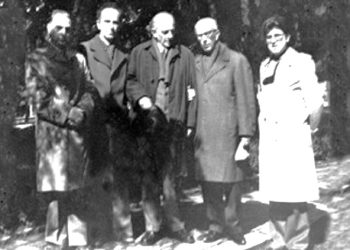
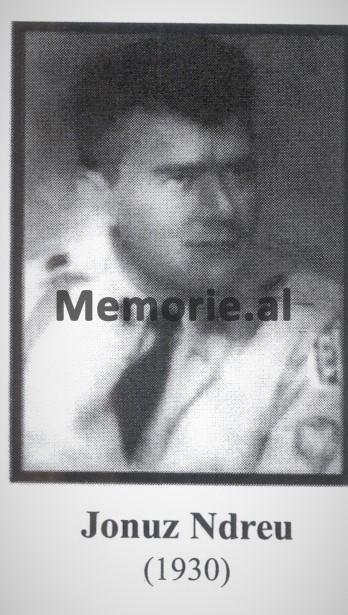
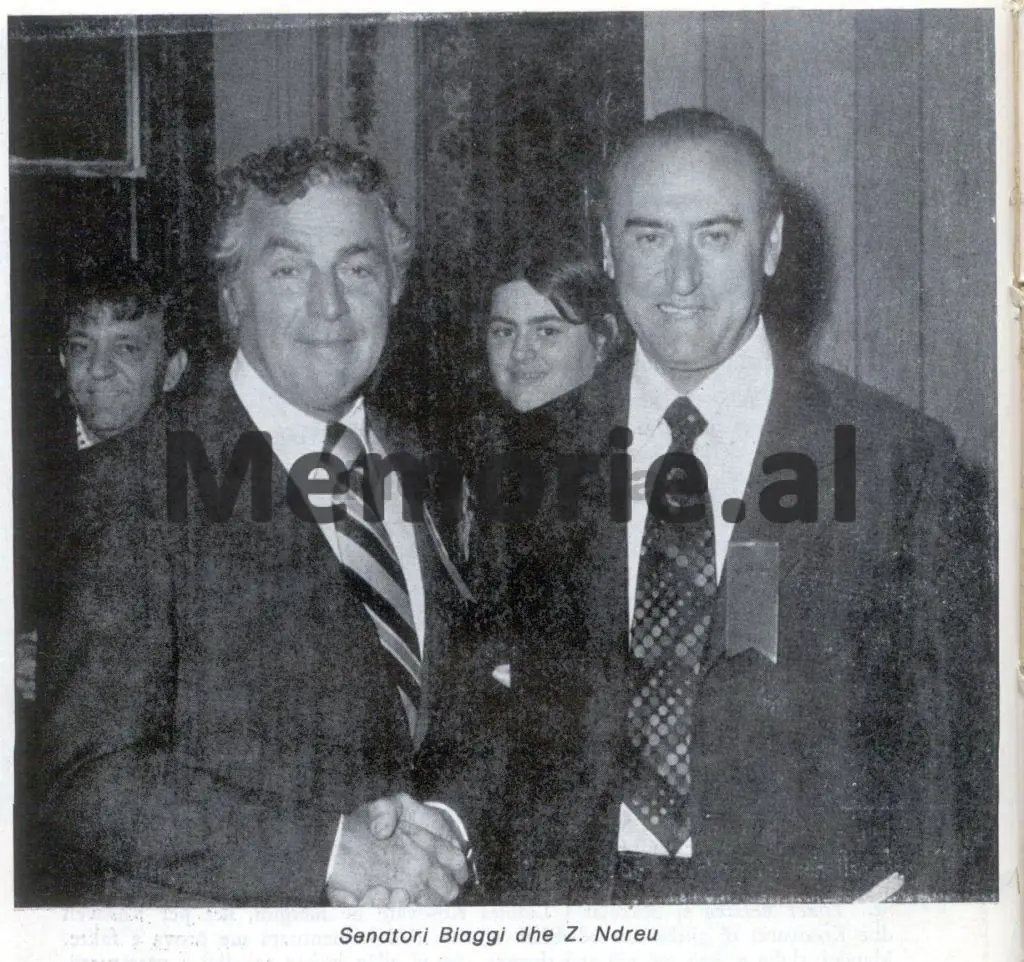
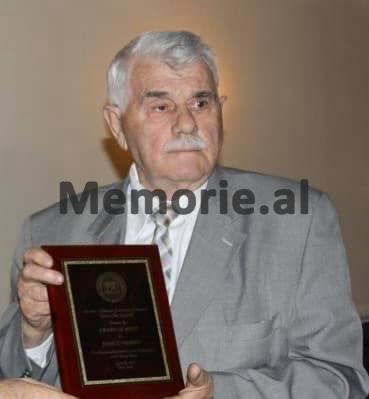
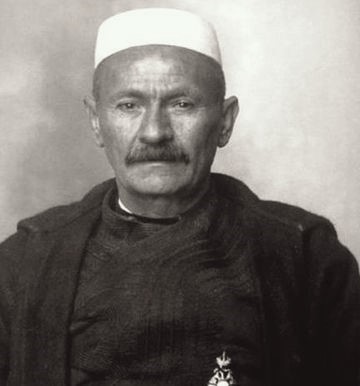
Memorie.al / The generation of these Albanians in exile is undoubtedly remembered to this very day as a unique and highly honored generation in every respect. Thanks to these men, they have left an indelible mark for all generations of Albanians. Meanwhile, for most emigrants, it is somewhat difficult to imagine that such a generation of men – so patriotic, democratic, and devoted to our nation – could ever return to our diaspora, as times themselves have changed. However, they are undoubtedly many. One of the “icons” of the diaspora over the years is Jonuz Ndreu, the son of Cen Elezi and the grandson of Elez Isufi (the “Mountain Bear”).
Nuzi (Jonuz) is a worthy son of one of the greatest Albanian families, known as the “Great House of Ndreu of Sllova” (Dibër), or the family that constituted one of the “Seven Mountains of Dibër.” After retiring, he lived in a New York village very similar to the natural beauty of his birthplace, Sllova. So much so, that when asked where he lived, he would jokingly reply: “I live in Sllova.” At home, he kept all the national symbols, from the red and black flag, badges with national emblems, books, tapes, and videocassettes, all magazines in Albanian, and even a traditional Dibër male outfit consisting of tirqe, xhubletë, and a white kësulë.
Jonuz Ndreu was known by everyone in the diaspora, providing an incomparable example of an exemplary Albanian: a patriot, a democrat, a family man, and a good friend. When he turned 75, celebrating his retirement after 37 years of work in America, he gathered with his wife, the honorable Mrs. Bale, his daughters, and a group of grandchildren. Jonuz Ndreu thus remains one of the symbols of the Albanian diaspora in America through the flow of years. However, he used to say that he still had much left to do for his family and society, remaining always preoccupied and engaged in all national activities.
The Escape from Albania
Jonuz Ndreu escaped the communist hell in 1949 from the Rrogozhina internment camp, where he was performing forced labor on the construction of the Elbasan-Korçë road. Interned in several forced labor camps, such as Berat and Kuçovë (in 1948), and a camp near Tirana, he worked on the construction of the Tirana-Durrës road. “We worked here until November of that year,” Nuzi recalled, “after which they put us in the Valiasi camp near Tirana. There, like slaves, we laid the first foundations of the Farm, as we internees worked on the irrigation and land reclamation.”
Continuing his memories, he recounted: “On May 6, 1949, when we escaped from Rrogozhina, there were nine of us. During our attempt to cross the border, we fell into unexpected skirmishes with the Pursuit Forces. We were nine people, and some of them are no longer with us today, like the late Esat Dine and Abdulla Kaloshi. Together with us were Muhamet Kadria, Muhamet Begu, Xhelal Dine, Esat Dine, Nikoll Gjon Markaj, Tafil Ndreu, Selim Haxhia from Puka, and a Kosovar emigrant, as Kosovar Albanians were called in Albania at that time.”
He described the adventure toward the free world as a bitter dream. “We traveled for three days and three nights. We lost our way, falling into skirmishes in the dry and wild mountains of Skrapar. During the clashes with the State Security forces, a close friend of ours, Esat Dine, was killed. The boy from Kosovo was also wounded, but unfortunately, due to the long time passed, I do not remember his name. Selim Haxhija, who was our group leader, surrendered because, as we later learned, he had been a ‘contingent’ (informant) for the State Security.
Meanwhile, those of us who survived – only six people – changed our escape route, heading toward the Thermal Baths (Llixhat) of Elbasan. We arrived there around midnight, splitting into two groups. The first group consisted of me, the late Abdulla Kaloshi, and Tafil Ndreu. The second group included Muhamet Kadriu, Xhelal Dine, and Nikoll Gjon Markaj (the son of the Captain of Mirdita, Gjon Marka Gjoni).”
In his memories of the escape, Jonuz recounted: “When we reached Dibër, we studied the terrain well and crossed the state border at night, entering Macedonian territory – the villages of Greater Dibër. There, without having contact with anyone, we fell into the hands of the Yugoslav military forces of that time. All three of us were put in prison, where the commander was an Albanian named Staf Lleshi (Mustafa Lleshi), and a long-time collaborator of the Serbo-Slavic regime in Macedonia. By his order, we remained in isolation for 21 days, and by his order – since Staf Lleshi, as a collaborator of the Serbo-Slavs, also cooperated with Tirana – he handed us over to the relevant Albanian authorities.
We stayed in Albania for about six months until we escaped again, the three of us, knowing nothing about the three friends we had left behind in Albania during the first attempt. In the autumn of 1949, it was October or early November as I recall now, the son of Sheh Haxhi from Peshkopia, Selami Shehu, came looking to meet us. We accepted the meeting so he could tell us where our friends were. He was aware and told us everything, as they were hiding in his house in a village near Peshkopia.
We also stayed hidden in the villages of Peshkopia, he told us, after we established contact and reached an agreement with Fik Maliqi, through his people in Macedonia, to escape again and enter there without surrendering. As soon as we crossed the border, they captured us and sent us for seven months to a camp near a village called Trashevë. From there, they transferred us to Sarajevo, where they employed us. We stayed there for about a year until the end of 1950, working as mechanics. From Sarajevo, they sent us back to Macedonia, to Gostivar, and from there to Pančevo, Serbia.
After two or three months, a Serbian police officer named Ziko Sharkiq, who knew Albanian very well, came to us along with my two uncles who had been released from Serbian prison. They came to inform us that Cen Elezi and Dan Kaloshi had died. Meanwhile, Ferit Sina, Rushit Sina, and Aqif Noka had been disappeared without a trace by Slavo-Macedonian criminals and their Albanian collaborators in Macedonia, as soon as they had escaped from Albania.
After staying for about six years across the Yugoslavia of that time, in 1955, we gained a degree of freedom to go wherever we wanted. This decision by the Yugoslavs came as a surprise to us. Having little trust in the Serbo-Slavs, we immediately registered to go to the West and were sent to the Gerovo camp. After 18 months there, we made it to the West. Our first arrival in the West dates back to 1955, at the refugee camp in Capua, Italy, which was under Anglo-American administration.”
Service in the U.S. Army
In this conversation, Jonuz Ndreu recounted: “Emigration was a great pain and it was bitter for us, but it was the only way to escape alive, as our fate would have been the same in Yugoslavia as in Albania – like the thousands killed, persecuted, interned, and imprisoned. Thus, in freedom, I chose my path. Initially in Italy, I registered to serve in the U.S. Army. As soon as my request was approved, they sent me as a soldier immediately to the USA. I served as a soldier in the American Army for five years.
I performed my military service in the Infantry, initially at a military base in South Carolina. After the first 8 months in uniform, I was transferred to Fort Devens, Colorado. Following the training at this base, I was transferred for long-term service to an American military base in West Berlin, Germany.
Since my health deteriorated during my service in Germany and I was placed under hospital care, the order was changed, and I was sent to serve on the island of Iceland, north of England. One year of service there, and then a return to the USA to the Fort Er base in Massachusetts in the Second Infantry Division. After I fully recovered, they transferred me back to West Berlin. There, I completed the final 18 months remaining in the American army.
I served with great diligence in the U.S. Army. The American military valued my service highly. I was among the few soldiers to serve in this army without American citizenship, and perhaps among the first to be promoted. I recall on this occasion my promotion to the rank of First Sergeant, the decoration for merits in the Infantry – a very valuable decoration – as well as several official military certificates and various gifts from the highest officials of the American Department of Defense (DoD), with the citation: ‘Good Conduct.’ A soldier held in high respect and honor by all colleagues and superiors where I served. In every command where I served, I was a favorite of the commanders,” he recalled with humility.
Political Activity in Exile
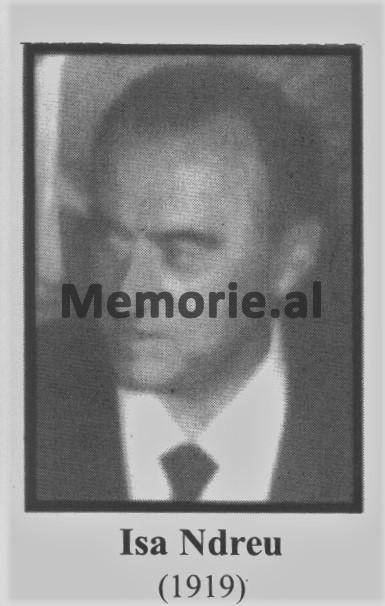
“Here,” says Jonuz, “I must also recall the first contacts with Albanian figures in exile. At the camp, after Isa Ndreu, several representatives of the ‘Free Albania’ Committee arrived, based in Rome, Italy, led by Sahit Kryeziu. Later in the camp, we established our first contacts with representatives of the first Albanian political parties in exile: representatives of the ‘National Bloc’ led by Ernest Koliqi and Kol Bibë Mirakaj, the ‘Balli Kombëtar’ Party, the ‘Legaliteti Movement’ National Organization, the Peasant Party (Partia Katundare), and other representatives.
Meanwhile, in the United States, after I first set foot there on September 11, 1957, and was discharged from the army on September 11, 1962, after serving for 5 years, I was engaged in the Peasant Party, which was then led by Isa Ndreu. Later, I was involved in many activities in the organization called ‘Tripalëshi’ (The Tripartite), which included the Peasant Party, ‘Bashkimi’ (The Union), and the ‘Anti-Communist Resistance.’
In 1962, King Leka I wanted to unite all Albanians and called them to Madrid, Spain. Since the ‘Tripalëshi’ organization took an active part in the Madrid meeting, represented by Isa Ndreu and Lec Shllaku, it was requested that it merge with other parties to form a single party. After the meeting of the Albanian diaspora in Madrid, it was decided to hold another meeting in New York (USA). In New York, the meeting of anti-communist political forces in exile was led at the time by Xhafer Deva, and I participated in almost every one of them.
After Xhafer Deva withdrew from this meeting, a former officer of the Royal Guard, Masar Pustina, was elected chairman of the New York meeting. Here, talks began for the reorganization of the diaspora in the USA. The ‘Independent Bloc’ could not participate because the Resistance Party was also there, which was considered a breakaway branch of the ‘Independent Bloc.’ So, to include the ‘Bloc’ in this group, we thought all three parties should merge into one.
However, the Resistance Party, led by Ndue Pjetër Gjonmarku, opposed this, and the meeting almost failed. The chairman of the ‘National Union’ Party, Loro Stajko, appealed to the participants, saying that if he were the obstacle to this disagreement over the party’s unification, he would resign, and he moved to the Peasant Party. Stajko’s discussion was met with applause from the delegates,” Jonuz Ndreu recalled.
“After all the negotiations were made,” he recalled, “an ideal understanding was reached – all the parties grouped in the ‘Tripartite’ would hold a joint congress where a chairman would be elected. The party would be known by the name ‘National Union.’ The ‘Albanian Democratic Union’ prepared to hold its first congress in Florence, Italy, where it was crowned with the name it bears today, the ‘Albanian National Union.’ With Mr. Isa Ndreu as chairman, Mr. Lec Shllaku as secretary, and two vice-chairmen, Adem Hodo and Loro Stajko, the magazine ‘Koha Jonë’ (Our Time) began to be published regularly as the organ of the ‘Albanian Democratic Union’ Party, continuing its work for 40 years.”
“I have constantly,” Jonuz Ndreu recalled with pride, “been a member of the leadership of the ‘Albanian National Union,’ and I think I have played a major role in this party, especially here in the USA. I have been the ‘granary’ of the Albanian National Union party. I have worked tirelessly and made sacrifices to fulfill all my obligations arising from the party.
I have had good relations and connections with all organizations, associations, and community religious entities, such as the ‘Bloc,’ ‘Legaliteti,’ ‘Balli Kombëtar,’ and ‘Vatra,’ as well as with the Church and the Mosque. I have represented the party, which I led for many years in America – the Albanian National Union (BKSH) – in every national and political activity. I participated as an honorary delegate in all the congresses of Legaliteti, the meetings of Balli Kombëtar, the ‘Free Albania’ Committee, and Vatra. I participated as a representative of the BKSH party in all Flag Day celebrations, demonstrations, and protests against the communist regime in Tirana, and those for the freedom and rights of Albanians in Kosovo and all Ethnic territories.”
Family, Work, and Society
Speaking about family and society, Jonuz Ndreu recalled: “I first started working in America at the ‘Douglas Management’ company. A company which later changed its name several times, but not its bosses. I stayed here from 1968 until I retired in 2005 – 37 years of work. In 1982, I suffered a serious traffic accident; the ‘Douglas Management’ company covered all my hospital expenses until full recovery, a large sum that surprised me. Meanwhile, the nephew of the big boss of the ‘Douglas Management’ company, on the occasion of my retirement (May 2005), presented me with a check for 25 thousand dollars.”
Among the most beautiful moments of his life are his arrival in the free world, his military service, and his connections with many people he no longer sees today. Life, up until those beautiful days when he was celebrating his retirement, was filled with joys and sorrows, just as everyone’s life is. He calls one of the most special moments of his life the time when Albania was liberated from the communist yoke. Communism fell, and democracy was born in Albania as well. Jonuz Ndreu experienced this moment as if he had been born again.
Since 1992, when Albania opened up, he had visited his country about 13 times. In 1992, he went back for the first time after 50 years to his birthplace, Sllova in the Dibër district, a mountain village bordering Kukës. He found the elders of the great Ndreu clan still alive: Xheladin, Rexhep, Baftjar, Lazam, Bexhet, and others. During that visit, he said: “Albania has consumed our lives, for my body is here, but my mind and heart are in Sllova, they are in Albania.”
At the retirement party, the entire Ndreu family in America, friends, relatives, and his well-wishers gathered. Amidst that joy in nature, his fellow travelers and fellow fighters in the Diaspora participated: the pure “Vatrans,” Chairman Agim Karagjozi, Vice-Chairman Dr. Gjon Buçaj, Agim Rexhaj, Zef Balaj, Zef Përndocaj, Hajdar Tonuzi, and others. On the occasion of his retirement, “Vatra” presented him with a painting of our National Hero, Gjergj Kastrioti Skënderbeu. Agim Rexhaj said: “Jonuz Ndreu is a fine example of an Albanian; from the day I was born until today, I had the good fortune to know this man. I met and knew him 16 years ago, becoming acquainted with his great contribution to the national cause.
His contribution to the Independence of Kosovo, the Democracy of Albania, the Cham issue, and the solution of the Albanian question in all Ethnic territories is unparalleled and extraordinary. He is among those few men in exile who have worked and contributed so much to the Albanian nation. He participated in every demonstration and meeting for Kosovo; in 1998, he was among the first to hand over a contribution of 5 thousand dollars to aid the war for the Kosovo Liberation Army, the Ministry of Defense of that time, and the Government of Kosovo, which was led by the late Colonel Ahmet Krasniqi.” / Memorie.al