From Ali Buzra
Part Seventeen
– LIFE UNDER PRESSURE AND SUFFERING –
(ASSESSMENTS, COMMENTS, ACCOUNTS)
Memorie.al / At the request and wish of the author, Ali Buzra, as his first editor and reader, I will briefly share with you what I experienced in this encounter with this book, which is his second (after the book “Gizaveshi në vite”) and which naturally continues his writing style. Sincerity and frankness of the narrative, simple and unmodified language, the accuracy and precision of the episodes or the lack of a refining imagination, intentionally applied later or not exploiting it, I think have served the author positively, who comes to the reader in his original form, inviting us to at least get to know unknown human fates and pains, coincidentally or not, leaving us to reflect as a starting point for awareness towards a catharsis so necessary for the Albanian conscience.
Bedri Kaza
The camp children who went to school were hungry. When they came out of class, they could barely stand on their feet. Most of them, when passing through the market, would beg for bread from the people selling there. The latter would ask them; – “Are you from the camp”? They would take bread out of their bag and almost always give a little bread to these exhausted children.
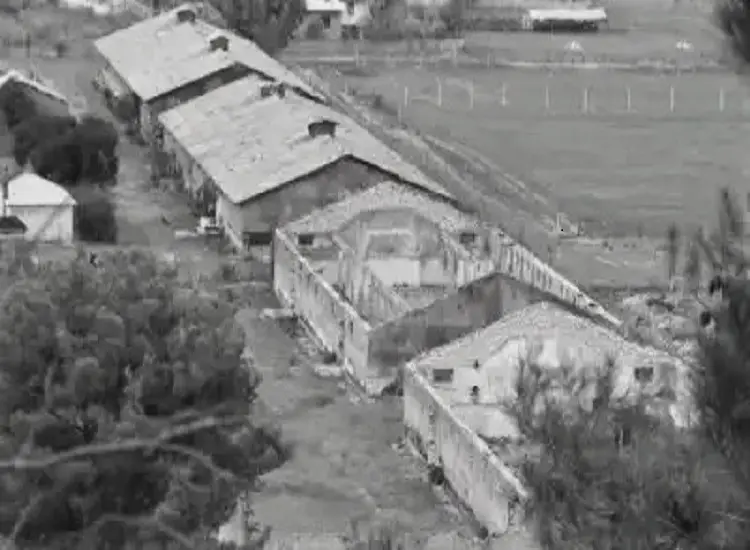
“The people of Tepelena were very generous,” – the survivors recount. In autumn and spring, when the land was worked, in the afternoons and on days off, the children would come to collect the stones that the plough brought up in the plots of the auxiliary economy, which were located around the camp.
This work was very tiring for them, as they were unfed, but what could they do, the police were watching over them. The arrivals at the camp increased every day, so much so that the barracks could no longer hold them. There was a large influx from Mirdita, after the killing of Bardhok Biba. Regarding this, the people of Mirdita recounted that many men were killed there in the presence of their children by Mehmet Shehu, while dozens of families were brought to the camp in Tepelena.
One day, mother Xhemilja started to sew Shefqet’s pants, which were torn, but she ran out of thread. She folded the pants and left the needle on top. A woman from Mirdita named Mrikë noticed her concern and asked her why she hadn’t finished sewing the pants. – “I ran out of thread,” – she replied. – “I’ll give you some,” – said Mrika and handed her the threads.
When Xhemilja took them, she noticed they weren’t thread, but strands of hair. Mrika explained to her that she sewed her clothes with them in the camp. Mrika had long, thick hair. Until 1970, the family of Islam Dobra and that of Mrika, along with her sons, spent time together in the internment camps. Mother Mrika, they recall, kept her children’s clothes sewn with strands of her hair, so as not to forget the Tepelena of that time.
Deaths continued to increase every day. The conclusion was clear. They were the result of malnutrition and the very harsh conditions in the camp. Finally, one night, they were told that the next day they should bring a container to get some stew, as until now only dry bread had been given. Leftover food scraps from the warehouses were used for cooking.
They started cooking; beans, oatmeal, rice and pasta. It is said that the cooks would first put them in water so that the worms would rise to the surface, but no matter how much they cleaned, the stew was full of worms. One day, Muhamet, who was older, was sent away from the camp. Later we found out that he, along with many others, had been taken to Vlorë for work, where a prison was being built.
In Tepelena, the mother remained with her two younger children, Hatixhe and Shefqet. Not only mothers and adults, but also the children tried to do something to survive. Regarding this, Shefqet recounts a quite chilling detail from life in the camp. One day, he and some other friends had filled a small sack each with nettles.
To avoid being seen, they entered from behind the baths, as that part was far away and less controlled. The children walk, a bit carelessly to avoid attention, but the guard’s whistle is heard. Captain “Tava,” as he was called, lines them up and tells them to empty their sacks of nettles. The poor children beg him to forgive them, but in vain. “Thieves, you dirty little beggars,” – he yells angrily. He takes the children and puts them in a room that had only walls, no doors and no windows.
There the children spent the night, shivering from the cold, and only towards morning did they fall asleep. In the morning, their relatives had been notified to bring them their bread. When the mothers came, they had been taken outside onto the lawn. They were all tied with wire from behind, while Zef Miraka, who was the oldest and most “disobedient,” had been tied with barbed wire. – “Break the bread into pieces and throw it on the ground,” – the guard tells them. – “Won’t you untie them”? – Shefqet’s mother speaks.
– “Do as I tell you”! – He shouts. The children lie flat on their stomachs and try to eat the breadcrumbs, swallowing them one by one out of hunger. The mothers stood tearful on their feet, while Captain “Tava,” roaring with laughter, pushed them away with a stick. The children, using only their feet, tried to reach them to eat.
– “At that moment,” – Shefqet recalls, – “a lieutenant comes out of the offices and says to the captain: – You’ve put them out to graze, heh heh heh…? When he saw the tearful mothers, he changed his attitude and ordered the captain: – Untie them, let them go. The children caught a cold that night, and were sick for several days, but even in these conditions they were forced to get up in the morning because the policeman would count them.”
A bitter memory for Shefqet and some of his fellow villagers remains the event concerning the barracks supervisor, a girl among the internees. On another occasion, 5-6 children, including Shefqet, are caught “in the wrong” and sent to the camp’s dungeon. The policeman opens the door and pushes them inside, but doesn’t enter himself, and the door is closed. The children were stunned as soon as they entered the dungeon.
Inside was the barracks supervisor, Shega, hanging? The circumstances in which that girl hanged herself are unknown. What didn’t happen there? The heartless policemen tried to commit the most despicable acts against the internees. Later it was said that an attempt was made to rape her, or…., but anyway it seems the reason for the hanging must have been due to serious motives.
In the place where bread was distributed, a steelyard scale with a hook was hung, where the bread was weighed for each family, according to the number of members. After receiving the bread, Hatixhe would divide it for each into three pieces, for three meals. In the evening, little Shefqet would ask for the morning ration to eat as well. He insisted they give it to him, pretending he didn’t want breakfast, and so his sister gave it to him. In the morning, when he was about to leave for school, Shefqet would look hungrily at the others’ bread.
The mother would divide hers and give him half of her ration. His sister would scold Shefqet; “why do you take it,” because mother was going to work. Shefqet, being hungry, did this several times, promising his sister he wouldn’t take from mother’s ration anymore, but the mother continued to give it to him. The mother’s heart burned and ached for her children, seeing them hungry.
One evening, a family from the north arrives at the camp. Carried in a blanket, they bring the woman of this family and some other women inside the barracks. It was said that the woman gave birth to a child. Shortly after, the father of the newborn child was called to the command post, and they asked him to give the child’s name. – “Let us think about it for a moment,” – the man replies. The lieutenant insisted on the name immediately. Then the man gives a name he thought of on the spot; “Dedë.”
In the morning, the new mother was also forced to line up for roll call. After the mother’s name, the name of Deda was read. His father said he was asleep, but Captain “Tava” insisted he wanted him there. They took the child and showed him to the policeman. A new “enemy” had been added to the camp, a newborn, and that was Deda. One day, the order came for the release of most of the Mirdita people who had been brought there following the killing of Bardhok Biba.
This day was accompanied by severe pain for all the people in the camp. Meanwhile, as the names of those to be released were being read, among them was a boy, 12-13 years old, who got permission and left the line to go to the baths. As he was running back full of joy, a powerful explosion was heard. A mine exploded under his feet.
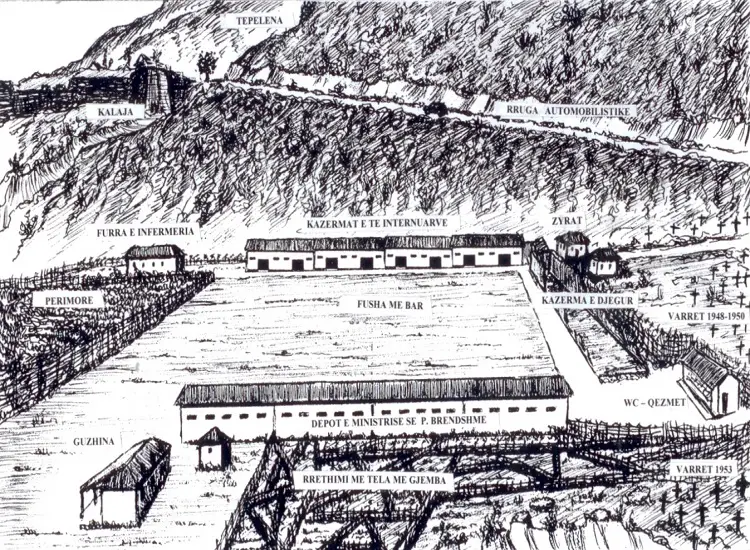
So many people had passed there over the years, but the hidden mine exploded to take the life of that young boy, whose family was waiting for him in line to return to their homes. His body was torn to pieces by the blast. A piece of sock remained in the field. There was no one who didn’t shed a tear, seeing this horrifying scene. The camp people lived in a place that hadn’t been cleared of mines!
Harder for Islam Dobra’s children was when they were separated even from their mother. They recall this event with great pain. The order is given to line up. Most thought there would be a release, but they were disappointed. Beyond the wires, some cars appeared. They were filled with people, mostly elderly and children. Two elderly people fall to the ground. The unit’s medic took them.
The others were brought into the camp. Those inside began to line up, according to the given order. Finally, the lieutenant spoke. He explained that the fittest from the camp had been chosen to work and that whoever heard their name should get on the truck. The children started to cry when the mothers’ names were read. Shefqet also experienced this distress. His mother was giving him instructions, that if he was chosen to go, he should listen to his sister, while trying to encourage them both.
In fact, what was expected happened. The name was heard, Xhemile Dobra. Little Shefqet, 7-8 years old, grabs his mother’s hand and cries. Meanwhile, he feels the strong hand of the policeman, who tore him away from his mother, and didn’t even allow him to hug her, shouting; “quickly, quickly, get on the truck.” He stood there crying, until he could no longer see his mother. Finally, when separated from his mother, the little one also thought that now, it would no longer be his mother who gave him from her own ration.
His sister, Hatixhe, who was 5 years older, took him, telling him not to worry, that mother would return. Regarding this, Shefqet Dobra writes in his book of memories: “The trucks departed at sunset…! Now, our camp became a prison of children, old people and the sick. This separation was the most painful drama. We were children who had lost our childhood, our life became sadder every day; we all suffered from innocence.
We all fell asleep crying, in our dreams we thought we heard the shouts of the policemen, who appeared to us with terrifying images. We cried in the darkness, until we fell asleep, and again we saw the same dream. The two children left like orphans stayed together with the families of Isak Alla and Azis Biçak, who took care of them as much as they could, in the terrible conditions of the camp. The next morning, instead of hearing the warm voice of our mother waking us up, we were frightened by the terrifying shout of Captain Selfo: Quickly in front of the bed.…!
Like lost birds were the children, like dry trunks, without branches or roots, were the elderly, lonely and abandoned remained the children and the old; this camp was a place of torment and contempt, of fatigue, hunger, mass death, the second ones were buried where the tractor had disturbed the previous ones, so that it wouldn’t be known how many were dying, This was hell, the executioner and the lieutenant.”
After a few months, Xhemile Dobra met her son, Muhamet, at the brick factory in Tirana. There, all the internees doing labor had been gathered. His mother had been assigned the hardest work, where they removed the mold from the pressed clay of the bricks. Through Muhamet’s intervention, via an acquaintance of his father’s they met there, Xhemile was removed from the heavy work and a man was put in her place. After about three years, mother and son returned again to the camp.
Regardless of the conditions, at least now the four of them were together. In the autumn of 1954, Islam Dobra’s two youngest children, Hatixhe and Shefqet, who were 16 and 11 years old respectively, were released, along with Halil Alla’s two sons from Zgosht, Sehit and Faik, also approximately the same age, two sons of Sabire Xhika from Gostima of Elbasan, and Afeza Velmishi from Lushnja, with a small child, who were on the same route.
They are given 150 old lek each, taken to the gate and told: “Go to your homes.” They were all young, except for Sehiti, who was a bit older, and Afeza. They took the few rags they had and left through the ominous gate of the Tepelena camp, with the satisfaction that they had escaped. Islam’s children carried with them the sorrow that they were leaving behind their mother and their brother, Muhamet. They waited for a bus to Vlorë, but all day they didn’t find one. That night they slept at the foot of the castle.
The next day again they didn’t find a bus. At lunchtime they returned to the camp to ask for bread. They stayed there another week. On the last day around noon, Hysni Biçaku, the son of Azis Biçaku, had met a driver who was going to Vlorë. The driver took them and dropped them off at Flag Square. There were two buses for Rrogozhinë, but it was very difficult to get a ticket. People would jump over each other’s heads and in the end the tickets would run out, leaving many without.
This episode, which happened during ticket sales at all agencies across the country, we all experienced during the communist period, but with these children it was different. For a week, the group of internees remained in Vlorë. They would buy one hundred grams of cornbread for the two of them, as it was the cheapest, but the money was running out. One day, Sehiti, with great difficulty, managed to get two tickets and got on the bus with his brother. The others remained there another week.
At night, they would spread their rags to sleep in the park. One evening, while they were spreading them out to sleep, a girl who passed by there every night asked them why they were sleeping there. They explained to the girl where they came from and where they were going, telling her their troubles. She turned out to be the ticket seller. – “Come, let me sell them to you tonight,” – she tells them. She had thought they were gypsies sleeping on the streets. That night they slept happily, because they had bought their tickets.
At eight o’clock in the morning, they set off happily, “forgetting” what they had left behind. Afeza got off in Lushnja with her child, while the others got off in Rrogozhinë. At the Rrogozhinë station, people waiting for the train, sitting in the square, were eating bread with cheese, curd or leeks, while these four children had eaten a little dry bread since the evening before.
They were hungry. Some of those present, who were struck by them, started asking them where they came from and where they were going. When they learned where they came from, they gave them a piece of bread, with whatever they had; some even gave them a ten-lek coin. The children asked at the ticket office for a train ticket to Elbasan, but they didn’t have enough money.
Then they decided to go on foot to Peqin. They set off with their rags in their arms, and saw the Elbasan train pass by, while they continued on foot. They arrived in Peqin in the evening, tired and exhausted to the bone. In Peqin, they caught the 8 o’clock evening train. That night, they slept on the benches at the train station in Elbasan. The next morning, they gathered their clothes quickly because people were arriving at the station, and they set off on foot for Librazhd.
They had parted ways with Sabire Xhika’s two sons back in Elbasan, now only Islam Dobra’s two children remained, Hatixhe and Shefqet. Tired and hungry, sometimes walking, sometimes resting, they continued on their way worried that night might fall on them outside, as they didn’t know how long the road was. Shefqet recounts that he wanted to ask a passerby going on foot or on a pack animal for bread, but his sister wouldn’t let him, saying we are in our region and they might recognize us.
They arrived in Librazhd before it got dark. Fortunately, there they met their uncle Beqir, who was on horseback. After passing through the city, he stops and gives them something to eat, but meanwhile asks them when they had last eaten. They tell him they had eaten very little bread the day before at lunch. Uncle Beqir had bread and food with him, but he didn’t let them eat their fill. He stopped several times along the way, giving them a little bread and food each time, so as not to harm them, as their stomachs hadn’t been full for years. Beqir was in his sixties, but still held up strong.
Traveling with him, the children felt very happy. Every now and then he would talk to them along the way so they wouldn’t get bored. He felt pity for his brother’s children, who had suffered all those years. That night they slept in Zgosht, at Aunt Hanifja’s house. The next day they arrived home. Before entering inside, they met Haxhi’s son, Selim, 6 years old, who was playing in the yard. He had been born in Vlorë, when they were in Tepelena. /Memorie.al
To be continued in the next issue