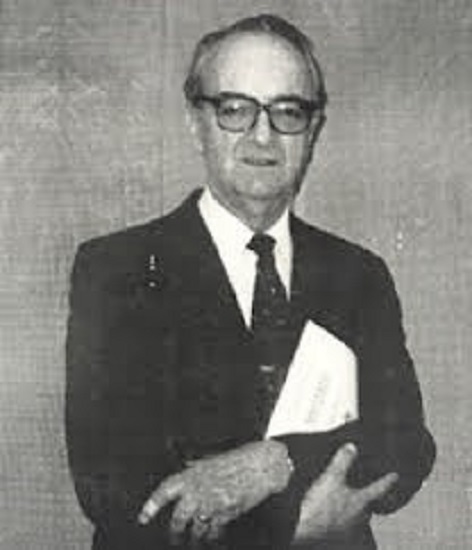
By SAMI REPISHTI
Part Twenty-Four
Sami Repishti: – In Albania, the communist crime of the past has not been documented and punished; no “spiritual cleansing” has been carried out, no conscious confession and denunciation of ordinary communist criminals! –
‘Under the Shadow of Rozafa’
Memorie.al / During the 1930s and 1940s of the last century, with the unstoppable torrent of fascism and communism descending upon Europe, sooner or later upon the entire world, “fate” also grabbed the Albanian nation by the throat. Like all young people, I too found myself at a crossroads where a stance had to be taken, even at the risk of life. Then I said “no” to dictatorship, and took the path that had no end, a sailor on a wide sea without shores. The rebellious act that almost killed me, at the same time set me free. I am an eyewitness to life in the fascist and communist hell in Albania, not as a “politician” or “personality” of Albanian macro-politics, but as a student, as a young man who became aware of my role, in that time and that place, out of love for homeland and desire for freedom; simply, as a young man with a pronounced sensibility, faithful to myself, to a life of dignity.
Continued from the previous issue
XXI
In prison, just as in the two previous years, we were placed in assigned rooms. We need rest and food, but we find none. Fortunately, the population of our prison had been “enriched” with a legion of young people, students from the Shkodër high school, convicted for “hostile” activity. They were a wonderful group, tortured young people who spent their days amusing themselves with irrepressible jokes or limited reading. What characterized them was a spirit of solidarity that had won everyone’s admiration.
Their appearance, which normally should have revolted any human conscience for its monstrousness – students, high schoolers still not fully grown, now lying in the dark prison of Shkodër, simply because they had expressed orally or in writing their dissatisfaction with the state of the country – had been transformed into a factor of resistance that inspired the older ones, their fathers imprisoned earlier. They became the joy of the “grave” that held us; they became the life of the half-dead that we, the earlier prisoners, were in those days.
Over time, they also created in prison the vertebral column of resistance against communism and the power that represented it. This raw and pure material became my closest friends. Alongside this group of young people, other elements began to come to prison, which were called “Titoists”. After the break with Tito’s Yugoslavia, some Albanian communists began to make distinctions between “Stalinist” and “Titoist” socialism.
Two of them were “volunteers” in the Spanish Civil War, had witnessed the clashes between “anarchists” and “Stalinists”, and had returned with contempt for the “absolute control” that the Stalinist element exercised over the “volunteers”. In the Tito-Stalin conflict, they saw the Spanish conflict, and enthusiastically sided with Tito. For the “Stalinists” of Tirana, this was “betrayal of the fatherland of socialism”.
Our discussions, although cautious, were conducted with passion, but their tone was civilized. They were few. Our “pro-Western” group, mostly university and high school students, officially known as “agents of American imperialism”, had created its own dynamic and was nourished, either by reading or by deductions reached during the long hours of meditation that prison offered in large quantities.
Our success was a unity of thought that was not uniform, and an unlimited solidarity that made daily life easier for each of us. For me, the arrival of the high school students opened new paths in the closed life of the prison, created new friendships, and pushed me to take new orientations that aligned with the thoughts and desires of these young, pure, and idealistic people. It was dough that promised much.
For many of the prisoners, especially the elderly and uneducated peasants, days followed nights in order, with a rhythm like the rosary beads of old Myrto, which dripped all day, all evening, for weeks, months, years without stop, without change, as if they wanted to kill the time that tormented them…! A day that dawns, a night that falls, a comrade who falls ill, a guard who goes mad, a friend who dies, a young man who ages, an old man who becomes a child, a soldier who sings, another who falls silent, a prisoner who wastes away from hunger, dies, goes out like a corpse and is covered in a pit without a marker.
Others waited for winter, when the wind, cold, and snow entered through the window frames that had no glass, lips black as tar, reddened eyes, hands like ice and frozen feet, until they froze forever, like those of countless comrades, whom every winter we accompanied without being able to weep for them, unbroken pieces of ice, bone and skin, tightly embraced and faithful for life and death! Only the “cracked one” continued his work, undisturbed.
As always, he walked back and forth in the narrow corridor between the beds, hands behind his back, head down, and with the monotony of his words, which we knew well, never losing his serious tone of expression, he would display the thoughts that troubled him every day, for a whole year: “When I get out, and I will get out one day, why wouldn’t I? After all, I am not guilty…! Let whoever wants to step forward, speak! Why don’t you speak?! Say what you have in mind, I’m listening carefully! Then why would I get out one day, why not, why wouldn’t I get out?! Of course I will get out…”?!
From the inner courtyard, the noise of the military boots of the cell guard approaching answered; he would stick his head through the window of the room and as usual, not seeing anything in the inner darkness, would leave without speaking. Then, he would take the keys from his pocket, from which the whistle also hung, and with the unlimited authority that the criminal regime had clothed him with, he would give the order of the day: “Pigs, go out to the latrine! Room seven, quickly! You only have ten minutes. Quick”! A hundred people would voluntarily go out through the room door, to take care of personal needs in three latrines, within ten minutes! Prison life, worse than madness!
In one of the isolation cells, a young man from Luma was held. They called him Mehmet. Those who knew him said he was accused of killing two Party members in the village, one of whom had miraculously escaped death. Now, he was seeking revenge. The Kukës court had not been fully convinced; nevertheless, they sentenced him to ten years imprisonment. The Party Committee had intervened, insisting on a death sentence.
The condemned was tried again, sentenced “to death”, and transferred to Shkodër prison, where he awaited execution. It was the rule in prison that those sentenced to death were fed only bread and water, in isolation cells, as the final humiliation before death. There were cases where the condemned had their knees broken with a hammer, to prevent any possibility of escape…! One day, we decided to send food to the cell. With the utmost care, we would throw him something through the square window of the cell door, along with a word of encouragement.
On my next turn, the guard on duty caught me by the scruff of the neck and threw me into a cell, for seven consecutive days, without a bed, without food. Only bread and water! Next to my cell was now Mehmet. We agreed by knocking on the wall. He understood the situation and began to cry. Sometimes he would raise his voice: “I’m sorry, brother!” he would repeat, and something else that I couldn’t understand. Two days later, they took him out of the cell. He had a meeting with his parents. It was the last time. I heard Mehmet’s voice, trembling with emotion.
Then his father’s voice, who spoke loudly: – “Not like that, son! What will we tell your comrades about you? Be a man!” – “Oh father! I feel sorry for you and for mother…! You are old and exhausted…! As for myself, I made up my mind long ago,” Mehmet answered, and added: “Speak a word, mother, why aren’t you speaking?” The mother wept with tears and moans, without speaking. Even in this solemn moment, before her son’s death, she remained the symbol of the Albanian woman’s position: suffer and die without a voice! Finally, she could not bear it, and with a voice that trembled but was clearly heard, she uttered: – “In God’s hands, oh Mehmet, in God’s hands, what else do you expect from a mother left without a son”!
The prison guard cut off the meeting. Mehmet returned to his cell, silent and shaken. That day, neither he nor I knocked. The next day, he made a small hole in the wall and began to blow. I approached. – “Can you hear me?” he asked. – “Yes,” I answered. – “I have paper and a pencil,” he told me, “and I want to write something about my life that no one knows. Can you keep the letter for my parents until you are released from prison”? Shaken uncontrollably, I promised without thinking. Who would dare refuse such a request from a man condemned to death?
Mehmet had written during the night, under the light of the yard lamp. The next day, he widened the hole in the wall and passed the letter over. Without reading this sacred relic, I put it in a corner of my jacket. A few hours later, two angry guards came to Mehmet’s cell. “Where is the pencil?” they said to him, “where is the paper?” Mehmet swore he had no pencil or paper. Faced with such a situation, afraid that the letter and the victim’s secret might be discovered, I put the letter into a bowl full of water. The letter got wet, and the writing began to slowly disintegrate until it disappeared completely. Then I swallowed the wet letter.
I watched the water change color and the ink circles expand until they reached the edges of the bowl, which swallowed the secrets of the condemned man once and for all. The destruction of the writing that was supposed to outlive Mehmet, and which had taken on a religious significance for me, sealed our impossibility to fight fate, a testament to the limitation of our powers before the brute force that suffocated us, and the final proof of man’s destiny on earth. That evening, Mehmet was taken from his cell for execution.
The next day I was allowed to return to the room. Tired from the harsh isolation, I was also spiritually crushed. It seemed to me that in this massacre of Mehmet, I too had contributed with the irreparable death caused by the annihilation of the secrets of his life, as if I had denied the victim survival! In the room, I mentally followed the journey Shkodër-Kukës of Mehmet’s parents, who were coming to see the body of their only son for the last time.
With two sons executed without guilt, the parents must have asked themselves about the bad fate that had befallen them, and perhaps, in the simple form of their belief, they must have dug deep to discover where they had erred and angered a God who now punished them so severely! In the difficult life, always endangered by events at home and abroad that the inhabitants of Luma lived, I could not find a convincing answer for the presence of “evil” on earth in such a naive explanation.
“Evil” in communist Albania was the complete moral degradation of the state and society, was vice in full bloom, the conscious desire to do harm, to damage, to break the hearts and bones of a population trampled underfoot, was the wicked goal and aim, a psychological sickness that corrupted minds and hearts until it drove them to madness.
Before such an avalanche, Mehmet’s parents found no other means or weapons to oppose it except their unquestioning faith in God and the spirit of fatalism that that faith counseled. “In God’s hands, oh Mehmet”! his mother said, and his father urged him not to “weaken”, because he would have to face “the comrades”, and wouldn’t know what to tell them! As if Mehmet’s death came second…?!
The long years in prison, confined like in a cattle stall, produced their inevitable effect. I began to lose patience and a certain feeling stemming from the impossibility “to do something”, to speak freely, to express myself as I felt, and to study, to expand my cultural horizon, became so heavy that despair covered me. The “evil” that had grabbed us by the throat grew every day, with no sign that it would ever end.
Some clandestine tracts from Albanian political émigré circles, dropped from the air, were dry and offered no new perspectives. The idea of “liberation” elaborated there focused mainly on unmasking the Soviet imperium and the creation of NATO as a shield for the Free World. There is no doubt that such news gave us courage. But at the same time, it became clear that the world was divided into two camps, and that Albania belonged entirely to the “Soviet Camp”.
In this clash of giants, our country was seen as an insignificant chess pawn. What worried me even more was the fact that local changes within the framework of the two opposing camps were practically impossible. Yugoslavia was an exception that would not be repeated. This negative development frightened us and made the “day of liberation” a distant mirage for the eyes of our tired bodies.
XXII
At the end of May, all the prisoners were gathered in the outer yard. Before us, we had a group of State Security officers and a doctor in a white coat. It was time for work. The great fear of the hard work we faced, this time did not prevent me from welcoming the departure from the dark prison, which seemed to me like a meat-grinding machine. There, only death awaited us. In the camp, at least we had air and sun that kept us alive. That day, the director announced that our departure from prison was permanent this time.
Work in the camps would continue even during the winter season. We were advised to take all our belongings, our sleeping “rags”, and our body “gear”. I was not shaken! After three years of experience, I was physically and emotionally strong enough to face the risk. Still young, I believed I would survive another five years to complete my sentence, and the knowledge of meeting many comrades from other prisons attracted me. Naturally, I was one of the first names on the list.
I gathered the remaining “rags”, said a fond farewell to some of the old prison comrades and the sick whom I would not see again, and went out into the yard square, waiting for the trucks and the departure. Strangely, I was calm! My concern now was my family, who, due to the camp’s distance, would not be able to visit. My mother, released from the camp, had aged greatly from indescribable suffering, and her health frightened me.
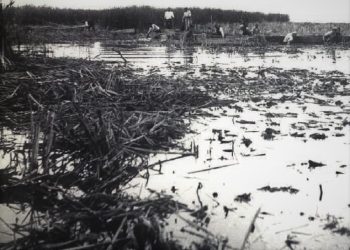
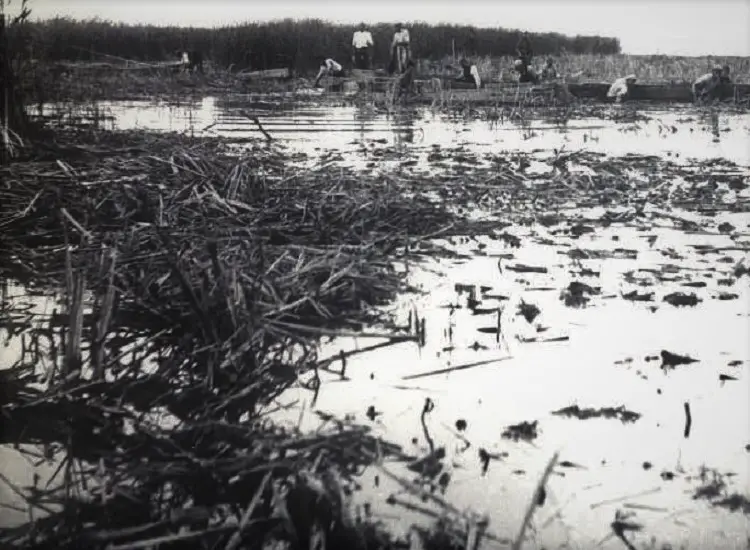
Only hope remained! From the guards’ stories, we understood that we would work on the reclamation of the fields of Kavaja, Lushnja, and Fier, on a long and wide network of drainage, collection, and irrigation canals. It was a project that would last several years. Again, chained and roped together in groups of six, we traveled all day to the Kafar camp. We got off the trucks, were divided into work brigades, and were settled in barracks covered with swamp straw and rusty sheet metal.
In the camp, we met many old comrades from other prisons, and as before, the spirit of solidarity formed. It was the greatest gift after the isolation of prison. Work began at a fast pace with mandatory quotas. Food was again poor, treatment by the guard’s harsh and long hours of work. But we adapted without delay, and in the canal work, we helped our weaker comrades fulfill their quotas as well.
Unfortunately, the proportion between “political” and “ordinary” prisoners had changed considerably, with the large increase of thieves in agricultural cooperatives and state shops. “Everyone steals,” some of them confessed. “You can’t live otherwise. Wages are too low”! From conversations with those who came to camp every month, we understood the external situation of the country. The description of the uniformity of life outside and the complete regimentation of their activity in work centers and social life impressed me greatly.
It seemed that the “outside world” was not much different from life inside the forced labor camps. Days and months followed each other without distinction, except for the changing of the seasons, which drew our attention. Winter had many days off. Dates and months were a luxury for those who were concerned. The others slept the heavy sleep of an animal that works all day and rests at night in its pen. Books were very few, newspapers were not allowed, and our conversations were repetitive.
There was no longer any doubt that our brains were atrophying more and more each day, and our intellectual curiosity was suffering a heavy blow. Tired, hungry, parched from lack of water, we lived in an environment where thieves and criminals were ready to practice their profession at our expense, us “politicians”, just to gain the sympathy of the camp command and, possibly, release from prison, only to return again for the umpteenth time. But in this atmosphere of fear and danger, our groups closed ranks and defended themselves courageously. Two different, opposing societies were created.
Brigade commanders and their informers secretly fed the camp command with “reports” against us. In some cases, our group “took measures”, spies were provoked and mercilessly beaten. Such an act ensured our isolation in cells during the night, but the message sent was clear and stopped physical attacks against us. There were other “ordinary” prisoners who approached us. They were “kulaks”, or those who had not fulfilled their “obligations”, or were imprisoned for other crimes that the “power” created as needed.
For these elements, we were half-heroes, and from them we found support in every respect. Sometimes, a young man would be found who, even in the midst of suffering, found time to lightly sing the sentimental songs of the old youth, with a pathos that touched us deeply and reminded us of the outside life that now seemed so distant and unreal. The sad voice of the young singer expressed the deepest form our suffering had taken: it was beauty crushed mercilessly!
That voice became the symbol of the endless suffering of creative man, of the artist, in confrontation with the heartlessness of the master-power that held violence as its only means to prolong its meaningless life. The prisoner who sang reminded me of the theme of the nightingale in a medieval German legend, which tells that the “owner” blinded the enchanting bird so that, in competition with others, it would sing more beautifully from the pain of its burned eyes!
Days passed without anything new: work in mud, lack of drinking water, poor food, punishments without bread, beatings without reason, and isolation in rusty tin booths for the slightest accusation or for the “pleasure” of an authority that had lost all connection with reason and heart. Like everyone, I would get up in the morning, take my meal – porridge or boiled potatoes in water and salt – eat out of necessity, and half-asleep wait for the order to set off for work. The Vjosë-Levan-Fier canal awaited us with open mouth! / Memorie.al
To be continued in the next issue