By SAMI REPISHTI
Part Twenty-Nine
Sami Repishti: – In Albania, the communist crime of the past has not been documented and punished; there has been no “spiritual cleansing”, no conscious confession and denunciation of ordinary communist criminals! –
‘In the Shadow of Rozafa’
Memorie.al / During the 1930s and 1940s of the last century, as the unstoppable fascist and communist torrent descended upon Europe, and sooner or later upon the entire world, “fate” also seized the Albanian nation by the throat. Like all young people, I too found myself at a crossroads where a stance had to be taken, even at the risk of life. Back then I said “no” to dictatorship, and took the path that had no end, a sailor on a wide sea without shores. The rebellious act that almost killed me, simultaneously liberated me. I am an eyewitness to life in the fascist and communist hell in Albania, not as a “politician” or “personality” of Albanian macro-politics, but as a student, as a young man who became aware of my role, in that time and place, out of love for my homeland and desire for freedom; simply, as a young man with a marked sensitivity, faithful to myself, to a life with dignity.
Continued from the previous issue
XXVIII
October 1956. – In Hungary, the revolution broke out, aiming to expel Russian forces from that country, overthrow the red dictatorship, establish democracy, and develop relations with the Western world. The noble Hungarian revolution was crushed by Soviet tanks, but the heroism of the Magyar people left indelible impressions on that country and the entire world. After Berlin and Poznan, came Budapest. Which would be the fourth heroic city?
In Albania, the atmosphere became very heavy, and the State Security organs were worried to such an extent that extreme measures were being planned. In the absence of radio news, the void was filled with hearsay and rumors, heard everywhere, often exaggerated. I listened, I hoped, and I did not speak. In the mentality of the Sigurimi, all former political prisoners were “potential insurgents”, ready to rise at the first suitable opportunity.
In order to remind us of its constant presence, the Sigurimi periodically arrested and interned two or three former prisoners, thus keeping the tension among us alive, as well as the general fear. In this tense state, I was informed that for the Shkodra district, there existed a secret list of nearly four hundred “hostile elements”, designated for execution at the first sign of a revolutionary movement, like that of Hungary. The list also contained my name!
The sudden news created a feeling of panic. The possibility of execution without trial, at a “critical” moment for the red dictatorship, not only frightened me, but also cut off any hope that I had nurtured for many years, that one day, in one way or another, I would see the day of freedom, whether through internal changes or through fleeing abroad. From the very first day after release from the camp, I was fully determined not to provoke the organs of the red dictatorship, either verbally or with thoughtless gestures.
Silence was the best defense. Daily work was necessary to dispel suspicions, and the self-isolation I began to cultivate carefully completed the picture of an individual who sought only a quiet, untroubled life. As the rainy season approached, work on the sewers was suspended. The group of workers was assigned to various jobs. The director of the Employment Office, who had hated me from the first day, ordered me to go every day to Bushat, on an open truck, as a manual laborer in construction. Often, under incessant rain, eight workers were transported along a 14-kilometer road, as helpers for the local bricklayers.
There we carried stones and bricks, prepared mortar with lime, sand and cement, and supplied the bricklayers. Often work did not stop even when a light rain fell. We covered ourselves with cement paper, but the difficult conditions did not allow us to meet the quota, and the daily wage was reduced as a result. What made this situation even more unbearable was the cold wind that froze our bones, especially when we were drenched by rain during the journey. In a bad situation with no way out, I consulted an old friend who worked in education. He suggested that I enroll in night courses in any profession, because that would guarantee me work within the city.
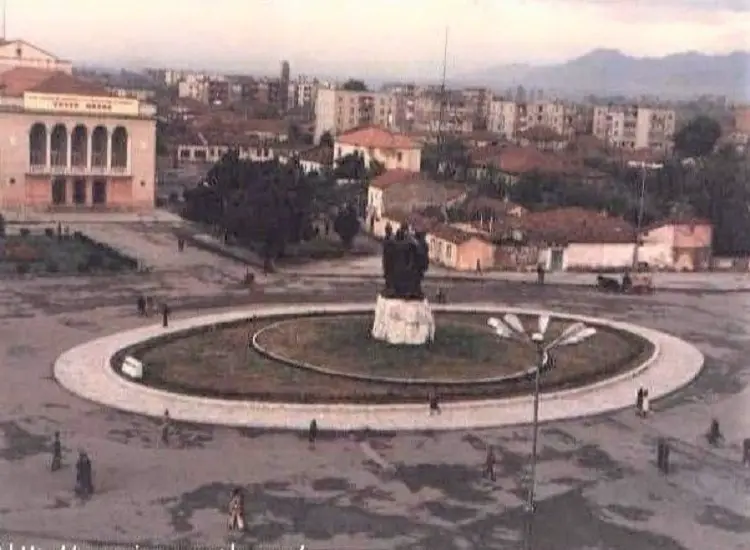
The next day, at the Employment Office, I submitted my request. “I come late from Bushat, and I don’t have time to go to school,” I said. The director looked at me fiercely, and without objecting, assigned me to work on the construction of the “Migjeni” Theater in the city center. From then on, I entered the list of regular workers. I worked well and did not allow any kind of suspicion to arise. Before me, there was only one objective: to earn my daily bread, until a good escape plan was properly prepared.
The main problem that hindered me was supporting my mother and sister. Fortunately, this problem was solved when my brother returned from the army and was employed without delay. With the increase in income, our economic situation improved. My poor mother! As if she couldn’t believe her eyes when she saw two boys at home, employed, and the table laden with food. Sometimes, as if wanting to reassure herself of this fortunate change, she would throw her arms over our shoulders and hold us close without speaking.
We did not disturb her in those moments of complete happiness…! But my brother’s arrival intensified my desire to leave the country as soon as possible, to leave a regime that constantly threatened my life. A feeling of impatience prevailed: “I can’t take it anymore!” I repeated to myself. I worked every day, silently, and returned home early. I lived consciously, a double life. Nevertheless, the voluntarily chosen solitude began to tire me. After my arrest, everything had been confiscated, first and foremost the books, photographs, and school certificates. When my mother informed me that the Sigurimi had taken my childhood photographs, a deep disappointment ran through me.
The idea that this monstrosity aimed to destroy my past, everything that I had been before the arrest, my friends and my memories, deepened even more my hatred for the vandals of our days. Their contempt for every person and everything that did not fit the framework of the “new world” they were building without feelings, without heart, without mind, was boundless. I tried to find consolation in reading from the public library, but the list of books was so poor that I was left with reading official propaganda materials or children’s. Requesting serious books could arouse suspicion. The clerk would report, and the State Security would draw its own conclusions…!
Then I tried to direct my attention to learning foreign languages. Fortunately, the Soviet magazine “Temps Nouveaux” and the English edition “New Times” were sold in shops, and I began to buy them regularly. At home, I read the French copy, a language I had studied in high school. Then I would place the English edition next to the French one, and in the absence of a dictionary, I would compare sentences and deduce their meaning. The little English I had learned in prison helped me a lot.
Despite the difficulties encountered, my ability to read English increased, and my vocabulary expanded. This effort, despite my strong will, tired me at first, and later discouraged me. I fell into a depression that worried the family. I was silent even with my mother, who so much enjoyed talking with me. One day, after returning from work, I found a small radio on the table. My mother told me it was a gift from my older sister. I believed her! My sister had always been so kind to me.
But I doubted the purpose of this particular gift. It was always my mother’s hope that the radio would create some kind of “entertainment” for me and get me out of the depression I had fallen into. For a few days, that’s what happened. Every evening, I listened to foreign stations in European languages. The flood of news that was transmitted gave me an idea of the outside world, which was denied to us. The constant references to Europe oriented towards unification, and the strengthening of NATO as a bulwark against Soviet threats, showed that the world had understood life in the countries beyond the “Iron Curtain” and the danger that this hermetically sealed society posed to the civilized world.
The idea of a free world, militarily prepared and capable of resisting the communist danger, filled me with enthusiasm. Berlin, Poznan, Budapest became my shrines. From the depths of the hell I had fallen into, the ray of hope appeared that one day this free world would extend its borders, and that my European country would one day become part of Europe. It was a dream for me, but a dream that lived with me and that would not die as long as I nourished it with spirit and heart.
Fired up by the fantasy of my dreams, I spent hours on end with my little radio. Usually, the windows of the ground-floor room where I lived were closed, the light was off, and the radio’s volume was so low that only I could hear it. Only when the local radio station’s music program came on would the volume be raised, the windows opened, and the room light turned on. It had become a rule for everyone. Until one evening I noticed that my mother would leave the room when the foreign broadcasts began. At first I didn’t understand. Curiosity pushed me to follow her. My poor old mother! Every night she would go outside, walk around the house, near the windows, to make sure that no one was spying on our life in the ground-floor room where we lived.
When the broadcast ended, she would return without a word, without any complaint. This gesture of the old woman wounded my heart. My selfishness was a heavy and undeserved punishment for my mother and sister, and I could no longer bear it. At first, I shortened my listening time; later, I stopped altogether. The silence of the two victims of the heartlessness of the dictatorship’s organs weighed on me more than any other reproach that could come from anyone. But they had accepted being victims and sacrificing themselves in silence. My mother insisted that I resume listening, but I refused.
She felt guilty, she understood perfectly well that my gesture would bring a heavy spiritual state upon me, and she wanted to prevent it at all costs. But I did not have the strength to disregard her fear! One day, while working on the “Migjeni” Theater, my sister visited me. She looked worried, although she tried not to show it. “The police” had come looking for me at home. They told my mother that I had to report to “Central Police” within the day. – “Don’t worry,” I said. “I’ll go during lunch hour. Don’t worry…!” – “Mother didn’t have the strength to come,” my sister replied. “She’s trembling with fear.”
I lowered my head. I was covered in cement dust and concrete mud. Such visits were usually not a good sign, nor did one expect anything good from the authorities. But in my state, complete obedience was required, without creating any suspicion. Again, going to the Police on my own feet was almost an involuntary entry into prison. I presented myself to the guard and showed him the summons letter. He asked for my ID, looked at my dusty body and clothes, asked where I worked, looked at some papers in front of him, and after making sure I hadn’t changed my address, let me leave. Outside the gate, my sister was waiting for me. I calmed her down, hugged her, and headed back to work. But inside, I was shaken. It was undoubtedly necessary to come to a conclusion. Any day, any hour, could bring the final catastrophe.
At a collective work meeting, it was announced that qualification courses for bricklayers and carpenters would be opened. For those with a secondary education, courses for assistant technicians and construction technicians were planned. Without thinking at all, I registered. The courses were held once a week, with practical training from selected master craftsmen. Despite the day’s exhaustion, I never missed one. At the end of the course, handouts with the basic elements of the trade were distributed, as a theoretical complement to the practice. All this activity did not burden me at all. The theoretical part was simple.
In the exam before the Commission, chaired by the Director of the Enterprise – whom I knew well and who attacked me every time he saw me! – I answered the questions put to me correctly. The director became nervous. – “Hey you, you son of a dog, we know you’re an intellectual… but tell me, can you put two bricks, one on top of the other? We don’t want words here…! Are you capable of doing the work?” – “Yes, Comrade Director!” I replied. “I have gained experience during these last few months!” – “This isn’t about brains or school…! Do you understand me? We want quality work, otherwise…”
He didn’t finish his sentence. He ordered me to go outside and wait for the result. When I was called back in, he told me: – “We’re giving you the fourth category, you son of a dog, because when it comes to theory, you know more than us…! Listen! The authorities have confidence that you will work conscientiously… otherwise…!” Turning to the site engineer on his right, he said: – “He has the ability to become a mid-level technician,” he said. “Why haven’t you taken him on?” – “He didn’t ask, Comrade Director…! But in time, we will examine this problem as well…”
I left the office. In the darkness of the night, I burst into uncontrollable laughter.
The farce being played out in that room was clear. The “authorities” wanted to exploit my “abilities”, and I was looking for a job that paid better and had no responsibilities. Getting a construction technician’s diploma meant directing work on a construction site. For anything that goes wrong, you have to answer. I could not accept this solution to the problem. It was an open road to accusations of sabotage; it was a trap I would not fall into. Two days later, I was assigned to work near the Civil Hospital, as a member of a brigade under the direction of an old, professional bricklayer with a heart of gold. His name was Shuk. All around me, workers and craftsmen worked nonstop, with quotas, in difficult conditions.
Almost all were “proletarians”. They lived only on their biweekly wages, earned from daily ten-hour work. The last two hours were unpaid, as a “gift” from the working class to the “glorious Party”. No one was satisfied. Some silently, others with sharp jokes, expressed their dissatisfaction with the work, with life, with the difficulties that surrounded us.
One night, at dusk, while returning home, a former schoolmate stopped me and asked for forgiveness for not daring to greet me during the day “because they’re watching me,” he explained. “I understand you,” I said, looking him straight in the eye. In the darkness of the night, this creature stripped of the garment of human dignity forced me to pity him. But from that night onward, I lost all respect for him. For me, he was a worthless rag, ready material for manipulation by the “authorities”.
It was Catholic Easter. I decided to visit “Master Shuk”, the head of the work brigade. He and his brother Jaku, two men from Dukagjin, were skilled and honest workers. I had complete trust in them, and when in moments of fatigue and despair they let out an insulting expression against the “authorities”, they would turn their heads toward me and laugh. Even in silence, we understood each other perfectly. The two brothers were devout believers, and the savage persecution of the Catholic Clergy had permanently alienated them from the “authorities”. For them, the “Albanian communists” were the “Anti-Christ”.
It was an unforgivable and final condemnation! In Master Shuk’s house, I was welcomed warmly. The ground-floor building where he lived was in a suburb of the city. The single room had an earthen floor, no flooring, a few chairs, a table, and two beds. Master Shuk was not bothered. He offered me a glass of raki, as was the custom, and raising his toast: “Praised be Jesus Christ!” he greeted. The conversation was free, simple, and full of jokes. But above all, it was deeply friendly.
At the end of the visit, when I expressed my desire to visit Jaku as well, the old man lowered his head and told me in a low voice: “Don’t go! Jaku doesn’t have any raki to treat you… with three children, he barely earns his daily bread…! He will be ashamed…! Better not go…”! “I’ll see you at work tomorrow, master!” I said, and left without a word. Jaku’s situation clouded my mind. Easter was a celebration of joy: red eggs, new clothes, full lunches, visits with friends and relatives, Mass at the Big Church, and a parade of cheerful scenes that followed.
How must Jaku have felt that day, when he didn’t even have a glass of raki for a friend?! Only his heart knew! But now and forever, Jaku, the silent bricklayer, would not be just a workmate for me, but another being, one more, who suffered like me, perhaps more than me. In the community of the poor where we lived, we were brothers…! Love for man, for this creature so noble and so crushed by oppression and poverty, remained without a doubt the deepest, most important, and permanent feeling for me!
Jaku’s situation brought it to the surface again. And yet, I constantly felt myself alone, and those around me whom I loved with all my soul were so different from me. Even Jaku, I thought with a certain shame, even he does not fill my solitude! I did not suffer less than the others, and they were not happier than me. Perhaps this was the explanatory key to our closeness: the feeling of shared suffering! But as an individual, I felt like a separate unit, isolated, condemned to be lonely, as an inevitable and obligatory price that I had to pay for being who I was, a black crow on earth, but equipped with a falcon’s heart, and with my eyes and mind in endless space, free… and without company!
During Sunday afternoon walks in the city center, none of my friends dared to accompany me. Some greeted from afar, with a smile. Others did not know me at all…! It was clear that I was watched by “spies” and looked at with fear by “the others”. I began to avoid the “piazza” and spend my leisure hours on the outskirts of the city. The figure of Victor Hugo’s Jean Valjean, who frightened passersby, came before me. Once condemned, I was condemned for life.
With the arrival of the rainy season, work slowed down. The quota was not met, and on rainy days, only half the wage was paid. This system made living conditions immeasurably more difficult, and reduced biweekly income to the point of insufficiency. One day, I returned from work, tired as usual. After cleaning up, I was surrounded by silence. At first I didn’t understand, until my mother broke it. – “We have no dinner!” she told me. My mother’s face and her difficulty in giving me the heavy news that after ten hours of manual labor there was no dinner, hurt me more than the lack of dinner itself.
My brother had not arrived yet. I looked at my sister sitting in a corner of the small room, who, without speaking, followed my every gesture and word with the greatest attention, directing her painful gaze sometimes at me, sometimes at my mother. My poor sister! Unable to find a suitable job, she lived with the crushing feeling of being a parasite, guilty, a worthless person…! Terrible! At the age of twenty-five, she had been placed in such a position that she no longer wished for life, at my expense or another’s, whenever fate would have it. I found no words to say.
Confused, I decided to leave the house, to walk, to run aimlessly, just to no longer be a witness to the sight of my crushed mother. To this martyrdom of unceasing suffering. At the moment I was crossing the threshold of the outer door, a voice that I thought was that of the drunken neighbor rang in my ears like a hammer on my head: “Turn on Radio Tirana… there’s folk music at this hour…!” Without realizing it, I gained new strength in my body. I slammed the door shut, quickened my pace, and a few minutes later I was running like a madman in the darkness.
It seemed to me that the entire edifice of my hopes and self-satisfaction, which kept me afloat like a nutshell whenever I thought that I had accomplished something, that I was on the right path, that I was moving forward with a steady step, ever further, ever higher in effort, to touch a sky that attracted and deceived me simultaneously, like a “fata morgana” in the desert, was collapsing that night. It seemed to me at that moment that a void as large as my heart itself was being created inside me, leaving me open-mouthed and frightened by the absence of something concrete to lean on…! Nothing, nothing to hope for!
All the past had been an evil dream; I had no present, and it was not worth thinking about a future. A feeling of complete powerlessness took hold of me, and an awareness of the meaninglessness of the life I was living, those days, seemed to destroy my will to try to find a way out. The spirit of pessimism enveloped me, and a deep despair, so much so that it pushed me towards the final, irreversible act…! Any outstretched hand could have been at that moment a bridge thrown over the abyss, the only connection to the world that offered an alternative.
What could happen to me, if this “bridge” that was offered was none other than the hand of the murderer stained with blood up to the elbow, the hand of the red executioner…?! Tired, hungry, desperate from the inability to feed myself and my family, despite the daily ten-hour work, I returned home. In the single room I found my mother and sister again. I embraced them, consoled them, assured them that I was not angry with them for the lack of dinner, but with the circumstances that forced us to submit before such a situation, unable to react. The next day I woke up early and went to work as always. Memorie.al
To be continued in the next issue