Part One
Memorie.al / A shoeshine costs 1 dollar in Tirana, but that is the last thing Albanians worry about. Many of them do not shine their shoes at all. In fact, most walk barefoot and others wear wooden clogs. The industrialization of the 20th century has only barely touched this country surrounded by mountains, which was once the Kingdom of Illyria and now proudly bears the name People’s Republic of Albania – the Land of Eagles. How little industrialization has affected the country becomes immediately clear when the driver of a “Warszawa” car (a Polish model of the Soviet “Pobeda” version), after we have spent 8 hours climbing up and down mountains, abruptly stops the car at the edge of an abyss. The up-and-down journey on mountain roads has put the hydraulic brake system out of order. “I’ll use water until I find some wine,” says the driver, putting on a philosopher’s mask.
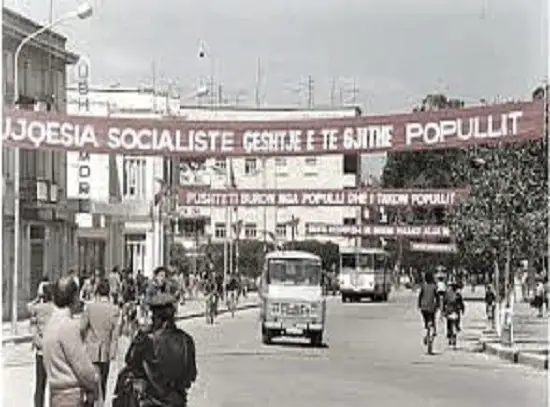
He pours water until the next village, where he can buy a bottle of red wine. He says wine is good enough for the brakes, because of the alcohol, and adds that raki is too strong. Although at major intersections in Tirana, and even in small towns, there are policemen dressed in neat uniforms, there are only a few cars on the roads.
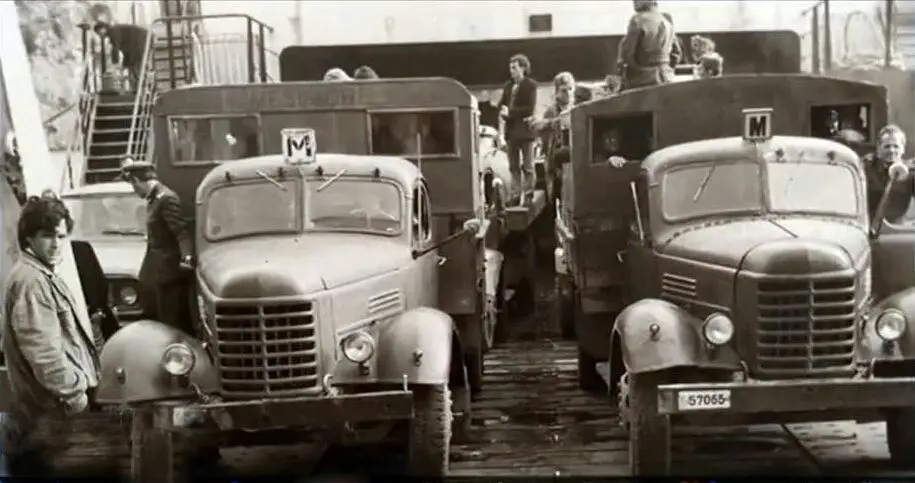
While traveling to Elbasan or near the farms, on the way to Lake Ohrid, you see alongside more loaded donkeys than jeeps, and flocks of sheep are just as common as the large convoys of Czech “Skodas” or Soviet “Zis” trucks zigzagging through the curves of mountain roads, loaded with chrome or supplies of any kind.
The most permanent are the pedestrians. Women with rust‑colored clay water jugs, which they carefully balance on their heads; girls in embroidered red skirts and decorated woolen headscarves; men with sashes and women with shawls; shepherds in rough cloaks and children dressed in rags.
The locals transport everything by donkey. They use a type of reed that is very functional: for house walls, room partitions, floor mats, bedding. There are small handcarts, as short as the dark‑skinned boys who push them, and large four‑wheeled carts, moving fully loaded and fenced with wooden planks.
TRADITIONAL SCENE
Albania has not changed much from what it was before communism came: men wearing white felt caps, women mostly dressed in black, and a few Muslim women in veils (ferexhe). As they walk or ride, women always have an infant they care for, nurse, or caress.
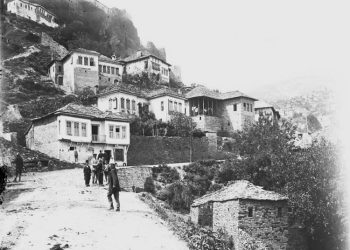
The men carry long sticks (crooks) with which they urge the sheep, and often a rifle hung across the shoulder on the back of one of them was noticeable. The roads are mostly those once used by the Romans and Illyrians; few of them were repaired during the Italian occupation in World War II, and from these remain gray stone guard posts in the curves, from which the mountains were watched.
There are barracks for soldiers built on mountain slopes or at the edges of fields and roads, near Lake Ohrid. It is not known why, when the war was at its height, military units were deployed to open paths in the mountains. From a distance, the noise of an artillery battery is heard. Maneuvers? Perhaps.
The sheep and shepherds seem undisturbed by them; maybe they are used to the noise. For about a mile along the river, on a mountain path, an entire division is bathing and washing clothes in the cold, fresh water. Almost the whole mountain is covered with shirts, drying in the late afternoon sun.
Along the roadside, Albanians have placed dry, thin sheaves of wheat, while shepherds graze their flocks, which startle whenever a truck, jeep, or official car passes, and rarely, a passenger car. There are no labor camps for prisoners on Albania’s roads.
I saw a large prison on the outskirts of Vlorë, with a wide front porch where women waited to meet their husbands or to send them food through the guards. I saw a large number of areas surrounded by barbed wire that could be simultaneously army assembly points or concentration camps.
THE ROADS ARE IMPROVING
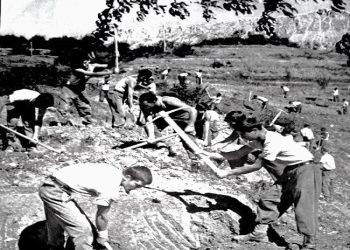
Large buildings are ready for volunteer road‑construction brigades, where groups of prisoners can be seen breaking stones. Some Albanians have bicycles, but there are no private cars. A young man said: “What do we need them for? Where could we go with them? Our conditions do not allow such things.”
He is certainly right. The bad roads are enough to turn an American car into a pile of scrap metal within a few weeks. In Tirana there are a few American‑made cars belonging to diplomats.
Here, besides the French, Yugoslavs, and Italians, the rest of the diplomats belong to the Soviet Eastern Bloc, from Europe or Asia. The pride of the capital is two new “Volgas,” products of the Gorky automobile plant in the USSR.
Combined in a candy‑brown color and a synthetic orange, they glide along “Stalin” Boulevard toward the Council of Ministers. Albania also has a telegraph system and a telephone network. Prime Minister Mehmet Shehu alone has four telephones on his desk. But the Tirana directory has only 90 pages, with an average of 12 numbers per page.
BEER IS DRUNK IN THE CITY
In the evening in Tirana or even in the port city of Durrës, people can gather in cafes called “Volga” and have a beer. Even though Albania has vineyards that should make it a country that produces mostly wine, beer is the standard drink in cities. There are so many Russians in Albania and their influence is so great that even Albanian toothpaste has the same flavor as that of Moscow.
No one can say how many Russians are in the country. Surely there must be several thousand. There are advisors, experts, trade delegates, security specialists, military personnel, and engineers. A large part of them occupy the upper floors of the hotel built by the Italians on “Stalin” Boulevard. They go to the beach on the white sands of Durrës and drink in open‑air cafes.
A Soviet engineer who had spent three years in the United States smiled at us almost amiably as he finished his aperitif of raki. “What a people!” he says. “You cannot imagine what they are like. What a country.” He shakes his head ironically and despairingly and begins to talk about Broadway, Times Square, and the small buildings in New York, the crowds on Forty‑Second Street, “packed like a wall.”
There is no doubt which place he would prefer. The rough roads for cars. Donkeys remain the main carriers in the mountains. The all‑powerful Russian advisors and the daily life of Albanians “proud” of the working class but without money to shine their shoes. Below, the third part of a series of writings from Albania.
THE GRATEFUL INDUSTRIAL CLASS
What Albanians think about them is difficult to understand? Even after a dozen conversations, always through a Foreign Ministry interpreter, it is hard to be sure. Certainly the proletarian class of the small country feels grateful for the forces that brought it to life, the Albanian Communist Party and the Soviet Union.
As for the peasants, they have nothing to say to foreigners. They give us some incomprehensible signs of happiness and well‑being. Their physical structure seems to express chronic resignation.
Perhaps the best impression we could get was from an Albanian who spoke English, who had lived and worked in the USA for 15 years before the war. “I worked in Cleveland,” he says. “In 1939 I came back to see my people. The war caught me here and I couldn’t return.”
I said to him, “This doesn’t look much like Cleveland.” “Brother,” he said, with the understanding that the Albanian agreed, “you can’t even imagine the difference.” “How do you manage to stay?” I ask him. He shrugs. “I’ve just forgotten everything. I told myself: I was never in America. It’s the only way to survive.”
Tirana, Albania – It would be simple to write, and not at all unfair, that Albania is a fragment of Stalinist Russia that has anachronistically managed to survive even in the post‑Stalinist world. But that is only one side of the coin. A traveler in this Muslim country under construction on the Adriatic immediately discovers that Albania is a country that the West has forgotten.
Poor to the point of bitterness, badly wounded by World War II, devastated by the hostilities of the Cold War, Albania is suffocating and in such a state that its inhabitants, whose history contains only tragedies, desperate from this terrible situation, are ready to try anything.
The condition of the country today is not at all satisfactory. The standard of living is the lowest in Europe, or very close to the lowest. Only in deep areas of Siberia or Central Asia can you see so many unshaven and unwashed people. But it must be added that the improvement in cultural and economic conditions has been brought about by the communist regime, which has been helped by the fact that the West has brutally refused to have anything to do with this country.
The visit of a few correspondents and a small group of tourists from Britain and France seems to show a small, even if modest, necessity to improve the hostile and isolating relations with the West. Prime Minister Mehmet Shehu insists that Albania wants to normalize relations with the West. There is enough reason to believe that Moscow would not allow this normalization, but at least this is a step forward and a big change from the situation two years ago.
If Albania is in this bad state, a large part of the blame belongs to the country itself and its leaders, but it is also a truth that very few Albanians know: that the distant stance, neglect, and hostility of the West towards a small country of proud people have also influenced this.
FIRST IMPRESSION
My first impression when I landed at Tirana Airport was that I had landed somewhere in the Soviet Union, perhaps somewhere among the mountains of the Caucasus. The first thing I saw was a handful of soldiers, dressed in something that looked like a dirty, moth‑eaten Soviet uniform. They all carried long rifles with fixed bayonets.
Everywhere there seemed to be Soviet officers, even Soviet police in their characteristic blue uniforms with the red stripe on their summer shirts. The policeman directed the scanty traffic, making hand signals similar to those of his colleagues in Moscow, and stood in the middle of a black‑and‑white crosswalk, the same as in Moscow. The writings in the airport waiting room were in Russian and Albanian. / Memorie.al
(New York Times special, September 9, 1957)
To be continued in the next issue