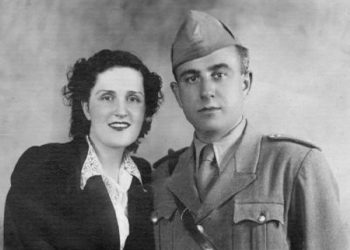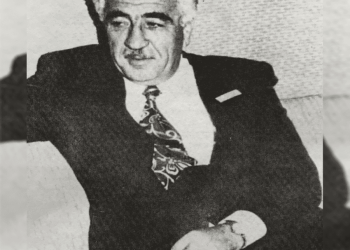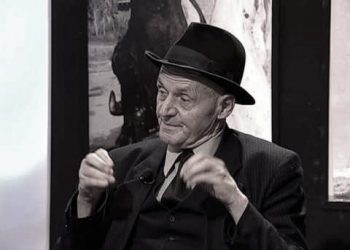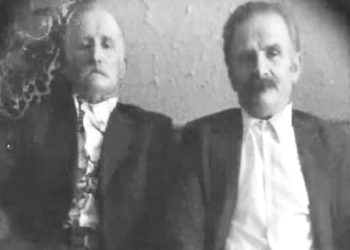
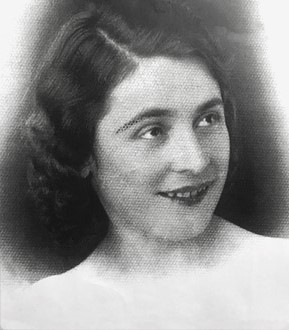
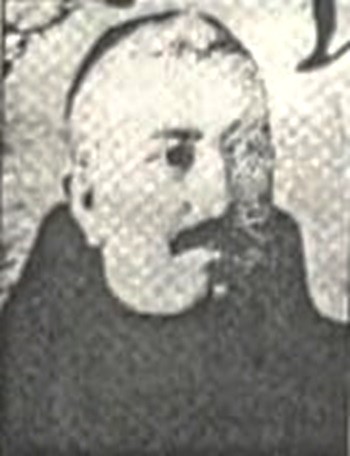
Memorie.al / The patriotic teacher, Gjergj Martini, was born on August 29, 1917, in Hot, Shkodra. His father was Martini and his mother Pashkë. From an early age he was orphaned, and his cousins took care of him. He was educated in Shkodra, where the village parish priest had sent him. Gjergj Martini had completed the lower gymnasium, to later continue at the ‘Normalja’ of Elbasan, and after its completion, he worked as a teacher, first in Vlora, then in Shkodra and Kukës. During the time he worked as a teacher in Vlora, he met a beautiful girl named Zografe. Zografe was also a teacher and they worked together in the same school.
In Zografe, Gjergji would find his soulmate and after a while they married. Zografe, for the time, was an intellectual who read a lot and spoke several foreign languages. In Tirana, she had finished gymnasium, while in Shkodra she had successfully completed the “Academia d’Italia” with excellent results.
After the capitulation of Yugoslavia in 1941, Kosovo was united with the Albanian state. Therefore, the Ministry of Education of the Albanian state had made the decision to send over 300 teachers and educators to Kosovo to open Albanian schools throughout the territory of Kosovo. Like his friends, Gjergj Martini was among the first to volunteer together with his wife to come to Kosovo, to join the educational system.
They were sworn to work for its benefit, and to commit to its freedom until their last breath. In the beginning, together with his wife, they began working as teachers first in Mitrovica, then in Gjakova, in Prizren, in Pristina, and returned again to continue in Gjakova. At the beginning of 1945, a great tragedy occurred; his wife, Zografe – his life partner – died of typhus, leaving behind their young daughter.
Zografe was only 25 years old. The pain was too great for the young Gjergj. After some time, he married for the second time, to a woman named Lina Shkreli, who was known as one of the first female teachers in Kosovo. Lina Shkreli describes Gjergj as a multifaceted man.
In her memoirs, he appears as follows: “Gjergji loved music, theater, and sports exceptionally much; he had even written a drama titled ‘Kosovarja’ and had staged it at the Gjakova Theater. He sang beautifully.” Seeing the great work Gjergj was doing, she adds that, “they appointed him director of the school in Gjakova. They had also appointed him director in Prizren and again in Gjakova.” During their short marriage, Lina would become pregnant, precisely at the time when Gjergj would be arrested. She gave birth to a son while Gjergj was before the judges in Prizren. She baptized the boy with the name Anton, as Gjergj had wished. Anton, too, suffered the same fate as his father, dying at the age of 20.
Gjergj Martini, seeing that Kosovo was occupied again, joined the Albanian National Democratic Movement without hesitation, to which he gave an extraordinary contribution both intellectually and patriotically. His main engagement was in the formation of the Central Youth Committee of the Albanian National Democratic Movement. He developed great engagement in forming district, city, and village committees across Kosovo.
The goal was to raise the population’s awareness through them regarding the created situation and, in any case, to begin preparations for an armed uprising against the Yugoslav government, and to work for the unification of Kosovo with Albania. Likewise, to begin collecting aid for the groups of patriots who were in the mountains?
The organization of the Central Committee was done in this manner: Hajdar Pllaneja was appointed Chairman of the committee. Meanwhile, for the propaganda sector, Kolë Parubi was appointed; for the information sector, Gjergj Martini was appointed to lead; for the armament sector – Enver Sudi; and for the health sector, Marsel Vuçaj was appointed. Under the directives of Prof. Ymer Berisha, they held regular meetings and made decisions about the tasks ahead.
Their activity did not last long. Their work was quickly discovered. Gjergj Martini was arrested together with Father Bernard Llupi, Marie Shllaku, Kolë Parubi, etc. During isolation in the investigation, Gjergj was interrogated five times. He openly told the investigators that he was dissatisfied with the communist system, which is why he had engaged in the Albanian National Democratic Movement.
He admitted that he had collaborated with Kolë Parubi, Hajdar Pllaneja, etc. He had participated in the collection of armaments because they were prepared to defend themselves from the Chetnik and Partisan hordes and at all costs to achieve the unification of Albanian lands into one state.
The largest judicial process, and one that sparked the interest of the broad Albanian masses, was undoubtedly the judicial process of Father Bernard Llupi, Kolë Parubi, Gjergj Martini, Marie Shllaku, and many others, who were close collaborators of Prof. Ymer Berisha.
The aforementioned process began on June 29, 1946, and ended on July 11 of the same year, which means it lasted a total of 13 days, not counting the days of investigation and others.
The public prosecutor of this process, as had become the rule in every other process, was Ali Shukriu. The trial was held in Prizren. Before the trial body, which consisted of the presiding judge—Dragutin Janjiq, the lay judges were Ismet Mulla and Selajdin Ahmeti. The court clerk was Branisllav Kijari.
Defense counsel for the accused were Bozhidar Zuleviq and Hysamedin Ejupi, Jovo Poznanoviq and Urosh Golluboviq, with the only lawyer – who was also a Russian remaining here after the war – Vladimir Znamenski from Gjakova.
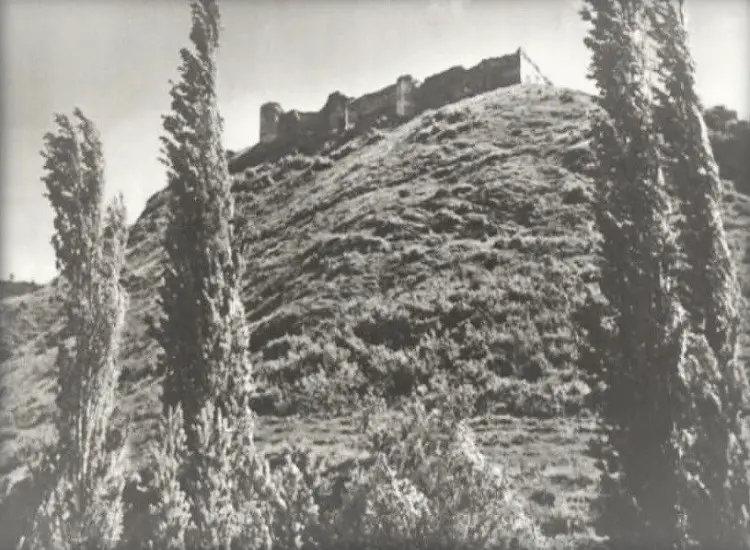
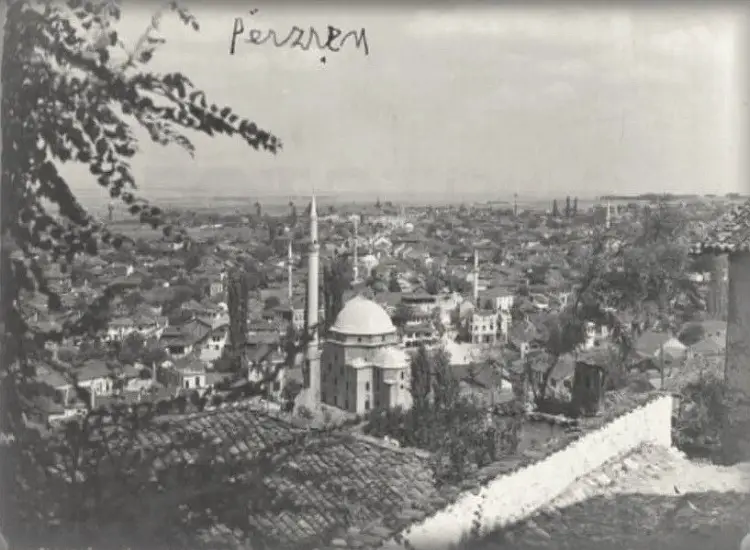
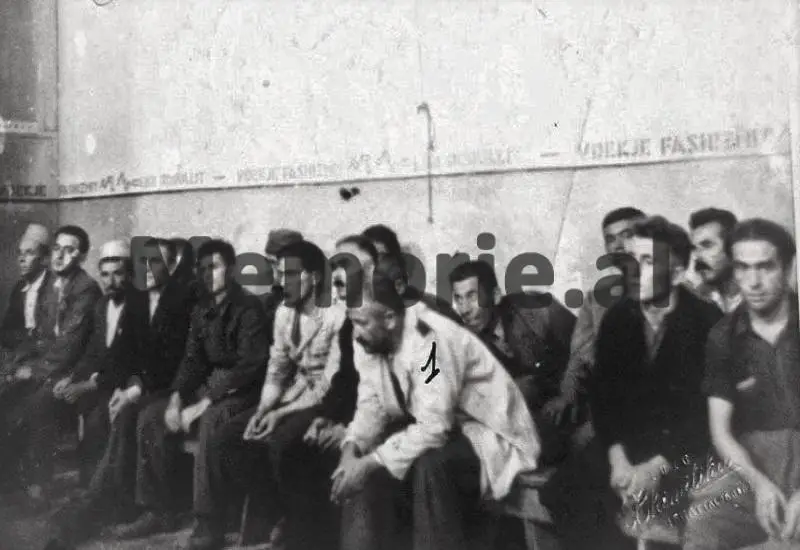
On June 29, beautiful Prizren had a day of mourning. Before the trial body of the occupier, 27 accused Albanians sat on the black bench. They were accused only because they had loved their country, freedom, and an Ethnic Albania.
The death sentence was carried out by the Internal Affairs section, at the People’s Council, through the police organs on November 24, 1946, in the Prizren of heroes. Present at the execution were:
- The leader of the Internal Affairs Section at the local People’s Council in Prizren, Njazi Maloku;
- The leader of the Internal Affairs Section at the People’s Council of the Autonomous Province of Kosovo, a delegate appointed by the Ministry of Internal Affairs of the People’s Republic of Serbia – Gligorije Sharanoviq;
- The Assistant Public Prosecutor for Kosovo – Sadri Doqi;
- The district doctor – Luciano Matroni. The execution by firing squad was carried out exactly at 6:30 in the morning, without the presence of the public. / Memorie.al