
By VELI HAKLAJ
Part One
Memorie.al / The anti-communist activity in Albania in 1946 and the ways in which the opponents of the communist regime were pursued by the State Security (Sigurimi) will be at the center of the dossier that begins today. Through archival documents, we will have a truthful presentation of the situation after the liberation of the country. The denunciation of the Mukje national agreement (August 1-2, 1943) by the leaders of the Albanian Communist Party, under the dictation of the Yugoslav tutors Miladin Popović and Dušan Mugoša, was accompanied by the intensification of the military actions of partisan formations against non-communist political groupings and military formations, with a clear objective: seizing power and establishing their rule in Albania. This confrontation, which gradually took on the features of a civil war, became bloody and had multifaceted consequences in the second half of 1944.
After having taken under control almost all of Southern Albania and a part of Central Albania, on June 1, 1944, the commander-in-chief of the Albanian National Liberation Army, General-Colonel Enver Hoxha, sent an order to the Staff of the 1st Division to advance north of the Shkumbin River, an order that began to be implemented on June 26, 1944.
The action of partisan formations in Northern Albania was accompanied by armed confrontations between the military forces of both sides, especially in Krujë, Mat, Mirditë, Dibër, Shkodër, Kukës, and Tropojë.
Having clear reasons for the advance of communist forces into the North, the country’s main politicians and military figures with anti-communist convictions gathered in the city of Shkodër.
Their discussions in meetings held in the village of Bulgër, in the city of Shkodër, and at the Franciscan Assembly of Shkodër (on November 12 and 18, 1944), culminated in the decision that some of the leaders would flee abroad, to England, Italy, France, and the USA, to negotiate with the Allies and, with their help, organize forces outside the country, with which to land in Albania in a short time, aided by internal anti-communist forces; the rest would retreat to the mountains of Central and Northern Albania, to continue the armed struggle against communist forces until the Anglo-American landing.
However, at the end of 1944, the partisan-communist formations began an operation for the physical elimination of political opponents who had or had not been involved in the war. Throughout the country, the persecution of regime opponents who had not left Albania began. In line with their objectives, on January 11, 1945, the communist authorities published the decision to establish the Central Investigation Commission for War Criminals.
Local commissions, subordinate to this Central Commission, were established in every prefecture and sub-prefecture of the country. On behalf of the Central Commission, the Minister of Justice, Manol Konomi, invited “all the Albanian people, men, women, young and old, to come to the aid of these commissions in carrying out their mission.”
Simultaneously with the establishment of the Central Investigation Commission and the respective local commissions, among the first acts approved by the communist authorities was the law on the formation of military courts.
As early as January 14, 1944, the activity of the Corps Military Court, the Military Court of the Corps Military Region, and the High Military Court was regulated. These courts tried criminal cases against military personnel and political opponents classified as “war criminals.”
Subsequently, numerous political trials were held, sentencing opponents of the communist regime in Albania to death or many years in prison.
In such a situation of political, military, and judicial repression, we also have the armed reaction of anti-communist forces in Northern Albania, led by the most influential nationalist figures in Shkodër, Lezhë, Mat, Mirditë, Dibër, Pukë, Kukës, Tropojë, which could not achieve their objectives and ended with multifaceted consequences for the organizers, leaders, and participants in these movements.
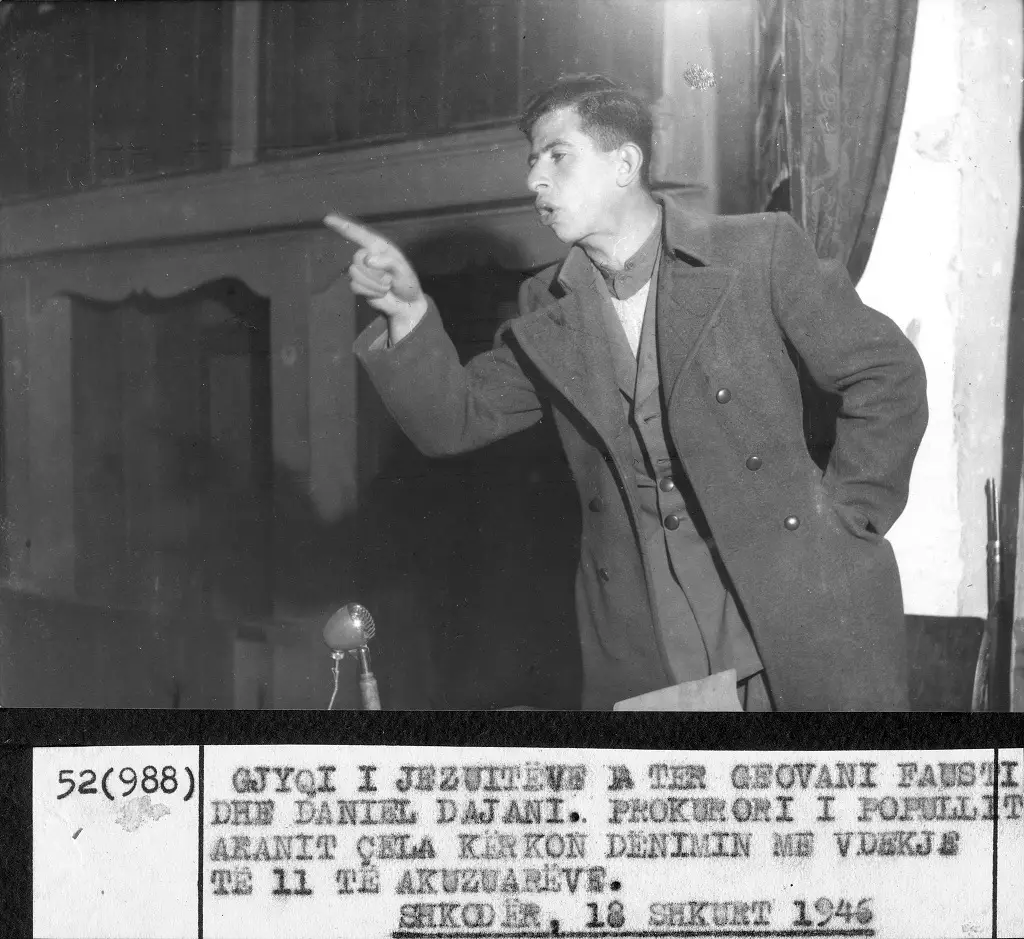
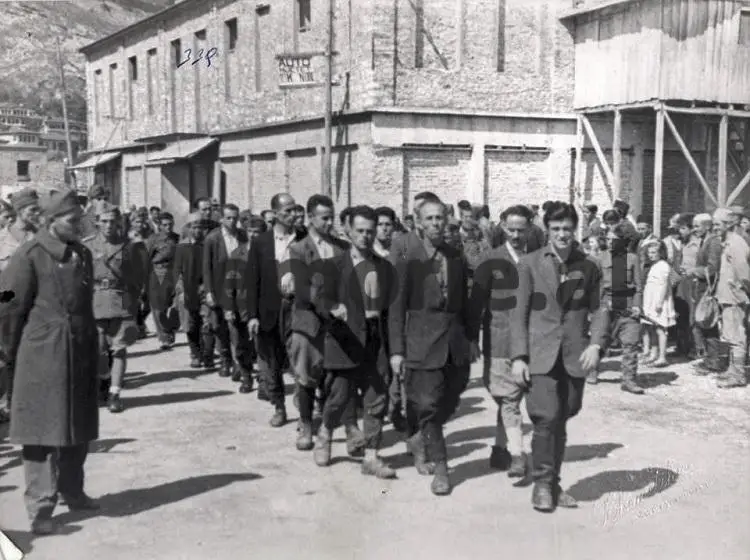
Following the arrests and political trials of 1945, even during 1946, there would be a widespread wave of arrests in all prefectures and sub-prefectures of the country. Hundreds of anti-communist activists were subjected to these political trials, which also faced the most inhuman tortures to admit their real activity against the communist regime, as well as a series of accusations fabricated by the dark structures of the State Security (Sigurimi).
Light is also shed on what happened during this period by a report prepared by the Staff of the State Security Directorate, within the Ministry of Internal Affairs, in 1946, which was sent to the highest state authorities of that time in Albania. The document does not specify the day and month of its drafting, but from the analysis of the events covered in it, it appears to have been completed in the autumn of 1946.
Through this document, which we will refer to in this dossier and which we will publish for the reader, the policy of mass persecution of individuals potentially opposed to the communist regime is clearly evident, even though in some cases no concrete data on their involvement resulted.
In some cases, the cooperation of the State Security structures with those of the Yugoslav secret service (OZNA) for the arrest and conviction of opponents of the respective communist regimes in Albania and Yugoslavia is also evident.
Periodic report on the activity of opposing political circles and groups and the work of the State Security in striking them.
The uncovering of the “Albanian Union” Organization in Shkodër and the arrests and political trials in Tirana caused the opponents of the communist regime in Albania to be left without some of their best leaders.
Due to the blows dealt by the structures of the People’s Defense Division, the State Security organs, and the Military Courts during 1945 and the first half of 1946, there was a great shock within the ranks of political opponents, and in all circles, a noticeable decrease in their activity was observed for some time.
Many honest, capable, and innocent people had been arrested and convicted, some of whom were considered valuable leaders for the Albanian opposition of that time. According to the report, through these actions, the organs of the communist dictatorship, among other things, had aimed to:
1) Severely strike all political opponents and seriously damage their ranks, cutting their momentum for a time; 2) Shape public opinion regarding their modus operandi and the supposedly anti-people political line that the regime’s political opponents were following; and 3) Project foreign policy towards the main allies in World War II, justifying the gradual cooling with the Anglo-Americans and entry under the Russian-Yugoslav tutelage.
But, despite the blows dealt to political opponents in their most essential elements, they had still worked continuously to organize themselves. What gave new impetus to their work and raised the hopes of opponents of the communist regime in Albania was the conference of the four ministers in Paris.
The political opponents tried to exploit the objections encountered at that conference among the four ministers by presenting an agreement between them as impossible and, consequently, predicting the outbreak of a Third World War. The political opponents of the regime presented the stance of the Anglo-Americans at that conference towards Albania as right, and meanwhile cursed the policy of the Hoxha government, especially for the stance it had held towards England and the United States of America.
Enver Hoxha’s visit to Yugoslavia and the signing of the treaty were underestimated by political opponents, presenting Yugoslavia as a state that plays no role in the international arena. They presented the concluded treaty as a colonization of Albania by Yugoslavia…! …
From their movements and the various slogans circulating, it seemed they were convinced that the Conference would not succeed. They heavily propagandized Albania’s non-admission to the Peace Conference and underestimated the admission to speak regarding the treaty with Italy.
Greece’s claims, the provocations made along our border by the Greeks, the stance of the Anglo-Americans at the Peace Conference towards our country, the mobilization of some groups and some insurgent movements (The Postribë Uprising, September 1946), had caused the political opposition groups to intensify their propaganda against the communist regime.
Apparently, they were more than convinced of the outbreak of a war between Albania and Greece. The slogans released at that time had significantly influenced the masses of the people. Another point where regime opponents constantly attacked was the economic sector. The various reforms, such as the nationalization of part of industry, pharmacies, the blocking of part of the goods, etc., they presented as unjust and misplaced.
In this respect, they constantly exploited the shortage of goods in the market and propagated these in various ways, spreading slogans that presented the authorities as incapable of conducting economic policy and that trade could not develop being under state control. /Memorie.al
To be continued in the next issue