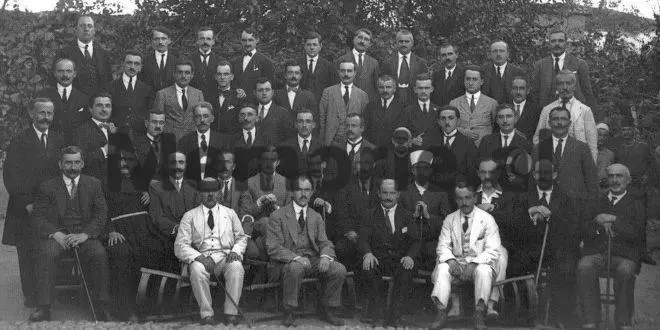


By Dashnor Kaloçi
Part One
Memorie.al / The history of parliamentary elections in our country, or more accurately, the attempts at elections, date back to the time of Ottoman rule, when Albania was part of the Turkish Empire. One of the first Albanian deputies elected to the first Parliament of Turkey, which opened its work in December 1877, was Abdyl Frashëri. But that parliament did not last long, as it was dissolved by the Sultan himself, due to the start of the Russo-Turkish War. After the dissolution of the first Turkish parliament, there were several other attempts at elections, all of which failed for various reasons. The first regular elections in Albania were held only in 1908, when the Young Turks came to power in Turkey. Those elections were not direct but by representation, or as they were otherwise known; with second-degree electors.
The first Parliament of Turkey opened on December 10, 1908, and out of 266 deputies, 27 of them were Albanians elected in the four vilayets of Albania. At that time, members of the “Union and Progress” Committee in Turkey, which included many Albanians, were divided and grouped into three political groups. The first group was “Union and Progress” (the Turkish-Macedonian party) with 164 deputies, where 130 were Turks, 5 Arabs, 1 Greek, and 15 Albanians, who were led by Hasan Prishtina, a deputy of Kosovo.
The second group, called: “Liberal Union,” (the Greco-Albanian party) which included 45 deputies, had 12 Albanians led by Ismail Qemali. Among the other Albanian deputies in the Turkish Parliament at that time were Esad Pasha Toptani, Nexhip Draga, Rexhep Pasha Mati, etc. After 1908, there were several other elections where Albanians continued to vote for their representatives in the Turkish Parliament, and that lasted un1til November 1912 when Independence was declared and Ismail Qemali was elected Head of Government.
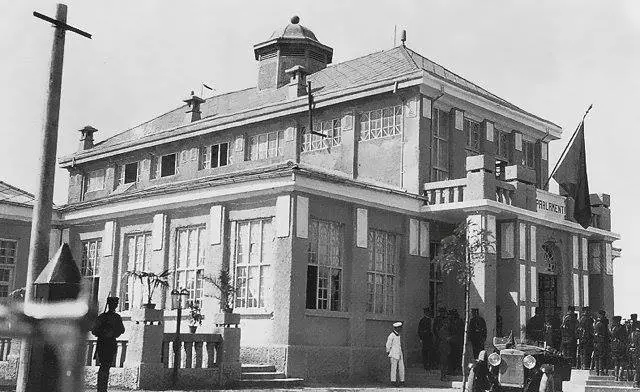
The first parliamentary elections in Albania were held in the spring of 1921, as they had not taken place until then due to the First World War, in which Albania was also involved. The first Albanian Parliament opened on April 21 of that year, and the first building of the Albanian Parliament was where the Academy of Sciences is today, and 76 deputies participated in that parliament, who were elected after a relatively regular process from the nine prefectures of the country, such as: Berat, Durrës, Elbasan, Gjirokastra, Korça, Kosovo, Shkodra, Vlora, and that of the Albanian colony of the USA. As in the past, those elections were held by the system of representation, or as otherwise known, with second-degree electors, where based on territorial division, the representatives of each region had the right to elect their deputy. As mentioned above, as well as a brief history of parliamentary elections in Albania from that period until 1991, Memorie.al has published in previous issues, here we publish the full Fundamental Statute of the Albanian Republic (Constitution) of 1925, where the legislation of the parliamentary elections of that time, as well as the Regulation of the Parliament, with the rights and duties of the deputies, which was published by the “NIKAJ” Printing House in 1925, holds a special place.
Fundamental Statute of the Albanian Republic (1925)
(Tirana, “Nikaj” Printing House 1925)
The free and independent Albanian Nation, proud of its past and full of confidence for the future, establishes this Statute in the Constituent Assembly.
Chapter I.
FORMATION OF THE STATE
Part A.
General Provisions
Art. 1. Albania is a Parliamentary Republic Headed by a President. Sovereignty emanates from the people.
Art. 2. The Albanian Republic is independent, indivisible, its territorial integrity is inviolable, and its land is inalienable.
Art. 3. The National Flag is red with a black two-headed eagle in the center.
Art. 4. Albanian is the official language.
Art. 5. The Albanian Republic has no official religion.
All faiths and beliefs are honored, and the freedom of their exercise and external practice is secured.
Religion cannot form legal impediments in any way.
Faiths and beliefs can never be used for political purposes.
Art. 6. Tirana is the Capital of Albania.
Art. 7. Legislative power is exercised by the Senate and the Chamber of Deputies according to this Statute.
Art. 8. Executive power belongs solely to the President of the Republic, who exercises it through the Ministers.
Art. 9. Judicial power is exercised by the courts and their decisions are given in the name of the Albanian Republic.
Part B.
Legislative Power
THE CHAMBER OF DEPUTIES
Art. 10. National Representation is comprised of two bodies; the Chamber of Deputies, consisting of deputies elected by the people, and the Senate, consisting of Senators, elected according to a special law.
Art. 11. Deputies are elected for 4 (four) years and one for every 15,000 inhabitants.
Art. 12. No one can be accepted as a deputy without being an Albanian citizen, without having reached the age of 30, without enjoying civil and political rights, and without possessing all the other qualities required by law.
Art. 13. The quality of a deputy is incompatible with any State employment with a salary or communal employment, or with active religious service.
Art. 14. The deputy represents not only the district that elected him, but the nation generally.
Art. 15. The deputy cannot be given any mandatory instruction by his electors.
Art. 16. Deputies have the right to receive an allowance of 5,000 gold francs per year.
This sum can be changed from time to time by law.
Art. 17. The manner of exercising the functions of the Chamber of Deputies is determined by its internal regulation.
Art. 18. The Presidency of the Chamber of Deputies is elected by it, and within it, at the start of each session, for its entire duration until the beginning of the next. The election of the presidency and the appointment of the officials of the Chamber of Deputies are done according to its internal regulation.
Art. 19. The Chamber of Deputies examines the powers and legal qualifications of its members, and judges and decides upon them according to the provisions of its internal regulation.
Art. 20. Every Member of the Chamber of Deputies is obliged to take two oaths; one before their powers and qualifications are examined, and the other before they begin their duty as Deputy.
The first oath is this: “I swear in the name of God and upon my honor that I shall perform the duty of examination with a conscience and complete impartiality.”
The second oath shall be made with these words: “I swear in the name of God and upon my honor that I shall faithfully preserve the independence and territorial integrity of Albania, that I shall remain loyal to the Fatherland and the Republic and uphold the Statute and the laws of the State, and that I shall perform my duty with complete conscience for the general good without being hindered even slightly by special or regional interests.”
Art. 21. A newly elected Deputy who, without justifiable reasons duly verified, does not appear before the Chamber of Deputies within two months to take the required oath, is deemed to have forfeited the deputyship.
The judgment on the admissibility or non-admissibility of the justifying reasons belongs to the Chamber of Deputies.
Art. 22. A Deputy who is absent from the meetings for two months in a row without the authorization of the Chamber of Deputies is automatically considered stripped of the deputyship.
Art. 23. When, for whatever reason, the seat of a deputy remains vacant, another must be elected in his place within two months from the day of the vacancy, but no sooner than one month.
Art. 24. The Chamber of Deputies meets automatically twice a year in two regular three-month sessions.
The first session begins on September 15 and ends on December 15, and the second begins on March 1 and ends on May 31 of each year.
Art. 25. Deputies cannot be held responsible for opinions expressed and votes given in the Chamber of Deputies.
Art. 26. During the session, deputies cannot be imprisoned for debt.
Likewise, during the session, they cannot be prosecuted or arrested for criminal matters, without the permission and decision of the Chamber, unless they are caught in flagrante delicto for a crime. In this case, the judicial authorities are obliged to notify the Chamber of Deputies, within 24 hours, through the Ministry of Justice.
For political offenses and crimes, deputies are always judged and punished, meaning both within and outside the session, by the High Court with the authorization of the Chamber, according to a special law.
Art. 27. The Chamber of Deputies has the right to decree the release of one of its members for the entire duration of the session if he was apprehended during the recess period, with the exception of those apprehended for crimes.
Art. 28. In an extraordinary session, only those matters that caused it will be discussed, which will be determined in the program prepared by the Government.
The President of the Republic has the right to close this session whenever he deems it reasonable, but always before the regular session begins.
Art. 29. At the opening of the first regular session, the President of the Republic, with a speech or message, presents the general state of the country and the measures deemed necessary to be taken by the Executive Power that year, and the Chamber responds as quickly as possible.
Art. 30. The Chamber of Deputies cannot discuss and decide without the presence of more than half of all its members who have passed the formalities of Articles 19 and 20.
Those who are absent with permission are not counted in the total number.
Art. 31. All decisions are voted by an absolute majority of the deputies present.
Elections concerning persons, if not voted by an absolute majority for the first time, are voted by a relative majority of the assembled deputies the second time.
Art. 32. The voting of laws is done once in principle and twice article by article, on three different days.
Votes for the codes presented by the Government and prepared by a special commission established by law, are done en bloc in three meetings on different days, except for those laws that the Chamber decides are urgent, which are voted according to the internal regulation.
Art. 33. The meetings of the Chamber of Deputies are public. Apart from the military forces, anyone else may participate in them in conformity with the regulation. The discussions of the Chamber are published in special volumes.
Art. 34. The Chamber of Deputies may also discuss in secret meeting if requested by the ministers or by five deputies and if approved by the majority, after all those who are not deputies have left the Chamber.
Art. 35. The Chamber of Deputies is inviolable. No official or armed force, except for the police body with a special badge, can enter the Chamber or the door of the building where the deputies meet without the decision and request of the Chamber.
Art. 36. Every act with legal force shall be announced in the official gazette, which is sent to all Municipalities of Albania.
The announcement shall be made at most two weeks after voting, and the act enters into force and implementation one month after the announcement, except for those laws that specify a different time limit for their entry into force.
Acts with legal force shall be inserted in the official compilation of laws and decrees.
Art. 37. The Presidency of the Chamber is obliged, within the session, to return to the Executive Power any project presented by it and rejected by the Chamber, along with the reasons for disapproval.
Art. 38. No bill that is not approved by the Chamber of Deputies can be presented for debate a second time in the same session.
Art. 39. Annually, the Executive Power shall present to the Chamber of Deputies for consideration and approval the general Budget of the State’s revenues and expenditures, along with the presentation of the ways and means by which those expenses will be covered.
All State revenues and expenditures shall be included in the Budget.
The Budget shall always be presented at the opening of the autumn session, which cannot be closed without the Budget being voted upon.
The manner of drafting the Budget is done by law. The Budget is voted chapter by chapter, twice on two different days.
The Executive Power, at the end of the fiscal year and within the second session of the next fiscal year, shall present to the Chamber of Deputies for consideration and approval the consumable Budget of the past year, which is voted once generally.
Art. 40. When, for whatever reason, the new Budget fails to take definitive legal form until the beginning of the fiscal year, for which it was prepared, the Executive Power implements the most advanced one for as long as the approval and voting of the new one is delayed.
In case the Chamber is open, it then grants a monthly credit to each branch of the administration, but this credit cannot exceed one-twelfth of the ordinary expenses that belong to it according to the old budget.
Art. 41. The Executive Power, under its civil responsibility, is obliged to mark in the annual State budget any law that burdens citizens with fees and taxes.
Laws that are not marked in the Budget are considered as lifted and without legal force.
Art. 42. When a credit granted in the budget is insufficient for that service, the Executive Power, with a decree-law within the fiscal year, requests the Chamber to increase that credit until it suffices, and, when expenses arise for unforeseen needs in the Budget, the Executive Power can again request an additional credit from the Chamber, always on the basis of a special bill.
Laws for supplementary and extraordinary credits are voted like ordinary laws.
In cases of war, insurrection, and public calamity when the Chamber of Deputies is in recess, the Government can, by decree-law, create an extraordinary credit under its responsibility.
This decree-law must be presented to the Chamber in the next session.
Art. 43. The Chamber of Deputies has the right to call before it any of the Ministers, to question them on any matter concerning their branch.
The manner of calling and the appearance of the Ministers are determined in the internal regulation.
Art. 44. The Chamber of Deputies controls the Government.
For the protection of general interests, the Chamber is obliged, in every specific case, to form Investigation Commissions from its own body to study the issues and facts related to them. Investigation Commissions have the right to request explanations orally and in writing, both from public authorities and from private individuals. They can also inspect all official acts that seem necessary to them.
Art. 45. The Chamber of Deputies accuses the Ministers and sends them before the High Court of the State, based on a special law.
Art. 46. The Chamber of Deputies cannot accept deputyships or listen to others except the ministers, or their substitutes, with the exception of the case foreseen in Art. 29.
Art. 47. At the end of the period or in case of dissolution of the Chamber of Deputies, the Executive Power is obliged, within two weeks from the day of its dissolution, to decree new parliamentary elections, which must be held no later than two and a half months and no sooner than one month from the date of the decree.
If, for unforeseen reasons, the period of the Chamber of Deputies ends more than one month before the time specified in the Statute, the new Chamber meets automatically fifteen days after the elections. If, during the time after the end of the parliamentary period and without the new elections being held, the Executive Power is forced to declare war or the President of the Republic resigns, by decree of the latter or his substitute, the old Chamber is convened for the approval of the decree-law for war or for the acceptance of the resignation of the new President according to this Statute.
Art. 48. The Ministerial Body, and the Ministers receive the vote of confidence only from the Chamber of Deputies. Memorie.al