
The Rare Tale of the Orphan Who Became a Legend
Memorie.al / In the diverse history of our country, there are countless tales of kaçaks, brigands, and outlaws (komitë) shrouded in the most astonishing legends. Truth and falsehood, facts and fantasy intertwine like a vibrant yet disordered mosaic, making the boundary between reality and image indistinguishable. This phenomenon can only be explained within the historical and socio-economic context of the time – the lack of information media, subjectivism, and the desire of poor, unprotected people to have an idol to follow.
If it were possible to gather and analyze data from the period they lived, we would reach the same conclusions: these rebels, often violent, endured extremely difficult and problematic childhoods or youths on a personal or familial level. In their social environment, they may have felt despised, abused, and violated. Filled with deep hatred for the injustices of the time but unable to solve problems through other means, they reacted violently to achieve their goals, convinced that their lives would have a swift end. Human society at every stage has had such individuals. Reality has carved a similar profile for them: acting against the laws of the time, protecting the poor, robbing caravans, committing brutal acts against the wealthy and rulers, and finally, achieving fame and the absence of a grave.
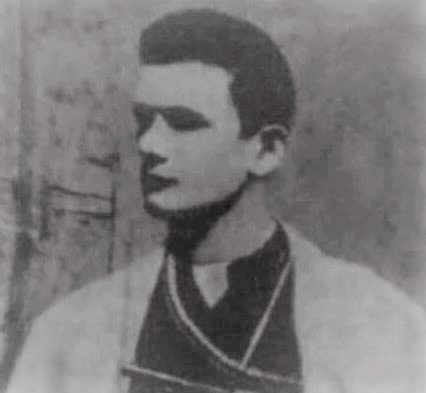
In fact, folkloric fame is the only “real estate” that accompanies them for decades after death. In the region of Mirdita and neighboring Shkodra and Lezha, when individuals noted for acts of self-sacrificing bravery are mentioned, Ndue Nufi of Kaçinar is often cited. The elderly still keep his stories fresh; it was even said that many mothers, while rocking their children in cradles, sang lullabies wishing they would grow up to be as brave as him. A century ago, when Ndue Nufi was born, no one in Mirdita had heard of the famous Englishman Robin Hood, yet their deeds followed a similar path.
Between Anarchy and Legend
After the 1990s, people – often uninformed but inspired by the songs dedicated to him – began making comparisons, especially regarding his fierce several-hour battle in Shkodra. I had the luck to hear stories of Ndue Nufi since childhood from my father, who was nearly his peer and had met him in the Shkodra prison. Around 1952, my father even told Enver Hoxha: “If you want to win over Mirdita, you should decorate Ndue Nufi.” The next day, Hoxha replied: “Ndue Nufi had no cause; he was an anarchist, with no connection to communism.” This answer sealed 70 years of official silence, though his legend continued to circulate.
Ndue Nufi represents a typical case, yet not a single line has been written to calmly analyze his profile – the circumstances that transformed a 15-year-old boy into an extreme rebel. He was not a “serial killer” characterized by poor judgment or personality disorders. He was a product of heavy circumstances, accidental events, and social injustices.
The Tragedy of a Youth
Born in Mzi (Vilzë) in Kaçinar, Mirdita, around 1918-1920, Ndue was the second child of a poor family. Misfortune followed him from the start; his father died months before he was born. At age 9, his mother gave him his father’s pistol. Before he turned 14, his mother also passed away. Tragedy struck his sister as well; while cutting wood in the forest, she fell and large stones crushed her leg bone. Without medical aid, she remained crippled and confined to their home.
The turning point came when a villager broke into their home and raped his crippled sister. When Ndue learned of this, his psychological foundation was shattered. It was a terrible “dishonor” (koritje); his honor, that of his house, his clan, and his village was at stake. Enraged, he notified the village elders and demanded the name of the perpetrator from his sister. Fearing the violence that would follow, she hesitated. Ndue drew his revolver and shot his sister in the shoulder, promising to take her to Shkodra for treatment only if she revealed the name. She spoke, and despite her physical inability to defend herself, Ndue killed her in front of the elders – a killing that even the Kanun (customary law) struggled to justify.
The Life of an Outlaw
At fifteen, Ndue took to the mountains with one goal: to kill the rapist, who belonged to an influential family linked to King Zog’s government. Eventually, Ndue killed the perpetrator’s brother. Hunted by the gendarmerie, he lived in the forests, sheltered by poor friends.
One night, while hiding in a cousin’s hut, he was nearly captured. A gendarme shot first, wounding Ndue in the right forearm. Instinctively, Ndue pulled his pistol with his left hand and killed the gendarme. Surrounded, he called out to see if there was a Mirditor among the besiegers. One responded, and Ndue surrendered under Besa (the word of honor).
In the hospital, a doctor amputated his hand at the wrist. Although the bullet hadn’t hit the bone, it was later understood the doctor had been paid to do this. He was sentenced to 100 years in prison. In his cell, after being beaten by two inmates, Ndue sharpened the handle of a long spoon against the stone walls for several nights. While they slept, he killed them both. His sentence was extended by 200 years. He jokingly told my father in prison: “Out of 500 years of life, I’ll spend 300 in jail.”
The Return to the Mountains and the Final Battle
In April 1939, during the Italian invasion, he escaped prison and returned to his life as a kaçak. His first act was to kill the doctor who had amputated his hand. He became a terror to the wealthy, robbing shops in Shkodra and Lezha, but he kept nothing for himself, distributing the loot among his followers and the poor.
He caught the attention of communists like Zef Mala and Tuk Jakova, who tried to recruit him. Ndue asked if he would be allowed to loot and give shares to his men; Jakova replied that communists were not looters. He also refused a commission as a “Major” from the Captain of Mirdita, saying he preferred to be a “General in the mountains.”
On the freezing morning of December 18, 1943, he gathered 100 young men in Vau i Dejës to march on Shkodra, but he chose only seven bachelors to accompany him. After opening the prison and looting a shop, he was trapped in Shkodra’s “Kafja e Madhe” as German forces and gendarmes surrounded the area.
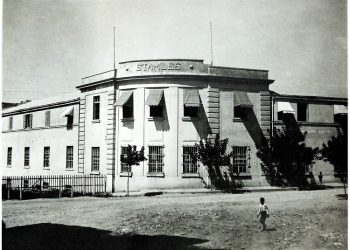
He fled to the Gjomarkaj palace, but the Captain—bitter over Ndue’s previous refusal to cooperate – denied him entry. Under heavy fire, Ndue and his remaining men retreated to the Apostolic Legation of the Vatican. He ordered the priest to leave and took a position on the second floor.
The battle lasted hours. German forces even used artillery from the Rozafa Castle. When his ammunition ran low, Ndue ordered his last surviving comrade to wave a white flag and claim Ndue was dead. When the gendarmes rushed the stairs, Ndue wiped them out with his last grenades. Finally, rather than be captured, he lifted his shirt and shot himself in the chest with his pistol.
The End of a Legend
On the morning of December 19, 1943, the bodies of Ndue Nufi and his seven followers were exposed to the public before being buried in the gravel of the Kir River. Thus ended the story of a man who became a legend across Northern Albania.
As Kolë Shtjefni wrote in his 1998 book, Mirdita: Customs and Traditions:
“Mrika of Gjon Marku wails for Ndue Nufi… they came to Shkodra and, sought by the gendarmerie as outlaws, tried to enter the Captain’s house for protection, but he did not let them in. Finding themselves cornered, they entered the house of the Apostolic Delegate by force, where they were surrounded by gendarmes and Germans.”/Memorie.al