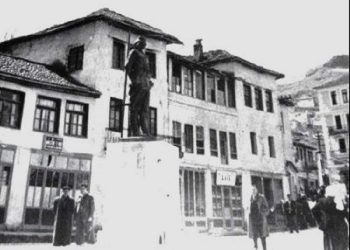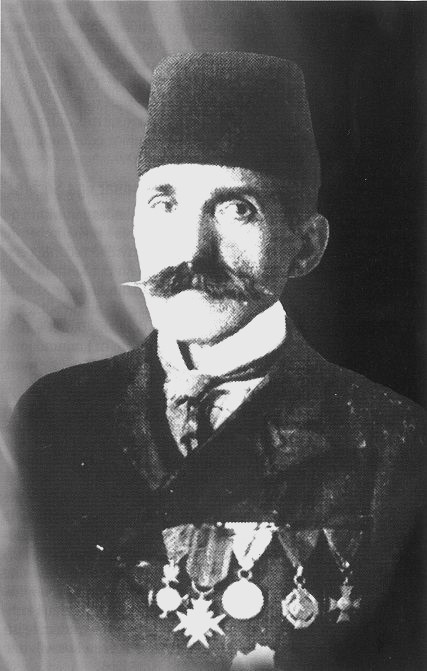
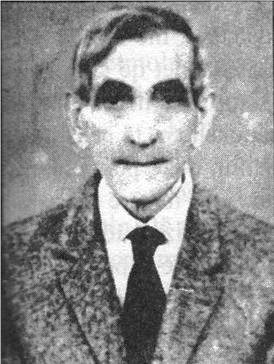
Memorie.al / Nasuf Tahir Dizdari were born in Shkodra in 1857 to a well-known urban family. His home was in the famous “Parrucë” neighbourhood, which had been made famous by the Kazazët and Jukajt families. The Dizdari family also had their property in this neighbourhood. In the period in question, Shkodra resembled a beautiful fortress, where various Euro-Asian cultures circulated on all four sides. It was the time when the Bushatli family had lost power, and Shkodra was left like a boat without a compass. The Ottoman influence had left its mark and was struggling not to be severed; the Venetian influence was no less prominent, followed by Austro-Hungarian and Serbo-Montenegrin influences. All these influences had turned Shkodra into a conglomerate of cultures competing to surpass one another.
The founder of this famous saga in Shkodra is known as Nasuf Beg Dizdari the first, who fell as a martyr in the Battle of Shpuzë for the defence of the homeland against Montenegrin forces. The way the first Nasuf Dizdari was killed is an interesting fact. He was a sworn brother (probatin) with Dasho Shkreli. Both participated in the Battle of Shpuzë in 1835, but in different sectors of the front.
When Nasufi set off to return home after the fighting on his side had ended, he learned that Dasho Shkreli and his brother, Selo, had been killed. Nasufi returned to the war once more, because, as he said at the time, life without his sworn brother was worthless to him. After a heroic resistance, fighting like a lion, the first Nasuf Dizdari was also killed, shedding blood on Albanian lands.
Then the saga continues with his son, Tahir Dizdari, who performed the functions of the Dizdar (Warden) of the castle, a role somewhat equivalent to the commander of today’s guard. At that time, the League of Prizren, whose chairman for Shkodra was Daut Efendi Boriçi, was being put on the table for resolution.
The Vali (Governor) urgently summoned Tahir Dizdari to the governorship and ordered him to assassinate Daut Efendi in the back, or to somehow get rid of him, because he was causing trouble for the government.
Tahiri categorically refused this, and in order to remove Daut Efendi from Albania, they transferred (interned) him to Lebanon, saving his life. Meanwhile, Tahir Dizdari was interned in Bosnia because he refused the order for the disappearance of Daut Efendi Boriçi.
Daut Efendi did not forget this favour that Tahir Dizdari had done for him. Later, upon returning from Lebanon, to repay Tahir’s honour, Daut Efendi gave his niece, his sister’s daughter, Nurije Juka, to his son, Nasuf, in marriage. Thus, they formed an eternal friendship with each other.
We note that it was a custom in Shkodra that if the grandfather was renowned, the grandson would be named after him. Nasuf received his first lessons at the “Ruzhdije Asqerie” mejtep (Muslim elementary school) in his hometown, then at the Saverian College, where the Turkish language was later introduced into the curriculum.
Since the family’s economic situation was good, he was sent to be educated and further schooled in Vienna and Istanbul, famous cities for the time, where he acquired a wide and comprehensive culture, and was known as a talented master of foreign languages.
From a young age, he showed interest in the history and folklore of Shkodra. He worked for a short time as a clerk in the sub-prefecture of Lezha, and was offered the position of translator, and later chief translator, of the Austro-Hungarian Consulate in Shkodra in 1897, a duty he would perform until the end of the First World War.
He worked with Consuls Ippen, Von Kral, and Zambaur, known for their publications related to Shkodra and Northern Albania. It is relevant to note that Consul Von Kral cut a lock of Nasuf’s daughter’s hair, thus becoming her kumbar (godfather) according to the Shkodran custom.
In Konica’s “Albania”
As early as 1897, the ‘History of the Bushatli family of Shkodra’ was published in Konica’s “Albania” in Brussels. In 1899, “The Life of Karamahmut Pasha” was published in “Albania” and signed N.B.D (Nasuf Beg Dizdari). It was published in both Albanian and French. He would present it from a patriotic perspective, where the condensed events flow complicatedly.
The economic and political crisis of the Ottoman Empire deepened the Pashalik (pashas’ domains), and he presented Karamahmut to readers as one of the most powerful of the time, bringing facts and arguments of his efforts for the unification of Albanians regardless of religion, his administrative abilities in solving demands and preserving the dignity of citizens, he would enforce the Kanun of Lekë and the Usull of the Highlands.
About the assassination of Karamahmut, he writes, among other things: “A misfortune for our country, when Karamahmud Pasha Bushatlliu was left as if the whole of Rumelia was ruined.” The history captivated readers so much that some of them wrote to ‘Albania’ asking why; “the article about the events of Albania was not printed”?
Thus, in issue no. 5 of this newspaper in 1901, the editorial office, echoing the writing, informed the reader that in the next issue “The burning of himself in the tower of Vranina in Montenegro” about the events surrounding Oso Kuka, would be published in three issues (6, 7, 8, 1901), as always under the pseudonym N.B.D.
Undisputed Merit
Nasuf Beg Dizdari has the undisputed merit that for the first time in the History of Albania, he wrote the history of the Bushatli family of Shkodra, at least from the literature that is served to us to this day. And he published all of this in two languages, Albanian and French, in consecutive issues of Faik Konica’s “Albania,” one of the most serious magazines of the time, the collection of which is now located in the Shkodra museum, donated by testament by Arshi Pipa.
On the proposal of Monsignor Jak Serrqi (the uncle of Alfred Serreqi’s father), addressed to the Holy See on August 23, 1913, he was decorated by Pope Pius with the Order of “Saint Sylvester,” with the motivation; “For the contribution given to the preservation of the institutions of the Catholic faith and the entire population of Shkodra, from the rebellion of Montenegro,” – written in Latin by the Bishop of Shkodra.
During this period of Hyrjet (the Ottoman Constitution), Nasuf Beg Dizdari was a deputy of Shkodra in the Turkish Parliament and participated in the discussion about the rights of the Catholic community of Shkodra. This was the reason for his decoration by the Holy See. Nasuf Beg would later work with passion in the field of folklore, publishing epic songs about Oso Kuka. Then with the columns “Letters from Shkodra” and, in linguistics, “Early Albanian sayings.”
He would also continue as a Correspondent of Shahin Kolonja’s “Drita,” in the column “Letters from Shkodra,” with the pseudonyms N. N. Shkodrani, N. Muhamedani (1904-1908). Then for the newspaper “Vllaznia” of Vienna, as a collector of folklore in 1917, where he would publish the songs of Karamahmut Pasha, Rexhep Qoshes, Oso Kuka, and Hamz Kazazi.
On the occasion of Isa Boletini’s burial in Podgorica, he delivered the occasional speech: Isa Boletini was killed himself as one of seven in Podgorica by Serb-Montenegrin forces, precisely on January 23, 1916. At that moment, he was killed along with his two sons, two nephews, and three other fellow fighters. His burial at that time turned into a national demonstration.
On January 23, 1916, he was treacherously killed by Montenegrin chauvinists in Podgorica, along with his sons, Halil and Zahid, his nephews Jonuz and Halit, and three other fighters. There were thousands of Albanians who came from all areas of Kosovo, and from the Albanian territories of Montenegro, such as from Tuzi, Podgorica, Ulcinj, etc., who participated in this funeral.
The treacherous murder cut short Isa’s life at the peak of his military and diplomatic activity; he was only 52 years old. Nasuf Beg Dizdari, who was interned in Podgorica at the time and was a close friend of Isa Boletini, delivered a speech over his grave. Nasuf’s fiery words echoed in the Podgorica cemetery:
“O fervent patriot and bravest of the brave of Albania, O falcon of Mother Kosovo and sworn loyalist of the homeland and my close friend, Isa Boletini. I am not intimidated by the cannons, nor the rifles, nor the bayonets of General Veshoviq’s army, nor the Serb-Montenegrin gangs, nor the turbulent state that we, the exiles, and the ‘Podgorica’ Albanian people are going through at this moment, to speak these few words on behalf of the exiles”…
Nasuf Beg’s extremely courageous speech caused a stir among all Albanians of Montenegro and the news reached Shkodra. The Montenegrin espionage targeted Nasuf and pinpointed him for assassination, but here too, his close friend, his schoolmate abroad, from Samrish of Dajç on the Buna River bank, Halil Zyber Krasniqi, came to his aid.
In complete secrecy, he came and took Nasuf by boat and crossed the Buna River to Albania, where he kept him incognito in his house for several days. Then he took him by boat to Ulcinj, where he found a ship and temporarily left for Italy.
In 1923-1924, Nasuf was the director of “Shpresa Kombëtare” (National Hope), which came out in Shkodra as a weekly newspaper. He taught the reader to love the nation, fraternity, and culture. He educated with political wisdom and reflected the socio-economic situation.
The main and national issues appeared on the first and second pages, the third and fourth pages covered cultural issues, encyclopedic chronicles, the lives of great people in particular, present in every issue, proverbs, aphorisms, etc.
Nasuf Beg Dizdari died in 1940 in Shkodra and he left seven children, sons: Tahiri, Qemali, Hamdija, Mit’hati, Ramizi, Enveri and Njazia. He also left two daughters: Fatime and Sanije. Thus, he left a full house, and it continues to be full to this day with nephews and nieces. / Memorie.al