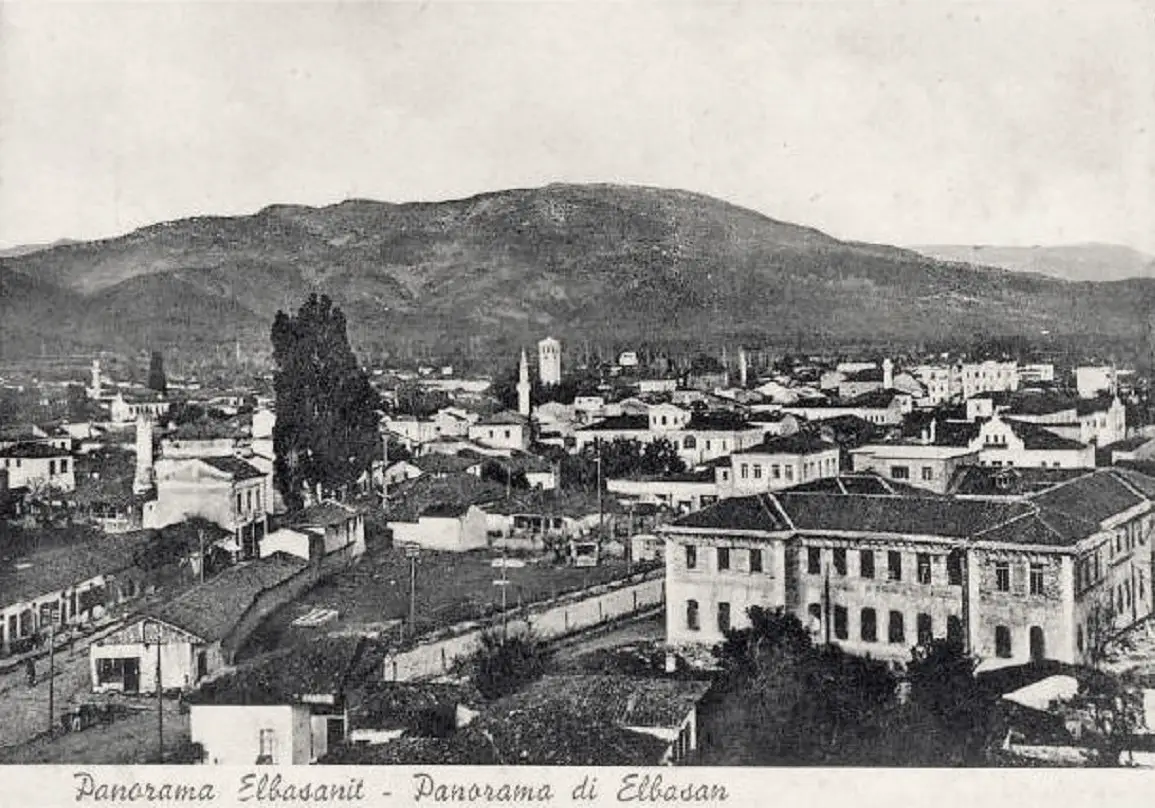


Memorie.al / The Bungo family from Elbasan is documented as early as the 14th century as one of the prominent land-owning families in Ottoman records. Generation after generation, they inherited a wealth that would be lost in a single year and never returned to them in the same measure.
Despite his great wealth, Demir Bungo did not align with the fascist regime, losing his position as a court secretary after refusing to join the Fascist Party. This made him a target for both the Fascists and later the Nazis. Nevertheless, he sheltered two Italians and saved them from Nazi pursuit. He endured internment in Porto Romano, was targeted by Gestapo officers, and miraculously survived. Demir Bey Bungo eventually joined the National Liberation Movement, which was no coincidence.
He was a son-in-law of the Baholli family – a family that for a long time sheltered Enver Hoxha and the General Staff at their estate in Labinot Mal. This connection existed because Nexhmije Hoxha was a cousin of this family. Yet, despite this connection and contribution, Demir Bey Bungo died in the Maliq prison-camp; one of his sons was imprisoned, while his other children were stripped of their property, expelled from school, and fired from their jobs.
Ferzilet, Demir Bey Bungo’s daughter, recounts the family’s hardships:
“My father was a chief secretary at the court in the early ’40s. He had studied at the ‘Normal’ school and, besides his inherited properties, worked in the administration. When Italy occupied Albania, he was fired for refusing to join the Fascist Party. He was later interned in Porto Romano alongside Aleks Buda and Abdyl Kongoli.
Even after returning from Porto Romano, he actively helped the Anti-Fascist Movement, sending medicine, food, and supplies to the partisans in Labinot Mal. During this time, he became a target for the Germans. A Gestapo colonel named Franz was hunting him, and the end in such cases was well-known: the concentration camps.”
Ms. Ferzilet, how did the Bungo family save the two Italians?
“Two of my father’s friends brought two Italians to be sheltered. Father hid them at our estate in Llixhë. Vincenzo Antonacci, one of them, visited our family only a few years ago, recalling with gratitude the family that saved his life.
We were constantly raided for two reasons: my father’s involvement in the National Liberation Movement and the sheltering of the Italians. There was a moment when my father had just arrived from Tirana. A sudden raid occurred. Father hid in the basement through a concealed entrance. He escaped by a hair’s breadth that day.”
What do you remember about your father’s contact with Enver Hoxha?
“Father was a son-in-law in the Baholli house, where the Movement – and especially Enver Hoxha – found refuge. I remember Enver trusted my father deeply; once, he asked him to find a loyal courier. Father found him Hyqmet Çoku, who became one of Enver’s most faithful messengers.
Father spoke freely with Enver. The Baholli family put everything at the service of the Movement, even their servants. Enver stayed at the Baholli estate in Labinot Mal for 14 months without moving at all.”
How did the relationship with Enver continue after the war?
“We had a close connection with Nexhmije; my mother’s father and Nexhmije’s father were first cousins. My mother and Nexhmije were second cousins. When the war ended, my father was unemployed. The land reforms began, and father was very dissatisfied as his properties were being seized. They wanted him to return as chief secretary of the court, but he refused.
He was against communism and favored a democratic power. He often said: ‘Communism is a utopia.’ Once, needing money for the family, he broke two gold coins. He gave them to a friend, but the friend was caught. The law on the confiscation of gold hadn’t been enacted yet, but father’s act was labeled ‘smuggling.’ He was arrested along with 80 others. They tortured him brutally to reveal the location of his gold. We had a safe with 2,000 gold coins and jewelry. They took everything but kept demanding more. They even imprisoned my mother to force her to reveal more gold. We were 7 children at home while mother was being tortured in prison. She was released after a few days.”
How was the Baholli family persecuted after the liberation?
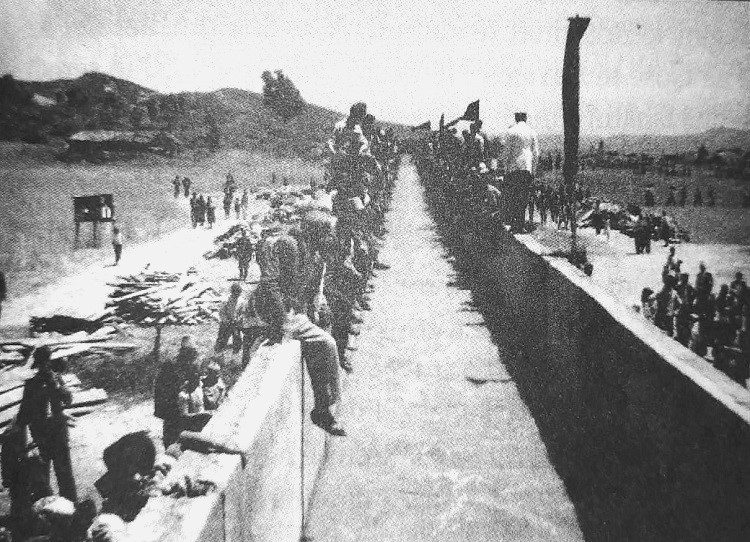
“My uncle, Nazmi Baholli, resigned and paid his taxes, but out of spite, they sent him to the Maliq prison-camp. His son, Sami Baholli – a close friend of Qemal Stafa – was a high-ranking official in the Presidium, yet his own father was sent to Maliq. The rest of the Baholli family was forgotten, despite protecting Enver Hoxha’s life.”
What was your father’s ultimate fate?
“My father never returned. He died in the Maliq prison-camp. We only found out recently through his criminal records that he had been granted ‘innocence’ – but only after his death.
They charged him with ‘Agitation and Propaganda’ just to seize his wealth. After his arrest, they took 3 houses, 8 shops, a bakery, fields, and olive groves. They even took our clothes. They stripped my brother of his pajamas because they hadn’t met the ‘quota’ of items they were ordered to seize from our home.”
How did the persecution continue for the children?
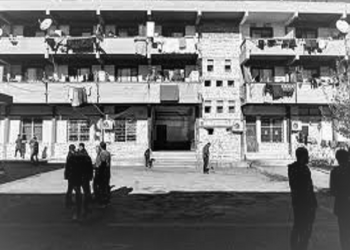
“We became teachers, but the class war continued. We lived in a single room lent to us by a neighbor, while a communist family moved into our house. The State Security (Sigurimi) targeted my brother Hysen with the absurd accusation: ‘You have praised Pele of Brazil.’ My brother was shocked and told them: ‘Go and accuse the newspaper Zëri i Popullit too, because they praised Pele as well!’ They arrested him during his military service. He served four years in prison. My other brother, Astrit, was fired. I was the only one working, but in remote areas under such harsh conditions that I am physically disabled today.
Once, my brother and I wrote a letter to Nexhmije Hoxha regarding our mother being stripped of her ‘Front’ membership card (a social death sentence at the time). Nexhmije sent an envoy who told my brother: ‘Your mother needs to be advised; she is hard-headed!’ My mother never lowered her head to ask for mercy. She worked with a pickaxe to raise seven children alone.”/Memorie.al