
From SAMI REPISHTI
Part Twenty-One
Sami Repishti: “In Albania, the crimes of the communist past have not been documented or punished, there has been no ‘spiritual cleansing,’ no conscientious confession and denunciation of the ordinary communist criminals!”
Under the Shade of Rozafa
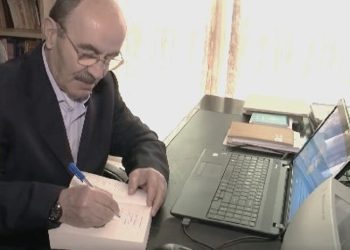
Memorie.al / During the 1930s and ’40s, with the unstoppable downpour of fascism and communism over Europe — sooner or later over the whole world – “fate” also turned its gaze toward the Albanian nation. Like all young people, I too found myself at a crossroads where I had to take a stand, even at the risk of my life. Then I said “no” to the dictatorship and set out on a road without end, a sailor on a wide, shoreless sea. That rebellious act almost killed me, but at the same time it freed me. I am an eyewitness to life in the fascist and communist hell in Albania – not as a “politician” or a “figure” of macro-politics, but as a student, as a young man who became conscious of his role at that time and in that place out of love for the homeland and a desire for freedom; simply, as a young man with heightened sensitivity, faithful to himself, to life with dignity.
Continued from the previous issue
XVII
On the last days of June 1948, the wake-up call did not sound. Many of us did not get up at all, glad for the rest from the crushing fatigue. Some tried to leave the barracks for personal needs, but the guard sent them back. Bewildered, we waited impatiently for any sign of change in the camp. Around noon, the camp gates opened and the director, accompanied by a dozen guards with sticks, ordered everyone out into the yard. After the usual lining up, he invited a brigade commander to read the daily newspaper aloud. Newspapers were not permitted in the camp. From time to time they held conferences before us whose gist was a string of accusations against “enemies of the people” and “Anglo-American imperialism.” But this time something went beyond the usual. From the headlines we understood everything.
“The Informburo Resolution” condemned the Yugoslav leaders for deviation and revisionism. For more than two hours, under the scorching sun of the Beden, unable to move, without bread or water, we listened with the greatest curiosity to every word, every line and every emphasis of the reader. For four consecutive years we had been bombarded, day and night, with “the great values of the unbreakable Albanian–Yugoslav friendship,” with “Tito’s Yugoslavia’s assistance,” with “the blood shed together in the fight against fascism,” etc.
Now it was the opposite. The change was so big and so sudden that we could not comprehend it. Was such a turn possible?! What would become of our communist Albania?! We returned to the barracks speechless, but with an indescribable joy! Speculation knew no bounds. Some began to prepare clothes, awaiting a quick release. Others hoped for a great “softening”…!
We all welcomed the change. Historically, Yugoslavia had posed a danger to our country. Kosovo was suffering under Serbia, Montenegro and Macedonia. Departure from Yugoslav domination was certainly desirable, but which path would communist Albania take?! The rupture of relations with Tito’s Yugoslavia had been the first blow that shook the new “faith.” The hopes of the past four years were broken, or at least cast into doubt.
As with any ideology that demands the complete surrender of the individual into the arms of the “collective,” the doubt that had entered was a deadly worm. In the absence of fundamental trust, the void created would be tried by the system’s self-destruction, had the red leaders not pulled from their secret cellars the appeal to traditional Albanian nationalism. “Proletarian internationalism” had failed!
Such a political stance, although it stroked the sentiment of the local majority, had no effect on the governing philosophy or practice of the communist leadership. We understood this! This government, in fact, was driven by narrow private interests, well served by the dictatorship of the proletariat. As a result, our initial illusions about a “turn” after breaking from Yugoslav domination in Albania’s political and economic life were quickly extinguished.
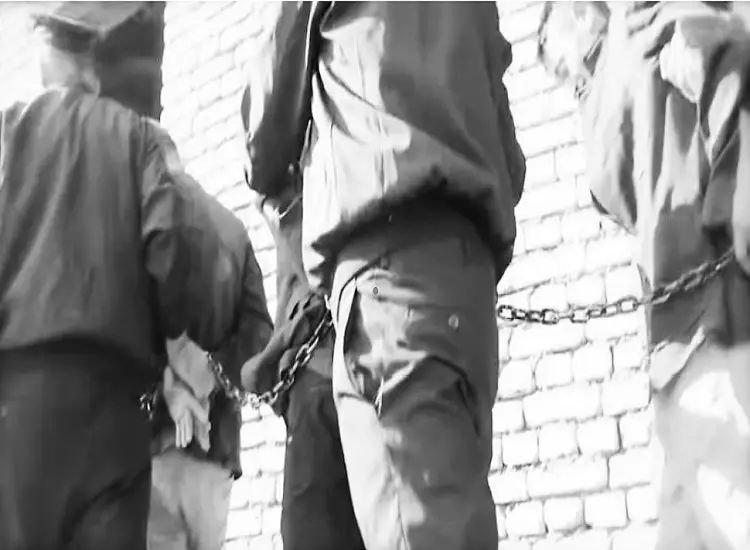
What remained were a short three-day interruption of work and the resumption of daily life with even greater harshness. The communist rulers’ fear of a strong Yugoslav intervention in Albania was felt even in our isolated camp. Guards became harsher, the director more aggressive, punishments more frequent and rations scarcer. The noose around our neck tightened day by day!
On Sundays we had a rest. Some of us were taken for various work chores requested by policemen and their families or for other occasional services. We would get up in the morning; take our ration of bread and tea, later the bulgur for lunch and bulgur for dinner. At dusk we would change within the barracks until the dawn of the next day. Sunday served us to wash body and clothes, whenever there was water.
Sometimes we would hang rags in the sun and shake off the dust. Free time was spent lying in bed to rest or in friendly conversations. Above all, we began to get to know one another, especially the group of students from the three prisons of Albania. With the greatest care, we began exchanging our thoughts honestly. For me, this revealed itself as a great victory.
After all that time I had the possibility to speak without fear that my trust would be abused by others. In this small circle of young idealists, gradually, a true friendship was forged based on mutual trust and shared political convictions that promised much for the future of the country and Albanian society. The chronic diseases of various ideologies — of religion, of region — which had caused so much harm in our country in the past, among us, had lost their specific value and remained only as troubling memories.
In prison, in camp, in shared suffering, the solidarity of the oppressed transcended the artificial dimensions of the “politics of the day,” and laid the foundations for building society on the human values of each of us as free individuals and citizens. In camp I became even more convinced that among us there was dough that would make a good future; there were citizens capable of forming a free society.
The spirit of solidarity that was born and our free exchange of ideas found expression in a kind of codification of our fledgling political “philosophy,” perhaps not well worked out, but certainly put on the right path. Our ideological and physical resistance against the dictatorship and its methods in Albania every day took on a broader meaning, a garment that was also its justification.
The very engagement against the scourge of poverty, oppression, disease, lack of education, injustice, the harmful phenomena of nature, unforeseen catastrophes — a heavy, unbearable, humiliating burden that destroys dignity and human welfare — took on a Promethean character, like a noble duel and an open-chested fight against the gods of evil: unthinking, base, vindictive and jealous of our courage. Under the red tyranny, man’s war against man was an act that, most unforgivably, broke this noble engagement; that war inevitably degenerated into repression, into death, into destruction.
The fiercer the regime of terror became, the more our conviction grew that Albanian communists would not forgive our opposition and that our life in prison would be prolonged forever with ever greater suffering. Because these youths languishing behind barbed wire represented, for the regime, the mirror of the Albanian conscience, the essence of an ideal the communists had betrayed, the symbol of the purity of thought and the purpose of the rebellious act. This imprisoned youth, like an uncontained sunbeam, blinded their closed, powerless eyes to see the world of crime, shaking their convictions to doubt.
Our persistent “no” was there, before the eyes of the dictatorship, a witness to the free spirit that refuses the unconditional surrender of slaves who never lift their heads! Sometimes, despite my brotherly love for the wretched like me, I felt a kind of joy without nobility when the torments were increased even more. In that state of revolt, I thought that these sufferings would one day explode into an uprising, because people would feel even more the heavy weight of a weakness born in each of us as a consequence of continuous subjugation and fear!
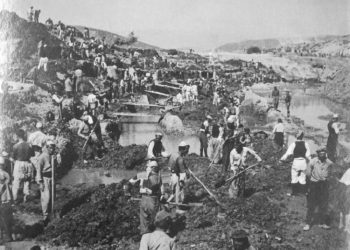
The length of the canal greatly increased the distance from the camp. On the return in the evening, the guards beat us with sticks to speed our step. The weak were always left behind. One evening a wretched man beside me fell, unable to walk further. I stopped. A strong arm lifted him to his feet. We carried him together on our shoulders to the camp. The sick man did not speak. We called the nurse who put him in the camp “hospital.” After dinner, my friend, a man from Vlora whom I befriended on the first meeting, and I went to the sick man.
He was freezing. We kissed the forehead of the victim whose name we did not know, and left. A few days later another unlucky man, of middle age and thin-bodied, was tortured by the guards who forced him to carry on his back a cart full of mud. He stood a little, his legs trembled, and finally he fell to his knees. The guards beat him. He did not make a sound. My friend from Vlora explained he had been a teacher at the Commercial School. “I will get to know him,” he promised me.
The next day we both visited the teacher resting in bed. He spoke slowly, but with a conviction that won me over. He was mature, knew the situation well and placed it with authority within the international context. I understood I had discovered a comrade of value, and I visited him often and willingly. Hermetically sealed within the camp’s barbed wire, the Vlora teacher opened a window for me from which the hope of a free tomorrow was born.
From the guards’ expressions we understood that the name Communist Party of Albania had changed to Party of Labour of Albania. Even as a premonition, this change affected me unexpectedly. This “Communist Party” which, for four years, had established the “dictatorship of the proletariat” in its harshest form could be called anything, shout any slogan it wanted, but it could not replace honest work.
Because there is immanent nobility in work that transcends the propaganda limits of dictatorship and which is unattainable by dictatorship. Work surpasses party, group, state. Within it there is something deeply human that belongs to every person, in every place and at every time. It is the honesty earned with sweat, the justification of individual loftiness as builder and creator, as long as it is free. Compulsory work is only slavery!
I looked at the little boy with white hair, as we called him Pirro, the sixteen-year-old from Korça whose father was in Burrel prison. Condemned for attempting to flee to Greece, little Pirro was the most beloved prisoner in the camp. The story of his life was unbelievable; the oppression practiced on his family was beyond earthly: all — parents and children — were in prisons or concentration camps.
I looked at the prematurely whitened hair of this young martyr at such an infantile age, and I could not believe that such dehumanization had an Albanian origin and that my Albanian people had fallen so low as to create such tragedies beyond the bounds of human possibility. Oh! For Pirro alone, the communist tyranny should be accused and punished! One day something happened that no one expected.
In an uncontrollable moment of revolt, Nimani, the man from Tropoja who had given me his coat to cover myself the first night in camp, slapped our brigadier in the face so hard that he was left speechless, motionless from the shock. In the midst of complete silence across the brigade, the brave man threatened: “If you report to the command, I will take your life!” No one made a sound. The brigadier looked around, lowered his head and left the barracks.
Again no sound, but the great silence was covered by a wave of general joy. The ice of fear had been broken. The brigadier who tortured us was no longer untouchable. The psychological effect of the slap could not be calculated. We felt that the iron wall surrounding us was not unbreakable. A new impetus of courage was born that emboldened us all to resist. The “slap” was the revelation of a spiritual impulse that arose from the victim’s boldness confronting the torturer. Such brave acts recompensed the long hours of humiliation and fear; they restored honor and dignity to the free human being now trampled.
XVIII
Night for me was a symbol of calm, rest and here, in the forced labor camp, also of regaining new strength. During the long months in the State Security cells, night was torture and torturers. For us victims, night was a co-conspirator, the right-hand of treachery, protector of evil, of moral disorientation, of crime. But here in camp night were the long hours between two hard days, two struggles against death.
Night was also the span of time that silently gave us the indescribable joy of being alone with ourselves; its darkness was the blessed hand that hid the faces of the executioners, the camp’s mud and the frame of death that surrounded us. Night offered us the chance to lay our crushed arms on our rags without being pelted with stones by the guards, the possibility to think eyes-closed, or wide-eyed to dream perhaps of others who were not in camp with us and who would see us again and treat us once more as “human.”
Night allowed us to hope to be free again. To be reborn? Is that little? What I dreamed of was to live again with my whole soul, body, every part of my being, the life of a free man — free like a tree green with pride in untouched forests, like a pine enjoying its own shade, like rain that falls without hindrance, like the breeze that gently caresses us, to be free as I desired with all my soul. “Krajli,” as we all called him among our closest comrades, was taken ill in the canal. He had long suffered from phlebitis in his right leg. They placed him on the mound of earth awaiting return to camp.
Carried on our shoulders in shifts, our group saved him from the police beatings. We sent him to the infirmary. The doctor told us he needed treatments he was unable to give. A few days later they pulled him out of the camp. “Krajli” was a young student like me who resisted the Security’s tortures with uncommon courage and was sentenced to five years imprisonment. Tall, agile in nature, warm-hearted, but very sociable, he enjoyed the sympathy of all the comrades. For us he was an irreplaceable friend who never lost his humor in the hardest days.
With the arrival of autumn, work on the canal became harder. Mud covered us on the road and at work. In the morning after the night’s rain, the earth was wet and heavy to transport. Meeting quotas became difficult and punishments, without bread or water, increased. The line of the unfortunate was long. Such a situation also created moral problems among others, because starving as we were; we had to share parts of our rationed bread with the condemned.
The hungry took bread from their mouths for those who risked death by starvation! Strangely, with this tightness of generations imposed on us, we found spiritual relief in the spirit of solidarity born among the miserable in camp. This spirit even frightened the “brigadiers,” who feared our anger. An unsanctioned way of life had formed, kept upright by the fear of both sides. Rainy days became more frequent and the need to finish the central canal was urgent.
The pressure from the police increased. Beatings grew frequent and the victims crushed by wood and labor returned on our shoulders each evening. Finally, working in the swamps became impossible. Water from the hills began to fill the canal and we were submerged up to our waists from morning until night. At the end of November work stopped. The prisoners emptied the camp and returned to the corresponding prisons to pass the winter. We were exhausted from fatigue and hungry. But we had survived!
In prison we found our sick comrades in even worse condition. Some had died. I looked for the old lawyer I used to talk with, but I could not find him. He had been released from prison. His seventeen-year-old son, Bardhoshi, was killed at the border in an attempt to escape to Yugoslavia. I had known the young enthusiastic student who had organized study groups in Shkodër high school for anti-government actions.
With all the shocks I had experienced since the early days of the red tyranny, when I read the long lists of executed people or heard, in the early morning hours, the dry crack of the machine gun, still, the killing of the young boy came like the final blow that shattered my belief in the “demonic” nature of my homeland!
After the killing of the boy and two of his peers of the same age, I began a process of self-criticism that led me to conclude that the soil where the trio of young martyrs had fallen was not worth their shed blood, and that the land that had become their grave could not be my homeland. From now on, for me, the homeland would be only the free place that nourishes and raises its youth, not the one that eats them alive like the villains of ancient tales. Oh, in your age, you seventeen-year-old brave boy now lifeless, the machine gun’s hail of bullets is not unleashed as it happens today in communist Albania!
Our prison was covered by hunger. Due to lack of organization, the prisoners did not receive their bread ration on the day of departure from the camp nor in prison on the day of arrival. The next day the bread came late, after lunch. We were tired and without food; the lack of bread for almost two days was the final blow. A feeling of fear that everything was done on purpose to measure our torture was widespread. Family visits were postponed for a week. Hope for food from family was extinguished.
Faces contorted by living suffering wandered through the prison rooms like aimless shadows. It was a dreadful scene. The guards were merciless, prison rules were very strict, and our ability to endure this hell on earth was weakened. Even winter days are long, endless, and unbearable in the dark rooms of our old prison, a building kept standing by constant repairs.
Bad weather, ceaseless rain, snow and freezing cold entering through the small always-open, glassless windows; the square yard within the high surrounding walls that closed the narrow slice of limited sky like a fist; the rooms from which nothing else was visible but the facing wall; the electric lights that went out constantly and were replaced by oil lamps where our pale faces could barely be seen; the great silence ruling because no one had anything to say; the faded looks fixed on the dusk of the yard; prisoners who slept, others who thought while most were unable to think at all — all hungry and almost all fed mainly on growing hatred, and the hope for revenge that kept them alive. /Memorie.al
Continued in the next issue.