

By AGRON ARANITASI
Part Three
THE TRUTHS I BELIEVE, THE FRENCH AGENT
Introduction
Memorie.al / When I began writing the book, “The Truths I Believe,” I had not intended to write about myself. The initial impulse arose when I encountered the State Security (Sigurimi) files regarding the surveillance of Citizen Agron Hajdar Aranitasi. Those files are further testimony of how someone could be persecuted when, at a certain moment; they were placed in the ranks of the “enemies of the people’s power.” Nothing was taken into account – not how he had worked, how he had behaved, or how he had lived. Not even the standing of his parents, brothers, and numerous cousins was considered; they automatically became subject to savage blows and suffered consequences through no fault of their own.
Continued from the previous issue
Chapter One: Family Origins
Liri Arapi (Aranitasi)
Liria was revolted and wrote to Manush Myftiu: “Who is he that seeks to shut the door of my house?!” As if she didn’t know! Only one man made the decisions. Surprisingly, Manush intervened (it is understood where!) and replied: “We will leave Vladimir in Tirana” (he was sent to work as a warehouseman in a trade enterprise). “As for Agron, do not ask me for anything!” As for Gëzim, who was expelled from the party but later reinstated as a candidate, Kurbnesh was deemed the most suitable place to redo his “probationary period” (stazhi)!
Surely, heavier blows were to come. Through people close to the family (such as Harilla Papajorgji), news was sent to her that “it would be best if Andi were taken by his father to Fushë-Arrëz.” Letters had arrived at the Central Committee of the Party, stating that: “Kadri Hazbiu’s nephew continued to study at the same school as Comrade Enver’s grandchildren.”
Liria fell seriously ill, spiraled into depression, and was hospitalized. I took Andi and Teuta with me to Fushë-Arrëz…! After she left the hospital and found her grandson and granddaughter gone, she told Hajdar: “If they treat small children like this, I will hand over my Party membership card.”
– “Shhh!-he shouted at her,-you will bring us all to ruin.”
-“Oh, but this is how it is, as I say,” she continued stubbornly.
Hajdar went to the Party Secretary of Region No. 1, Isak Shehu. He told him about Liria’s health condition (which was already known in Tirana). Isak advised him not to rush. He would speak to someone. “I don’t know where he spoke, but Isak told Liria that she could only take little Teuta,” Hajdar told me later. Andi, who had “dared to continue his studies in the same school as Comrade Enver’s grandchildren,” was not forgiven. He stayed with me for seven years in Fushë-Arrëz.
When he entered high school, Liria brought him back to Tirana and enrolled him in the “Qemal Stafa” school, even though the “Petro Nini Luarasi” school was closer to home. But the children of the “Bllok” (the leadership elite) studied there…! The internment of her son was another blow for Liria. But even heavier was the blow of his non-return after his internment ended. Nexhmije Hoxha, despite the intervention of Foto Çami, Hekuran Isai, and Pirro Kondi – who were prompted by Shefqet Peçi – issued a veto. And her veto could not be overridden. All these things broke Liria, and on April 30, 1991, she closed her eyes forever.
I told her story to clarify that, in that system, no one was safe outside the will of the “Number One.” Liria, an underground activist since age 19, a partisan and deputy company commissar at 20, one of the most well-known and educated women in the capital, elected to the leadership of the BGSH (Women’s Union of Albania) for many, many years, with a husband equally well-known in high party and military positions, could not be certain of her fate. People connected to her suffered, and she suffered too. It could not have happened otherwise. Such was the nature of the communist power, to whose victory her own rifle and that of her husband had contributed.
Hajdar Aranitasi
I searched for a long time for Hajdar Aranitasi’s files (work/personal and party/membership). The General State Archive gave me a negative response. His party file did not exist in the archive. This seemed strange to me. Hajdar Aranitasi had been elected twice as a candidate for the Central Committee (at the 4th and 5th Congresses) and Vice-Chairman of the Party Control and Audit Commission (at the 6th Congress). Based on the duties he had performed before 1961, and especially after that year, Hajdar Aranitasi had been part of the Politburo Nomenclature. Following this, I requested his work file. This too was unsuccessful. I turned to the Archive of the Ministry of Internal Affairs, since he had worked for nearly eight years (with an interruption between 1966–1972) in that ministry.
A file of about 30 pages was found. On its cover was written: People’s Republic of Albania. Ministry of People’s Defense. Surprising! The file belonged to the Ministry of Defense but was kept in the archive of the Ministry of Internal Affairs! As a rule, the work file should have contained nine service evaluations (karakteristika) for the period 1943 – May 1957, as stated in its summary list, but only six were found. There were two work evaluations, one from 1954 and one from 1955, when Hajdar was serving as a military attaché in Moscow.
There were no evaluations for the years 1956 and 1957. There was no evaluation for when he was appointed commissar of the Naval War Fleet (in Vlora). There was no evaluation for when he was appointed First Secretary of the Party Committee of the Ministry of Internal Affairs. There was no evaluation for when he went to work in the apparatus of the Central Committee. Why? At that time, things were not done this way! In his autobiography, he writes:
“I was born on July 15, 1918, in the village of Aranitas, Ballsh, Fier. I completed primary school in the village of Aranitas during 1930–1935. I finished the ‘unique’ school (8 years) in Korça. Also in Korça, during the years I served as a division commissar, I completed secondary school. I performed military service in the National Army from July 15, 1939, to September 20, 1941, as part of the ‘Gramozi’ battalion. In August 1942, I was promoted to sergeant in this battalion. I left the army and returned to Aranitas. From there, I joined the partisans. On December 15, 1942, I was part of the Skrapar Unit. Its commissar was my fellow villager, Ramiz Aranitasi. I married Liri Arapi, a party member since March 1943. I was personally accepted into the party in May 1943. My military service is recognized from February 1943.”
Hajdar Aranitasi’s Military Career
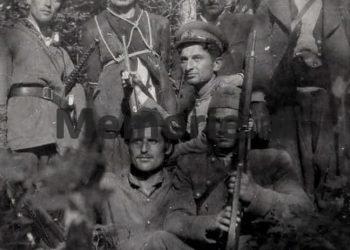
Initially a partisan, then a squad commander in the Skrapar battalion (February 1943). In July 1943, he was appointed commissar of the third company in the second battalion of Skrapar. In September 1943, he was appointed commissar of the “Petro Sota” battalion in the 3rd Mallakastra Group. From October 10, 1943, until September 9, 1944, he was a battalion commissar in the 5th Brigade. On September 9, he was dismissed from his post as commissar and served as a simple partisan until September 30. On September 30, 1944, he was appointed commander of the Discipline Battalion at the General Staff (the Discipline Battalion was the predecessor of the future Republican Guard – my note). In the period from November 30, 1944, to March 15, 1945, he was appointed deputy head of the Army Security Branch.
Between March 15 and May 10, 1945, he served as commander of the 3rd People’s Defense Brigade. From May 10, 1945, to February 15, 1946, he served as district commander in Korça. From February 15, 1946, to February 20, 1947, he served as commander of the 8th People’s Defense Regiment (based in Tirana). Between February 20 and December 12, 1947, he was at the disposal of the Ministry of People’s Defense. From December 12, 1947, to July 7, 1948, he studied at the Tank Academy in the Soviet Union. Due to health issues, he interrupted his studies and was assigned commander of the 11th Regiment (July 1947 – December 12, 1948). From December 12, 1948, to March 15, 1950, he served as commander of the 29th Regiment in the First Infantry Division. On March 15, 1950, he was appointed commissar of the 8th Division in Korça. He remained here until December 1953, when he received his appointment as Albania’s military attaché to the Soviet Union (December 1953 – September 19, 1957).
From September 20, 1957, to February 22, 1958, he worked as head of the Foreign Branch in the Ministry of People’s Defense. From February 22, 1958, to October 3, 1959, he served as commissar of the Naval War Fleet in Vlora. From that date until March 31, 1966, he worked as First Secretary of the Party Committee of the Ministry of Internal Affairs. On March 31, 1966, he was placed in the reserve and put at the disposal of the Central Committee apparatus. Between 1966 and January 15, 1971, he worked as an instructor in Hysni Kapo’s group, covering the Ministry of Defense and the Ministry of Interior. At his own request, due to health reasons, he asked to leave his post at the Central Committee. Hysni Kapo proposed that he return to the Party Committee of the Ministry of Interior, but since he and the Minister of Interior had become related by marriage (krushq), Hajdar Aranitasi declined.
He expressed a wish to serve as commissar at the High School for Officers of the Ministry of Interior. From January 16, 1971, until July 31, 1975, he worked as the commissar of this school. On July 31, 1975 (at age 57), he requested to retire (officers usually retired at 55). Even after retirement, he continued to work (without financial compensation) in the Party Control and Audit Commission. During his military service, he was decorated with 10 medals and orders. For his activity during the National Liberation War, he was awarded the “Medal of Remembrance,” the “Medal of Liberation,” the “Medal of Bravery,” the “Partisan Star Order” (Third Class), and the “Order of Bravery” (Third Class).
During his service in the People’s Army, he was awarded the “10th Anniversary of the Army Medal,” the “20th Anniversary of the Army Medal,” the “Order of the Red Star,” the “Order of Skanderbeg” (Third Class), and the “Order of Skanderbeg” (Second Class). In July 1950, he participated in the Army wargames with the 8th Division (Korça Division). In February 1951, he participated in the Division wargames (8th) in offensive maneuvers. In May 1952, he participated in the Division wargames (8th) with infantry troops. For the successful execution of these games, he was personally rewarded by the Supreme Commander, Enver Hoxha, with a wristwatch (Swiss made “Eberhard” – my note). In 1952, for merit in work, the Second Congress of the PPSH (Labor Party of Albania) gifted him a pair of binoculars. When Marshal Zhukov visited Albania (September 1957), he gifted Hajdar Aranitasi a pair of binoculars.
Service Evaluations for the period 1946–1957
From 1946 to 1957, there are 6 work evaluations (not 9, as stated in the file summary). The evaluations are good. He is described as: “A good fighter, brave, loyal, and determined for the party line. An element of sacrifice, both in war yesterday and in work today. Maintains good character and morals. Capable as a leader and commander for his unit. Possesses good combat skills regarding defense. Has some knowledge of military art. Remains oriented in critical moments. Has initiative and is quick in decision-making. Orders given to him and tasks entrusted to him have been performed well. Studies materials coming from the General Command and has mastered them. He transmits what he knows to his inferiors. He has not completed any military courses or schools. Politically and theoretically good, while general culture is not very high. Fits the current duty and has good conditions for development.” It is noted that he has poor health. It is also noted that he should be schooled.
In 1944, he was promoted to Second Captain. In 1947 (while serving as commander of the 8th People’s Defense Regiment), he held the rank of First Captain. In July 1948 (serving as commander of the 29th Regiment of the Ministry of People’s Defense), he held the rank of Major. In July 1951 (while serving as Division Commissar), he was promoted to Lieutenant Colonel. His work evaluation for this year is the best he had until then. It was signed by General Sadik Bekteshi. It stated: “He performs his duty well. He is conscientious. He has known how to organize work well and mobilize the political branch and party organizations to grasp key problems. He has assisted in their proper resolution. He is operational. He demands accountability and assists subordinates. His division took third place in the Army wargames. For this, he was rewarded by the Supreme Commander with a wristwatch. He is politically advanced. In political work exams, he received a grade of 5 (the highest). He is disciplined. Have good relations with superiors and subordinates. Needs schooling. His health is deteriorating.”
In November 1954, the head of the Personnel Directorate, Dilaver Poçi, proposed an out-of-turn promotion for Hajdar Aranitasi. He proposed he be given the rank of Colonel, although this rank was only due in July 1956. Dilaver wrote that: “Hajdar Aranitasi is an officer with tenure in the army. Loyal and honest. He faced difficulties during 1954 (first year in Moscow) due to a lack of work experience. He strives for his advancement and knowledge of the sector.” Hajdar would work in Moscow for four years. Ambassador Mihal Prifti, as seen from the work file, only provided two annual evaluations (there should have been four and one summary evaluation upon his transfer home). The evaluations are for 1954 and 1955. They are the worst evaluations in his entire file.
In the 1954 evaluation, it stated:
“Comrade Hajdar is an old party comrade. Politically advanced and clear. He was not accustomed to office work. He had difficulty acclimating to the nature of the work and the living conditions here in Moscow. Work difficulties make him irritable and skeptical…! Over time, things have improved. Now he knows and follows issues better. In Comrade Hajdar, a desire for independent work, outside of superior control, is noticeable. He is not totally mobilized at work, does not work with a plan, and often leaves things to spontaneity. This comes for several reasons. First, he says I will not always be a diplomat, this work is not for me, I won’t be in this sector permanently. He is convinced that as soon as his wife finishes her studies at the High Party School, they will return home (Strange – his wife would finish studies three years later, in July 1957 – my note).
Second, Hajdar is hindered in work by his poor health. Third, his wife attending school has caused all family chores to fall on him. He has three children who have their own concerns. One gets sick, then the other. The (Soviet) maid they have works only 8 hours. She spends her time shopping and cooking (Untrue – my note). His wife, Liria, lives at the school. She only goes home on Saturdays. These are the reasons why Comrade Hajdar is not fully connected to the work.” – Mihal Prifti. One is astonished by such an evaluation, in which Albania’s most important ambassador speaks like a malicious gossip. Simply to debunk Hajdar’s “troubles” with the children, I wish to state that the Aranitasi family, when they left for the Soviet Union, took with them a 60-year-old woman from the well-known Erebara family (Nadire Erebara). She stayed with the Aranitasi family until the end of 1956. It was she who cooked and cared for the “two boys and their concerns,” because the third, the youngest, was in a weekly kindergarten and only came home on Saturday nights.
The Soviet maid dealt with cleaning and checked on our school progress. We were doing very well in school. I had only one “4” (in Russian language) and “5s” in all other subjects. As for food, it wasn’t bought at the market but ordered at a specific shop, only for diplomats, and delivered home. Mihal Prifti did not like that Liri Aranitasi requested and won the right to higher education without going through him. Our relations with the Prifti family were cold. Liria did not like Mihal, and especially his wife, Sofia. From what I heard from Hajdar, these relations were influenced by the friendship of the Prifti couple with a senior Albanian officer studying at a military academy in the Soviet Union. He had become a regular at the Priftis’ home, while the Aranitasi couple had disliked him since the war. Furthermore, they had heard that the Prifti family friend aimed for the military attaché post. And Mihal supported this wish. The 1955 evaluation is better. It states:
“Hajdar has become better acquainted with the work of his sector and is more interested and careful than before. However, characteristic of Comrade Hajdar is a lack of continuity in organized work and constant mobilization. This is due to his health condition as well as his conviction that he is in this job temporarily (Here, someone has placed a question mark – my note). The lack of desire (this is also underlined and a question mark placed – my note) for full mobilization in work in Hajdar has also appeared in the work of the Party Committee. There has been a certain resistance from him in his activation in committee work. He says he is only interested in his own work. For this, he has been criticized by the superior. Relations with comrades are now good and normal.” / Memorie.al
Continued in the next issue
![“After the ’90s, when I was Chief of Personnel at the Berat Police Station, my colleague I.S. told me how they had once eavesdropped on me at the Malinati spring, where I had said about Enver [Hoxha]…”/ The testimony of the former political prisoner.](https://memorie.al/wp-content/uploads/2024/09/admin-ajax-4-350x250.jpg)