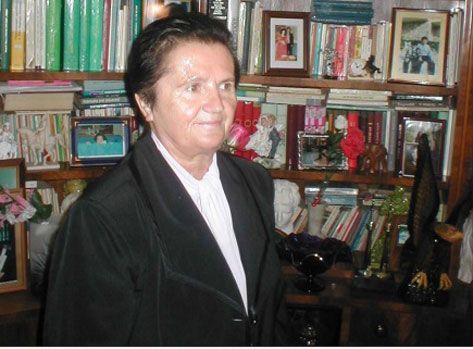
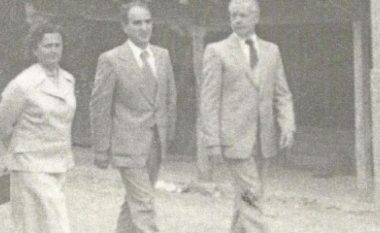
Memorie.al publishes Tefta Cami’s letter from November 1974, sent to Enver Hoxha and Hysni Kapo, where she denounced Haxhi Lleshi, claiming he was hiding behind several Dibra veterans who “sought to diminish the stature” of her father, the martyr Ahmet Cami. “Comrade Enver, I am now convinced that Comrade Haxhi Lleshi, behind my back, seeks to create opinions against me. I will forever be a soldier of the Party.”
Sometime around 1973–’74, on the occasion of the jubilee celebrations for the 30th anniversary of the formation of the National Liberation Army and the “liberation of the country from Nazi-Fascist occupiers” – festivities which were to be commemorated with great pomp and a magnificent military parade – instructions were issued by the Central Committee of the PPSH (Labor Party of Albania) in several districts to propose that certain martyrs of the Anti-Fascist National Liberation War be awarded the high title of “Hero of the People.” This typically occurred during jubilee anniversaries of Albania’s liberation or other holidays, primarily July 10th, the day the “People’s Army” was created.
In this context, during the 1973–’74 period, which also coincided with the inauguration of the Martyrs’ Cemetery in Tirana, orders were given for various districts to select martyrs whose remains would be transferred to the new cemetery in Tirana, where the “Mother Albania” monument had just been completed. Consequently, District Party Committees, in cooperation with veterans’ organizations, began selecting those who would be declared “Heroes of the People” and those whose remains would be moved to Tirana.
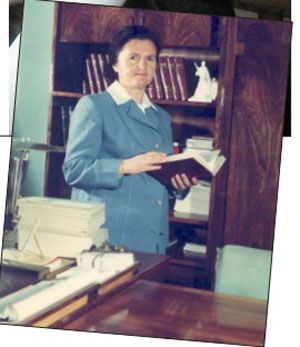
This process was not easy and began to create the first rifts and problems between different clans, not only within the War Veterans’ organizations but also among the leaders of the District Party Committees who made the final decisions. Such an event occurred in the Peshkopi district in 1973–’74, where the “bone of contention” was the martyr Ahmet Cami, father of Tefta Cami. Tefta was a young, highly emancipated woman from Dibra who, through her will and tireless work, had climbed the career ladder: from teacher to editor of the local newspaper “Oshëtima e Maleve” (Echo of the Mountains), head of the Women’s Organization, Secretary of the District Party Committee for Propaganda, and simultaneously a candidate member of the Central Committee of the PPSH.
Naturally, in all these high positions, she was greatly aided by being the “daughter of a martyr,” which was a tremendous advantage at the time for anyone aiming for a party or state career. Precisely when “Comrade Tefta Cami” held the post of Secretary for Propaganda, the newspaper “Oshëtima e Maleve”, which was under her direct supervision, published an article about her father, Ahmet Cami. He was the former commander of the Golloborda unit, who was said to have been wounded under unclear circumstances around October 1943 and died in the Tirana hospital on October 23, 1943.
Ahmet Cami, a scion of a renowned family from the village of Viçisht in Golloborda, had served as a military officer in several districts during King Zog’s Monarchy. During the Nazi-Fascist occupation, he had created and commanded the Golloborda partisan unit, which reportedly contained no communists, starting with Ahmet himself, who held nationalist views. Alongside this unit, the Dibra district also hosted the partisan unit, or as it was later known, the “Dibra Partisan Battalion,” commanded by Haxhi Lleshi – a figure of great popularity at the time, not only in the Dibra region but across northern Albania.
The difference between Haxhi Lleshi’s battalion and Ahmet Cami’s unit was that the latter had far fewer effectives and, as mentioned, no communists. Conversely, Haxhi Lleshi’s battalion included many communists and well-known names that later held posts as ministers or members of the Central Committee, such as: Sul Baholli, Rrahman Hanku, Rexhep Doda, Ahmet Jegeni, Ymer Lleshi, Xhavit Hatipi, Hilmi Çausholli, etc.
Some of these veterans did not welcome the article in “Oshëtima e Maleve” regarding Ahmet Cami. They reacted sharply, sending a letter to the First Secretary of the Peshkopi District Party Committee, Hekuran Isai, who had just replaced Sul Baholli. In their letter, these veterans from Dibra informed “Comrade Hekuran Isai” that the writing about Ahmet Cami contained many inaccuracies. More clearly, they viewed the article as propaganda conducted by his daughter, Tefta, through her subordinates, to “prepare the ground” for him to be declared a “Hero of the People.” This was unacceptable to them, as it diminished the stature and “war merits of Comrade Haxhi Lleshi.” They questioned: “What heroism did Ahmet Cami perform to be declared a ‘Hero of the People’?”
This was a clan war over “war merits,” which at the time translated into a “struggle for power and career.” In this context, the letter from the Dibra veterans – who lived and worked in Tirana and had been close comrades-in-arms of Haxhi Lleshi – infuriated Tefta Cami. She addressed a letter of complaint directly to Enver Hoxha, openly accusing Haxhi Lleshi of being the one hiding behind that letter. According to testimonies from prominent figures from Dibra, it is thought that Tefta Cami would not have dared to write such a letter complaining about Haxhi Lleshi without the support of a top leader like Hysni Kapo, to whom she also sent a copy.
This version is further supported by the fact that Tefta Cami also wrote to Manush Myftiu, First Secretary of the Tirana Party Committee, asking for the authors’ work to be analyzed within their party organizations in Tirana. Clearly, Tefta Cami had “prepared her case” well before sending the letter to Enver Hoxha, as Haxhi Lleshi then enjoyed Enver’s full confidence, and rising against him seemed like heresy or extreme audacity.
Enver Hoxha did not place any notes on Tefta Cami’s letter other than writing “for Comrade Hysni,” delegating the problem to him. While it is not exactly known how Hysni Kapo resolved it, subsequent events suggest a “middle ground” was found. Ahmet Cami was not approved as a “Hero of the People,” but Tefta Cami was brought to Tirana, first as a regional secretary and soon after as the Minister of Education and Culture and a member of the Central Committee.
Tefta Cami’s career continued to rise, while that of her “opponent,” Haxhi Lleshi, began to decline. Haxhi Lleshi’s clash with Enver occurred around 1977, coinciding with his divorce from his wife, Haxhire Jegeni. Haxhi Lleshi went to Enver’s Villa 31 late at night to explain the divorce. He told Enver that his wife had met her cousins (the Jegenis) who had come from Dibra e Madhe (Yugoslavia), whom Haxhi considered “Titoist agents.” When Haxhi told Enver that his wife had asked him: “What about the relatives who visited Comrade Nexhmije [Hoxha’s wife] a month ago from Yugoslavia, were they agents too?”, Enver was reportedly stunned.
Though Enver praised Haxhi’s loyalty that night, it marked the beginning of the end for Haxhi’s political career. A few years later, Enver removed him as Chairman of the Presidium of the People’s Assembly. Enver even sought to discredit him, writing in his diary: “Last night I called Haxhi, who in his old age has lost his mind…”
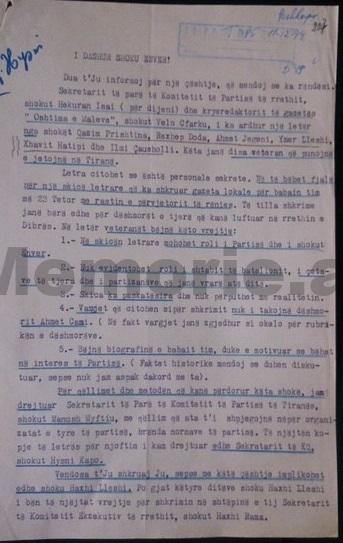
The following is the full letter from Tefta Cami, published exclusively for Memorie.al.
TEFTA CAMI’S LETTER TO ENVER HOXHA AND HYSNI KAPO
DEAR COMRADE ENVER,
I wish to inform you of a matter that I believe is of importance.
A letter has been sent to the First Secretary of the District Party Committee, Comrade Hekuran Isai (for information), and to the Editor-in-Chief of the newspaper “Oshëtima e Maleve”, Comrade Velo Cfarku, from Comrades Qazim Prishtina, Rexhep Doda, Ahmet Jegeni, Ymer Lleshi, Xhavit Hatipi, and Hilmi Çausholli. These are several veterans who work and live in Tirana.
The letter is cited as being personal and secret. In it, they write about a literary sketch the local newspaper published about my father on October 23rd, on the anniversary of his fall. Such writings have been done for other martyrs who fought in the Dibra district as well.
In the letter, the veterans make the following observations:
- The literary sketch denies the role of the Party and Comrade Enver.
- It fails to highlight the role of the battalion staff, other units, and other partisans killed that day.
- The sketch contains inaccuracies and does not correspond with reality.
- The verses quoted at the top of the article do not belong to the martyr, Ahmet Cami. (In fact, the verses were chosen as a header for the martyrs’ section).
- They provide a biography of my father, claiming it is done for the interest of the Party. (I believe historical facts should be discussed, as I do not agree with them at all).
Regarding the goals and methods used by these comrades, I have addressed the First Secretary of the Tirana District Party Committee, Comrade Manush Myftiu, so that they may explain themselves within their Party organizations, according to Party norms. I have sent the same copy of the letter, for notification, to the Secretary of the Central Committee, Comrade Hysni Kapo.
I decided to write to you because Comrade Haxhi Lleshi was also implicated in this matter. During these same days, Comrade Haxhi Lleshi made the same criticisms regarding the article to the Secretary of the District Executive Committee, Comrade Haxhi Rama, at his home.
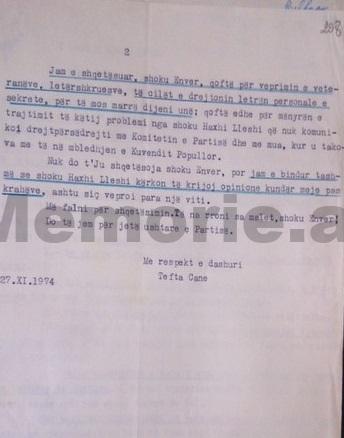
I am concerned, Comrade Enver, both by the action of the veterans, the letter-writers – who sent the letter as personal and secret so that I would not be informed – and by the handling of this problem by Comrade Haxhi Lleshi, who did not communicate directly with the Party Committee or with me when I met him at the meeting of the People’s Assembly.
I would not trouble you, Comrade Enver, but I am now convinced that Comrade Haxhi Lleshi seeks to create opinions against me behind my back, just as he did a year ago.
Forgive me for the trouble. May you live as long as the mountains, Comrade Enver./Memorie.al
I will forever be a soldier of the Party.
27.XI.1974
With respect and love,
Tefta Cami