

By Mërgim Korçë
Part One
Killing, According to the Code of the Mountains
– An Analytical View –
Memorie.al / Driven by the fact that throughout the dictatorship our ‘Code of the Mountains’ (Kanuni i Maleve) was so much maligned and attacked – and even more so, dragged through the mud – I decided to set myself the task of conducting an analytical study of it. My objective is to analyze it while avoiding, as much as I am able, all extremes; thus, not only by refusing to follow the example of the researchers of the communist dictatorship and taking a diametrically opposite path, but by striving to analyze the positions of the ‘Code’ with as much balance as I possibly can. In what follows, it will be noted, and subsequently clearly understood, why – despite being the son of a man from Korça and a woman from Gjirokastra – I feel the need, while treating a subject fundamentally concerned with how the norms of ethics and morality were regulated among the highlanders of the Northern regions, to address the readers in the Gheg dialect!
In order for the reader of these lines to understand my spiritual state, the emotions I feel, as well as the pleasure I derive from the opportunity to bring some of my early youth memories to the press, you must forgive me… but you must return with me over sixty years back in time!
Weeks had passed where I went to sleep and woke in the morning with the fixed thought of when my late Father would decide for us to go to Orosh, to the Tower of the Gjomarkajs, where we had been invited, with their customary generosity, Father and Son – by the Captain of Mirdita, Gjoni, and his son, Mark Gjomarkaj.
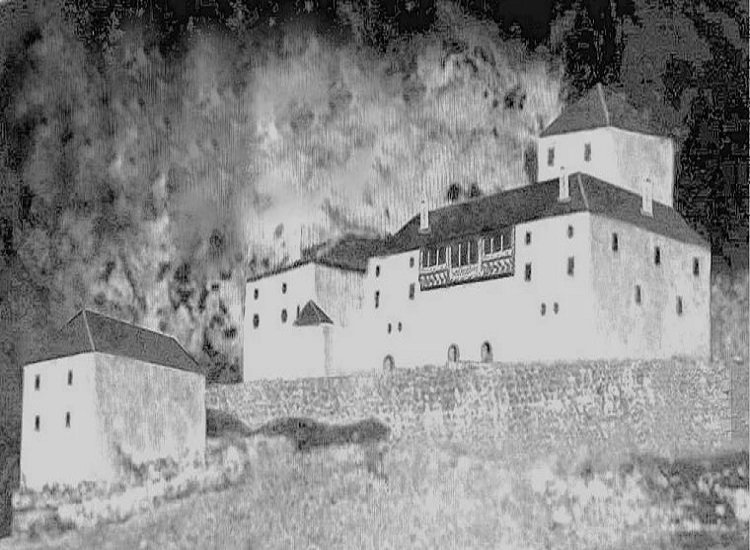
And one beautiful spring day, that day arrived! I will not dwell on describing how we traveled by car to Milot and then, (where Uncle Mark stopped to change into Mirdita attire), we mounted horses… and rode straight to Orosh. Nor will I stop to describe the stone Tower of the Markagjons, built upon a hill crest – a structure which, without anyone telling you, presented itself through its majesty, revealing what it was and to whom it belonged!
I described all of this fleetingly with the sole dual purpose that the reader, who honors me today by reading this analysis, understands that I truly have reason to feel deeply moved spiritually. On the other hand, I wish to show that my interest in understanding and interpreting the ‘Code of the Mountains’ found its initial spark during the discussions held between my Father and Captain Gjoni, as well as his son, Mark (who was a profound and subtle expert and interpreter of the ‘Code’ on that occasion and in the years that followed).
Along this path, I cannot fail to emphasize a fact which gains importance for the very subject being treated: Captain Mark was a graduate in Jurisprudence – thus, he was a specialist in the field of justice and law – and in him, the knowledge of customs and traditions, kneaded through the articles of the Code with the leaven of centuries of folk experience, was intertwined with the perspective and judgment of a jurist.
I made this introduction for the two reasons I explained at the beginning; that is clear. But on the other hand, although only two nights were spent in Orosh, the discussions of those two nights ignited my imagination, and consequently, whenever issues of the Code were discussed among the Gjomarkajs, Mustafa Merlika, Monsignor Luigj Bumçi, and other friends of my Father, I was all ears!
Thus, my fortune to have heard those conversations first-hand from experts of the ‘Code’ – and naturally, later reading and re-reading the ‘Code’ over the years with an increasingly mature judgment – leads me today to raise several issues regarding it, which I have been mulling over for years, even decades. To analyze it extensively and leave no “i” undotted is clearly beyond the scope of a newspaper article, not to mention perhaps beyond the scope of my own knowledge.
However, having had the luck to hear judgments regarding the ‘Code’ from the mouths of some of the most prominent personalities in the field of culture in general, and the ‘Code’ in particular, I believe it would stir some interest to highlight first the dialectic of presenting the problems, and then the broadening of the horizon offered to the reader by presenting how those intellectuals interpreted the cardinal points of the ‘Code’. Drawing now from the experience of those lessons, I am trying, together with the reader, to enter into some reasonings and draw some conclusions that may pave the way for us to find a common denominator to judge the Code without prejudice.
It is clear that during the period of the dictatorship, the ‘Code’ was treated as the bearer of all the evils of that world, and was even reduced in explanation as if the ‘Code’ in its entirety was nothing more than a code of blood vengeance. This void of knowledge, as well as entirely one-sided, truncated, and malicious information, could not have failed to influence later generations, who are not to blame for being so educated in schools and universities; thus, today, whenever two traffickers or ordinary thieves are killed, newspapers title their sensational articles in capital letters: “Three people killed in Shkodër. The ‘Code’ has acted once again!”
On the other hand, the specialists in the field of Civil or Criminal Law, who during the decades of the dictatorship had obtained their academic titles as if by deed, today remain silent (and they do well to remain silent), while there is a certain breed that even today wishes to present themselves as supposed specialists in the field of the ‘Code.’ For heaven’s sake, were those decades of preaching and judging based on communist morality not enough, that even today, when speaking of the ‘Code,’ you continue to propagate how the National-Liberation Councils had as their primary aim the reconciliation of blood feuds?! And who, may I ask, reconciled the feuds – the communists who ignited the civil war?! Those who, through assassinations, murdered and disappeared the prominent people of our nation?
Never mind that those who were not murdered by assassination were executed by the so-called People’s Courts! Was this the reconciliation of blood feuds, in contradiction with the ‘Code’? Or was the “Hakmarrja” (Vengeance) Battalion created to reconcile feuds? These same specialists even today claim that the ‘Code’ trampled upon the rights of women! Agreed. We accept this for a moment. But I ask these gentlemen: did the ‘Code’ operate in the early Middle Ages, or in the twenty-first century?
How is it then that, through the lens of today’s judgment, we wish to condemn the ‘Code’? And along this path, I am bringing a comparison to provoke some thought in the reader. I believe everyone considers the Roman legal tradition – renowned throughout the world with the Code of Justinian from the year 529 (AD), known as ‘Corpus Juris Civilis,’ continued by the Bolognese legal school of the famous Irnerio in the year 1100 (AD) – as the precursor to modern Italian justice. Is that not so?
Yet, does it not seem serious when I state that Italian women gained the right to vote no earlier than the year 1925?! And if this were the most unsightly mark in the treatment of women within the bosom of a civilized nation, it would be only half the evil! But there is even more to consider: a country like Switzerland, where 80 years ago the League of Nations had its headquarters -which was supposed to resolve the rights of peoples across the globe – gave women the right to vote no earlier than the year 1972?! Thus, without wishing to go deeper into such arguments, I brought these forth so that when the ‘Code’ is judged, we may be as grounded as possible.
Another problem that must be addressed is that of the category of younger researchers – yet still the scions of those communist jurists – who, educated in the West (where only they were able to go), must understand that the ‘Code’ should not be an object of derision in itself, but on the contrary, its good and highly positive aspects for its time must be highlighted, for in this way we honor our Nation. And here begins their failing.
On one hand, they cannot help but be influenced by the pressure of their parents, who burned the ‘Code’ at the stake; and on the other hand, having no possibility of contacting those Albanian intellectuals who knew the ‘Code’ fundamentally, they fill the half-century void by listening – in an entirely Pindaric manner – to assertions or considerations from people who have mostly only heard of the ‘Code,’ or by collaborating with Western authors who viewed the ‘Code’ with the eyes of idyllic dreamers, seeing in its practice during the late 19th and early 20th centuries their own customary codes – such as England’s Magna Carta, signed by King John Lackland in 1215, a document recognized as the very foundation of Anglo-Saxon Common Law!
To support this view of mine, I will bring an example. Colonel Oakley Hill, the organizer of the Albanian Gendarmerie during the years of the Monarchy, told my brother in Athens, in 1953, that his dream had been, upon retiring, to buy some sheep and a ram and spend his life wandering through the Highlands of Albania! My brother took this statement from Colonel Hill with reserve, calling it a sign of typical British politeness.
However, years passed. Finding himself in London on business, my brother sought to meet the Colonel, but he had since passed away. He then paid a condolatory visit to the Colonel’s wife, and she, in conversation, wishing to show her Albanian guest how spiritually connected her husband had been to Albania and the Albanians… revealed once again to my brother that unfulfilled dream of the late Colonel Oakley Hill!
I brought this typical example to show that the analysis of the ‘Code’ through the lens of Western well-wishers is far from the Albanian reality of even that time, let alone judging it for more ancient periods. The evil then deepens even further when the Albanian researchers I mentioned above, in order to be objective, cite foreign researchers and even collaborate with them on works regarding the ‘Code,’ where the lack of knowledge of the latter regarding the history of the environment of our Highlands (let alone the mentality of our highlander through the centuries) leads them to compare our ‘Code,’ for its severity, with the Code of Hammurabi of 1700 (BC), where the penal condition was distinguished by: “an eye for an eye and a tooth for a tooth”!
Along this path, I am taking two typical examples, the judgment of which will clarify my position in what follows. I assert that studies and analyses in all fields, and especially in the field of the ‘Code,’ should be welcomed, and we should also strive not to be influenced at all (within our possibilities) by prejudices against their authors. This would be the criterion closest to the truth that is sought.
I will now concretize this position of mine. As far as having no prejudice on my part, I personally would wish for a Prof. Ismet Elezi (regardless of the fact that he was the head of the Legal College of the Prime Ministry during the time of the communist dictatorship), or anyone of his rank, with their technical experience and the expansion of their field of knowledge gained for decades in the field of law and sociology, to analyze the ‘Code’ by forgetting communist prejudices.
This would be a great step forward in the implementation of my view: that what is not known can never be praised, nor can the value of a thing that is unknown be highlighted. Therefore, I highly value the competence of this category of professors. Likewise, it should be valued when Prof. Ismet Elezi himself is forced to admit that his writings were permeated by citations of political and ideological content as long as politics and ideology were dominant. He also admits that his views and thoughts from that time (he speaks of the time of the dictatorship) should be re-evaluated.
Up to this point, I am in full agreement that the professor in question should not only not be prejudiced, but welcomed with his studies. But the trouble is that those views and ideas have infiltrated the blood of him and his colleagues, and he goes where he goes – and not only during the dictatorship, when he and his colleagues followed the line, but even today they continue to speak with the same old convictions, which they do not even accept to re-evaluate.
Specifically, even today Prof. Ismet Elezi continues to hit the nail on the head by mentioning how the Resolution of the Peza Conference envisioned the reconciliation of blood feuds, or brings up the taboo of the National-Liberation Councils regarding their struggle determined to reconcile feuds! While the esteemed professor continues to believe in what he mentions today, and does not see that those councils and that so-called anti-fascist struggle led to the civil war, merely to take power into their hands, he proves without the slightest doubt that he continues to be indoctrinated and cannot judge the ‘Code’ impartially.
He speaks of the Peza Conference and National-Liberation Councils, but he has never delved into analyzing that in Peza the influence of Abaz Kupi and his associates still persisted – let alone later, when all the balanced members of the National-Liberation Movement, such as Riza Dani, Sheh Karbunara, Dr. Enver Sazani, and Shefqet Beja with their associates, were executed as traitors! Thus, that war which began camouflaged as National-Liberation was precisely a civil war for the seizure of power, and subsequently, a period of fierce violence within the same kind, merely for the maintenance of power!
We move to the second case. It is true that a scion of the community that burned the ‘Code’ in the fire is also Mr. Fatos Tarifa, Ph.D. But his good will to study the ‘Code’ in general, and also blood vengeance according to the ‘Code’ in a specific way – researching as much as he could about it – I cannot but call a good and valuable beginning. Without going into details, only a priori, I am convinced that this researcher is less indoctrinated than Prof. Ismet Elezi.
Thus, regardless of the fact that he too served as a professor of Political Science, I am very much in agreement that, if he has the will and desire to cast aside prejudices, he would be a much more impartial researcher of the ‘Code’ than Prof. Ismet Elezi and his colleagues. This is a small point, but certain.
We come now to the heart of the matter. Regarding Mr. Tarifa, I pose the problem as follows: Mr. Tarifa has published writing as part of collaboration with Prof. Jay Weinstein for a volume about the ‘Code.’ He begins his writing by citing the foreign researcher John Scriven, who puts forward the thesis that; the highlanders, when they had no one to fight, fought among themselves. Or he continues by citing J.J. Hutton, who stated that the Albanians of the Northern Highlands are proud of their self-isolation.
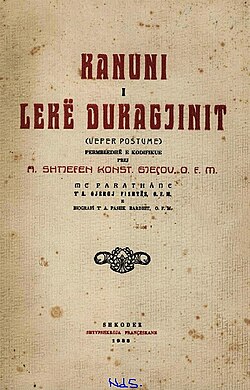
Then he continues with the neo-Malthusian theory of Carleton Coon, and thus no fewer than 18 foreign authors are cited. Agreed. I sincerely state that I value the effort of Mr. Tarifa to research the ‘Code’ and what foreigners have said about it. But a genuine and impartial researcher, who wishes to avoid the prejudicial influences with which his past tries to cloud his subconscious, I cannot accept that among Albanians, he refers only to one researcher, now deceased – Father Gjeçovi.
Firstly, the late collector of the ‘Code’ has been gone for almost 80 years. His manuscripts -without wishing to make any negative allusions toward them – were held for over five years without being published, and thus the Father himself never had the chance to distinguish what he had written himself and what was put in his mouth after publication! Here for me is the crossroads with Mr. Tarifa.
Doubt arises within me regarding the sincerity of the esteemed researcher: is it possible for him to renounce the past ideology that kneaded and formed him, and join in an impartial investigation of the problems of that unwritten Constitution which regulated for centuries the lives of the inhabitants of our heroic northern lands, and which was called the ‘Code of the Mountains’? I materialize my doubt, which I hope is mistaken. Mr. Tarifa cannot fail to know that to give a balanced judgment about something; both the “pros” and the “cons” must be heard.
Being forced to rely only on the assertions of foreigners in judgments given about the ‘Code,’ and also only on what Father Gjeçovi left written – how did it not occur to him to meet in person in New York with the man who is called the greatest expert in the field of customary law, Captain Ndue Gjomarkaj? Captain Ndoja, for better or worse, is the scion of Captain Gjon Markagjoni. His life experience in general, and certainly regarding the ‘Code’ in particular, is very broad and extensive. / Memorie.al
To be continued in the next issue