
Part Two
Memorie.al / Jusuf Gërvalla: “In the summer of 1966, when a naive part of Albanians residing in Yugoslavia had begun to believe that with Ranković’s fall all evils had ceased, the Party of Labour of Albania issued a detailed analysis that showed the opposite. The article we are presenting here has lost none of its relevance even today. On the contrary, it also applies to the current situation in Kosovo and the other Albanian territories occupied by Yugoslavia.” (Note: The tortures of Shefqet Jashari took place in 1980, at the time when Jusuf Gërvalla prepared this article for republication – (Xh. D.))
Continued from the previous issue
Who answers for the crimes of genocide in Kosovo?
Article from “Zëri i popullit”, 31 August 1966
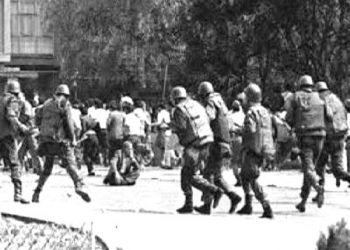
Let them take the testimony of another emigrant, Xhem Zek Haxhija, from the village of Bogë in Rugova – Pejë: “In January 1956, the UDB officers of the Pejë district, Bogolub Radić and Vlado Dazhić, gathered 65 men in the village shop for a day and began torturing us. The tortures and humiliations by the UDB were not inflicted only on us men, but also on Albanian women – something that neither the sultans of Turkey nor the kings of Serbia and Montenegro were able to do in our highlands.” There are many such testimonies about the barbaric atrocities of the Titoist criminals. Hundreds of people died in the hands of the UDB executioners, during torture or a few days later. Many others, unable to withstand torture a second or third time, tragically ended their lives by killing themselves, drowning, slashing their throats, throwing themselves into wells, rivers, etc.
Meanwhile, thousands remained maimed and incapacitated for work, some of whom died after many years, some went mad, and some still suffer today from wounds inflicted back then. And to put a lid on their executioner‑like activity, the Yugoslav authorities issued a categorical order that Albanians maimed during the tortures of 1955‑1956 should under no circumstances be admitted to hospitals for treatment. Albanian prisoners held in Titoist prisons live in inhuman conditions. In Niš prison alone there are over 2,000 Albanian prisoners. Likewise, in Sremska Mitrovica prison, which is also a central prison, there are over 700 prisoners, one‑third of who are of Albanian nationality. Meanwhile, half of those convicted on political charges in Srem are Albanians.
The Titoists have turned the Albanian regions of Yugoslavia into prisons and concentration camps for mass extermination. Evidence of this is the prisons in Niš and Srem, in Idrizovo in Macedonia, in Prishtina, in Gjurakovc, in Suhareka, on Goli Otok, etc. Everywhere, Albanians in Yugoslavia live with the fear of uncertainty about tomorrow. Death hangs over their heads like the sword of Damocles. One prisoner recalls with horror: “I have seen all kinds of crimes against Albanians,” he says. “I have seen crimes where they slit a man’s throat like a lamb. But what I saw one day in Prishtina prison I cannot describe. Even now I am horrified when I think of those crimes and fear grips me. There were three Albanians in the prison. One of them had been cut to pieces; the other two were alive, but one had his arms and legs broken, while the other had an ear cut off, an eye gouged out, and one side of his moustache cut off together with his lip.”
– The prisons of Yugoslavia, especially in Kosovo, have been equipped with the latest modern techniques. They are fitted with refrigeration chambers and heating chambers. Arrested persons are taken naked into the refrigeration chamber at a temperature many degrees below zero and kept there for two to three hours straight. Then they are immediately taken into the heating chamber, where the temperature is above 30 degrees. This abrupt temperature change destroys the human organism. This torture is intended to ruin people’s health and break their will to accept unfounded charges and to be placed in the service of the Titoists. Such chambers exist in Prishtina, Niš, and Idrizovo prisons.
Doesn’t such treatment of Albanian prisoners in Titoist prisons remind you of the treatment of anti‑fascists in the Nazi concentration camps?
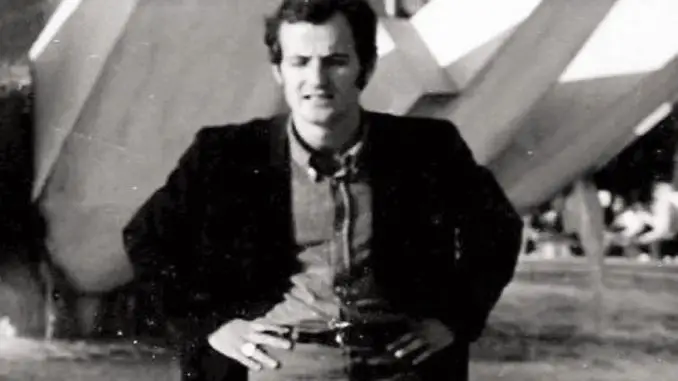
And it could not be otherwise, since the director of Niš prison held the same position during the time of the king and the German occupiers, and now under the Titoists. Likewise, the director of Srem prison is known as a Chetnik and a professional killer and torturer. In such prisons suffer persecution the most brutal: the Kosovar patriot writer Adem Demaçi, Adem Demaçi: “I met Jusuf after my first release from prison. He was connected with us…! Jusuf Gërvalla remained undiscovered. Some groups also remained undiscovered, because we did everything possible to maintain conspiracy. Jusuf’s group was like that. I knew Jusuf, I knew Bardh.” The patriots Ramadan Shala, Selajdin Daci, Shefqet Deçani and hundreds of other patriots, who together with the Albanian people of Kosovo, the Dukagjin Plain, Macedonia and Montenegro, have not submitted and will never submit to Tito’s yoke, the exterminating violence, national discrimination and genocide that have been elevated into a state system by the Titoist regime.
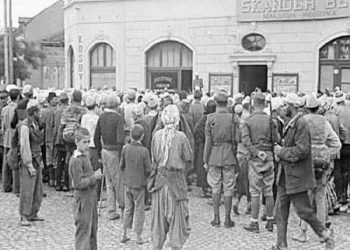
Only seven days after the Brioni “turnaround”, the worker Hamit Fejzulla Sollova from Vučitrn managed to escape from the Titoist hell and come to Albania, but with his jaws shattered and bruised from the tortures of the Budva UDB. He was beaten in an inhuman way by seven Titoist agents simply because, after the exhausting day’s work, during the lunch break in the shade of a park, he was singing a song in his mother tongue together with two other comrades! That was enough for the UDB men to beat him badly, break his jaws and throw him onto the main road. Hundreds of such cases occur even today. We ask: Who answers for these terrible crimes of genocide that for decades have been systematically committed by the Titoist regime against the Albanian population in Yugoslavia? Is it only Ranković and his UDB gang? No. For these and other crimes, not only the principal executors, not only the servants, but first and foremost their master in crime, the executioner Tito, and his entire criminal gang must answer.
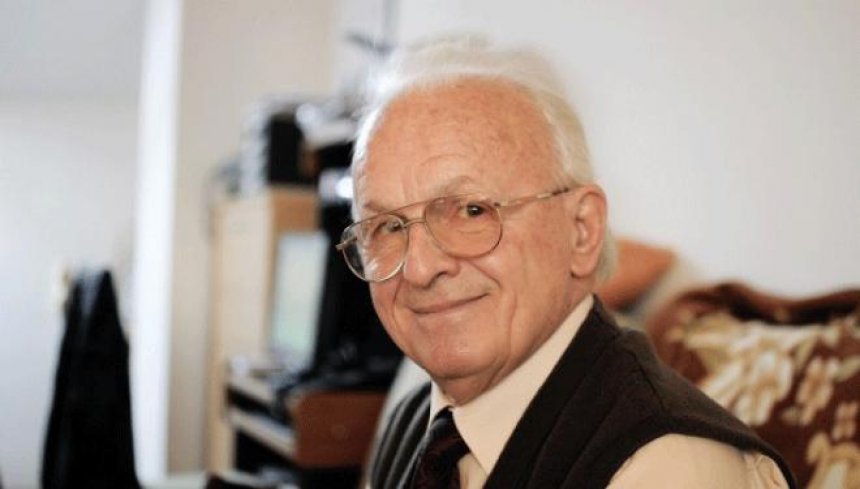
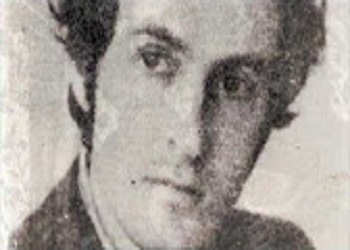
Shefqet Jashari: “The investigation lasted 7‑8 months. It is difficult to name all the investigators who took part in the mistreatment. Especially ruthless were Asllan Sllamniku, Slavković, and a certain Muharrem. I also had the chance to meet Abdullah Prapashtica, who watched the ruthless Asllan
Sllamniku beating my legs with a whip.” One of the aspects and objectives of the general line of national policy of Tito’s clique, besides killings and mass crimes, has been and remains the denationalisation of the Albanian population of Yugoslavia in every way and by every means. To this end, they have combined administrative measures and police terror with intensive propaganda activity, aimed at and expressed by suffocating the patriotic spirit, denying autochthony (“in your lands you are newcomers, therefore you must leave here”), marginalising the Albanian masses from political life and denying their national demands, misleading and degenerating them with religious “opium”, and inflaming hostilities and fratricidal strife according to the imperialist principle of “divide and rule”.
During the last decade, Titoist propaganda has tried by all means to “argue” and justify the violent “integration” of the Albanian masses into Serbian, Macedonian and Montenegrin ethnic groups, the supposedly “voluntary” relocation of Albanians to foreign countries, attempts to change place names from Albanian to Slavic, the forced Turkification of Albanians, and, under the pressure of economic deprivations, the absorption of Albanians into the depths of Yugoslavia. The slogan of “freedom to live where you want” and “to call yourself what you want” essentially constitutes the political‑economic imposition on Albanians to leave their homeland and live in the remote depths of Yugoslavia, or to emigrate to Italy, Austria, West Germany, etc., as slaves of monopoly capital. For the Titoists, any means is suitable to achieve the goal.
It is no coincidence that Đoko Pajković, a member of the Central Committee of the League of Communists of Yugoslavia, former secretary of the LCY for Kosovo, proclaimed as an official compulsory line the “freedom” for Albanians to deny their nationality. In the 2nd session of the 3rd legislature of the Provincial Council of Kosovo, he said, making an open allusion to Turkification, or better put, the denationalisation of Albanians, the following: “No one can stop me from going to a Turkish school if I myself want to… That is my freedom; I can be a Serb, a Turk, an American, who knows what.” The cosmopolitanism of the revisionists knows no bounds, but this cosmopolitanism is expressed in a very specific direction: to deny Albanians, under the so‑called freedom to “choose” any other nationality, the right to be Albanian.
In the economic field, the Titoists, in order to force the Albanian masses to relocate into the depths of Yugoslav territory, widely use economic pressure and very heavy taxes. All Albanian regions in Yugoslavia are economically very backward, since all the main industrial facilities are concentrated mostly in Serbia, Croatia and Slovenia. In Kosovo, the Dukagjin Plain and the other Albanian regions, the Titoist authorities have given importance only to those economic sectors through which they can exploit the great wealth of these regions, and they send this wealth to the interior or to the West, causing impoverishment among the Albanian masses. With such methods of typical colonialist exploitation, they operate in the rich mines of Trepča, Deva, Goleš, etc. In these mines, the administrative and specialist staff is Serb‑Macedonian and Montenegrin.
If you look for an Albanian in these mines, you will find him in the category of unskilled worker. Even in the few industrial facilities, the Slavic element dominates, e.g., out of 400 workers in the tobacco factory in Gjilan, only 90 are Albanians. The regions inhabited by Albanians have been turned into colonies that are intensively exploited by Serbs, Montenegrins and Macedonians. Unemployment rises rapidly. Regarding this, Slobodan Penezić stated clearly in Prishtina: “Despite the progress, unemployment is not being solved; it is necessary for workers to go to other regions.” Later, Dušan Mugoša, as then secretary of the League of Communists of Kosovo, openly declared: “We are still not able to provide employment for a large number of people. Every year, around 7,000 inhabitants of this province (Kosovo) go to seek work in other parts of the country, outside Kosovo and Metohija.”
Meanwhile, each year 14,000 new labour hands are added to the army of the unemployed. This phenomenon continued later at the same pace. On 20 August 1966, Tanjug reported that at a meeting of the Executive Council of Kosovo and Metohija it was established that “the number of people being employed in this province is increasingly decreasing, and the possibilities for employing new workers are also constantly diminishing. According to statistical data, at the end of May this year there were 5,000 fewer workers employed than in May of the previous year.”
Under these circumstances, relocations into the depths of Yugoslavia currently constitute the main form of denationalisation of the Albanian regions. Consequently, from 1958 to this day, tens of thousands of Albanian inhabitants have been relocated to the northern regions of Yugoslavia, to Vojvodina, to Croatia, to Slovenia, in addition to the fact that, according to press statements, more than 250,000 Albanians from Yugoslavia have so far been forced to abandon their homeland for Turkey.
The fierce Greater Serbian and anti‑Albanian chauvinism of the Titoists has also manifested itself in the field of education and culture. The Albanian people in Yugoslavia are convinced by their long experience that the current manoeuvres of Tito’s clique, regardless of the “sweet” words, regardless of the masks, have only one aim: to strengthen the shaken power of the Titoist clique, to strengthen national oppression, exploitation and denationalisation of Kosovo. For the Albanian people in Yugoslavia, as for all the oppressed peoples of Yugoslavia, the deep crisis that has struck Tito’s clique is something that was to be expected; it is an unavoidable consequence of the very antagonistic contradictions that have been simmering for years within the gang of renegades. But the bitter experience of many years under the cruel rule of Tito’s gang has made the Albanian people of Kosovo, the Dukagjin Plain, Macedonia and Montenegro vigilant, to open their eyes and be on guard so as not to be deceived by the demagogy and traps of the Titoist clique that have erupted recently throughout the country.
The game that Tito is now playing with the help of a handful of traitors such as Veli Deva, Ali Shukriu, Xhevdet Hamza, etc., is a very cunning and dangerous game. But Tito and his heralds cannot fool anyone. The Albanian people of Kosovo, the Dukagjin Plain, Macedonia and Montenegro know who the Titoists are. They know very well that it is these same Veli Devas, Xhavit Nimanët, Ali Shukrius and Xhevdet Hamzas, and a handful of other traitors, who collaborated with Tito’s beasts in the bloody crimes of Drenica and Tetovo, of Ulcinj and Prishtina, of the “weapons action” and of Pejë – they are the ones who, when the Albanian population of those regions was bloodied and torn apart by Tito‑Ranković’s clique, they were the ones who whitewashed and embellished Tito’s executioner regime. The Albanian people of these regions will not fall into the new trap of deceptions by these traitors and their masters Tito, Kardelj, Bakarić, etc.
No matter how brutal, cynical and cunning the measures of the revisionist rulers of Belgrade may be, they will never succeed in denationalising, exterminating and annihilating the Albanian population of Yugoslavia. This people, who with marvellous heroism stood up to the raging waves of Ottoman and Slavic invaders over the centuries and have courageously and with heroic determination preserved their language, traditions, customs, culture, their personality and vitality, all the characteristics and particularities of their nation – such a people cannot be subjugated or exterminated. It is eternal and will triumph. The day will come when Tito and his gang will inevitably have to account to the end for their monstrous crimes, for the unprecedented genocide in Kosovo. / Memorie.al
(Article from the newspaper “Zëri i Popullit”, 31 August 1966. This article, under the care of Jusuf Gërvalla, was republished in the newspaper “Bashkimi”, Organ of the “Red Popular Front”, January 1981, page 4).