
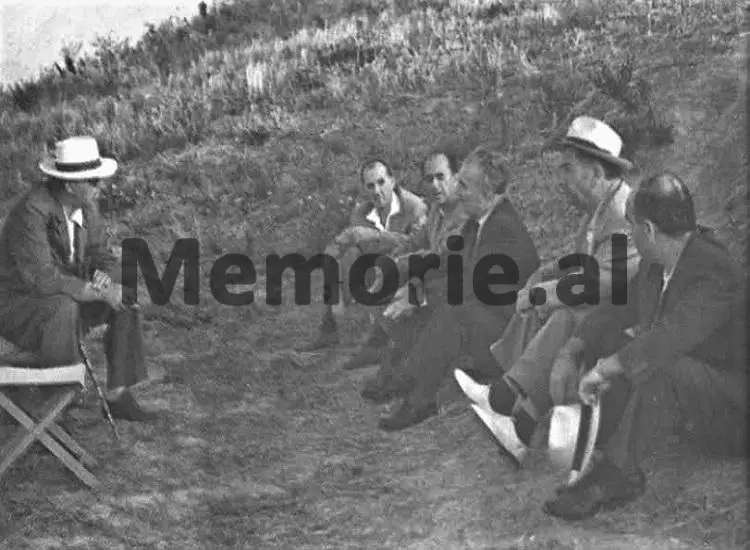
Memorie.al / The journalist of “Mediterraneo,” a periodic magazine of about 300 pages, published in French, in the homeland of the French language, and distributed to many countries bathed by the Mediterranean Sea, also came to Albania. He arrived in Durrës on an old catamaran. He traveled south, walking like a pilgrim along this itinerary: Durrës – Vlorë – Corfu – Piraeus – Cairo. On the map, he had marked other points in the Gulf regions bordering this sea, or that might fall around the “Mediterranean” of our own. He was long-haired and resembled those Southern Italians, mainly Sicilians. He gave me a copy of the magazine “Mediterraneo.” When he wrote the reportage about the south of our country, which was to be read on the shiny pages of the magazine, he would send me some copies of “Mediterraneo.” In fact, he kept his word, but the burning and scorching that entered our country on a Tuesday and a cursed year in ’97 caused the magazines to get lost somewhere in the hands of customs inspectors, with whose pages they had wrapped bread, or some cartridges. The Italian journalist asked to see the villas of the leaders of the communist regime from before the 90s, on the hill of Uji i Ftohtë (Cold Water). His request caught me a bit off guard. The dark-haired Frenchman asked: “Why, is it not possible?!”
The Italian Journalist’s Article, in “Mediterraneo”
…The villa of the former main leader of the communist regime is still there today; only its destination has changed. As soon as you exit the Uji i Ftohtë tunnel, there are no signs or inscriptions. Left then left again. The imposing villa. A 3-story building, a magnificent skylight. The road comes from behind, leading to the entrance gate. Since the 2000s, this building has been repurposed for Anti-Trafficking services. It was guarded just as it had functioned in its time. We waited until the order came and the soldier opened the large gate.
“He passed under this gate,” the driver said.
The Frenchman asked: “What?” In front, the three-story villa had a climbing rose garden.
“We asked the Frenchman: How does it look to you?”
“For us, nothing new; we have plenty like this in France. For you, it’s too expensive.”
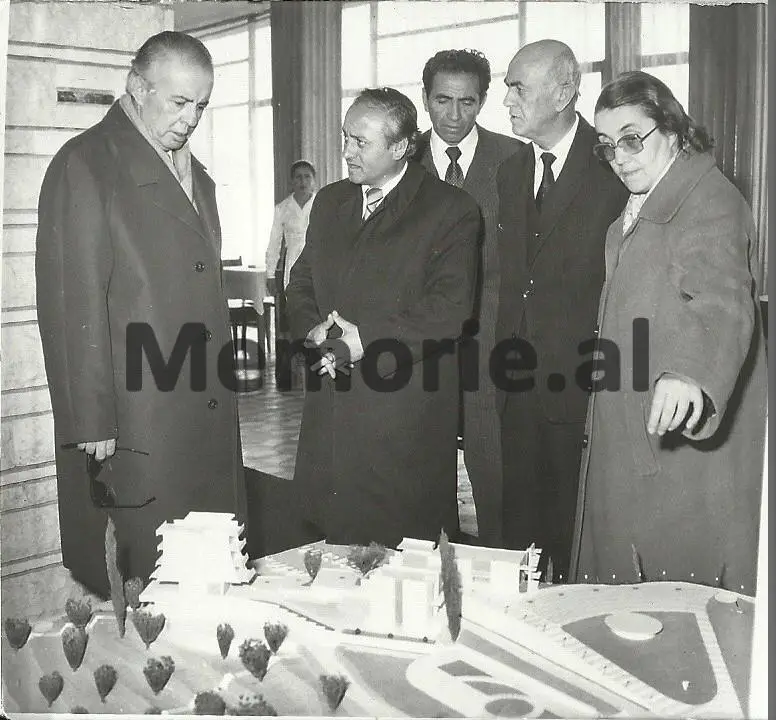
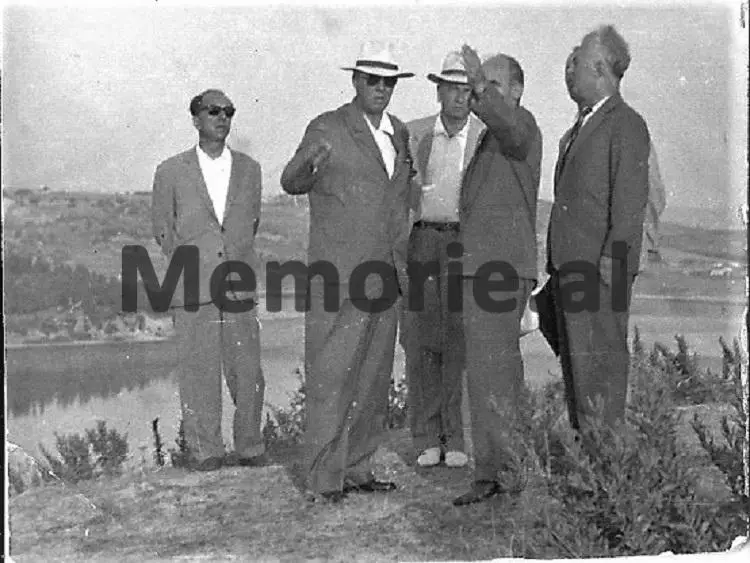
Meanwhile, the director of the villas arrived. He guided us through the retreat where the family and the communist leader himself, Enver Hoxha, spent their holidays. “The villa was frequented more by the children and less by the leader,” he said.
In the final years, the main leader did not take his summer vacation in the seaside villa here in Vlorë, but in Pogradec. The villa had an elevator. We went down to the lower floor. It was a large hall, the size of the villa’s footprint. The director began to explain that this was a games room – such a large space was built just for entertainment…! There were basketball hoops, volleyball net, and a drinks counter that quenched the thirst of the owners after every game.
Then we moved to the villa’s kitchen.
On the upper floor, there were many rooms for the staff. The floor above contained two main bedrooms.
…The leader’s room was on the west side, and his wife Nexhmije’s room faced the Shushica Mountain. The dimensions of the rooms were almost the same. What stood out was that the room could be about 30 square meters, and the bed at the end of it seemed quite small. At the head of the bed was a radio. Next to the bedroom was another antechamber which, as the villas’ director explained, served for the leader’s personal doctor.
With the deterioration of his health (he suffered from diabetes), the personal doctor stayed in the adjacent room for any unexpected event. A large corridor separated the rooms. Nexhmije’s room also had the same dimensions and furnishings. If you compared it to the time when the majority of Albanians had no shelter or lived in 1+1 prefab apartments, several couples within narrow walls, this constituted luxury.
The director of the villas said that the equipment for this villa had been ordered in the Italian state, and arrived there by ship. About 60 million Lek, at the exchange rate of that time, had been spent to buy the villa’s comfort. On the second floor, there was a kind of pine that neither grew nor dried out but remained evergreen.
I had read a book that the leader’s personal attendant, a certain Sulo G., had published during his regime. That book mentioned the construction of a pipeline and a pool to bring seawater up to that hill, for the villa’s swimming pool. He had not gone to the sea for years, refreshing himself instead in the pool water.
The pool was in a lamentable state, completely empty. It hadn’t been used for years. People were never left in peace with their speculations as to why it wasn’t used? It had rusted. Flowers in the back yard constituted a fragrant oasis with their scent. They were a rare decoration. They were in strong colorings, prominently red. The villa was built on that coastal hill for holiday time. The communist leader spent some time here, but as the villa director mentioned, from conversations, he had learned from the service staff that the communist leader did not come to the summer villa of Uji i Ftohtë anymore in the final years of his life.
The children, grandchildren, and great-grandchildren would use it – what an imagination that is hard to decipher!
My thoughts are waves of that sea, crashing on its witnessing shores. Its reflection allows us to clarify the depth beneath the water’s surface. What if? But the regime collapsed, and there is no “what if”…!
…In truth, without denying it, I will say what I saw, quite clearly. A road that descends straight to the sea, right at the tunnel, without being seen by people outside the villa walls. If you tell young Vlora residents, they shrug their shoulders. Otherwise, the older ones remember the time when the area was fenced off. It is real because it is in nature, located there on the seashore, above the tunnel or beside it, it seems to me.
This has been seen or is known only by those who have entered this territory. The villas that the government officials built in Uji i Ftohtë showed their thirst for privileges and comfortable conditions, while the country’s population lived in difficult housing conditions, especially in the 80s, where housing remained the main problem, so much so that, at least in 1992, Vlora alone inherited over 2,000 or 3,000 homeless people.
The villas of the government officials of the communist regime of Enver Hoxha and his successor, Ramiz Alia, often became the cause of anecdotes. When “uncle” came, as they secretly called the main communist leader, the RAI stations were made available to them in real-time, by turning on the TV signal booster for the villas.
When a group of foreign tourists arrived in that part of the city during the communist regime years, the Committee Secretary gestured to them to film over there, pointing out the villas. They filmed them on celluloid. The filmed images were never shown anywhere. An event had occurred that was kept in great secrecy. The films were burned by State Security agents in their cars.
In a view that catches the eye, there are 3 floors, which in the front part have a veranda overlooking the sea. There are large trees, ornamental shrubs, mainly climbing flowers that formed tunnels of flowers; there is an unimaginable space and field of view. It is built on a hill and occupies several hundred meters of land.
The villa of the communist leader served for a 50-year period as a government services villa, while it was transformed after the 2000s into the Anti-Trafficking Center. The villas of the former members of the Political Bureau of the Central Committee of the PPSh are also located in this area.
…The villa of the assassinated former Prime Minister, Mehmet Shehu, is a fairytale construction. It is located very close to the sea. The first floor has almost touched the sea. The other two floors often hear the waves roaring on days with strong rain showers and wind.
…There is another construction, slightly displaced. Three floors; in terms of form and architecture, the construction is more complete. The other villas, located in the “Villas of Uji i Ftohtë” cluster, have a distinctive architecture.
The method of consideration for the construction of the villa complex in Uji i Ftohtë during the communist regime was conceived to create comfortable conditions for the Party leadership in one of the most coveted places on the southern coast. So, they could rest peacefully there, far from the noise. There were controls, signs, and police to avoid nighttime noises in their conversations. When darkness covered them, they would ask: “What’s wrong, why are they clattering like that?!”
Many of the members of the Political Bureau of that regime, after being declared “traitors and enemies of the people” in almost every plenum, or period of danger to the Party, were removed from there, frozen in camps and prisons, or in the cold underground.
One of them was the former Prime Minister of that regime, Mehmet Shehu, a former fighter in the International Brigades in Spain in 1936, the strong hand of the regime, known for the killings carried out without trial during the War, against the nationalists.
The villa built for the former Prime Minister Shehu has a position and construction that, viewed from any angle, constituted an attraction on the southern coast.
Qazim Koculi, when the Vlora War ended, was gifted a villa on top of the Uji i Ftohtë hill. His villa faces the sea. For almost 50 years, it was included in the block of government services that served the state functionaries of the regime. Eqrem Bey Vlora also mentions Qazim Koculi’s villa in his memoirs. “The villa of Qazim Koculi, one of the main characters of the Vlora War era, was gifted to him by the government of the time for his contribution to the Vlora War, as one of its leaders.”
Qazim Koculi (1887 – January 2, 1943) was an Albanian politician in the early 20th century, who only held the post of Prime Minister of Albania for one day. He was also a distinguished military leader, which he demonstrated with deeds in the Vlora War in 1920, as the main military commander of the Albanian forces. Memorie.al