From FAZLI HAJRIZI
Part Two
Memorie.al / I had been persistently searching for Ago Agaj for several months, and no one could help me find his address. I called across the four corners of the continent where Albanians lived, I asked individuals and associations in New York and other cities, but to no avail. Some told me he lived in New York; others advised me to ask Baba Rexhep, saying he could put me on Ago’s trail. “Two years ago, he settled in Florida,” the head of the Tekke told me on the phone. “Florida? Just a word of mouth. South or north? Go on, try and find now which part of that state he lives in!” But it’s not said for nothing that chance is often the king of everything.
Continued from the previous issue
Ago Agaj recounted: “Isa Boletini thus gave Ismail Qemali moral support and went to stop the Turkish army from entering Vlora. We also have Hasan Prishtina, who played a major role for Albania’s independence. There was also Sali Gjuka, a patriot from Peja who died in Berat as the director of education. The Kosovars were the ones who broke the Turkish army in 1912. They entered Skopje and behaved so well that the foreigners there were amazed by their order and discipline.
All the wars and uprisings that took place in Kosovo were oriented towards independence. The greatest was that of 1912. Mustafa Kruja, when this war started, dressed in highlander style, with 12 others, went and took part in it. When it ended, he returned through Mirdita. But one must not forget that Dedë Gjo’ Luli started the war before other regions,” – Ago Agaj spoke and again recalled the time he went to help the Albanians in Mitrovica who were fighting against the chetnik bands of Draža Mihailović.
– “In the Serbian parliament, there was a great uproar that the Albanians of the Mitrovica province had allegedly burned a Serbian village and killed and massacred many civilians. The Albanian committee of the province tasked me with going to this village and reporting on the situation. I set off and, before even arriving there; I met on the road Albanians who were leaving their homes. The village of these poor wretches had been burned by the chetniks, while no Serbian village had been destroyed by Albanians.
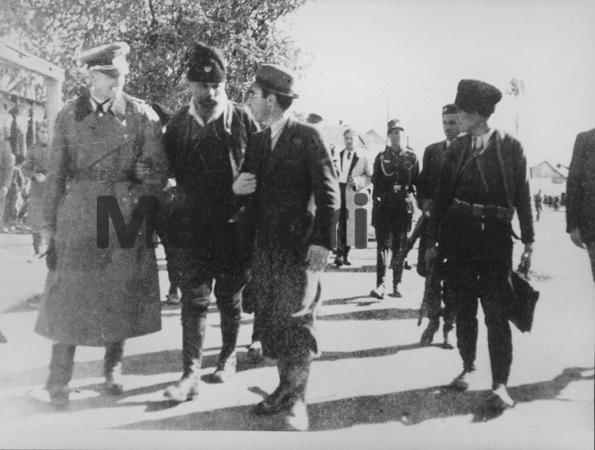
They told me that the arsonists were from the bands of Vojvoda Kosta Pećanac. I sent the report to the Albanian committee that led Mitrovica and, upon its suggestion, I translated it and handed it over to the German commander, Rittmeister Friedrichs, who expressed satisfaction with its accuracy and truthfulness,” – Ago Agaj recounted. – “The German commander and officers, in order for things to go better since I had gained the sympathy of the people in two meetings, proposed that I be appointed prefect of Mitrovica. Xhafer Deva was also of this opinion, who promised to help me and cooperate with me. The Committee also accepted the Germans’ proposal.”
Ago Agaj immediately began the Albanization of the administration. He appointed Shefqet Shkupi as the court president, Kudret Kokoshi as the prosecutor, and others, all of whom had come as volunteers from Albania. For the position of gendarmerie commander, he appointed Isa Boletini’s son, Bajazit. Not much time passed before the man from Vlora, entrusted with the duty of prefect of Mitrovica, found him in an unexpected situation. Draža Mihailović’s forces attacked the gendarmerie post in Banjska. Messengers were sent, on foot and horseback, to sound the alarm throughout the district: ‘One man per household, who has a weapon, report as soon as possible to the prefecture, be it night or day, because Draža Mihailović has attacked us.’
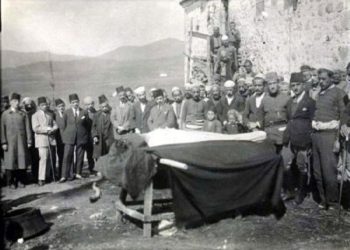
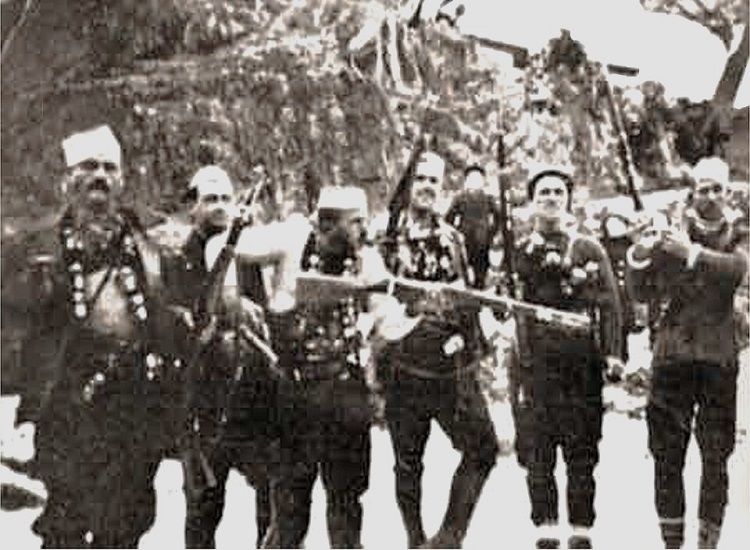
“At this time, a handful of brave men, commanded by Second Lieutenant Mehmet Gradica, reached Banjska and, with a furious assault, as only the men of Llap can do, they captured the post-command by midday. Only a few of Draža’s soldiers managed to escape. The bodies of our gendarmes killed by the chetniks had not yet been buried. They had been thrown together near a stream, after having their noses and lips cut off and other mutilations done to them. After being photographed, they were buried. Further on, the Serbian chetniks were also buried, but untouched. I have never been able to understand this custom of mutilating killed enemies on the part of the Serbs.
The Christian religion does not allow this, and I believe it is a heritage from pagan times brought from the steppes of Asia.
A Serbian officer told me that the Serbs even did the same to their King, Aleksandar Obrenović, and his wife, Draga, when they killed them,” – Ago Agaj writes in his book.
He, along with Xhafer Deva, went to the war front to encourage the Albanian fighters who were fighting mainly with Serbian rifles. He asked for help from Ferhat Draga in Tirana, but he did not reply. Then he turned for help to Drenica, the region most renowned for bravery, which was near Mitrovica, but at that time was included in the Italian zone. Ago Agaj had a secret meeting in Drenica with Shaban Polluzha, who gave him his word that he would come to his aid himself with men who had weapons.
– “We returned, while he did not delay and issued the call: ‘Men from seven to seventy, against the Serb!’ He set off on the holy war together with his fighters, armed, but at the border he was stopped by the Italian army. With his fighters, he turned back uphill, came out all the way to Kolašin, where he was attacked by local chetniks. He launched a counterattack and put them to flight. The next day, in the morning, he arrived in front of the prefecture in Mitrovica,” – Agaj recounted.
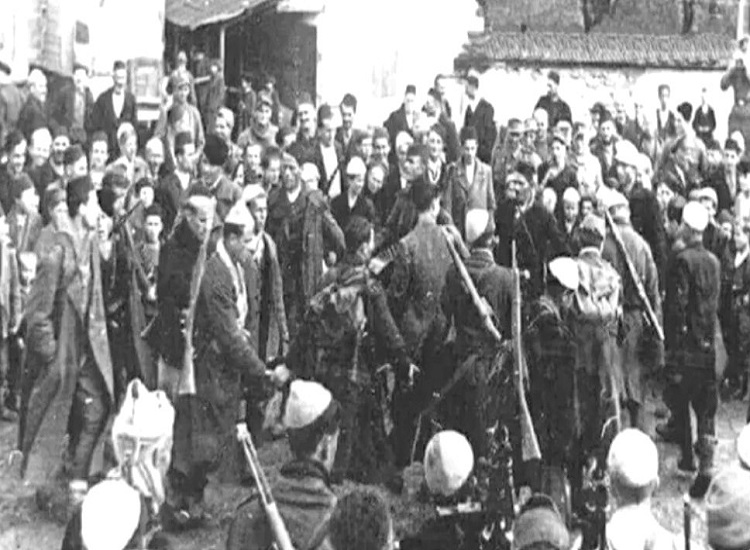
– “The aid that came to us from Drenica under the command of Shaban Polluzha gave us heart and courage to also launch a counterattack. And this action was done in Kosovar style: on foot, with noise, with heavy curses for the enemy, who took to his heels. Draža escaped, but left his horse behind. Pride and national conscience grew greatly after the victorious war, in a completely free atmosphere, since the Germans never interfered in our affairs. And those few who were there were rarely seen,” – Agaj recalled.
To tend to the wounded Albanians, Agaj brought Dr. Ibrahim Dervishi from Vlora, whose arrival was greeted with tears of joy by the wounded. He recalls the case of a 13-year-old boy whose wound Dr. Ibrahimi examined.
– “We went from bed to bed to visit the wounded in the hospital and reached this little boy.
– ‘And you, what are you doing here?’ – the doctor asked him.
– ‘I am wounded,’ – the boy replied.
He was holding a rifle to his chest. He slept with it. When we went with the doctor to visit him, he thought they would take it away.
– ‘Please, don’t take my rifle!’ – he cried out in fear.
– ‘I promised him he would keep the weapon, and I even promised to find a medal for him as well,'” – Agaj recalled.
– “A problem for us,” – Agaj continued to recount, – “were the two nephews of Isa Boletini, 12-13 years old. I don’t know how they had gotten their hands on two short Italian rifles with bayonets. They had tried several times to set off for war, but were turned back because I had ordered the guards to stop them and bring them before me. Finally, Xhafer Deva solved this problem by convincing them that if they protected me, they would be doing a greater service to the homeland, since my life was in danger. From that day on, I always had them with me, but I was never at ease because, with their Argus-like eyes, they checked every move around me. I was afraid they might shoot some innocent person who seemed suspicious to them,” – Ago Agaj recounted.
In his book, Ago Agaj has described several times the complaints of the Serbs, about whom he said that “it is a characteristic of theirs to complain without cause and to slander and create false accusations.” “The Albanian people,” – he continued, – “do not know how to complain, they are overly proud, they endure and never lower themselves. The Serb, before an authority, stands with that ugly military cap in his hand, humble, obedient. But at the first opportunity, he becomes a wolf insatiable for blood. Yet even this wolf is a mongrel mixed with jackal blood; when he finds a chance, he slaughters until he tires,” – writes Agaj.
For a short time, Mitrovica and its district experienced a freedom they had never had in their history. This freedom, as Agaj says, so ignited the people that even women took part in the celebration of November 28, 1941. It was the first time they participated in a gathering. For the first time in 500 years, they came out into the square dressed in national costumes, adorned with gold and precious stones, and with artistic embroidery, so much so that foreigners were left amazed. However, after this celebration, as Agaj recounts, an unexpected conflict occurred with the Germans. The command had decided to imprison all the Jews and the Roma community. In Mitrovica, there were not many Jewish families, but there were about four thousand Roma, whom they called ‘gabels’. They spoke Albanian and sided with the Albanians.
– “We gave explanations to the Germans that the Roma are of Egyptian origin, while the Gypsies are of Indian descent and are nomads who don’t settle in any one place. This explanation was not enough, and other facts were needed. Through Vehbi Frashëri, we found the book by Professor E. Novak, who had studied these peoples. Thus, the Roma were saved, and they, as a sign of gratitude, gave a concert, as only they know how. We saved the lives of the Jews. We placed them in a good building. After my departure, Xhafer Deva found a way to send these families to Albania, where they found shelter and hospitality,” – recounts Agaj. He stayed at the head of the prefecture for a short time, because Germany intervened with the Italians, as “this freedom and this administration were taken as an example even for Albania, and the youth there were demanding the same administration.”
– How did the Germans explain their coming to Kosovo?
– “They had a program divided into two parts: one said that ethnic Albania should be strengthened militarily, while the other said it should advance through education. The Germans’ goal was for Albania to become a loyal fortress in the Balkans, because they didn’t trust the Greeks, and they had never been on good terms with the Slavs.”
– How did the love for Albanians arise?
– “The German Illyrologist Hans Krahe wrote: ‘The Illyrians first settled in the present-day Baltic states: Estonia, Lithuania, etc. The name ‘Baltic’ comes from Illyrian meaning ‘mud’ or ‘low-lying places’. The Illyrians came to Eastern Germany where they created pottery craftsmanship, because until then people drank water from rivers and springs. From there they expanded and came to Southern Germany, where they stayed for a long time. The closeness of character between Germans and Albanians dates back to that time when the Illyrians stayed a long time in this region. The affinity between Germans and Albanians is also shown through *besa*.
No other people give as much importance to one’s word and manliness as these two peoples. In the Balkans, the only anti-Slavic people have been the Albanians. The brave and *besa*-keeping Germans found these qualities developed and evident in the person of Xhafer Deva, and their trust in him was boundless. Besides this, they found in him culture, intelligence, political talent, and knowledge of the peoples and languages of the Balkans. He spoke fluently Albanian, Serbian, Turkish, English, and almost better German. He knew the mentality and culture not only of the Balkan peoples but also of the great peoples of Europe.”
– And the current friendship with the Germans? At what level is it? – I ask the ‘man from Vlora of Kosovo’.
– “Germany has changed. It has become much Americanized. Germans have become more businessmen. They are no longer those old Germans. An Egyptian general, who had studied in Germany, when I was in Egypt, told me that the allies tried to destroy this state, but today it is economically very powerful. However, in another aspect, the allies succeeded. They changed the German character,” – Agaj said, and added:
– “After the war, great changes occurred in Europe. But in Albania, the opposite happened, a disaster occurred with the destruction of Albanian morale and character. Enver Hoxha was a sadist who delighted in the sufferings of his opponents. When his emissaries asked me to be a liaison between the Albanian communists and the Yugoslav ones, since I had served in Mitrovica and knew the Serbs well, I told them I would do this job on one condition: that Kosovo remain part of Albania. And they were never seen again.” The caregiver brought the medicines for Ago Agaj.
– “With these, I keep my soul alive,” – said the 96-year-old, who did gymnastics every day. Every morning he would go outside, stay for an hour, and come back inside. Even in the evening, he wouldn’t sleep before taking a good walk. The nights were very long for him. Sometimes he would sleep three or four hours, sometimes not at all. Shortly after, the caregiver returned and told us that Ago Agaj had been sitting in the armchair for several hours without moving, so this meeting had to end as it was.
– “Before you leave, give me your word that you will come again?” – he asked with a look that I cannot forget, as the caregiver of the Old People’s Home had prepared the wheelchair to take the 96-year-old to his bedroom…!
In lieu of an in memoriam:
Ago Agaj (1897-1994); “I am dying without seeing Kosovo free”
Ago Agaj, one of the oldest Albanians in America, died on December 24, 1994, in Clearwater, Florida, at the age of 97. Agim Sula was the last to part from him. His brother, Daver Agaj, informed me of the sad news, according to the bequest left by the deceased himself.
– Two weeks before passing away, Ago physically deteriorated so much that he couldn’t move from his bed.
– He fought his whole life for the national cause, so today he lives not only in the hearts of his relatives but also of Albanians who knew him,” – he adds. In a letter, a few months before he passed away, Ago Agaj wrote to the author of this piece:
“I am on my deathbed. I speak from the hundred-year experience of my life. I have had and still have the conviction that the fate of the Albanian nation will be decided in Kosovo. If Kosovo is saved from the claws of the Serbian hydra, then we will have an eight-million-strong nation and no malicious neighbor can achieve what it desires. If Kosovo, God forbid, remains under Serbian occupation, then danger also arises for Albania. So, when I strive for Kosovo, I strive for the nation, for Albania, for Vlora… Either today or never, the Albanian people must make efforts to save Kosovo.
This conviction has its roots in the father of the nation, Ismail Qemali, who, at a large meeting with the notables of Vlora, received a telegram and, after reading it, began to cry. Ismail Aga Mezini, his friend, shaken, said to him: ‘Gather yourself, tell us what happened to the sons’? Ismail Qemali replied: ‘No, nothing happened to the sons, but our homeland suffered. Kosovo remained outside the borders of Albania’,” – wrote Agaj and added: “I hope that the tears of the father of the nation will become a strong weapon for the realization of his dream.”
In that same letter, Ago Agaj expressed his wish to one day go to Kosovo, although his health and old age did not allow it.
“If I were in good health, I would be in Kosovo today. Not to make the Kosovars act bravely, because their bravery is well known, nor to help the intellectuals, because today Kosovo has produced distinguished intellectuals like Ibrahim Rugova, Anton Çeta, Zekeria Cana, etc. They strive for Albanianism and I am proud of them. My purpose for going to Kosovo is to rest after death in Albanian soil,” – wrote Agaj, author of the books “The War of Vlora” and “Milosh – Hero of Kosovo”, published in America.
Ago Agaj was buried in the city cemetery in Clearwater, Florida. His funeral was attended by relatives and compatriots from the United States of America and Canada. / Memorie.al