
By AGRON ARANITASI
Part Eleven
– THE TRUTHS I BELIEVE, THE FRENCH AGENT –
Introduction
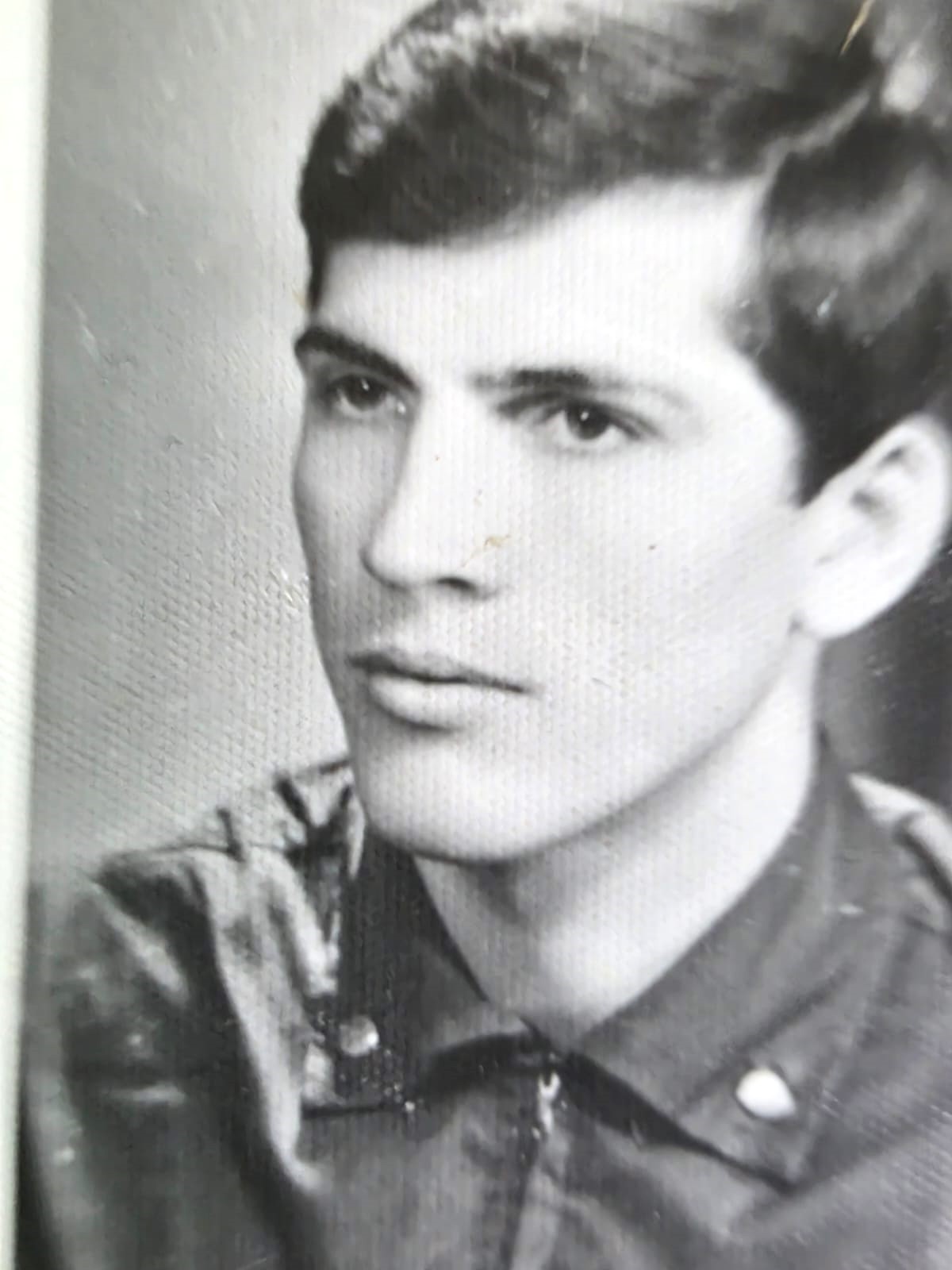
Memorie.al / When I started writing the book The Truths I Believe (PAPIRUS Publishing House), I had not intended to write about myself. The first impetus came when I became acquainted with the State Security files concerning the surveillance of the citizen Agron Hajdar Aranitasi. Those files are one more testimony of how someone could be persecuted who, at a certain moment, was placed among the enemies of the people’s power. No account was taken of anything – not how he had worked, nor how he had behaved, nor how he had lived. No account was taken either of the stance of his parents, brothers and numerous cousins, who automatically were subjected to brutal blows and suffered consequences without any guilt.
Continued from the previous issue
The year 1979, a conversation with Liri Aranitasi
In April–May 1945, Liri had experienced her first disappointment. In a skirmish with the Pursuit Forces (that was the official version), Vllasi was killed. Around the same time, her father, Toli, was interned, even though his house had been one of the main bases of the Communist Party of Albania. The internment lasted only six months. He was released through the intervention of Hysni Kapo. Liri continued her life in the Party, but something had changed. Her trust in the Party had wavered.
In our family, conversations were held in which various aspects of life were criticised, but they did not acquire the content of a confrontational stance towards the Party of Labour of Albania and Enver Hoxha. Such conversations took place in many families connected to the Party, whose heads had studied in Moscow or in the countries of Eastern Europe. It is known that there, in the years 1954–1956, the so‑called “thaw” had begun and the policies of the cult of Stalin were condemned. This also manifested itself at the Tirana Conference (April 1956).
The conversation I am writing about took place after the death of Hysni Kapo. “I want to ask you something, but promise me you will do it,” Liri said to me. “If I can do it, no problem,” I replied. “You must not join the Party. This Party does not like people with free minds and loose tongues like us.” By “loose tongues” she meant our attitude towards the problems of the time. We criticised things we did not like. “I promise you,” I answered.
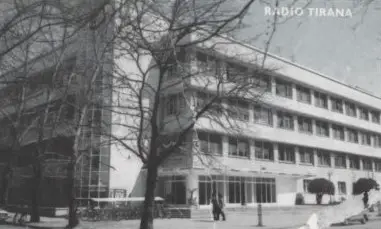
I was much attached to my profession and held one of the best positions at Albanian Radio and Television (RTSH). I worked with the “Ampex” videotape recorders, I travelled abroad, I had been proposed for a nine‑month specialisation in Paris. Joining the Party involved a three‑year internship within the working class. I did not like that. On the other hand, not joining the Party – especially for the son of a family like mine and the son‑in‑law of a Politburo member – might not be viewed favourably. I solved the situation easily.
Because of the problems that had arisen for him, Vullnet (Musaraj) had to join the Party. He asked me not to submit my application at the same time as him. They might accept me and not him. I “fulfilled” his wish and later used him as a justification for why I was not joining the Party.
That Liri’s life – and not only hers – had become something ambiguous, something double, was not an exceptional thing. Such had become the life of many Party functionaries who could not agree with the economic and political difficulties Albania was undergoing. They understood that this was a consequence of Enver Hoxha’s personal attitudes. In the end, I did not join the Party.
I saved several years of my life, because I would have been expelled, just as they did with the two daughters of Kadri Hazbiu (Lena and Moza), with his eldest son‑in‑law Medin, and with my brother Gëzimi (who was expelled by the basic organisation, but the Party Committee of Tirana District No. 1 reinstated him as a Party candidate).
The year 1981 – RTSH begins colour transmissions
1981 was the year of the 8th Congress of the Party of Labour of Albania. The General Directorate took advantage of the occasion and proposed to the government that the proceedings of the Congress be broadcast in colour. This required a set of equipment which, according to a study, cost around 250–300 thousand dollars. In the material sent to the government, it was stated that broadcasting the Congress in colour could also be watched by the Albanians of Kosovo.
Sometime before, Josip Broz Tito, during a speech, had addressed the Kosovars: “You watch television programmes in colour, whereas the Albanians watch them in black and white.” Tito’s statement had not gone unnoticed by the Albanian leadership. The response came positive. A detailed plan was requested. I presented it, at that time being the chief specialist of television.
To select the colour cameras, a group composed of Marash Hajati, Vullnet Musaraj, Agron Aranitasi and Spartak Bakllamaja was sent to Austria. Austrian Television used Japanese‑made “Ikegami” cameras, known for their quality. After Vienna we ended up in Paris, where the contract was to be signed. It was signed in June and stipulated that the equipment would be delivered by the end of October.
Around the middle of October, Miti Tona, head of the Press Sector at the Central Committee, came to my office. He was a composed and polite man. He sat opposite me and said: “I have a conversation to have with you. Comrade Ramiz sent me. He wants to know if we can broadcast the entire activity of the Congress in colour. Can the editing be done immediately after the live broadcast of the proceedings?”
I answered: “The live broadcast of the proceedings poses no problem. As for the editing, it takes time, especially since Comrade Enver speaks at length and, as you know, makes corrections that need to be cleaned up!” Miti continued: “Now I will say something that only you and I will know. Comrade Ramiz also knows. Enver Hoxha will speak for about two hours; the rest will be given recorded on tape. This is a secret. If it comes out, it is understood who will bear responsibility.” It was understood: he and I (Ramiz, of course, not!). I replied: “All right, but you have to talk with Comrade Çajup and the others.” – “What I said is only for you; the others will be informed in due time,” Miti concluded. In fact, the others were informed only in the last days of October. Çajup Rusmajli immediately said: “We must hear Agron’s opinion.” Miti had replied: “Agron is aware and agrees.”
His words put me in a difficult position with Çajup and Agron Çobani, the director of RTSH at the time. They appeared disappointed with me. They told me they had not expected such a thing, especially since it concerned the proceedings of the Party Congress…!
Three or four days after the meeting with Miti Tona, Ramiz Alia called me on the phone. “When will the cameras arrive?” he went straight to the point. “The contract stipulates by the end of October,” I replied. “That must be asked of the Ministry of Trade.” “I don’t care what they say. I want your opinion.” I assured him that the cameras would arrive on time. And, indeed, they arrived on 28 October. Only three days remained to put them into operation. Here, as usual, Vullnet entered the scene. Within the day, the cameras were integrated into the RTSH television bus.
When the lighting in the hall was switched on, we faced an unforeseen problem. The colour red dominated the picture. Without delving into the cause, Vullnet adjusted the cameras so that they produced a normal colour signal. But the next morning, when the hall filled with delegates, the picture was almost blue. Then we understood what the problem was. When the hall had been empty, the red of the armchairs dominated; now that it was full of delegates, the black suits of the majority dominated. Vullnet got back to work and returned the cameras to their previous state.
Ramiz Alia observed all his interventions from his villa, to which the RTSH signal was sent via an underground cable. He became worried. As soon as he arrived at the hall, he asked to be informed about what he had seen. I explained what had happened and assured him that everything would go well.
Ramiz did not show enthusiasm for the previous tests. He had told me that a day earlier. But in him, no ill intention was noticeable. He was worried about how we would fare in this new initiative and … of course, what Enver Hoxha would say. In truth, we all had that worry.
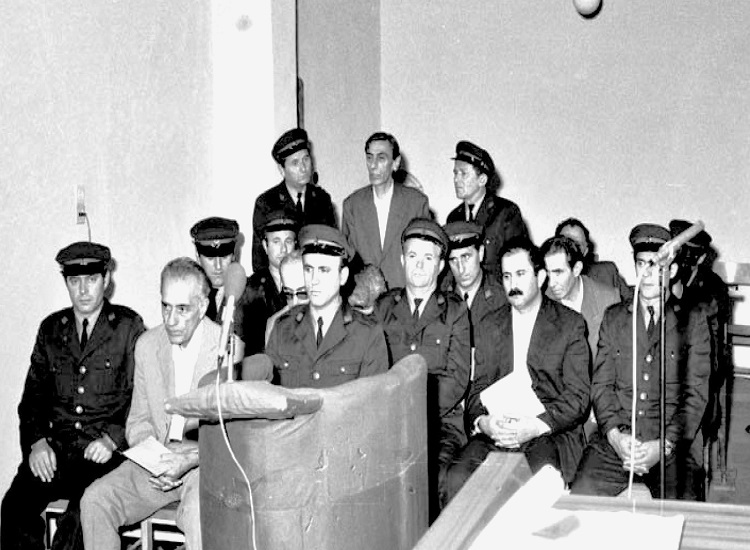
Meanwhile, a great concern had arisen for the Party. For several months, the Party “trial” for Mehmet Shehu had been taking place. The director Albert Minga had been given instructions on how to film the Congress. Certain persons were not to appear on screen! First of all, Fiqret Shehu had to be avoided. The same applied to Feçor Shehu.
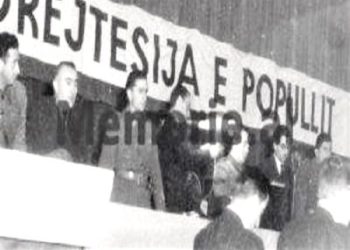
The proceedings of the Congress were opened by Ramiz Alia, who was seated between Enver and Mehmet. Then Enver Hoxha took the floor and spoke for about two and a half hours. The rest of his speech was given edited. Mehmet’s apathetic attitude was noticeable. He applauded little. He did not exchange words or smiles with Enver.
The image of Enver Hoxha and the others in the presidium came out well. Mehmet Shehu and Hekuran Isai, who were wearing black suits, did not come out well. The “fault” lay with the camera lenses, which were designed for close‑up shots (for newsreels) and not for long‑distance shots. This worried Berti. He complained to Vullnet. Vullnet replied that nothing could be done. Berti expressed his concern to Çajup. I was called. Mehmet’s suit was causing us concern. Someone had to tell him. Since Fiqret, during the breaks between sessions, passed through the hall where the equipment was set up, we explained the problem that worried us. We asked her that the next day her husband wear a light‑coloured suit. The next day we saw that Mehmet had followed our “suggestion”. (Someone tells this story differently, even writing that he himself spoke with Mehmet Shehu. Another writes that it was Çajup who went to Mehmet. The truth is what I am telling.)
Given the way events were entangled, few would have dared to speak to Mehmet Shehu at that moment. With Hekuran Isai, the problem was solved more easily. To the request made in the name of the General Director, he responded with humour: “Tell Çajup to give me one of his suits, especially since we are the same height!”
On the morning of the third day, we were getting ready to start work. I had climbed onto the podium, near where Mehmet Shehu would speak. I was surprised to see his doctor, Lleshi, placing a large number of small packets of medicine on the inner side of the podium, above which the microphones were placed. It was obvious that Mehmet was not well. The troubles he was going through had taken their toll. Mehmet spoke at length and the speech was broadcast live. With a live broadcast, you cannot do anything; you cannot avoid showing the speaker for a long time. Contrary to what is said today, he appeared on screen for a long time.
The rebroadcast was a different matter; it was given after careful editing. Ramiz Alia himself took care of it. The speech was shortened and Mehmet appeared less in relation to the hall. What were noticeable were Enver Hoxha’s awkward applause and the absence of a warm embrace at the end of the speech. The delegates in the hall and the guests following the proceedings from monitors placed outside understood that something had cracked in the relationship between the two main leaders.
This was also noticeable to the leaders of the two strongest Marxist‑Leninist parties at the time: João Amazonas, leader of the Communist Party of Brazil, and Raúl Marcos, leader of the Communist Party (Marxist‑Leninist) of Spain. Later, after Mehmet Shehu’s suicide, they requested clarifications from the Central Committee of the Party of Labour of Albania.
Everyone awaited the composition of the new Central Committee with interest. Nothing special happened. Mehmet and Fiqret were elected members of the Central Committee. It was noticeable that Feçor Shehu, the Minister of Internal Affairs, again remained a candidate member of the Central Committee (!). The colour broadcast of the proceedings of the 8th Congress served as a starting point for the next request.
Following the principle “strike while the iron is hot”, the General Directorate of RTSH sent to the government the project for switching the production and transmission of RTSH programmes from black‑and‑white to colour. / Memorie.al
To be continued in the next issue