By Moisi Murra
Memorie.al / Haki Sharofi, was not a cleric, but he did more than a cleric. The works in the periodicals of the 1930s – 40s, in “Zani i Naltë” and “Islamic Culture”, rank Sharof among the most prominent Albanian theologians of the 20th century. In the works “The Qur’an”, “What does the Qur’an teach?”, “Islamic religion is not a dogma”, “What does the Prophet, peace be upon him, teach”, etc., the depth of thought and the power of interpretation of Sharof in Islamic knowledge are described. Without a doubt, his brilliant work in Islamic knowledge remains “Moral and Religious Education”.
In 1930, Sharofi also dealt with many social problems, becoming the forerunner of that generation of writers who seek profound changes for a new life. Among them, it is worth mentioning: “Albanian mother does not know how to raise a child”, “Child’s growth”, “Albanian mother does not know how to save and keep her hand on expenses”, “Albanian housewife, does not know how to set the table”, ” The Albanian mother does not know how to establish love between family members”, “The Albanian mother does not know how to establish infant education”, “Did the shortcomings of the Albanian mother come to an end?”, etc.
Of great interest are the studies “Mevludi” by Hafiz Riza Shkodra, “Mevludi” by Ismail Floqi, “Nezimi i Berati and his Divan”, the drama “Gjaveja” by Sami Frashëri, etc. Sharofi has been active for 63 years.
His activity in several fields, such as that of teacher, researcher, publicist, Albanian speaker, orientalist and brave fighter in defense of his lands, makes him an outstanding personality of Albanian culture and being.
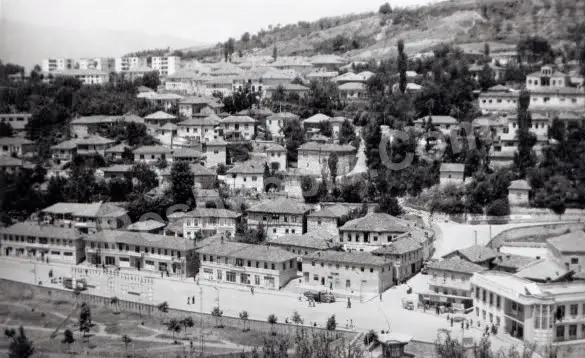
Haki Sharofi was born on April 10, 1894, in the city of Dibra e Madhe. After finishing primary and secondary education in his hometown and in Elbasan, he wandered the streets to find a job. In September 1912, he was appointed a teacher in Ghurash of Manastir and in 1913, in Manuretal, Turkey.
Since he was far from the Shilar environment, he returned to Vlora, where, advised by Luigj Gurakuqi, he continued for a year at the “Normalen” in Elbasan, a qualification course for teachers in the subject of the Albanian language, which he finished in February 1914.
Since 1909, he had opened a quarterly “course” in the meadow of Qenanica, near the city of Dibra e Madhe. “…I was 7-8 years younger than my “students”, – recalled Sharofi. I agreed with you, fulfilling the wish of the adult “students” and started working in Qernanica”.
On April 14, Sharofi opened the first official Albanian school in Peshkopia Mosque. “When I started work, wrote Sharofi, it was April 1914. The students had brought from their homes a piece of postiki to sit on and a small box to put their notebooks and writing tablets. Instead of the sign, we found a piece of black stove sheet. The letters were completely missing. We prepared the notebooks ourselves with writing papers.
This is how the Albanian school opened its doors in Peshkopi”.
After six months, Esat Pashë Toptani, who had started learning to write and read Albanian at the age of 49, comes to Peshkopi, where after raising the Turkish flag, instead of the Albanian flag, he closed the first Albanian school. Haki Sharofi is forced to leave Dibra.
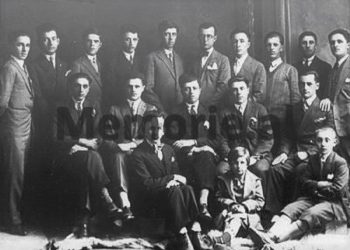
After many efforts, he was able to secure a job as a court secretary in Shijak. In September 1916, he returned to Dibër, where he served as a teacher until 1920, in Peshkopi, Trojak and Slovakia. In June 1921, Haki Stërmilli, Haki Sharofi, etc. Trying to create a society according to the “Homeland” federation charter
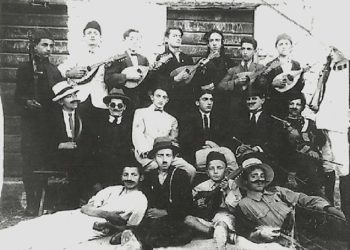
The newspaper “Koha” of July 16, 1921, announced that; on June 19, 1921, the company “Djelmnia Dibrane” was established based in Tirana, with Secretary Haki Sharofin. Two years later, on July 22, 1923, branch no. 1 of this company in Peshkopi, with advisor Haki Sharofi. This society had a wide political-cultural activity, almost for two decades.
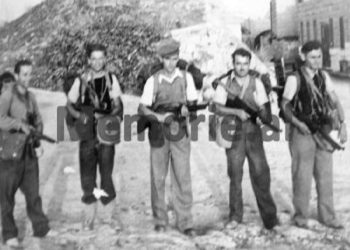
In September 1921, Haki Sharofi aligned himself with the insurgent forces of Elez Isufi, in defense of the national being against Serbian chauvinism. Enthusiastic about the heroic resistance of the popular uprising forces of Dibrane, against the numerous forces of the Serbian army in the War of Lan Lura, he wrote the poem “Drin o lum i gjana”, which became the hymn of “Djelmënija Dibrane”.
On December 2, 1923, Haki Sharofi was appointed director of the Peshkopia Boarding School, which was opened in Shehat Shehu’s house. Later he moved to Kastriot. Under the leadership of Haki Sharof, Kastriot Boarding School became one of the most popular schools in the country.
The newspaper “Bashkimi” of November 7, 1924, published an article by Dom Lazër Shantoja, where he emphasized the good work of Haki Sharof and Qemal Drita who “… with a truly exemplary zeal had prepared for Dibra and Albania, the young smart and well-educated…”!
During the 1923-1924 academic years, Haki Sharofi and Hamit Muça were the first organizers of the opening of the female school in Peshkopi, in the house of Bajram Iljazi, with teacher Nazmie Pasholli.
This year, in the month of September, Haki Sharofi addressed the Ministry of Education for the opening of a school for the villages of Gjoricë e Epërme, Gjoricë e Poshtme, Çerenec and Viçisht.
“…It is very necessary to open a school for these four villages, please consider this request, and if it is not possible now, keep a note for later”. He would do the same a few days later for the villages of Herbel, Popinar, Erabar, Grazhden, Dovolan, Trepç and Pejke, emphasizing that: “… these villages have many Christians among the people”!
As a member of the “Bashkimi” society, Haki Sharofi responded to the General Council’s call for revolution, lining up with weapons in hand alongside the democratic forces. He participated in the Third Congress of Educators in Tirana, on August 12-21, 1924, which took decisions on the democratization of education and secularism and the further unification of the Albanian school.
Two months after the return of Ahmet Zog to power, by decree no. 24/28, dated 13.2.1925, Haki Sharofi, “fired from his job as the director of the Kastriot Boarding School”. The newspaper “Indipendenca Shqiptare” of February 15, 1925, would also announce the reason for the dismissal of the democratic teacher: “since he abandoned his job and laid down his arms, Mr. Haki Sharofi, director of Kastriot Boarding School”!
In May 1927, he was returned to education with the position of director of the “Orphanage” in Tirana. At the end of this year, he returned to the boarding school in Kastrioti, and then he was transferred, in 1928, to the “Kosova” boarding school in Kruma, to the Plotore School in Vlora, in 1929, and from 1930, until 1951, he taught language Albanian in the Madrasah of Tirana.
During his stay in Krumë, one of his contemporaries, Sali Alibali, remembers an incident that speaks of the strong character, manliness, courage, patriotism and love of Haki Sharof, for our flag and the legitimate right of Albanians for national integrity. “It was November 28, 1928, – remembers Sali Alibali…! It was getting ready to raise the Albanian flag. But some tools of the Italians wanted to raise the Italian flag alongside the Albanian flag. At this moment, I saw Haki Sharofi when he broke away from the crowd and came before the prefect, saying: ‘We do not allow the Italian flag to be raised alongside the Albanian flag. Albania has a flag for which blood was shed; the flag with two proud vultures’. Our flag waved in the air.”
In addition to the passionate work of the teacher, Haki Sharofi, he has left documented generations, the heroism of Dibra from antiquity to our days, in two volumes. His sons, in the context of the 75th anniversary of the declaration of independence, were kind enough to donate these volumes to the library of Peshkopia.
These works are a valuable contribution to the provincial history of Dibra, in particular, and the national history in general. They stand out for scientific culture, historical veracity and interpretation of fact.
Of particular interest are the studies: “Figure of Skenderbeu in Dibër” and the localization of some battles of this era in this region; “Studies on the ancient history of Dibra”, “Dibra on the verge of declaring independence”, “Building the city of Dibra”, social organization, etc. Together with Ismail Strazimir and Haki Stërmilli, he is the author of the monograph “Djelmnia Dibrane”.
He has left us over ten short biographies of Dibra national figures, such as: “Hoxë Voka”, “Kreshniku i Dibra” (Elez Isufi), “Hamdi Ohëri”, “Vehbi Agolli”, “Hoxë Muglica”, etc.
In the culminating moments of the homeland, Sharofi breaks out as a poet.
His poetry is significant, sensitive, powerful, political, which tends to rest on the national base. Such are: “Drin, o river of gjana”, “A mountain”, “Flag Day”, etc.
A publicist, Sharofi dealt with philosophical, sociological, moral, political and religious problems. He directed the magazine “Zani i Naltë” for several years in a row.
As a good connoisseur of oriental languages and French, in recent years, although at an advanced age (he passed away in 1977), he worked at the Institute of History and the State Archives as an Albanian translator of Turkish documentation.
“Love for the motherland, flag and mother tongue,” wrote Sharofi, “armed us, the first teachers, to break through the darkness with the muzzle of the rifle and the tip of the pen.” In 1993, after his death, he was given the title “Teacher of the People”. Memorie.al