By Isuf Bajrami
Part Two
Memorie.al / “In the name of our population, we protest once again against all of this; we present to the Investigative Commission of the U.N.O. Security Council the tragedy played out in Chameria and draw attention to a barbaric act committed with the aim of exterminating our population. We emphasize the need for a swift conclusion to the Cham problem and are convinced that our demands will find a solution, which are…”! This was stated, among other things, in the memorandum of the Anti-Fascist Committee of Cham Emigrants living in Albania, sent to the Investigative Commission of the United Nations Security Council in 1947, signed by Taho Sejho, Kasem Demi, Rexhep Çami, Tahir Demi, Vehip Demi, Dervish Dojaka, and Hilmi Seiti.
In continuation of our protests and demands addressed to the Great Allies and the United Nations, we seek justice for what we present…
MEMORANDUM
OF THE ANTI-FASCIST COMMITTEE OF CHAM EMIGRANTS IN ALBANIA
TO THE INVESTIGATIVE COMMISSION OF THE U.N.O. SECURITY COUNCIL
REGARDING THE TREATMENT AND MASSACRES OF THE CHAM ALBANIAN MINORITY IN GREECE
We, the Anti-Fascist Committee of Cham Emigrants in Albania, with faith in the democratic and humanitarian principles of the U.N.O., in the name of the Cham emigrants in Albania, present before the Investigative Commission our lost rights, the oppressions, persecutions, and massacres carried out by the Greek fascists to exterminate the Albanian Minority in Greece. In continuation of our protests and demands addressed to the Great Allies and the United Nations, we seek justice for what we present:
Continued from the previous issue
Dervish Sulo from the village of Spatar in Filiates describes the events in Spatar as follows: On a Saturday morning in September 1944, the entire population was gathered in front of the mosque of the village of Spatar. The soldiers began looting and dishonoring women, girls, and even elderly women. Paçe Çulani, 50 years old, was dishonored, robbed, her hair was cut, then her ears, and she was finally killed in her garden near Miço’s wheat field.
In our house, the family of Sako Banushi from Skopjona was settled, consisting of eight people – men, women, and children. After the women were dishonored and their breasts pierced with knives, everyone was massacred. In Damin Muhameti’s house, 5 women and 3 children were killed. In Fetin Muhameti’s house, Hane Isufi was tortured and then dishonored along with another woman. In Dul Sherifi’s house, the 80-year-old Sulejman Dhrimica and his wife were beheaded.
In Mete Braho’s house, 20 people – women, children, and men – were burned alive. Kije Nurqi, 76 years old, was slaughtered with a knife. In Zula’s vineyard and Avdyl Nurçe’s garden, I saw 30 massacred individuals. In Haxhi Latifi’s house, the daughters of Haxhi Culani were dishonored, while in Mejdi Meta’s residence, Hava Ajshe and Nazo Arapi were dishonored; the latter was subsequently massacred.
The victims and losses, according to statistics to date during the massacres of 1944 and 1945 at the expense of the Albanians in Greece, reach the number of 2,877, divided as follows:
- Filiates and district: 1,286
- Gumenica and district: 192
- Paramythia and district: 673
- Margellic and Parga: 620
This was the fate of all those who could not leave Chameria, with the exception of a few women who are today living witnesses of this chilling massacre in Paramythia, Prage, Spatar, and Filiates.
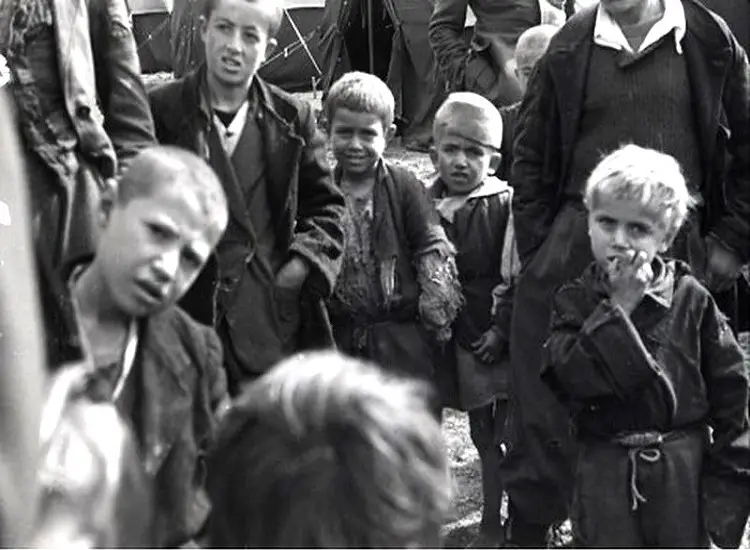
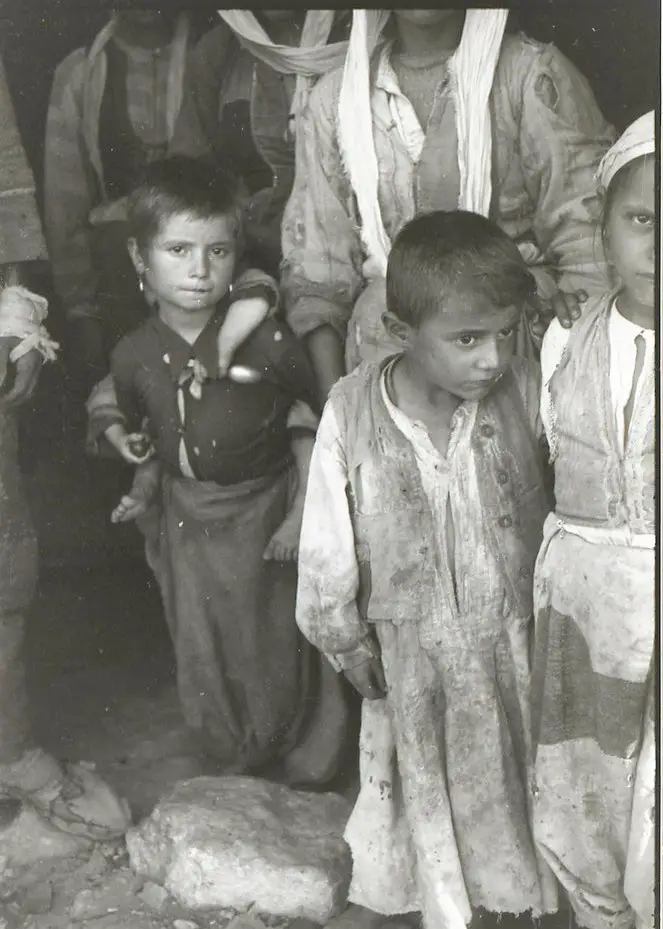
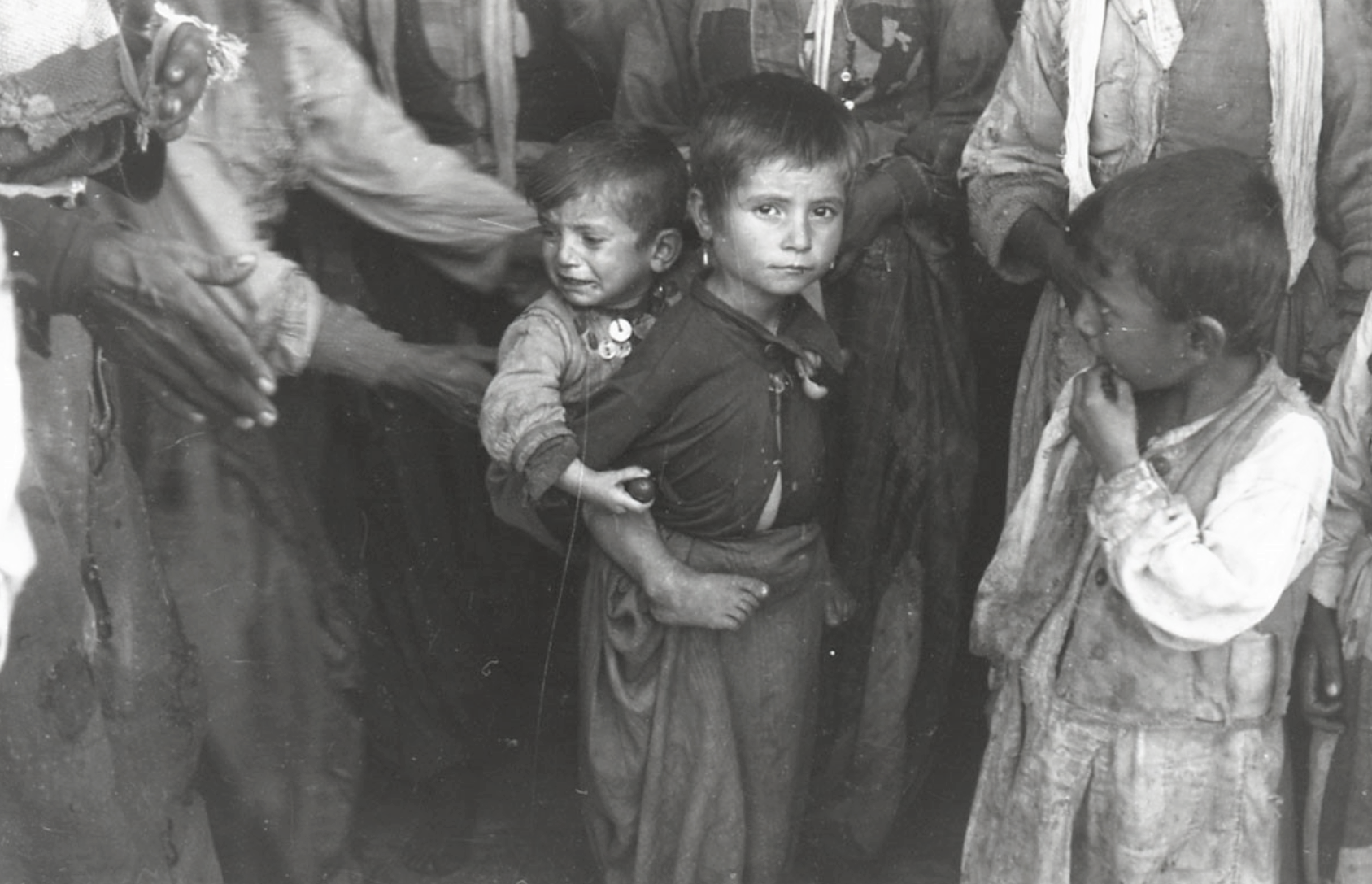
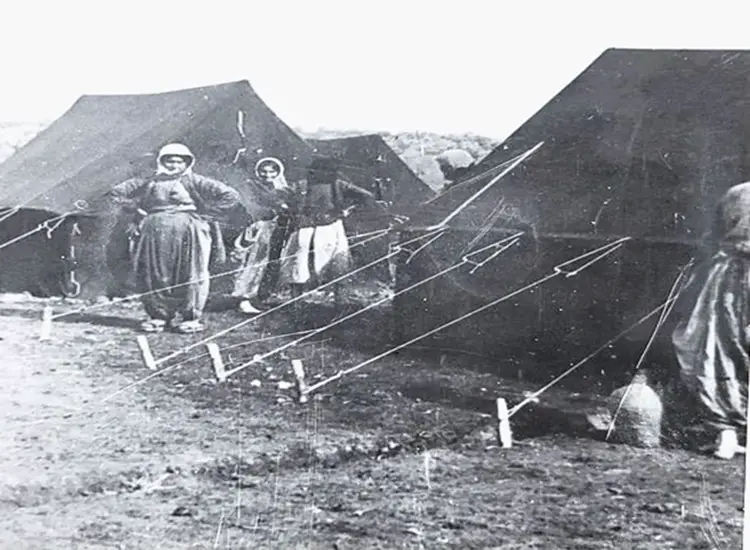
Through their mouths, the criminality of the barbaric acts organized by the Greek monarcho-fascist reaction in Chameria emerges clearly and nakedly. This slaughterhouse, inspired by the lowest feelings of chauvinistic and religious hatred, ended with the forced displacement of nearly 28,000 Chams who came and took refuge in Albania under the most deplorable conditions.
68 villages with 5,800 houses were looted, destroyed, and burned. From the calculation of damages, it results that 17,000 head of small livestock, 1,200 head of large cattle, 21,000 quintals of grain, and 80,000 quintals of oil remained in Chameria and were looted by Zervas’s monarcho-fascist forces, as well as the product of the year 1944-45, which reaches 11,000,000 kg of grain and 3,000,000 kg of oil. During the emigration, 110,000 head of small livestock and 2,400 head of large cattle died or were lost.
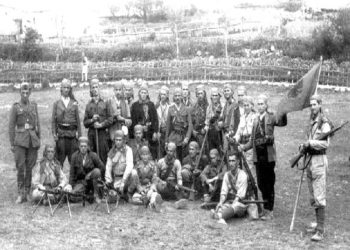
From all this, the great economic catastrophe suffered by our population is clear, as they were left on the roads of emigration with only the clothes on their backs. Chameria contributed both materially and morally to the great anti-fascist war. The population of Chameria threw itself without reserve into a total war against the occupier and formed the IV Battalion of the XV Regiment of ELAS. From the small population of Chameria, more than 500 fighters emerged who fought resolutely against the Nazi-fascist occupiers and the Zervist traitors.
The blood of the martyrs Muharrem Myrtezai, Ibrahim Hallumi, Hysen Vejseli, etc., shed alongside that of the Greek partisans at the Ceramic Passes, concretely testifies to this fact. At the conclusion of the war and the liberation of the country from the occupier, the troops commanded by General Napoleon Zervos operated in our regions and villages not as liberators, but as executioners and sworn enemies of the Albanian element in Chameria.
In the Caserta agreement (Zarafis-Zervas) of August 1944, the resistance troops were placed on common fronts against the Nazi army under a joint command and in specific operational zones. This agreement was violated in Chameria. The Zervist troops compromised with the Germans and, by firing upon our forces, hindered the activity of the IV Battalion of the XV Regiment in the designated zone of Filiates.
The operations and massacres in the Filiates region are directly linked to this situation and are in open contradiction with the trust and spirit of cooperation established in Caserta. Even the last village of Chameria, Koska, one of the organizational bases of the resistance forces of the National Liberation Front in Chameria, was destroyed and burned as a conclusion to the act of destroying Chameria.
A commission of the Cham Anti-Fascist Council was sent on October 30, 1944, to Athens to see the Greek government of Mr. Papandreou with a protest vote against the massacres in Chameria, simultaneously demanding they be halted. Papandreou’s government did not wish to take any measures or commitment regarding what was presented.
After the operations of December 1944, with the liberation of Chameria from the Zervist occupier, a part of our population repatriated again and settled in the Filiates region. On March 12, 1945, the government forces of the Corfu garrison, violating the Varkiza agreement of February 1945, organized and treacherously carried out the hideous massacres of Vanra (Filiates), which once again exposed the naked stance and policy of the responsible authorities of the Greek government regarding the extermination of the Albanian population of Chameria.
In support of this established situation, the UNRRA Mission in Albania received approval from the Washington headquarters for an allocation of 1,450,000 dollars in favor of the emigrants as immediate aid for our difficult situation. Even under these conditions, the Cham emigrants continued to contribute more and more to the Front. At the Shales (Konispol) conference held at the end of September 1944, the voice of the Chams in emigration rose stronger for cooperation against the occupier and the injustices of the Greek monarcho-fascists.
On September 23, 1945, at the Congress of Vlora, the Cham delegates representing all groups of Cham emigrants in Albania spoke out against the Greek monarcho-fascist massacres committed upon them and demanded, through memoranda addressed to the London Conference, the examination of their problem and the punishment of those responsible for the useless bloodshed in Chameria and the infinite suffering. The Congress concluded with a resolution summarizing all its proceedings.
During the emigration, we have many times addressed the world regarding our denied rights and have requested repatriation. On October 30, 1944, the Cham Anti-Fascist Council sent a protest vote to the Greek National Unity Government, the Mediterranean General Staff, the Allied Governments, and the Central Committee of EAM, speaking of the barbarities of the Greek fascists in Chameria.
On May 9, 1945, the Cham Anti-Fascist Council sent the Allied Military Missions a copy of the telegram addressed to the Chairman of the San Francisco Conference regarding the rights of the Chams based on the Atlantic Charter. On June 27, 1945, protest telegrams against the massacres in Chameria were addressed by the Cham Anti-Fascist Council to the Democratic Government of Albania, and the Soviet, British, American, French, and Czechoslovakian Allied Military Missions, the Yugoslav Legation, and Albanians in America, Italy, and Bulgaria.
A pro-memoria was addressed to Mr. Hutchinson, a Labour MP of Great Britain, on November 26, 1945. A telegram was addressed to the General Directorate of UNRRA by the Cham Anti-Fascist Committee (September 25, 1945) requesting aid. A memorandum was addressed to the presidency of the Conference of Allied Foreign Ministers in London by the Delegates of the Cham Congress on September 3-4, 1945.
A memorandum was addressed to the United Nations Assembly in London by the Cham Anti-Fascist Committee on January 11, 1946, where the massacres were re-evaluated and rights were demanded. A memorandum was addressed to the United Nations Assembly in New York by the Cham Anti-Fascist Committee on October 25, 1946, etc.
We are victims of the monarchist regime that today rules in Greece. Together with the brotherly Greek people, we suffer the consequences of the black terror unleashed by them throughout Greece. For two and a half years, we have been wandering through Albania in misery, far from the Homeland, while our rich lands are unjustly exploited by the agents of the Monarcho-Fascists in Chameria. Our sufferings during emigration have been and are without limit.
Thousands have died from this created situation. Despite the protests made and the rights that belong to us, we continue to remain in emigration while the Greek Government takes measures and settles foreign residents in our Chameria without any right, in order to prevent our return.
In the name of our population, we protest once again against all of this; we present to the Investigative Commission of the U.N.O. Security Council the tragedy played out in Chameria and draw attention to a barbaric act committed with the aim of exterminating our population. We emphasize the need for a swift conclusion to the Cham problem and are convinced that our demands will find a solution, which are:
- Taking immediate measures to prevent the settlement of foreign elements in our hearths.
- The repatriation of all Chams.
- The return of property and compensation for our damages caused to movable and immovable property.
- Aid for the reconstruction of hearths and our settlement.
- Assurance and guarantees derived from international treaties and mandates, such as the ensuring of civil, political, and cultural rights, and personal safety.
- The trial and punishment of all those responsible for the crimes committed.
Expressing our most distinguished considerations,
The Anti-Fascist Committee of Cham Emigrants
Taho Sejho, Kasem Demi, Rexhep Çami, Tahir Demi, Vehip Demi, Dervish Dojaka, Hilmi Seiti./Memorie.al
Tirana, 1947