

By SAMI REPISHTI
Part Fifteen
Sami Repishti: – “In Albania, the communist crimes of the past have been neither documented nor punished; there has been no ‘spiritual cleansing,’ no conscious confession or denunciation of the ordinary communist criminals!” –
‘In the Shadow of Rozafa’
Memorie.al / During the 1930s and 40s of the last century, as the unstoppable fascist and communist storm descended upon Europe – and sooner or later upon the entire world – “fate” seized the Albanian nation by the throat. Like all young people, I found myself at a crossroads where a stand had to be taken, even at the risk of one’s life. It was then that I said “no” to the dictatorship and embarked on a path that had no end, like a sailor on a vast, shoreless sea. The rebellious act that nearly killed me simultaneously liberated me. I am an eyewitness to life in the fascist and communist hell of Albania – not as a “politician” or a “personality” of Albanian macro-politics, but as a student, as a young man who became conscious of his role in that time and place out of love for his country and a desire for freedom; simply, as a young man with a pronounced sensibility, faithful to himself and to a life of dignity.
Continued from the previous issue
It is strange! During torture, the instinct for self-preservation dominated. Before the cruelty of the criminal interrogator, the prisoners scream, sigh, beg for mercy, and shed tears, as if such behavior constituted the most pacifying fuel for the brutal instincts of the “Red” criminals. At that moment, a smile of satisfaction would appear on the filthy mouths of the executioners – an expression of the fulfillment of their deeply felt need: revenge against the enemy. Who was the “enemy”? Anyone, guilty or innocent, who crossed the threshold of that Dantesque hell,: the State Security (Sigurimi). As soon as they entered the Sigurimi, the victim was subjected to a barbaric process of breaking the will to remain clean and faithful to oneself. Everything revolved around preparing the “process” (the case file), which took on scandalous proportions and served the broad scheme prepared by the “comrades above.”
The longer the victim was held in “interrogation,” isolated from the outside world, the stronger the physical and psychological pressure became from the only two individuals allowed communicating: the investigating officer and the jail cell guard. What was demanded was the confession of the “crime” and “repentance”; the former did not exist, the latter made no sense. Faced with such absurdity, the victim was kept “isolated” for long periods, even years. The “executioner” hoped that the more he banged on the cell door where the victim was locked, the more the guard observed them through the small window and insulted them with the foulest language, the greater the chance that this victim would be unable to maintain their moral purity and, consequently, would end up as a formless mass from which the Sigurimi would build its “puppet,” according to the wishes of the “comrades above.” The moral annihilation of the tortured victim was a primary objective!
In the interrogation room, the hours stretched endlessly. It felt as if they would never end. Sometimes, the Sigurimi officer was everything to me. When I looked him in the face and tried to know him as best as I could – to understand this monstrous creature and to communicate, to prove the injustice of my treatment – I discovered the poverty of his intelligence, his inability to think freely, and his impossibility to act independently. Then, a suffocating despair would overcome me, and it seemed as if I were not just bound in shackles, hands and feet, but that as a living creature, I was entirely at the mercy of a being that was not only non-human but also consciously aware of its role as an executioner. The “executioner” was not just a tool of the crushing machine, whose engine was self-fed by his fanaticism and that of the “comrades above.” He was a deliberate criminal!
In this suffocating atmosphere of soiled consciences, the fear of the “comrades above” that reigned over all the “executioners” deepened the crime. There, the voice of conscience had fallen silent. There was no room for courage or the hope that one day light would create a new world from the stagnant chaos in which we lived. Far from the world of men, and against it, “they” worked with hands and claws for the metamorphosis that would turn us into carnivorous beasts. In the early days, between two sessions of torture and alone in the cell, I began to dream of various possibilities of escape: an earthquake that would ruin the prison and provide a chance to flee; an uprising that would take us out; an unbelievable act by a guard who, touched in his heart, would help us get out…! Above all, I cultivated the belief that in any case, the conscience of the “Western free world” would be touched – their outrage, serious warnings, military preparations, and finally, as the most humanitarian act known to mankind – and of this I was fully convinced! – a direct intervention that would change the situation, punish the guilty, and bring us freedom…!
At this point, I would become so exalted that I would return to the beginning, repeating the line of thought, refining the moral justification for the intervention, listing one by one the injustices I had witnessed or heard from others. As if I were before the Universal Court of Humanity, I defended my thesis and that of my fellow prisoners, accusing the oppressor, demanding more care, attributes, and concrete, appropriate expressions…! Again, I would be filled with joy, rejoicing so much that it seemed as if I heard great movements outside, like a marching army. Sometimes, I discerned the cries of the people demonstrating for freedom and military hymns…! And so, for long hours, until fatigue snapped the thread of my daydreams, the piercing screams of those being tortured in the room next to my cell would bring me back to my senses, or the voice of the Red Guard, opening the door and commanding: “Get up, you swine! Come with me!”
After several hours of torture, he would drag me by one leg from Room No. 15 and hurl me back into the cell, half-dead. For how long?! I did not know! It had been so long since I had seen the light of the sun; I had lost touch with the passage of time. But I still lived with my dreams. Those dreams kept me alive and kept me from going mad. After three days, they brought me back to the interrogation office. The officer told me they had typed up my “statements” and that I had to sign the “minutes” (proces-verbali). I asked to read it before signing. He became enraged: “Do you not have faith in the people’s power?!” he threatened me. “Here, only your statements are reported!” I stood my ground. He slapped me across the face, making it burn. I went silent, lowered my head, but did not take the pen to sign. Neither of us spoke! The executioner then took the copy of the minutes and told me to sign page by page. I read the first page and signed. When I wanted to open the second page, I realized every page had four other copies, which he insisted be signed.
I refused. “I will sign the pages I read,” I said stubbornly. “This concerns my fate for the coming years. This is a document of vital importance to me…!” The officer was furious. With a brutal gesture, he pulled the papers from my hand and put them on the desk, called the guard, and began a monologue of the foulest insults: “You don’t trust the people’s power…?! This is not the fascist Questura…! These are the sons of the people…!” Meanwhile, his face had turned red with rage, and I understood that a new session of torture was being prepared. The Red Guard brought a raincoat-like “vest” (jelek), which they put on me. With my hands tied, they passed a long piece of wood under my arms and over my chest. Then, they raised both my legs and placed them on the ends of the wood. In this position, I became like a frog on its back, a round scarecrow with hands, feet, thighs, and buttocks exposed, especially the genitals. “Will you sign?” he asked angrily. “I want to read it first…!” I replied.
A hail of sticks rained down upon my body, fastened in this “vest,” but this time, apart from the screams of pain, I did not utter a word. He continued with the beating, the insults, and the threats. I remained silent. Finally, he ordered them to untie me, and after I stood up, he told me to sign the first pages of each copy. I accepted! I read every line carefully and realized that charges I had refused were included. I found myself before an insoluble dilemma: either sign or accept the torture. Crushed by such treatment, which lasted thirteen consecutive months with short interruptions, I did not resist further. “I will reject them before the Court,” I thought to myself. “Escape the torture, or you will die in their hands!” The officer took the signed “process,” ordered the guard to return me to the cell, and left. In the cell, when the guard told me to pack my things, I understood I was being transferred.
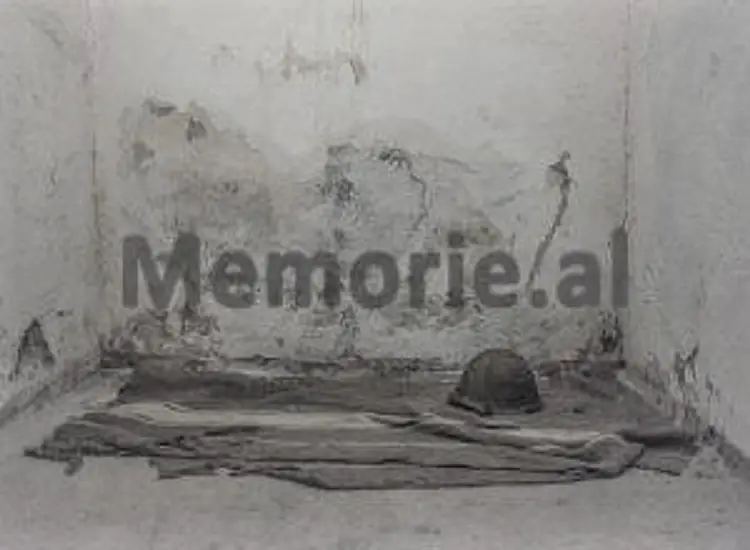
With my rags on my shoulder, my hands in shackles, and my legs trembling from weakness, I began the walk between two armed guards through the dark streets of the city until I reached the prison of the Franciscan Assembly. They placed me in a room with another unfortunate soul. I dropped my load on the floor, opened my mattress, and fell upon it as if dead. The guard tied my feet as well. With my hands and feet bound, I slept until morning. My “roommate” looked at me in astonishment. I told him I was a student. He told me he was from the village and was accused of cutting telephone lines. He swore he was innocent. Nonetheless, there was something about this youth that troubled me. Prison experience and suffering had taught me to be very cautious. I spoke little; I felt a massive need for sleep. When the guard threw the two rations of bread through the door onto the floor, I was asleep. The “roommate” had taken them, and after eating half of my ration, he had placed the other half near me…!
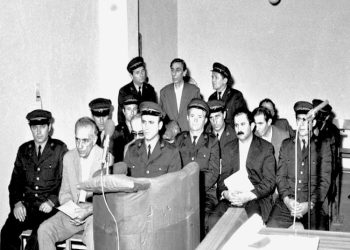
I woke up, found the bread, and ate it without question. The next day, when the bread came again, I realized the usual ration was larger. But it didn’t matter. After a night and a day without torture and with sleep, I began to recover. A day later, I received food from my family and clean clothes. I could not believe that the destructive period of torture had ended. The trial for me and my friends was being prepared. In anticipation of torture, during and after it, when all thought was focused on recreating every detail of the hours spent in the room of suffering, those who were frightened knew true fear – the fear that forces one to abandon the struggle undertaken and advises withdrawal, flight, leaving the world of resistance where people unite to live or die together. Others, with pain in their bodies, spoke, perhaps more than they should have. But when the torture ceased, if only for a single hour, they found themselves unshaken in their faith, filled with hatred for the “executioner” and contempt for their own physical weakness.
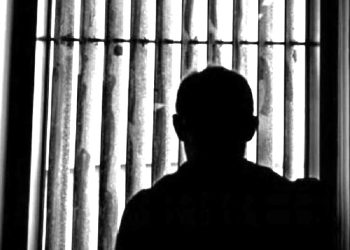
They were material properly prepared for the birth of soldiers of freedom – or criminals! The fundamental difference depended on loyalty to human dignity, on the living constructive hope or its absence and destructive hatred, on looking toward the future or living with the memories of a bitter past, the scars of which end in incurable lifelong wounds! Suffering without hope of an acceptable conclusion, without hope of release, made life impossible and prison terribly unbearable. Often, it seemed to me as if the true prison was not the four walls that crushed me day and night, but the fear I had that these four walls marked the permanent, final limit of my life space, and that the world behind them, on their other side, would never exist for me again. There I would die, and the sufferings of the past, the sufferings of the present, were nothing more than the natural flow of my unchanging life until death!
To die during the suffering, or immediately after it, was horror itself! Only the hope that life would not end here, and that days pregnant with “desires” would follow the black time I was living, enabling survival, would raise my morale, strengthen my endurance, and feed my mind with the most fruitful sustenance of a man who fights: the string of daydreams, often childish, yet saving and resurrecting, kept me alive!
Two weeks later, two armed guards took me during the day and escorted me to the main Sigurimi building. We climbed the stairs, which I now knew very well, knocked on the office door which opened, and entered. Behind a large and luxurious desk sat the “Major,” with whom I had “dialogued” several months prior. He told me to sit in a chair before the desk, ordered the guards to unshackle my hands, offered me a cigarette which I did not take, looked at me carefully from head to toe, and in an uncertain voice said to me: – “Did you hear that Qemal Draçini died?” – “No!” I replied. “I know nothing… isolated as I am, I hear only the guards’ footsteps in the corridor and the bang-bang of the heavy doors opening and closing all night,” I said, raising my eyes as if to say, “what else do you expect from me?!” but it was not true. – “He died!” he said. And looking toward the window, hands in his pockets, he shook his head slightly, letting me understand that a debate was unfolding in his brain.
Then, with a quick gesture, he turned toward me and continued: – “That’s how he wanted it!” with a note of regret that I noticed immediately. Changing his tone, he continued: – “He couldn’t endure the suffering any longer, the suffering of the prison… the intellectual who promised so much…!” Looking me straight in the eye: “You all expected a lot from him, didn’t you?!” he said. – “Yes!” I replied, crushed by grief, although deaths at the hands of Sigurimi officers did not come as a surprise. Raising my head, I couldn’t contain myself from saying: – “You too, Mr. Major! We all expected a lot from him. He spoke so much about the future, with such soul and self-belief, that he inspired… you might say… optimism in life…!” And with a bitter smile that unnerved the Major, I said: – “Qemal is dead! Albania seems poorer to me… I cannot bring myself to believe it…!” – “Still, you still haven’t woken up?! Hey, open your eyes! Don’t you see that the revolution is marching?! There is no obstacle that stops us. You, the bourgeois scholars… you… we will annihilate you…!”
And lowering his voice as if afraid of being overheard, he added: “…and especially those who promise as he did…!” – “Then why don’t you say that Qemal was killed? – We aren’t that stupid…!” Turning his back, he continued: “He consumed a significant amount of DDT powder and drank water…! Exactly as it should be… to die with great pain…! There is no doubt he was fully conscious of the suicidal act…! As for us,” he said turning back to me, “As for us… it’s better this way… one less enemy… one less execution…!” – “Why was Qemal scheduled for execution? – There was no hope for salvation when I last saw him…!” And in a low voice, he added: “I think he was right to think the way he thought… Qemal knew us well… he had read enough… heard enough… he had no illusions… and he would have ended by the stick or by the bullet…!” And with a cynical laugh he added: “It seems he was afraid of the stick… As for execution… I don’t believe he was afraid. He was brave… but, torture… torture is something else…!” – “Torture…!” “Stop!” he interrupted me.
And with the tone of a propagandist speaking before a silenced meeting, he continued: “Communists do not torture!” as if he wanted to calm himself. Sitting in the wooden chair, head hanging from the shock of Qemal’s death and complete physical exhaustion, it felt as if every bone of my body, crushed in torture by the uncarved wood, began to ache again, thinking of the final hours of my unfortunate friend. A great need to express myself, to shout out loud, overcame me. But the fear of punishment was greater in that place of torture. Nonetheless, I found enough courage to say: – “Mr. Major! I do not have the necessary courage to give the proper answer. Furthermore, what is my word worth today?” – “Speak!” he told me. “I came to talk with you, not to interrogate…! The role of the interrogator belongs to others…! You have completed the ‘process.’ Haven’t you?!” he asked. – “Yes!” I told him. “After thirteen months of heavy interrogation…! Therefore, what I say now, in this moment, when I speak and think more clearly than two weeks ago, is the truth.
It is I, as a man and a student with political convictions, more or less defined. I am for the freedom of everyone, Mr. Major, even for the communists. This is, you might say, my philosophy. Later, when you have completed the orders received ‘from above’…, it will not be me again; it will be only a body full of wounds and pain, speaking with the hope that further wounds and pain can be avoided…! I am no longer responsible for the words I am forced to speak…!” And looking him straight in the eye, I added: – “Mr. Major, my process is the process of a body crushed and full of wounds…, you must believe it!” He paused for a moment, not because he didn’t know this truth, but because of my open words. He thought a bit and replied: – “Regardless, we fulfill a duty, a duty that serves a historical process that we direct and that ends where we desire. Nothing else matters more to us today… naturally, not even the life of a worm such as you are today…!” – “A worm that thinks, nonetheless,” I replied, offended. – “Heh! That is why you are a harmful worm.” “If…! – If I didn’t think?” – “You wouldn’t be here… perhaps.” – “But would I be a… free worm?” I said in a half-whisper. – “Free…! Freedom burned you! You would be a worm like the others…!”
“Who do not open their mouths…, or who do not stop repeating the litanies of the new faith…!” – “At least they are feeding on the idea of a better future…!” “What was their past?” – “A void, you are right!” “But I have no doubt that even the present does not inspire them more. If before they had lost hope for a better life… today they are afraid for the very life they have…! How can he who might die at any moment, shot in a public square or locked in prison for life, wherever the Sigurimi pleases, hope for the future?” – “You’ve gone too far now. It isn’t quite that bad…!” – “Sit in my chair, Mr. Major. Look at the new world you are building through my eyes, hear with my ears the screams that rise today from one corner of the country to the other… everywhere in this land where life…!” – “Enough talk!” he turned to me in anger. And with a mocking tone: “You are a good lawyer for the reactionaries!” I did not answer. I was sure I had crossed the line. But he had encouraged me to speak at the beginning. Now, at the end, it seemed we both regretted what was said. Silence fell! He called the guard, and without another word, we parted, never to see each other again!
It was the second time I had spoken with the “Major,” and he knew my anti-fascist political stance well. Perhaps something remained in him that prevented him from behaving harshly with me. I exploited this weakness of his for a moment. But, simultaneously, I began to think that perhaps in his ideological fortress, a “crack” had begun… or was I too naive?! Now, in the presence of this “revolutionary” turned “Security officer,” I saw the embodiment of the degenerative act brought by the brute force of an imposed and constantly threatened authority. The possibility of a dignified life promised by the “revolution” he served and that had inspired him had evaporated before the burning desire for absolute power and the pleasure provided by the new dictatorship. The image of a brighter fate for the country and the people was darkened once and for all by lies, hatred, and the black cloud that the secrecy of the crime cast over the eyes of an entire nation. Everywhere blackness reined, everywhere stretched an indescribable darkness! Because of the daily crimes, the entire idea of freedom coming from the revolution was stained, blackened, annihilated.
The souls and hearts of many communist activists had rotted, just as the corpses of the victims left behind rotted in the streets and squares of the country, in the firing ranges, buried or still above ground—always stubborn monuments that would remind the living and those not yet born how great the weight of the crime was, and how deep was the void of a revolution without generosity, like communism in Albania! From the revolutionary surge of the National Liberation War, which promised the birth of heroes, the Albanian “communists” ended up in Stalinist militantism, which transformed them into typical anti-heroes…! On our return, we were approaching the Franciscan Assembly, where my cell was. In front of the entrance door, a large crowd of family members was trying to hand over clothes and food for their loved ones. The Red Guard insulted them, pushed them, spat on them, but they stood their ground. My guard tried to clear the way through this wretched crowd. Suddenly, I saw my mother and our eyes locked.
It had been more than a year since we had been parted. I tried to smile. She saw me and rushed without thinking at all toward me, hoping to embrace me. But she had taken only one step when the Red Guard kicked the old woman, dressed in black, in the stomach. My mother fell to the ground, clutching her injured belly with her hand. Immediately, the guard pushed me with force. – “What are you looking at, you swine?!” – he said. – “It is my mother,” – I replied, as I crossed the threshold of the prison door. After a moment that seemed as long as a year, I couldn’t contain myself from saying: “I would never kick your mother!” The brutal guard looked at me for several moments with the eyes of an idiot who hears but does not understand, and called the corporal of the guard: “Take this prisoner into custody!” he said. Two minutes later, I was back in my cell, with a troubled mind and a broken heart. In the cell, I found two new young prisoners, villagers from the plains of Trush. I greeted them with the joy that the presence of two living people near me brought after a long isolation. They returned the greeting without any interest. I understood I was dealing with tortured souls who are afraid to speak, or with youths unaccustomed to prison. I sat on my rags, spiritually wounded by the scene of the policeman kicking the old and despised mother. Memorie.al
To be continued in the next issue