By Agim Janina
Part Two
Memorie.al / Getting to know Ibrahim Kodra happened as it does with any artist. First, you happen to hear about them and their work, and later comes the opportunity to meet them. The artist lived in Italy and news of him was scarce, but in meetings with his contemporary painters, his name was rarely mentioned. His works were unknown. People whispered that they were “modern.” In the Art Gallery, there was a landscape of Tirana that few had seen. The fame of the painter’s name arrived unclearly, intertwined with legends and truths. It was known he was from Ishëm (some think it means “the beautiful”), where he spent his childhood, while his early youth was spent in Tirana. Having left for Italy, he was a “great absentee.” While researching the School of Drawing, his name was present in every conversation held with his contemporaries.
Continued from the previous issue…
Kodra’s acquaintance with Picasso piqued my curiosity and brought back an old saying by a painter, which had always troubled me regarding its truthfulness. It was said that Picasso had stated that Albania is a country where painters are born. I asked him.
– “I don’t know if he ever said that. Picasso said that Albania has a people who have suffered, but who are born with various artistic vocations,” he replied and continued, “Hemingway also came to Milan to film The Sun Also Rises (Il sole sorge ancora), based on his book. They set the film to an Albanian song that I brought from Albania, about partisans.” Kodra began to sing softly:
“The wheat has begun to ripen
All of Albania has risen to its feet.
Albania, you are… a mother
Full of partisans
Albania, you are a heroic mother
Full of Bolsheviks, hey!”
They liked the song so much that all the communists knew it by heart. The film’s director was Aldo Vergano, and it was scored with this song – a catchy tune. When the book Songs of the Resistance was published, I did the cover illustration, and they included this song inside. I had dinner with Hemingway. A simple man, but he drank…! The greater people become, the simpler they are.
Kodra fell silent again. We looked at each other. This was something unheard of. Names like Picasso, Hemingway, Quasimodo, and Eluard were mythical in Albania, and it was the first time they were pronounced with such ease by an Albanian painter, leaving a flattering impression on everyone. Kodra was the inspiration for the soundtrack of a film based on the novel of the great writer Ernest Hemingway, and he said this quite simply, without any boasting!
The film was also remade by Hollywood, starring famous actors like Ava Gardner and other distinguished performers. Much later, while digging into this fact, I learned that the poet Mario De Micheli would state: “The Song of April 25th was made exactly during the days of the uprising, when the partisans entered Milan. I learned this Albanian song from an Albanian painter named Ibrahim Kodra, who at that time was at the Academy and was connected to the group acting among the Resistance intellectuals.”
And elsewhere it is read that this simple song was born in the hot days of the war when the partisans entered Milan. It is based on an Albanian melody, hummed by the painter Kodra in a neighborhood bar in “Brera.” Over this melody, lyrics were improvised by various poets, artists, and intellectuals present. It is part of the Italian Resistance Songs.
Before we could fully catch our breath, Kodra began to say: – “Eugenio Montale, the Nobel Prize winner (1975), made a book, Fifteen Years of Poetry, Fifty Works by Kodra. Today I am the most prominent painter, and the most beautiful things have been written about me: ‘Kodra, the greatest painter of our century,’ ‘Kodra is a universal symbol,’ by Carlo Bo, a great writer.”
– “Did you know Salvador Dalí?” – a student who had been listening to the painter’s narration for a while interjected.
– “Dalí? Of course. A bit of a… (laughs) he was extravagant! When I first went to Paris, I saw four people carrying a huge loaf of bread, ten meters long, to his studio. It was written; ‘Bread for the workers,’ Dalí. (Laughs). He used it in a painting.”
– Did you know Georges Braque?
– “I didn’t know Braque personally. I knew the one who started the School of Cubism in France. Braque was there too, of course. I started painting in Milan, but I’ve been to Paris, where I saw and knew many artists like Breton, Picasso, and Aragon, who practiced modern painting. Surrealist painting was created by André Masson, Breton took it from him, and then he went to America and passed away there…!”
Kodra fell silent again. Renzo Calzavaro intervened, saying that Kodra had met and known Afro Basaldella in Padua. When he went to Venice, he was a friend of Tommaso, a friend of Guttuso – world-famous painters. The Maestro has a beautiful quality: he never speaks ill of other painters. He always speaks well. However, there are many painters, not at his level, who speak only ill of others.
The Maestro always speaks well of his colleagues. This is his nature. “Why should we speak ill of others, to confront them?” – he used to say. Kodra’s collection in Milan is very large, and not only in Milan, but throughout Italy. I have many things from Maestro Kodra. Here are some paintings that are mine, which I bought from him. I have been following him for several years.
The painter returned to the conversation and, in that steady, calm way, we continued. At one point, I asked him how he had maintained ties with Albania and how it appeared on his canvases. He smiled and replied:
– “Albania for me has been the greatest inspiration, because I have always worked thinking of Albania. Some critics have said that I work as if I have the costumes, the dress, the life of Albanians, the land, and the colors in mind – having always before my eyes the hills and mountains of Albania. I remember Qafa e Shtamës, where the water was like ice, Mamurras, that great day…! Albania has always been in my soul. I was born here; I grew up here in my childhood. These are memories of great importance.
I have taken from folklore, from the life of my people; I have continued, always having the greatest inspirations. My advice is a connection with the country; one must work by living with our customs, our folklore, our clothing. This has made an impression on my work too. I draw inspiration from the Albanian people, which are why I have always said – let the whole world know – that Kodra is always Albanian.
Albania has produced great painters, poets, writers, and musicians; it has given great projects, it has given everything. When one sees bambini (children) sleeping in the streets, problems with people walking barefoot, then Mother Teresa comes to mind – meaning her greatness, from a humane, human perspective, which crossed all boundaries of humanity… who receives the greatest rewards from the Albanian people and the Albanian land.
I am very pleased with Albania. I feel as if I am in my own home, because the Albanian people gave me those spiritual tools, so that if I have a name today, I owe it to the Albanian people, and to those who gave me lessons to move forward.”
-In painting, what do you give more importance to: line, color, or composition?
-“Composition, because it is of great importance. Also form. Composition is form. Form, meaning, represents the way of expression in art and poetry. The colors then come on their own.”
-Did you have a favorite color?
-“I have always been asked this question. I have said everywhere that I seek to present the colors of life – colors make life – the colors of the sun, water, and earth. There are three colors that have made human life.”
-Can we say that Albania is a country with beautiful colors, a strong sun?
-“Yes, it has many beautiful colors, truly beautiful colors. Colors are very much loved here… I am inspired by these colors.”
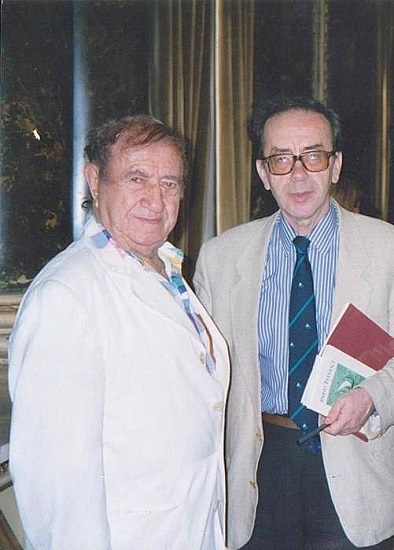
Then Kodra began to speak about the meeting with the writer Ismail Kadare.
-“Kadare came to Milan in ’73 to meet me. With some other friends, we gathered and spent a night together. Kadare told me; ‘Kodra, you must send some catalogs to the Cultural Center in Tirana, because they don’t know you.’ I sent them, and then they invited me to Albania. They took me to Ishëm. And besa (on my word), we even went to the Academy of Arts. And besa, we did a lot…!
Foto Stamo sent me everywhere; he took me around here in Tirana, as far as Krujë and Shkodër, then he hosted a dinner at his home. Paskali was there too, who said: ‘Kodra puts in his catalog that his first professor was Paskali; this means Kodra has not forgotten Albania!’
To tell the truth, before Albania, Kosovo recognized me first. Why? A journalist from Zagreb had a meeting with the poet Quasimodo in Milan. Quasimodo was with me and introduced me. He was surprised. Those from Zagreb loved Kosovo. He wrote an article in Telegraf. This article was read by the director of the Zagreb Library, whose name is Aleksandar Stipčević.
He knew the professors of Kosovo, and then they came to see me in Milan because the interview had been done for Rilindja. So, in 1955, I held my exhibition at the People’s Theatre, near Bozhuri. The famous Albanian actor Bekim Fehmiu also came. They asked Bekim what he had to say about the exhibition. ‘I have no words!’ he said. ‘I know painting, but I know the Picasso of Kodra!’ That’s what Bekim Fehmiu said, the one who played Ulysses.”
-When did your transition to Cubism happen and why?
-“In 1945, we created a group in Brescia to adopt some trends. At that time, there were things like abstractism and cubism; we chose cubism because in cubism there are three dimensions, whereas abstractism has two.
In Italy, too, they want to hold many exhibitions. Art is difficult, and you have to participate in competitions, in many things. It is not easy. In 1938, when I went to the Academy of Arts, you must imagine that 50 people graduate from the Academy every year. In seventy-some years, how many do they become? It is very difficult because many failed; some became teachers in schools, others went to publishing houses to do drawings for books, illustrations. It’s not easy, besa; you have to work hard.”
The painter fell silent and took a breath. I lined up some questions, to which he replied briefly.
-Can we talk about any crisis in art today?
-“Yes, yes, there is a crisis, because the world is much politicized. They have closed galleries in Paris, in Milan,” – Kodra concluded, and as he fell silent for a moment, I noticed his eyes grew misty, and suddenly he began to sing:
“I lay down and slept
Sleep did not find me
I was dreaming across the river
Oh, you blonde-haired girl
Who was born in the town
Come, come, I will take you
To have you forever
Oh, you playful blonde girl…”
We began to smile, and Kodra added: “The girls of the Lyceum loved me very much.”
The student didn’t wait but replied:
– Was it because you were gentle?
Renzo Calzavaro chimed in:
– The professor, gentle?!
He cast a quick glance at the young girl and added in his slightly hoarse voice:
– “I was gentle, sweet…! Kodra, they used to say I was very handsome. I didn’t know it myself. If I am handsome, it is not my fault; my mother made me this way.”
– Paskali spoke to me about you as a very spirited boy.
– “I was a great student…!”
– And that you made beautiful drawings.
– “Of course, my drawings were always published in newspapers during the war. I worked a lot. When I was young, 15–16 years old, the authors we read most were Gorky, Yesenin, and Dostoevsky. I read many different books, theories from all over the world. The director of a magazine in Milan, whose son was my friend and later became a philosopher – when we went to dinner together once, the director told his son that Kodra is a modern encyclopedia, he knows everything.
When they asked me about art and everything else, I answered immediately. Art is a relationship between science and freedom. Poetry is the same. According to Freud, poetry is born from within the person and seeks to show the true reality of life itself. Psycho-poetry is something else; it’s not that it must be explained, the people must understand it themselves.
It gives only the meaning, or when you don’t know what it means, it is guessed – like, for example, Marc Antony’s speech at Julius Caesar’s grave. By speaking well, saying that ‘Bruto è uomo d’onore’ (Brutus is an honorable man), Brutus is this and Brutus is that, who loved Caesar – by speaking well, he made the people understand, without them knowing, that he was not such a man…!”
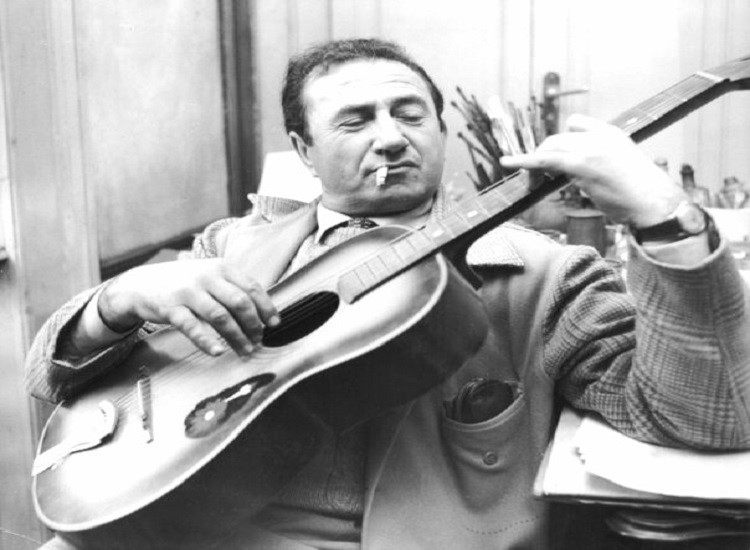
– Did you also engage with music? Did you play the guitar?
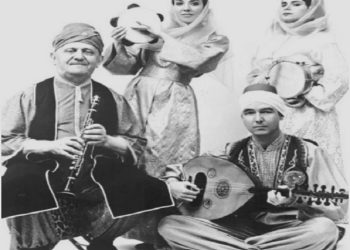
– “Yes, I play the guitar, the mandolin. In Albania at that time, schools were strong. In them, we learned music, guitar, mandolin, and we formed piccoli complessi (small ensembles) with tambourines…!”
Kodra feels aggrieved by what was written in the press by some artist who attacked him for his values. One of the managers had talked a lot and stated that he had caused a lot of trouble, so during his speech, he began quoting what they had written about him.
– “As a draftsman, I was the best of them all; I won 200 awards, do you understand? The French Academy gave me the Gold Medal – the only one in Italy. My name is in many museums, in books, they have put me in encyclopedias…! I have made 6,780 works. They are all over the world, here and there, because I had 12 agents working for me…! These great, well-known people spoke.”
– Do you have friends in Kosovo?
– “Of course. They welcomed me very well. We were friends with Muslim Mulliqi. Gjelosh Gjokaj, Rexhep Ferri, Xhavit Nimani.”
– In the Art Gallery, there is a blank white wall that has the name ‘Kodra’ written below. Will you leave any work for them?
– “I believe so… yes, they should have a work of mine…! I have made some paintings that I have dedicated to Albania. One is titled ‘Fantastic Albania’.”
The greatest wonder is that the greater they are, the simpler they are.
– Are you satisfied with life?
– “Very, very satisfied.”
– Have you received what you wanted?
– “Yes, besa,” – Kodra smiled and added slowly, – “I didn’t want anything; they gave it all to me.” / Memorie.al