


– An Unknown Portrait of Julian Amery: The Sworn Enemy of Communism in Albania, Whose Brother Was Sentenced to Death by Britain After Betraying His Country to Join Hitler and Mussolini –
Memorie.al / On a winter evening, my knocks on the door of a house in the affluent Belgravia district of London were answered by a lady who appeared to be in her 30s. She was tall and slender. Her face and two small, sparkling eyes behind “John Lennon style” glasses offered a warm welcome. “Father is waiting for you,” she said with a smile. It was incredible how much this lady resembled the actress who played Rocky Balboa’s wife in the film of the same name, starring Sylvester Stallone. This was the daughter of Lord Amery – or Julian Amery, as this significant personality is better known among Albanians.
The houses of British aristocrats retain a special traditional charm, but in most cases, they are somber. Classic furnishings, including the carpets and curtains, do not allow for elements of modernization. The English, when receiving guests – especially journalists – show great care. They dress impeccably, and a tie is an indispensable part of the attire. To my surprise, Lord Amery was not dressed in this customary manner. Over green pajamas, he wore a long dressing gown used at home during the day and night.
The Lord struggled to stand or made an attempt, as I thought, but could not. His effort ended with a slight movement from his seat. We had discussed an interview several times, and finally, the moment had come. The personality of British colonialist, interventionist, and imperialist policy – as some would call him – and the legend behind the conception and execution of secret operations, now sat before me.
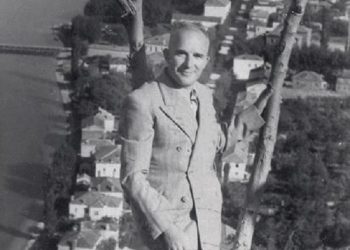
I took out the Dictaphone and placed it on the table near a bottle of whiskey, from which the Lord had consumed at least one glass. (Later, I assisted him with one or two more). The significant unfolding of history began, in which he had been a participant. Later, I also took out my camera, which I had loaded with film – the best kind (Kodak 400) – so as not to fail; one of those shots is the one you see in this post.
Lord Amery did not feel well. In his eyes, one could see a fatigue mixed with a profound sadness. He was around 74 years old, but life, with its hyper-condensed dynamics, had exhausted him. In reality, by the end of the conversation, I realized he had honored me with the interview despite being ill and despite my initial judgment of his attire. Perhaps he had done this for himself as well – to say a few things before leaving this world. We did not meet again, and a year later (September 1996), Lord Amery passed away.
The Amery family was prominent with a long political tradition. Julian Amery’s father, Leo, held several state functions and was among Churchill’s closest friends. Continuing the aristocratic tradition, Julian was educated at elite British schools – Eton College and Oxford University. As a student, Julian became known to the British public due to his romantic relationship with the writer Barbara Pym, who was significantly older than him.
During World War II, the Amery family faced a serious crisis. Julian’s brother, John, was a fascist who went to Germany to join Hitler’s state apparatus, where he conducted propaganda against Great Britain and the USA. Later, he assisted Mussolini until, at the end of the war, he was captured by British forces, brought to London, and sentenced to death (hanging) for treason. This was a heavy stain on the Amery family. However, Great Britain is a democratic country where responsibility is personal and does not cross these boundaries. Thus, this did not prevent the Amery family, particularly Julian, from holding high state offices after the war.
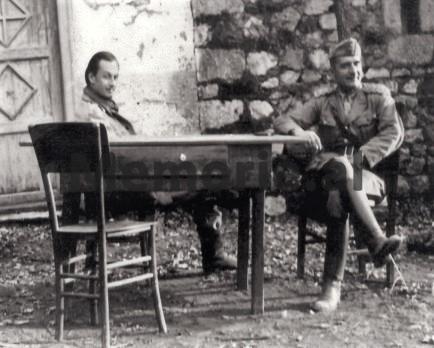
During the war, Julian Amery displayed patriotism and heroism. Among other actions, he entered history for his role in Albania and later for his advocacy regarding Albania. In 1943, Julian Amery, David Smiley, and Billy McLean were sent to Albania as liaison officers with groups fighting the occupier. Due to their shared mission and close bond, they were called “The Three Musketeers.” First, they went to Enver Hoxha’s partisans and later to the nationalist forces, which they preferred over the communists.
In 1944, London decided to provide more support to Enver Hoxha’s partisan forces, just as they did for Tito’s in Yugoslavia, and the “Three Musketeers” were withdrawn from Albania. This decision by London – specifically by Churchill – which enabled the communist victory in Albania and Yugoslavia has sparked a debate that continues to this day. It created a basis for conspiracy theories suggesting that within the British command in Cairo, and later in Bari, there were communist officers who influenced this decision. However, this is not true. Churchill decided to support the partisans because these forces were more active in the fight against the Italian and German occupiers.
In 1948, the “Three Musketeers” were reactivated. The Cold War had begun, and things were shifting. Communist Albania was becoming a Russian military base, while Yugoslavia was distancing itself from Russian influence. Greece was in a state of chaos. In response, at the highest levels, the British and Americans drafted a plan: to pull Albania out of the Soviet communist sphere. If successful, this would stabilize Greece and create a complete anti-Russian line, providing security for Western Europe.
Consequently, one day the British Secret Service (MI6) contacted Julian Amery to ask if he would accept a role leading the political implementation of this plan. Unbeknownst to Amery, the service had also contacted the other “Two Musketeers.” All three considered the mission in Albania a personal matter, as they were embittered that their nationalist friends had lost the war; now was the chance to correct that injustice. Therefore, they accepted the task with great pleasure.
Julian Amery traveled to Rome to perform a “Mission Impossible”: to create political consensus among the Albanians. And he succeeded. There he met Vasil Andoni, but two other prominent figures were missing: Mit’hat Frashëri and Abaz Kupi. Abaz Kupi was stranded in Greece, and the state would not let him leave. But with the help of MI6, Abaz Kupi was brought to Rome, even traveling by plane from Athens.
When Mit’hat Frashëri arrived from Istanbul, Amery also met Ahmet Zogu and revealed the plan: a force of Albanian subversives would be sent into Albania to expand activities to overthrow Enver Hoxha and topple communism. Then, free elections would be organized, democracy would be established, and Albania would enter the Western sphere, receiving full economic and political aid from the British Empire and the other superpower, America.
Despite divisions and hesitations, these Albanian personalities could not reject a plan that seemed ideal. Organization began quickly, and volunteer recruits signed up in numbers exceeding what was needed. In Malta, David Smiley began their training. The plan required the support of Yugoslavia and Greece. Washington and London ordered their ambassadors to meet Tito and secure his backing. Since Tito had broken with Soviet influence and moved closer to the West, it was thought he would support the Anglo-American plan for intervention in Albania.
But it did not turn out that way. Tito, being a strategist, realized this plan was dangerous for him too. According to the plan, Albania would leave communism, democratize, develop economically, and come under Anglo – American care. Therefore, Tito – advised by Kardelj – categorically rejected the plan and refused to help in any segment. Ultimately, why would Tito help a foreign plan when he had his own plan, through which he constantly kept Albania under influence and pressure?
Julian Amery went to Greece to secure aid so that the subversives could be assisted if they had to retreat from Albania into Greek territory. This, too, was a difficult task, but he managed to get a promise from the Greek army and police. Thus began the implementation of the plan, which – as is well known – ended in a debacle, leaving Albania at the mercy of brutal communism.
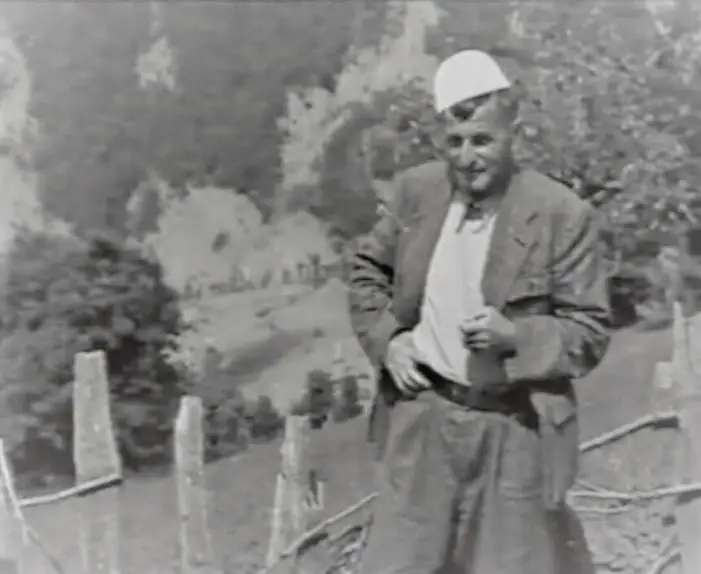
Nevertheless, Julian Amery remembered an interesting moment that occurred at his home when he brought members of the “Free Albania” Committee involved in this plan to London. After lunch, they went for a walk in the garden. Abaz Kupi saw a snake in the garden, ran after it, and caught it. Being a man of the countryside, he was not afraid of snakes. But he chased Mit’hat Frashëri around the yard with the snake; Mit’hat, being an urban type, ran away in fear. Amery would say with humor: “Abaz wanted to test if the snake was poisonous.”
Regardless, Julian Amery considered himself a friend of the Albanians. However, facts exist proving that during a lunch at the Yugoslav embassy in London, when discussing Albania, Amery suggested that partitioning the country between Yugoslavia and Greece might be a good solution. This is perhaps a careless statement, but highly problematic for someone who calls himself a friend of Albania! Yet, one must keep in mind that among British politicians, there existed a great love for Yugoslavia, especially Tito’s Yugoslavia. This remained the case until 1997, when Tony Blair changed the course. / Memorie.al