By Ilirjan Gjika
The Persecution of the People of the Orthodox Church / Testimony and Facts from a Prison Diary
Memorie.al / Fier is one of the cities whose history is not lacking in facts and testimonies of persecution during the communist years. Such events began immediately after the establishment of this regime, when under absurd accusations, punishments and persecutions took various forms. Such was the fate of many people who had served in the structures of the Autocephalous Orthodox Church of Albania, whose only fault was that they were “unsuitable” for the new regime. In Fier, we can mention the cases of Sotir Bitri or Vangjel Lule, well-known names in this city, whose lives followed different fates.
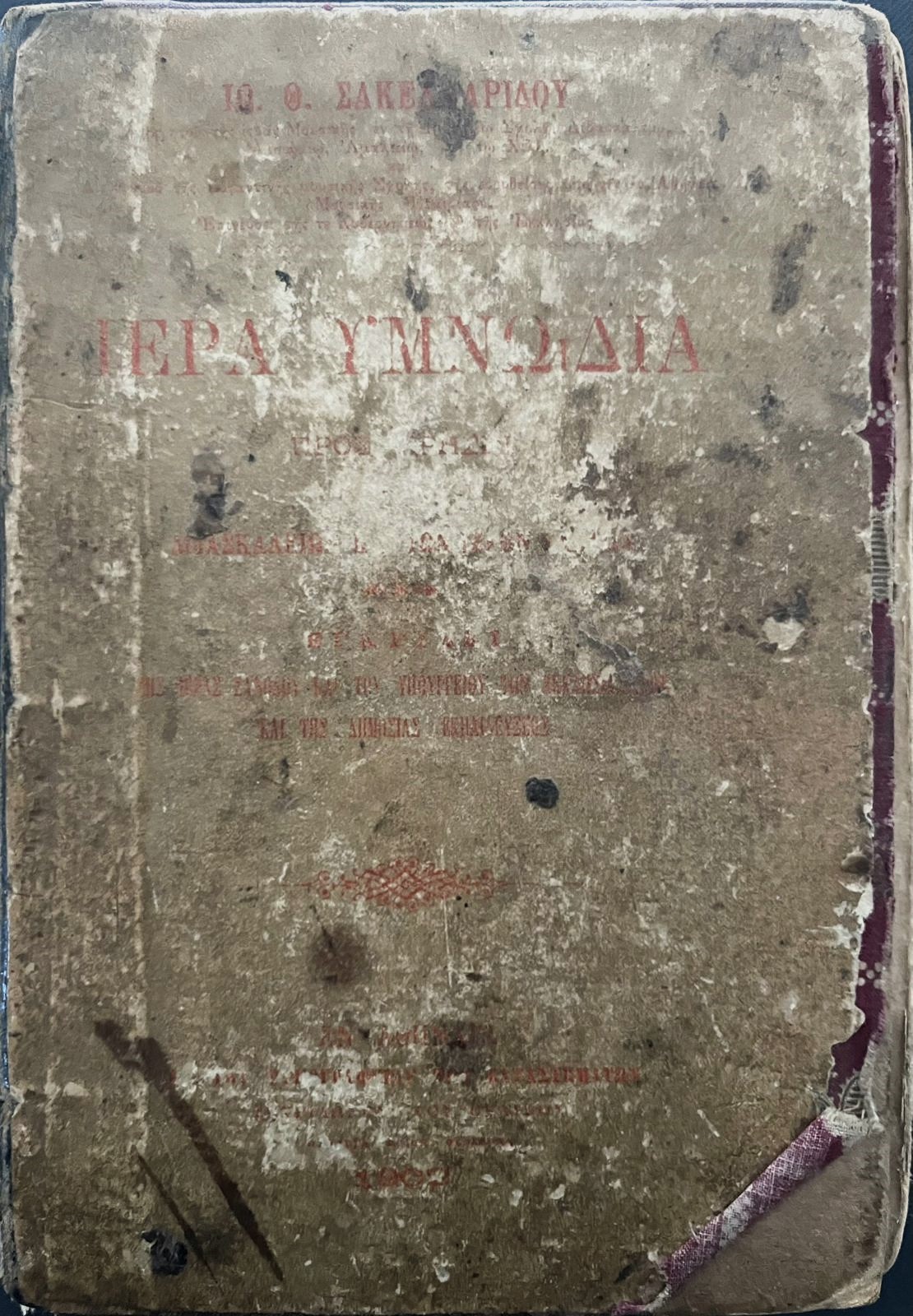
“Even though company in prison is valuable, this book here became deeply comforting and an inseparable companion amidst great sorrows and the limitation of freedom,” – wrote Vangjel Lule in his notes kept in the prison of Fier, dated June 1, 1949.
Written in lead pencil on several scattered pages of a book of church hymns, this short diary informs us directly about the persecution of these men, who had played an active role in the democratic and social developments of the country.
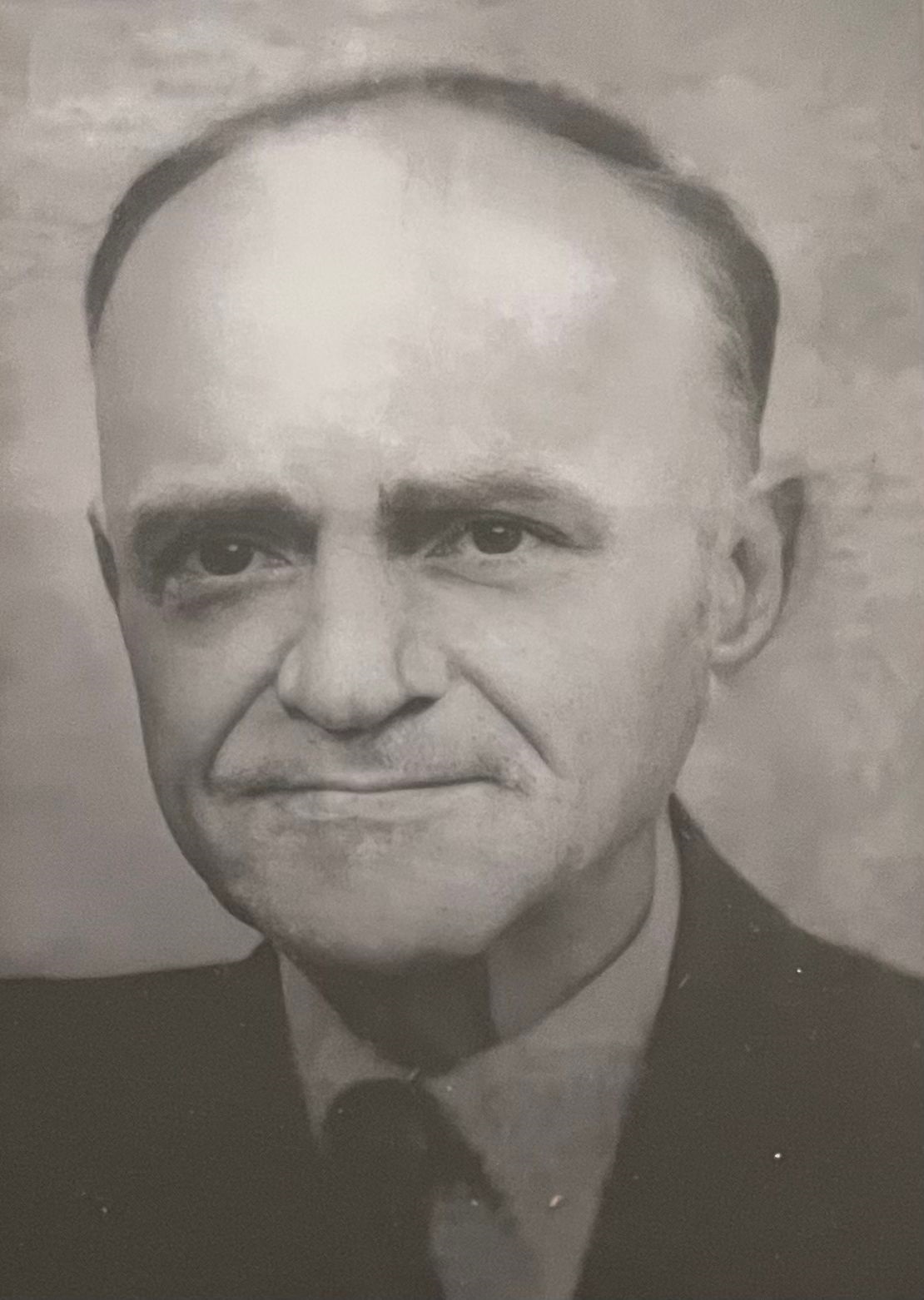
One such person was Sotir Bitri, the city’s first pharmacist, a well-known and reputable individual in Fier, Berat, and beyond. There are a series of documents in the Central State Archive that testify to his activity and participation in local institutions, private enterprises, and various state entities during the period of Independence.
In addition to his duty as a pharmacist, which he performed for many years with correctness and professionalism, Sotir Bitri served as the Mayor of Fier from 1920 to 1922.
In the local elections of 1922, he was one of the members of the municipal council who received the most votes. Meanwhile, in 1929, Bitri appears as one of the members of the board of directors of the Fier Chamber of Commerce.
Likewise, in a document dated September 6, 1937, Sotir Bitri’s name appears as one of the members of the Initiating Commission of the Society for the “Irrigation of the Plains of Myzeqe,” an association of private entrepreneurs involved in the irrigation of agricultural lands.
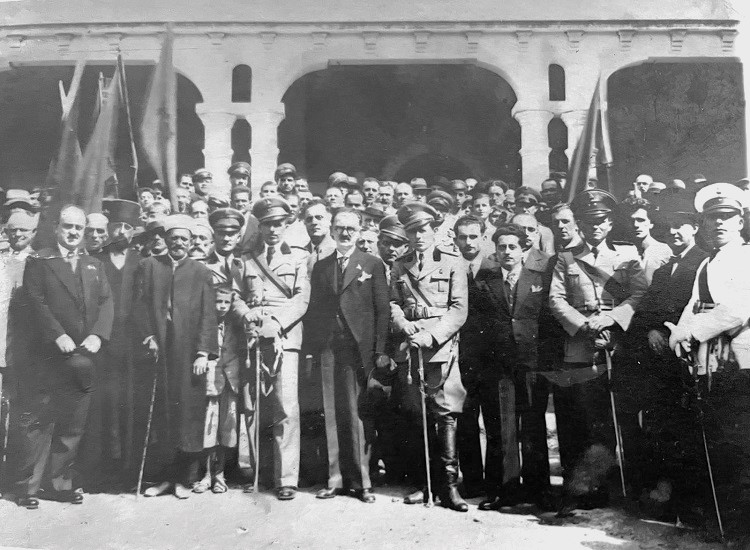
Meanwhile, like many others, he was a participant in the Fier Uprising of August 14, 1935. Along with Dr. Kostandin Kallogjeri, Dr. Musa Delvina, Ramiz Omari, Idriz Bylo, Taqi Bozo, and Duran Qadhimi, Bitri was part of the Administrative Commission, the body that took over the management of the city of Fier.
For his participation in this event, he was sentenced by the Special Court for Political Offenses, by a decision dated September 9, 1935, to 101 years in prison, a measure that was later amnestied by King Zog. But Sotir Bitri was also one of the representative personalities of the Orthodox Church.
According to the Book of Decisions of the Commission of the Church of “Saint George,” which is preserved in the Document Fund of the Fier Historical Museum, we encounter him not only as a member of the Church Council (Demogerontia), but also as the Vice-Metropolitan of the Orthodox Vicariate of Fier between 1929 and 1942.
In this context, the writer Jakov Xoxa, who dedicated the most important part of his work to the history of Fier and Myzeqe, placed Sotir Bitri as a character in his writings. Specifically, in the novella “Three Elders and Mihali is the Fourth,” published in 1958, Xoxa labels him not only as a spicer (pharmacist) by profession, but also as an epitrop (church warden).
“That year, the cross was being thrown neither in the mild nor in the frosty waters. The Germans were swollen [stationed] at the girls’ school, in the mill barracks, and had spread up the church square. The bridge over the river, from which the cross was thrown into the water every year, had become a manger, and to its railings, livestock were tied, brought down like loot from the mountain.
The women did not dare go to church through the feet of the fascists, and the priest and the warden struggled to find a remedy. And though the warden happened to be a pharmacist (spicer), the remedy was not found, and that year it was fated that the cross remain hanging on the bishop’s chest, without kissing the water,” – he writes, among other things.
Meanwhile, Sotir Bitri would pass away tragically in the prison of Fier in 1949. We find this fact in the aforementioned diary of Vangjel Lule, in the entry dated March 15, 1949.
Precisely here, between the written lines, we read: “The late Sotir Bitri died on March 15, 1949, towards Tuesday morning, as a prisoner for extraordinary profit taxes. May God forgive him and may the earth lie light upon him. Amen!”
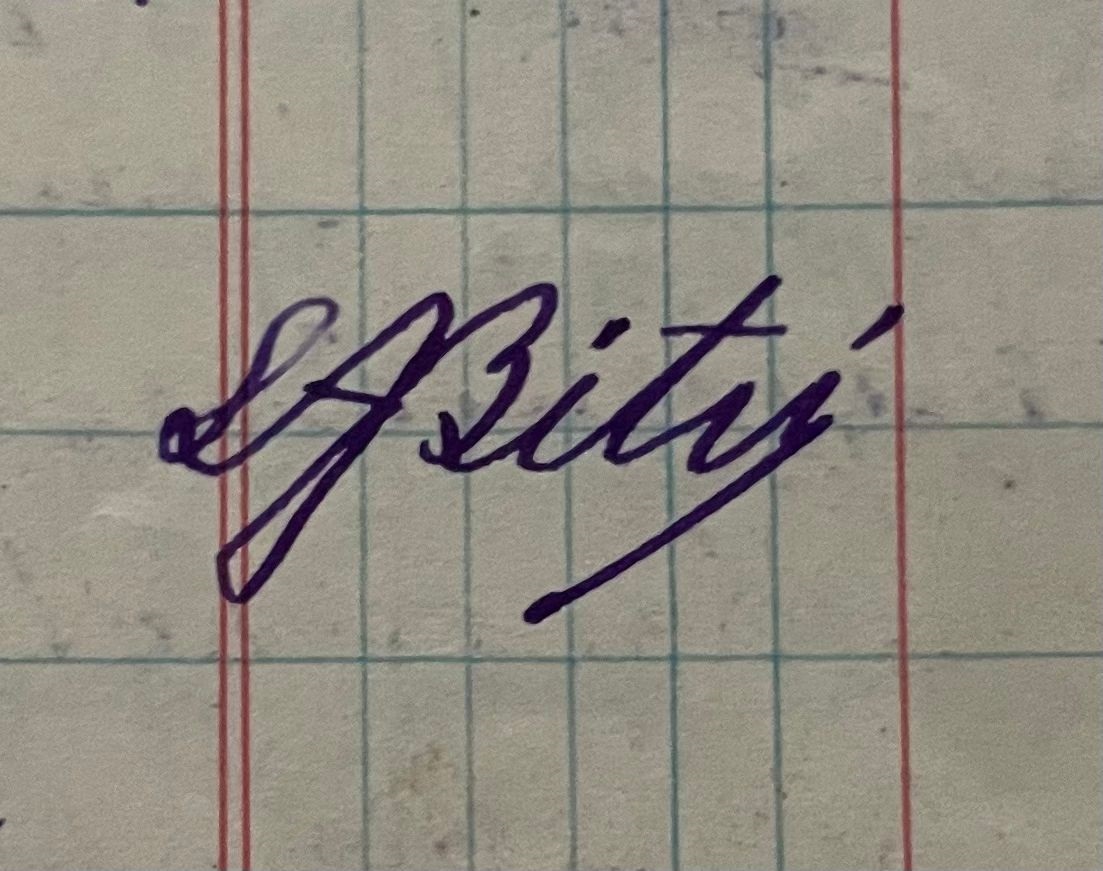
At the time, Sotir Bitri could never have imagined that in the book he gifted to his friend Vangjel Lule on February 5, 1942, his own tragic death would be recorded. Nor had the latter imagined that these notes would later be handed over, along with other books, to the Fier Historical Museum!
But who was the patriot and prominent activist, Vangjel Lule, the keeper of these autobiographical notes? Born in Fier on March 1, 1892, he was known to the public as a friend and collaborator of Fan Noli, an activist of the “Vatra” Federation, a participant in the War of Vlora, a member of the “Bashkimi” (Union) Society, etc.
During his years of emigration in the USA (1910–1920), in addition to his activity as a lyre player (psalt) at the Church of “Saint George” in Boston, Vangjel Lule published the book “The Lamentations over the Grave of Our Lord Jesus Christ,” translated into Albanian by Fan Noli.
After returning to the homeland in 1920, he served as a lyre player at the Church of “Saint George” in Fier, and as secretary-accountant and Vice-Metropolitan in the Orthodox Vicariate of Fier. From him, we also have a series of historical memory testimonies, including events from World War II and the liberation of Fier.
Vangjel Lule passed away on November 19, 1965, and as a sign of respect, one of the squares in the city of Fier today bears his name. In the diary in question, Vangjel Lule also tells of his own painful experience.
“They put me in prison on 23.8.1948 and I was released on 4.9.’48, after I sold everything I had; they put me back in prison on 16.10.1948, for second extraordinary taxes that I did not owe the state and did not possess. Fier, prison, Wednesday 1.6.’49.
May God save me from this hell,” – he writes in another passage. Nevertheless, this patriot and prominent activist would be released from prison and reintegrated into daily life, where he would perform valuable services to the state, the church, and society.
He personally took care of and delivered to the Metropolis of Berat in 1957 the Codex of the Monastery of Saint Cosmas. Otherwise known as the Codex of Fier, this manuscript, with historical and ethnographic value for the Myzeqe region, is preserved today in Fund 488 of the Central State Archive, part of the collection of the Codices of Albania.
Meanwhile, in addition to the diary in question, Vangjel Lule left other notes in books that once belonged to the Church of “Saint George.”
Today, they serve as documents of great value regarding the historical developments of the Orthodox Church, its people, and Fier. Among these, we can highlight descriptions of the city, the invasion of April 7, 1939, the English bombing, its liberation on October 15, 1944, etc.
As part of the Document Fund of the Fier Historical Museum, these notes are now open to researchers in the field and the public, thus witnessing a piece of history and collective memory. / Memorie.al