

From Prof. Dr. Colonel Memush Habilaj
Part Two
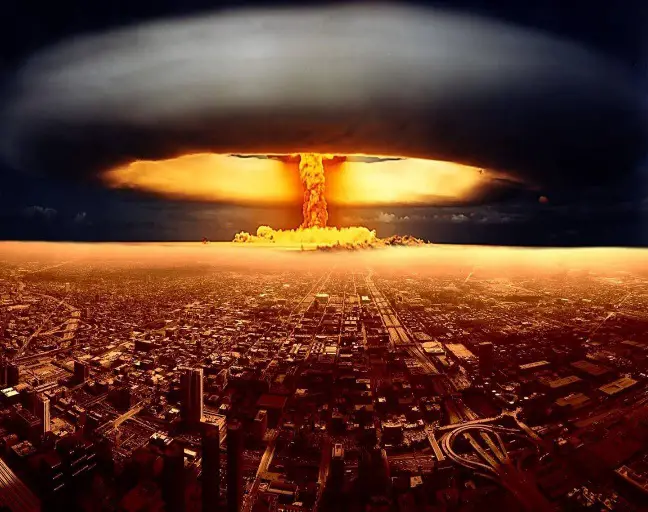
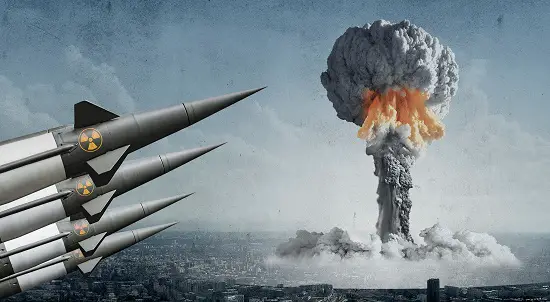
Memorie.al / The Nuclear Weapons Era for humanity opened on August 6, 1945, the date on which the US dropped the first nuclear bomb on Hiroshima, Japan, conventionally named “Little Boy,” using Uranium-235, followed by the second strike on Nagasaki on August 9, 1945, with the bomb named “Fat Man,” using Plutonium-239. This nuclear attack caused up to 140,000 human casualties in Hiroshima alone, destroyed 50,000 buildings, and caused other incalculable damages, accompanied by long-term consequences for people and the environment.
Since the first nuclear test explosion on July 16, 1945, and until today, nuclear powers have conducted 2000 nuclear tests (on land, in the air, underground, and underwater), bringing consequences to the environment, human health, and degeneration in the planet’s climate. Nuclear weapons are weapons of mass destruction; their damaging effects are unlimited in space and time.
Continued from the previous issue
The Hiroshima Disaster – Nuclear Strategy and Scenarios of a Possible Nuclear War
For humanity, the nuclear era began with the first strike in history carried out by the US on the Japanese cities of Hiroshima and Nagasaki. Simultaneously, this marked the beginning of the Cold War (1945–1990). From the single nuclear power state, the US in 1945, by 1990, the world had 9 such powers, with a formidable nuclear arsenal. During the Cold War period, nuclear powers pursued a universally accepted policy based on maintaining a global nuclear balance, which guaranteed international stability.
The nuclear arsenal served as a tool of forced persuasion, intimidation, blackmail, and pressure to maintain this stability. In accordance with this global policy, a series of agreements were undertaken between the nuclear powers for the limitation and non-proliferation of nuclear weapons (N.W.), such as the SALT-1, SALT-2 agreements, etc.
But within international policies, the armed forces staffs of each country developed military doctrines for the concrete use of N.W. in combat operations, without worrying much about the grand policy. In the countries of the Eastern Bloc, the former Soviet Union (Russia today) and China as nuclear powers, the principle of “No First Use of N.W. in an armed conflict” (“Non First Strike” – NFS) was accepted, a principle which would aim to form the basis of global nuclear ethics. However, in their 1980s military doctrines, it was stipulated that a nuclear strike could be launched against any state or coalition of states, whether or not they possess N.W., that undertakes a large-scale aggression against their country.
The US has never accepted such an NFS principle but has reserved the right to use N.W. in any military conflict, both for its own interests and for the defense of its allies worldwide, based on the “Nuclear Umbrella” strategy. In 2010, the US (President Obama) accepted the NFS principle, the limitation of N.W. non-proliferation, and nuclear disarmament, and in 2014, they reached a nuclear parity agreement with Russia.
All nuclear powers have concentrated the authority to order the use of N.W. in the authority of the country’s president, who makes the decision with the advice and approval of the Minister of Defense and the Chief of the General Staff of the Armed Forces.
The Armed Forces Staffs maintain ready the plans, structures, potential scenarios for the use of N.W., and the control and launch systems for N.W. over any point on the globe and at any time. Generally, in their nuclear strategy, these staffs initially foresee two scales of nuclear strikes:
- The First Strike: A preventative nuclear strike, a preemptive strike, delivered against targets of special importance to the adversary, with the aim of making it impossible for them to launch nuclear strikes. This is achieved through strategic aviation or missiles held constantly at combat readiness, aiming for a limited and localized nuclear strike, without extending over populated centers.
- The Second Strike: The retaliatory strike, nuclear revenge, undertaken as a response to the adversary’s first nuclear strike, using all types of N.W. and means of delivery. It is carried out against targets or populated centers to exact revenge and terror upon the adversary, indiscriminately eliminating targets and the unprotected population.
If no solution to the military conflict between the parties is found, strikes continue without limitation over the adversary’s territory, including their allies, taking into account that the adversary will give the same response over your country. The war will turn into a global nuclear war. Consequently, the nuclear war will have no limits, and even those countries not participating in the conflict and far from the theater of operations will suffer.
The Earth will be engulfed by a nuclear collapse that will make any kind of life on it impossible. All nuclear powers today declare that they will not launch the first nuclear strike in a possible military conflict, carrying out military actions with conventional weapons in specific regions. Nuclear war experts have constructed scenarios and predicted the consequences of a nuclear war on the globe, which must be evaluated by the political castes that lead the nuclear power states.
The possibility of dictatorial and warmongering cliques coming to power in certain countries and times, which stop at no method or means to strike opponents of any kind, should not be excluded. The predictions and calculations of the main damages for several nuclear war variants, published by nuclear war experts in 2022, give these indicative figures:
Knowing that the world today possesses an arsenal of up to 15,000 N.W., of which 5,000–6,000 may be of strategic power, half of them N.W. with an average power of 200 KT, and the other half thermonuclear weapons with a nominal power of 5 MT, and when the bomb that destroyed Hiroshima was 20 KT (nominal bomb), a simple calculation shows that the current global nuclear arsenal is equivalent to 800 thousand to 1 million nominal nuclear bombs.
- In case of a limited nuclear war, using 50 nominal bombs, up to 10–15 million people will be immediately annihilated, while up to 100 million others will be included in delayed deaths from radiation, radioactive fallout, and electromagnetic pulses. A radioactive cloud would rise above the ground, which would contain a mass of carbon (soot) and silicon up to 5 million tons, covering the globe, darkening the light, the temperature would drop, agriculture would collapse, and hunger would engulf hundreds of millions of people.
- A limited nuclear war between India and Pakistan, using 100 nominal N.W. by both belligerents, would cause up to 2 billion casualties, 1 billion direct deaths and the others slow deaths. The consequences of this war would extend thousands of kilometers away, to countries that have no connection to this war.
- A nuclear war between the US and Russia would cause the immediate disappearance of 360–400 million people in both countries. If Western European countries were also involved in the conflict, this figure would reach 600–700 million. European countries with high population density would suffer catastrophic losses, and the economy of the conflicting countries would suffer a total collapse.
- A global nuclear war involving all nuclear powers would annihilate up to 99% of the population of the globe. Humanity would end in collapse, the earth would become uninhabitable, no kind of life could develop on earth, the temperature would drop to $7-8^\circ\text{C}$, the “Nuclear Winter” would arrive. The rehabilitation of the environment and the revitalization of life will require entire centuries.
The probability of a nuclear war developing by nuclear powers is approximately in time: up to 63% within the next 50 years, 87% within 100 years, 98% within 200 years, and within 500 years, it reaches 99.99%. This prediction is based on current political and geopolitical developments and trends, the psychology and strategic concepts of the military staffs of N.W. possessing countries, the psychology and counter-activity of progressive forces in the world, and many other factors that may change over time and bring about other, currently unpredictable, situations.
Humanity has only one sure way to escape the nuclear holocaust: the complete and unconditional elimination of nuclear weapons across the entire globe.
ADDENDUM: The Chernobyl and Fukushima Nuclear Disasters
Starting from 1945, the year the nuclear era began, until today, a series of nuclear accidents have occurred worldwide, involving N.W., their means of use, and nuclear reactors utilized for electric energy. From the long list of these accidents, two of them actually constitute nuclear catastrophes, both in terms of human and economic damage, and from the ecological impacts on the environment that will extend for centuries.
To assess the scale of nuclear disasters that affect human society, in 1990, the IAEA (International Atomic Energy Agency) defined a 7-level assessment scale, with the maximum value of 7, the INES – International Nuclear Event Scale. The Chernobyl and Fukushima disasters have the maximum level of 7, as the largest. Regarding these catastrophes, we present below a summary overview of the effects and damages caused.
The Chernobyl Disaster:
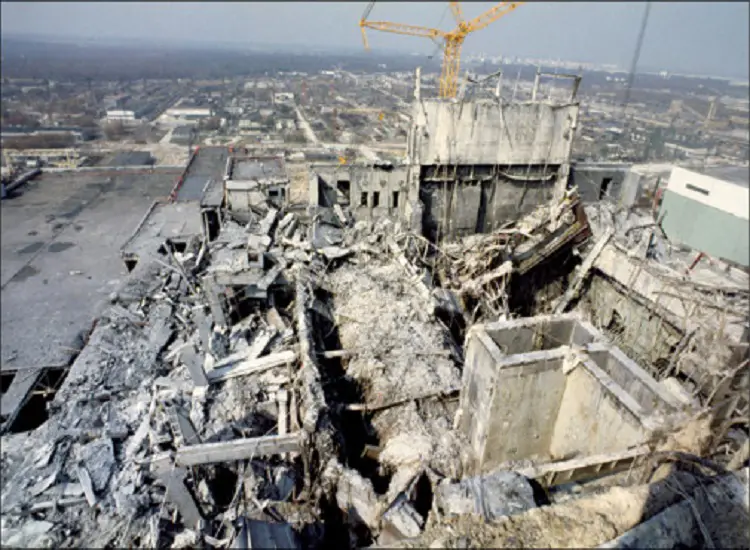
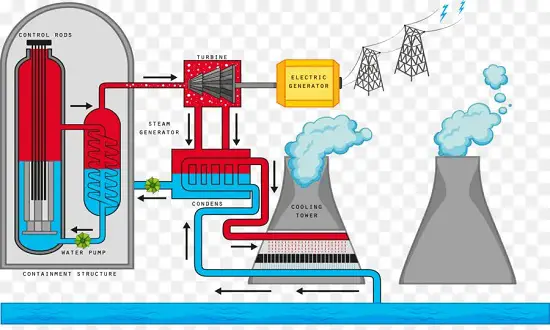
Chernobyl is a city in northern Ukraine, in the Pripjat swamps, bordering Russia and Belarus. A nuclear energy complex was installed there, consisting of a battery of four of the most powerful reactors in the world. For reasons that are still unclear, on April 26, 1986, Reactor No. 4 suffered a technical failure and went out of control. Due to the reactor’s overheating, the entire installation, which contained 190 tons of Uranium oxide, the dome of 2,000 tons of special iron-concrete, and everything in the reactor territory, melted and evaporated.
A cloud loaded with radioactive material was formed, which initially moved under air currents towards Belarus, Poland, Sweden, and Finland. On April 28, radioactive ash was detected in Sweden, 1,100 km away from Chernobyl. With the change in the direction of air currents, the cloud headed to Europe, reaching the Pyrenees, but without crossing them; its branches spread to Scotland and Canada. A total of 335,000 people were affected by the radioactive contamination (some put this figure at 500,000), over 60,000 in the Chernobyl zone, 125,000 in Russia, Ukraine, Belarus, and up to 125,000 in European countries.
About 60% of the radioactive contamination fell in Belarus, and 135,000 residents were evacuated. An exclusive zone with a radius of 30 km from the explosion center was defined, under strict surveillance, and every resident was evacuated from it. Studies conducted until 2005 have identified 4,000–9,000 deaths from acute radiation and delayed consequences. Work for the cleanup of the exclusive zone will continue until 2065. Over 70 years, there will be an increase in cancerous diseases and genetic deformities. In total, damages and expenses for environmental rehabilitation are predicted to be up to 700 billion USD (including inflation adjustments). The area may become habitable after a minimum of 300 years. Contamination from the isotope Plutonium-239 will be present for up to 20,000 years.
This explosion released 6 tons of nuclear fuel and 400 times more radioactive contamination into the atmosphere than the bomb that destroyed Hiroshima, but 100–1,000 times less than the contamination caused by the nuclear tests conducted during the Cold War (1945–1990). Radioactive contamination is caused by about 200 radioactive isotopes of 34 elements, classified into three groups according to their half-life ($T_ {1/2} $) (longevity), and which are considered harmless after 10 times their $T_ {1/2} $:
- Short-lived isotopes: The main ones are Iodine-131 ($^ {131}\text {I} $), with $T_ {1/2} = 8.05$ days, Barium-137 ($^ {137}\text {Ba} $) with $T_ {1/2} = 12.8$ The most dangerous is Iodine, which accumulates in the thyroid glands and causes cancerous diseases. This isotope loses its activity after about 80 days (10 $T_ {1/2} $ periods).
- Medium-lived isotopes: The main and most dangerous are Strontium-90 ($^{90}\text{Sr}$), with $T_{1/2} = 28.8$ years, which accumulates in bones and generates leukemia, and Cesium-137 ($^{137}\text{Cs}$) with $T_{1/2} = 30.2$ years, which is absorbed by vegetation, enters the food chain, and accumulates in the heart, causing cancer in many organs. In environments contaminated with these isotopes, one must wait up to 300 years ($10 \times T_ {1/2} $) to become habitable, but even after this period, these elements remain dangerous in very small concentrations.
- Long-lived isotopes: With $T_{1/2}$ from 200,000–16 million years, the main and most dangerous are: Technetium-99 ($^{99}\text{Tc}$), Neptunium-237 ($^{237}\text{Np}$), Plutonium-242 ($^{242}\text{Pu}$), Iodine-129 ($^{129}\text{I}$), which will practically remain in the environment indefinitely, remaining a source of contamination and disease.
The Fukushima Disaster:
In the city of Fukushima Daiichi, Japan, a powerful energy installation consisting of a battery of six nuclear reactors was built in 1971. At the time of the accident, Japan produced 25% of its electricity from nuclear reactors, with the prospect of this figure gradually reaching 30–50%, due to the lack of alternative energy sources. After the Fukushima accident, the closure of nuclear reactors began, bringing the energy obtained from them down to 5.2%.
Starting from March 2011, a gradual maintenance schedule for the Fukushima reactors was planned. On March 11, 2011, a powerful earthquake occurred in the ocean, with an epicenter 130 km away from the reactors, which caused a tsunami that raised a wave 13–14 meters high. The wave arrived at the shore after 50 minutes, crossed the 8-meter-high protective wall of the coastal nuclear complex, and flooded the energy installations located 10 meters above sea level.
The tsunami wave destroyed the energy system throughout the area, interrupted the power supply to the nuclear complex, as well as its energy backup, causing the reactors to go out of control. However, thanks to the perfect warning system in case of earthquakes, the sensors immediately stopped the reactors’ operation, thus avoiding an unimaginable nuclear catastrophe. With the persistent work of the personnel, the catastrophe was contained, preventing it from escalating into a nuclear disaster of unlimited scale. The situation was brought under control between March 21 and 28, 2011. An exclusive zone with a radius of 20 km (as in the case of Chernobyl) was defined. 164,000 residents were displaced to a distance of up to 30 km from the destroyed installation, and the entire area was placed under strict control. The radioactive cloud contained the isotopes Cesium-137, Iodine-131, Xenon-133, etc.
Up to 40–80% of the radioactive material precipitated into the ocean, contaminating marine life and creating major ecological problems in the environment and the spread of radionuclides in the marine-origin food chain. After Chernobyl, the Fukushima catastrophe ranks second in scale. Studies conducted until 2023 have identified 19,759 people affected by radiation, 2,200 hospitalized and 51 dead.
Among the residents of Fukushima, the phenomenon of radiophobia emerged, with symptoms of depression, anxiety, blindness, various stresses, mental disorders, etc. Predictions published until 2023 calculate an increase in cancerous diseases: general cancers by 4%, leukemias by 7% and thyroid cancers by 70%. Total damages reached a value of 360 billion USD, indexed to 487 billion USD in 2023, values higher than the benefits from the nuclear energy installation. Memorie.al