
Part Two
Memorie.al / Coincidence led me to meet Safet Kolgjini these days, from Lusën in Ujmisht, located on the eastern edge of the Lumë region. As soon as he mentioned his birthplace, the names of two well-known personalities of our nation from this village immediately came to mind: Tahir Kolgjini and Baba Reshat Bardhi (the World Grandfather of Bektashism for the years 1993-2011). I ask him about Tahir and he replies that they “are branches of the same ancestral tree,” planted there early on, while there was no other human presence around. History also confirms this, where the Kolgjini clan (Gjeta Kola) stands at the origin of the village’s creation. The same can be said for the Peposhi clan (Pepa). Both of these clans came from Lura in Dibër; they multiplied among themselves and with others, reaching a total of over 350 houses in the village by the end of the 1980s.
Continues from the previous issue
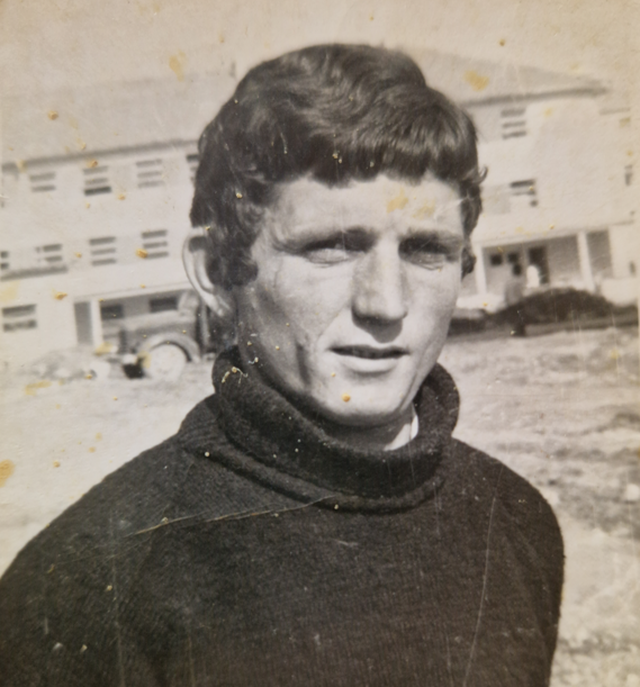
You understand everything from the calm narration of Safet, who, although the middle of the brothers became a strong supporting arm for them. He was 19 years old when their father became disabled, due to the amputation of one leg, which had gangrene from the cold. Faced from childhood with the harshness of political fate, which, like for everyone, dictated living in a socioeconomic system full of difficulties and shortages, he matured prematurely…!
He was born on March 13, 1954. He could not know his grandfather, as he left Xhemal, Safet’s father, young, only 6 years old. He left him a child, and also without the support of brothers, so necessary for difficult times, as during 1917 his two older sons passed away prematurely.
This bad fate was compensated by the maternal care of a noble woman like Rabie Tusha (Rabe), who lived for a full 105 years, as well as his sister, Life Kolgjini, 10 years older. However, from his grandfather, Safet inherited the name; a name honored by work full of dedication and sacrifice. From his father, he inherited vitality in the face of God’s trials.
We are talking about men who stood upright in any confrontation (even with one leg like Xhemali), as the “responsible gene” of the clan that created the village. Therefore, in these cases, the burden of inheritance requires strong moral shoulders to carry it.
These are burdens that would break you if you did not stand straight. Thus, in a way, the inheritance of the name turned into a debt for Safet, which had to be paid with honorable work and effort. But when you inherit the surname along with the name, then the burden of responsibility becomes even greater; the moment between observation and action has passed in favor of the latter.
On the other hand, the time and the new politico-social system installed after the country’s liberation were unfavorable to the objectives and goals you could set for yourself, no matter how extraordinary a man you were. In these conditions, despite everything you could inherit from your ancestors, only hard work remained, which you could use to achieve the set objectives.
It was about a type of work which, besides physical strength, the only encouraging philosophy you could rely on was everything emanating from Naim’s verses: “Work, work night and day, / to see a little light.” In that period, such an expression was commonly used, as advice and request for every aspect of life and social activity, including school.
Meanwhile, the only way to give a name to virtue was through facing many difficulties, where it was more difficult to put what you knew into practice than to simply know it, because others dictated what they knew and desired. You had no choice, and more difficult than showing independence was maintaining your dignity in the face of the maneuvers aimed at denaturing the human spirit of those who came from traditional families and clans with a great name.
“It was September 1961 when I started the first grade of elementary school,” Safet recounts. “The rupture of diplomatic relations with the Soviet Union had just happened. The political-social situation, but mainly the economic one, presented many problems. I gathered all this negative impact from the behavior of the adults, even though I didn’t understand much.
Nevertheless, everything became clear as, for instance, I (not only me but the whole class) wrote the letters of the ABC book with a primitive pen, using the wood of the elderberry as a handle and dogwood grapes as ink. After I finished the first grade, during the summer, I collected blueberries and medicinal plants; I sold them to buy books and clothes. This story continued year after year until I finished the eight-year school, also in the village.”
Despite the many difficulties and shortages, Safet managed to achieve very good results in school. He applied for secondary school. Considering that from the first to the eighth grade, he had been active as a dancer and reciter in many artistic shows and competitions, he requested to go to the Artistic Lyceum.
However, since the formal rule was that three branches had to be chosen, he added the “7 Nëntori” Polytechnic and Medicine. “I cried for three days straight,” says Safet, “when I saw that they had sent me to be a bricklayer, a two-year course in the so-called ‘School of Labor Reserves’ in Shkodër.
I experienced a great disappointment when I noticed that children of those with political support had gone to the chosen branches. Nevertheless, I went, finished only the first semester, and returned. That was the extent of my education; I started working at 15 and never left it. But even for work, we had to go far, to somewhat hide the family heritage, which was a disadvantage at the time when people from lower strata were valued and supported. As far as I remember, it was March 22, 1969, Sultan Nevruz Day, when I left home for Burrel, where my older brother, Sedin, was working at the Road-Bridge Enterprise…”
He stayed there for a short time. He started work with reduced hours. He worked and was paid for 6 hours; that’s what his age allowed. The earthquake of April 3, 1969, occurred in the villages of Izvor and Rabie in Tepelenë. The whole of Albania rose to its feet, as stated in the propaganda of the time. Among them was Safet’s brother’s brigade. Sedi meets him and tells him to return to his hometown. “Okay,” he replies to his brother, while having something else in mind. He leaves after him with random cars. From Burrel to Laç, he travels in a “Skoda,” in the flatbed. Then he takes the train to Fier. He arrives there in the late evening hours and settles in the city hotel. He feels uneasy as he looks around at people dressed well than him. More than anything else, his peasant sandals (opingat) stood out. He had only 450 old leks with him. The next morning, he goes to the market and buys a pair of sneakers for 390 leks. He is left with 10 leks in his pocket. The final destination was Izvori and Rabija in Tepelenë. He goes to the crossroads of the roads from Fier to the South. He waited for almost 7-8 hours until a coal truck came, and the traffic policeman helped him, telling the driver where to take him.
He arrives around 10 o’clock at night in Izvor, from there, asking for directions, he walks and reaches Rabija after two hours. He works there for about two and a half months. It was summer; he was supplying water to the actionists. He earned about 12 thousand old leks. He returns to his hometown, giving half of this money to his father. With the remaining part, he sets off in search of new work. For about 3 years, until he went into the army, he worked in 3 different enterprises: in the Kukës Road-Bridge and NSHN (National Construction Enterprise) and the Vau i Dejës Hydropower Plant.
After 3 years of military service in Tropojë, he starts working in the Kalimash Geological Enterprise, about 50 km from his village, where he stayed for a full 17 years until the early ’90s. The biggest sacrifice was that he made this round trip every day. He got up at 3:30 in the morning to arrive in Kalimash at 7 in the morning. He walked part of the way and the other part by bus. The same thing on the way back. Nevertheless, he excelled in his work, achieved high results, and was therefore decorated with the “Order of Labor Class 3” and the “Order of Labor Class 2”.
These were sacrifices made for the conscience and honor of the family and clan. However, when he thought that his two brothers were suffering the consequences of mountain collectivization, his conscience was not clear; the little sleep he got at night was often disturbed. He had once accidentally met the chairman of the Pezë-Helmës village council. He finds the opportunity to talk to him about his brothers, to transfer them near the capital. They agree. It was the summer of 1986. In one of these days, he arranges a supply route to Tirana with the enterprise’s vehicle.
“One trip, two jobs,” as they say in popular language. They load the few belongings and he sets off with his brothers around 12 o’clock at night. To avoid attracting attention, they travel on a rural road, Grykë e Fanit, on the current route of the Nation’s Road. The Chairman of the Pezë-Helmës Council receives them well and settles them in his house. The first letters start coming from the village. It became a big problem and the chairman gave up, as he was threatened with disciplinary measures by the relevant party and power organs.
So Safet and his brothers, after staying for about 4-5 days at the International Hotel, find a new settlement opportunity in Dias of Petrela. They buy a house there, understandably old and worn out, for 150 thousand old leks. Meanwhile, they also start working; Sedi in the Kërrabë mine, and Besniku in the cooperative. After this solution for his brothers, Safet felt calmer and continued working at the Kalimash geological enterprise.
He joins his brothers in the early ’90s. In ’93, he works as a bus manager on the Tiranë-Korçë line, where he faces the traumatizing issues of emigrants returning from Greece in those first years. He is reminded of the words of an English poet from the 17th century, which a teacher from the northern areas, whom he had met as a passenger on the bus while he was also returning disappointed from Greece, had paraphrased to him: “Those who live in the homeland and learn to know God and themselves, do not need to go further.”
Therefore, it doesn’t take long before he and his younger brother, Besniku, open a car repair shop. Now, in this type of business, including the trade of spare parts, all three of Safet’s sons (Ylli, Dashi, and Agroni) are employed. Also, Sedi’s son, Nazmiu, and Besniku’s son, Eltoni, who, of course, have their separate businesses. Everyone is settled as well as possible, but Safet still sheds tears today for a son, who inherited his father’s name, Xhemal, who would have been alongside the three other brothers, and who unfortunately passed away at the age of 21, due to natural causes. Hence, the saying comes naturally to him: “When there is desire and will, man can do anything, except for those things that are in God’s hands.”
Regret, as an offspring of the clan that created the village, is the depopulation of the country by the youth. “Most of them have emigrated to England and other Western countries, and have no intention of returning,” he says. “But love for the country starts with love for the family, clan, and village…”. The role of Safet and his two brothers in the family education of their children through work and love for each other is synthesized in the words that Agroni (Safet’s son) told us: “We owe our father’s toil, which not even a lifetime is enough to repay.” These words of parental appreciation, which a Roman historian calls “…the first law of nature,” besides love, convey gratitude, commitment, and the oath of worthy inheritors of the Kolgjini clan not to lose their national identity. Memorie.al