
By Ahmet Xhavit Delvina
Part One
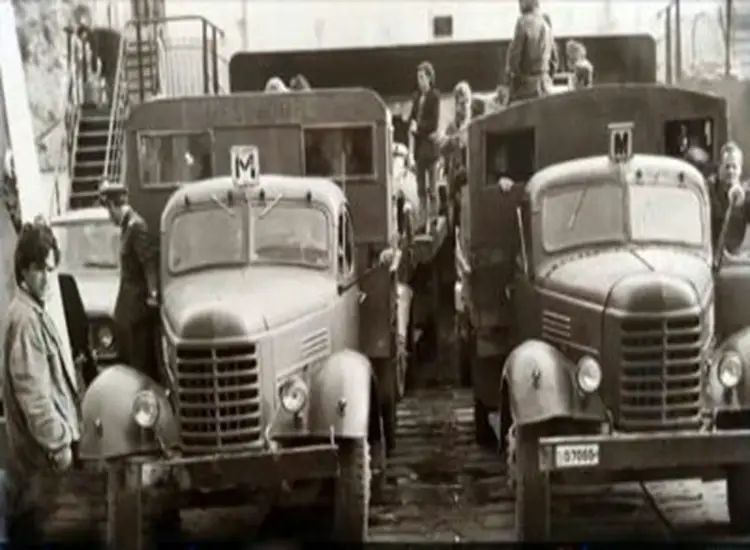
Memorie.al / I are writing down this event where I acted as the “conductor,” one that has left an unforgettable impression on me. It is a small fragment of our people’s lives during that dark period of communist rule. It was 1954; I set off from Burrel for Tirana at 4:00 AM. I was a soldier in Unit 7620, serving as an auto mechanic in the workshop. On this occasion, I was transporting a GMC military truck (“James”), Made in USA, for a major overhaul at the Army’s Central Workshop. This type of combat vehicle was entirely unsuitable for civilian transport; it had an open driver’s cabin with a canvas top, but in this case, the top was missing, and the windshield was gone due to a previous collision. The truck bed was entirely metallic, with low sideboards only 25 cm high, uncovered and without any side rails. It was February, the peak of a brutal winter.
The Encounter at the Bridge
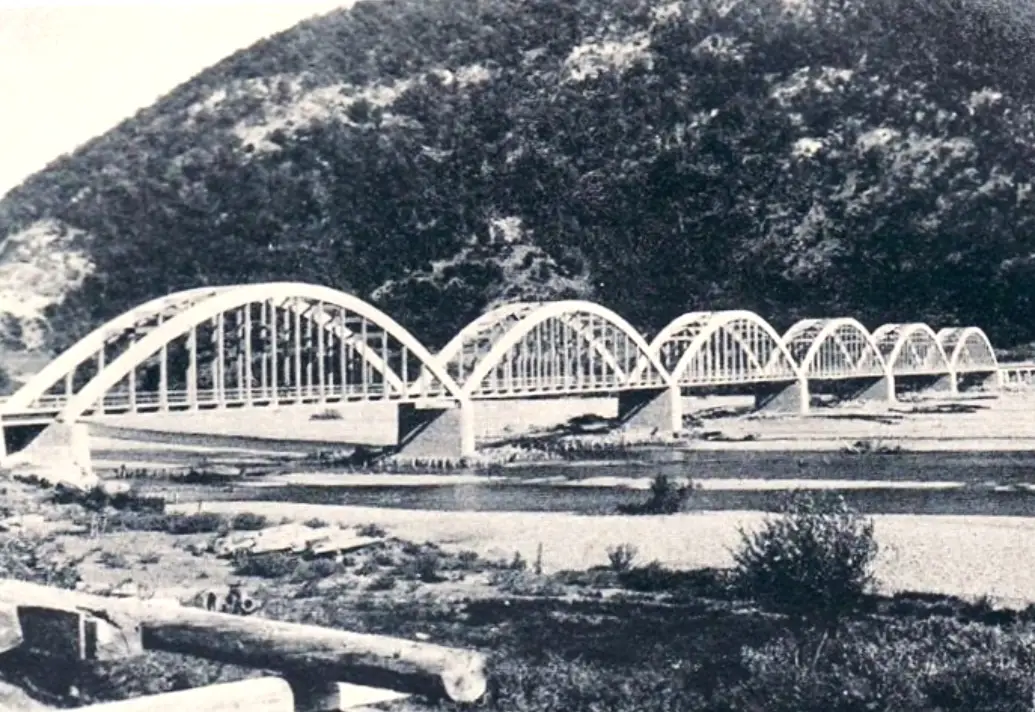
As I descended toward the well-known bridge over the Mat River (Burrel) at the Tirana–Peshkopi intersection, I saw a relatively elderly woman dressed in black emerging from the darkness under the bridge. She signaled me to stop with great persistence. I pulled over immediately and asked, surprised, why she was there in that place at night, what had happened, and what help she needed. She hesitated for a moment.
“Speak, Madam, speak,” I told her, looking her in the eye.
After looking closely at my face, she burst into tears, but quickly composed herself. “Forgive me for crying,” she said, “but I was deeply moved by your politeness given these circumstances. I never expected a ‘partisan’ to treat me with such humanity, let alone call me ‘Madam’… Madam!” She pursed her lips in astonishment.
I replied instantly that I wasn’t a partisan, but a conscripted soldier.
She answered: “Forgive me, I was confused by the red star on your cap,” and continued, “Please, is there any way you could take us to Tirana?”
“Yes, come on, hop in,” I said, “but unfortunately, the truck is open and has no comforts at all.”
“As for it being open or lacking comfort, that doesn’t matter. But we are 14 or 15 women in total, warming our hands by a fire we lit with some sticks under the bridge. We’ve been there for two days and two nights; we’ve run out of everything. We are at our wits’ end, and we can’t find a vehicle to get back to Tirana. Well, what do you say? Please do not refuse us, please have a heart, we are dying, believe us,” she said, tearing up.
With all due politeness, I told her to have her companions come and see the vehicle, and if they were willing to brave it, they were welcome. At that moment, she felt an indescribable joy. She went back under the bridge to announce that “fate had descended from the heavens.”
The “Passengers” of Burrel
Shortly after, I saw them running from under the bridge toward the truck one by one – women whom, by a twist of fate, I almost all recognized. They were close friends of my family and our relatives in general. They had been there for their periodic visit with their loved ones imprisoned in the Burrel Political Prison.
I was overjoyed to have the chance to directly help these poor souls (qyqare). They still couldn’t believe the path of degradation the regime had forced upon us “overthrown” classes, while the communists always hoped they would one day be rid of us. I decided not to introduce myself; if they knew who I was, they might have refused my help out of pride, knowing the poverty of my own home – a poverty shared by all families of our social standing (sëra).
They did not recognize me throughout the “operation” because my head was shaved; I was wearing a Russian helmet with the earflaps down, black overalls, and gloves.
The Journey of the “Lord Triestino”
I cannot describe the physical and spiritual state of those women during our journey. They hadn’t eaten for days, were freezing, demoralized, and nearly penniless. At one point I asked them, “I don’t understand, were you trying to kill yourselves by waiting in these conditions?” They answered in unison: “Please, just take us, don’t leave us to die here under the bridge.”
One of them approached me: “Listen, Mr. Driver, I don’t know if you believe in God? Because all of us here do, and we will pray to the Great Lord for you and your family, so that you may never see hardship in this ‘cursed’ world.”
I tried to interrupt, but they said, “It’s not right, but we give you our word, we will empty our pockets for you and your nobility.”
“Fine, fine,” I said, “but I doubt there’s enough left in your pockets to match your good will.”
We set off. Near the “Uraka” bridge, I stopped and opened a bottle of Korça Cognac. “Everyone, take a sip and finish the bottle; I believe this will keep you from freezing.”
The lady who first called me “partisan” said: “In our circumstances, this much care seems too much; I don’t think we can ever pay you what you deserve!”
“Forgive me, ladies,” I replied, “you deserve much more, but unfortunately I cannot offer you ‘Bordeaux’ cognac – which is what you deserve, served with Perugina chocolates. But poverty is what it is, so you will drink what we have.”
They rushed to the bottle. After finishing it, they said: “Honestly, if we hadn’t drunk this, we would have turned into blocks of ice.” I then offered them “Labinot” cigarettes.
“Shall we start the ‘ferry’ to Tirana?” I asked jokingly.
“What ferry?” one asked, laughing.
“Today my truck has turned into a ‘tourist ferry.’ A previous passenger once suggested I name it the ‘Lord Triestino’ because it sails so excellently through the puddles of our ‘wonderful’ roads.”
They looked at each other and said: “Set sail then, Captain!”
The Stop in Rubik
We didn’t stop until Rubik. I suggested we eat something, but in those days of the infamous rationing system, you couldn’t find food anywhere. We had three types of coupons: for bread, for food, and for clothing. In the so-called “clubs,” you could only find starch jelly (pelte), barley coffee, and alcohol.
The “talkative one” of the group remarked in Italian: “I suggest we take a taxi and dine at a ‘modern and traditional’ restaurant; let’s not eat the lunch offered by this ‘Garibaldi’…”
Another friend snapped at her: “Shut your mouth, you chatterbox! It’s not your fault; it’s this poor man’s fault for not letting you rot back there!”
I smiled and offered them a 3kg tin of Russian Army preserved meat, an officer’s ration I had bought dearly from a quartermaster for my own family. I cut two loaves of army bread and said in Italian: “Buon Appetito!”
They ate with a mix of finesse and desperation. Later, I bought them starch jelly and coffee served in an aluminum pot with only four cups and no saucers – the reality of Albania back then.
The Incident in Mamurras
Before reaching the Mat Bridge, the elderly lady in the front seat pleaded: “Please, let us pay something. No one does anything out of the goodness of their soul today. You took the bread from your own mouth for us. Are you perhaps of our ‘class’ (sëra), my son?”
“No, no,” I replied, “I just felt sorry for you.”
In Mamurras, we were stopped by the police. They saw the passengers had no tickets (which were mandatory from the Burrel agency) and that my truck, with its low metal sides, was forbidden for passenger transport due to safety regulations.
I told the “dear” policemen: “Unfortunately, this ‘cargo’ was forced upon me as a ‘peshqesh’ (unwanted gift) by the Head of the Internal Affairs Branch in Burrel, Gjolek Alia. In fact, he told me: ‘Get these bitches out of my sight, I can’t stand to look at them.’”/Memorie.al
Continued in the next issue…