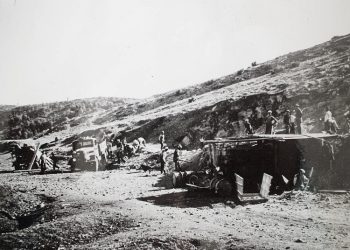
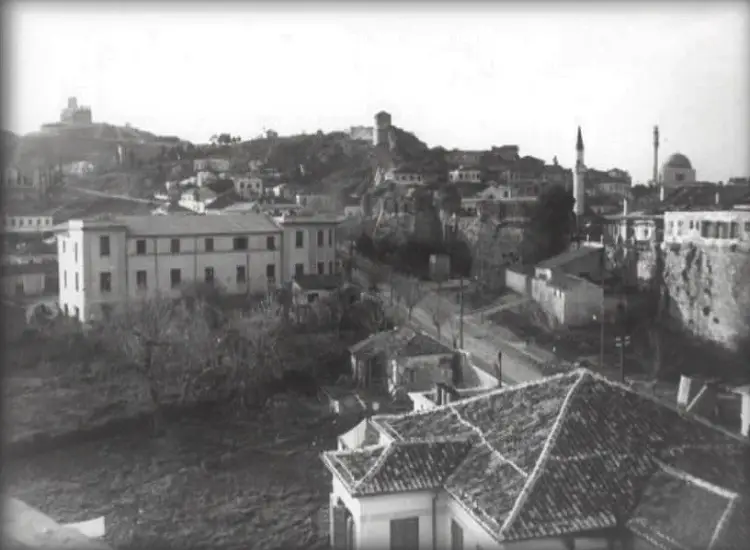
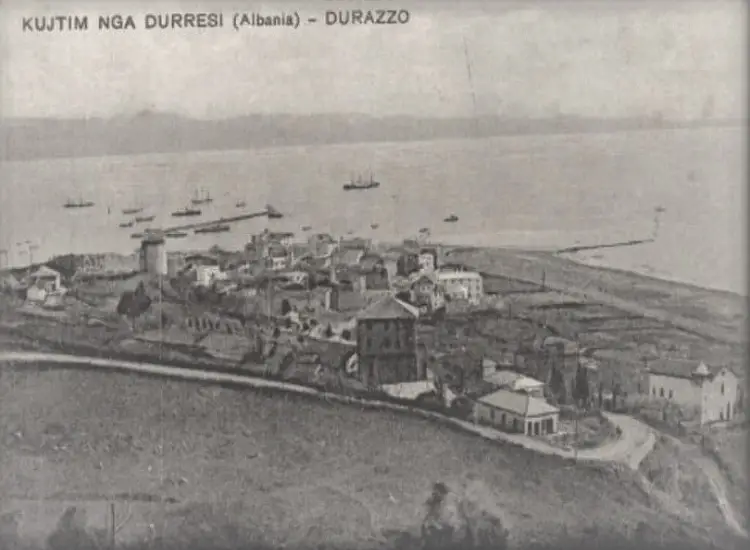
Memorie.al / If we visit Tirana, Kavaja, Elbasan, etc., we will notice something common among them: in the central squares of these cities, we will see towers built during the Ottoman period that served as clock towers, all of which were constructed in the 19th century. But we do not see such a thing in Durrës—why? According to documents and photos found in the Central State Archive, after the earthquake of December 1926, which caused extensive damage in Durrës, the Italian state offered assistance to the Albanian state authorities, sending specialists to Durrës to assist in the demolition of damaged structures. As part of this operation, photos show Red Cross workers along with the army demolishing several objects, among them the clock tower of Durrës.
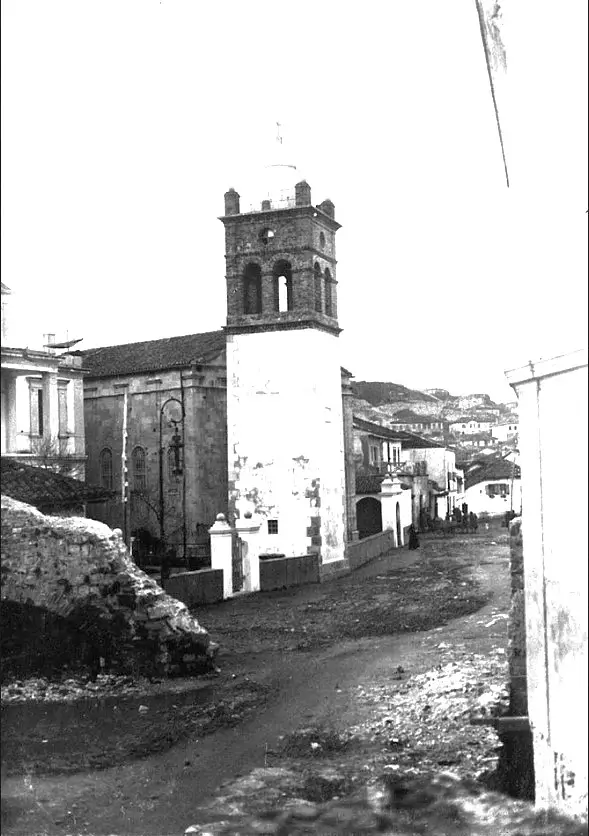
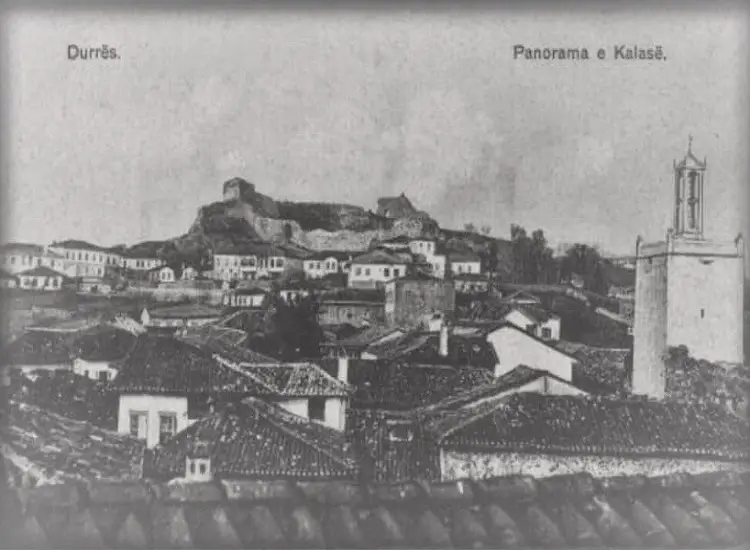
Fortunately, this is documented by the photos taken by master Ymer Bali, who captured this moment. Although we recognize its existence through numerous photos from those years showing that the tower was there. At first glance in the photos, it resembles a church bell tower, a point often debated on social media! But of which church?! The question remains unanswered!
Given that little has been written about it by local authors, in my research at the State Archive and beyond, I managed to find several facts to prove that Durrës did have a clock tower, as evidenced by documentation.
The fact?! At the end of the 19th century, Durrës became a Sanjak (prefecture) of the Vilayet of Shkodra, and as a Sanjak, it had other Kazas (municipalities) under its jurisdiction, such as Tirana, Shijak, Kavaja, and Kruja. Naturally, as the capital of the prefecture, Durrës could not lack its own clock tower.
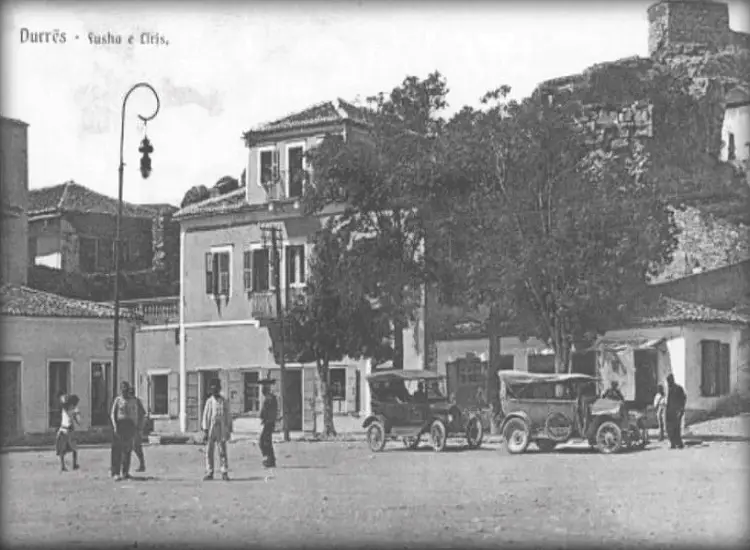
Currently, no traces of it remain, and very few people in Durrës know that it was located next to the city hall, where the bust of Hafiz Ali Podgorica stands today, atop the Turkish wall that still stands there. We verify the existence of a clock tower in Durrës from documents found in the Ottoman Archive in Istanbul.
Through Ottomanologist Ermal Nurja, I managed to secure a translated document which states: “Directed to the High General Inspectorate of the Vilayets of Rumelia, to His Highness vested with power! (Following the customary praises).
I present to you with immense joy that the quarantine room, the clock tower, and the harbor checkpoint of the city of Durrës have been built from the foundations (meaning they are new constructions, not prior ones) and their inauguration will take place on the happy day ahead of us (the upcoming anniversary of the enthronement of Sultan Abdulhamid II, which is August 19).
The order and the ferman belong only to the master of the matter. Date of the act: July 27, 1907. Mutasarrif of Durrës, Kazim (seal)”(1). So, from this document dated July 27, 1907, where the Mutasarrif of Durrës addresses the High General Inspectorate of the Vilayets of Rumelia and informs them that the quarantine room, the harbor checkpoint, and the clock tower are new objects built from scratch, and August 19 would be set as the date for their inauguration, coinciding with the enthronement of Sultan Abdulhamid II.
From this document, we verify that the tower was a relatively new construction (with a striking clock mechanism), dating from the beginning of the 20th century, unlike the towers in Tirana, Kavaja, Elbasan, etc., which are constructions from the 1800s (however, the fact that the tower was built from scratch does not exclusively exclude the idea that there might have been another tower previously; this document simply shows that the last time a clock tower was built in Durrës was this year, 1907).
But why was the clock tower not rebuilt in the same place? There may be several hypotheses for this, one of the most convincing being that after the 1926 earthquake, the construction of civil and state buildings began with great momentum; alongside houses and commercial buildings in Durrës, the construction of the municipality (city hall) building began.
The building would be positioned at the start of “Liria” (Freedom) Square where, according to the project, it would be 3 floors + 1 basement floor, and atop the building on the left corner, the clock would be built. It would feature a mechanism manufactured in Germany by the company “Eduard Korfhage & Söhne” and two bells (2).
This, I believe, was a significant reason for it not to be rebuilt in its previous position, but rather to be integrated into the municipality building. / Memorie.al