By Eda Zhiti
Memorie.al/ It was a meeting of a different kind at the University of Illinois, UIC, the largest in that state. In the Department of Medicine, Center for Global Health, the College of Physicians faculty invited the poet Visar Zhiti. What would be discussed? Poetry? Would his life under dictatorship, prison, collective trauma, later freedom, and exile be recounted? Would they ask him about all of these?
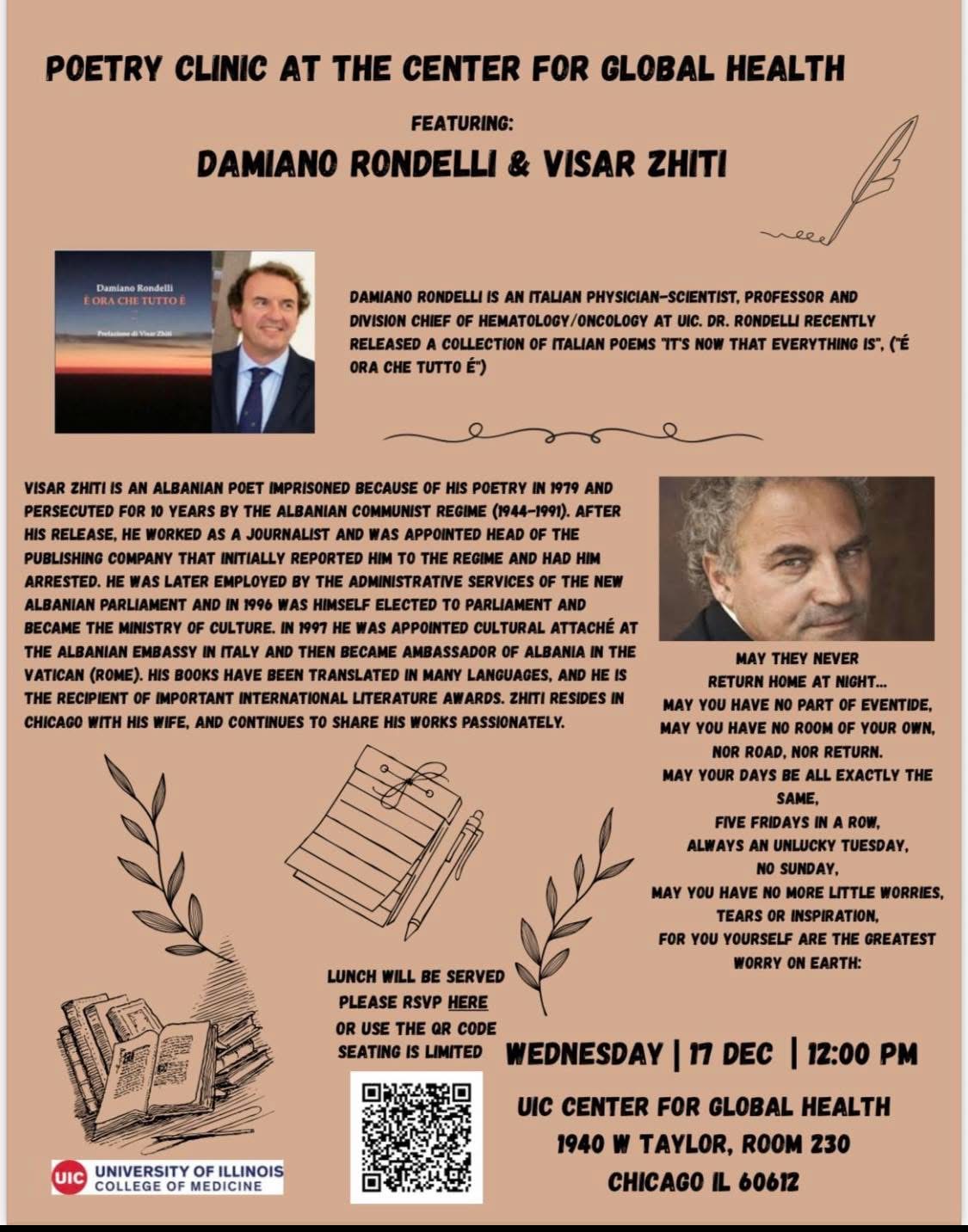
THE POETRY CLINIC
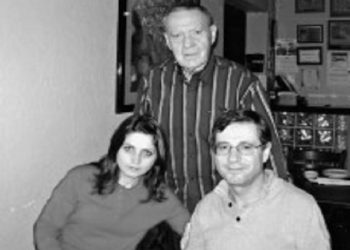
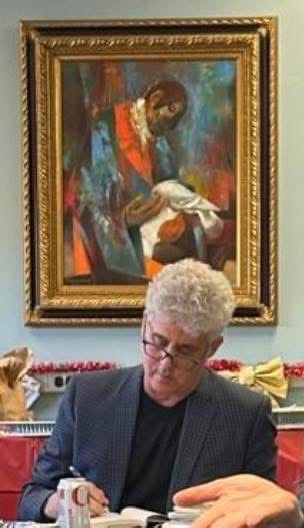
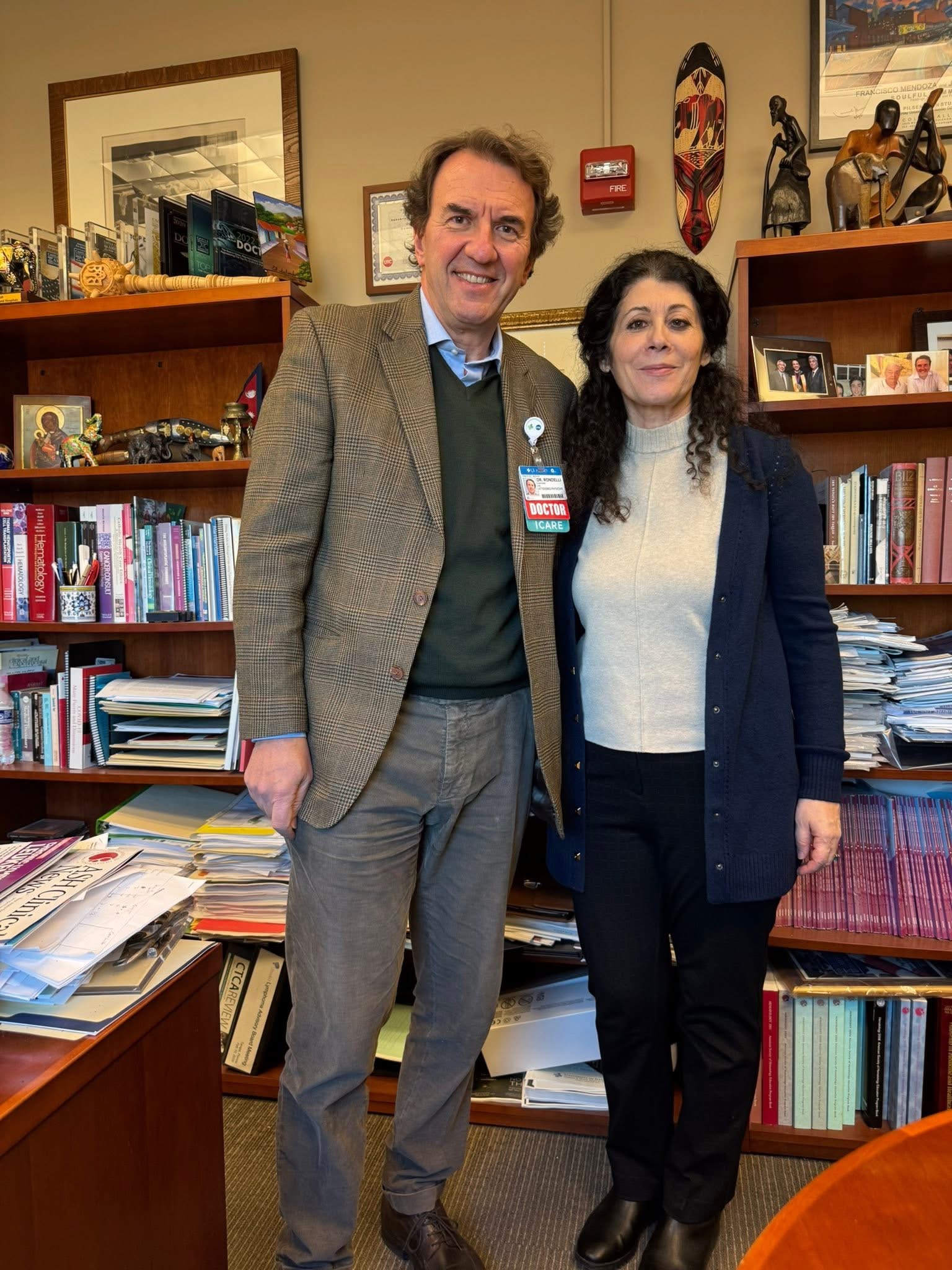
This is what was written on the English invitation. “Is it a metaphorical idiom?” Visar would joke, adding with a smile: “Terrifying and beautiful.” Then, photographs of the moderator and the guest were placed, with the following notes below them:
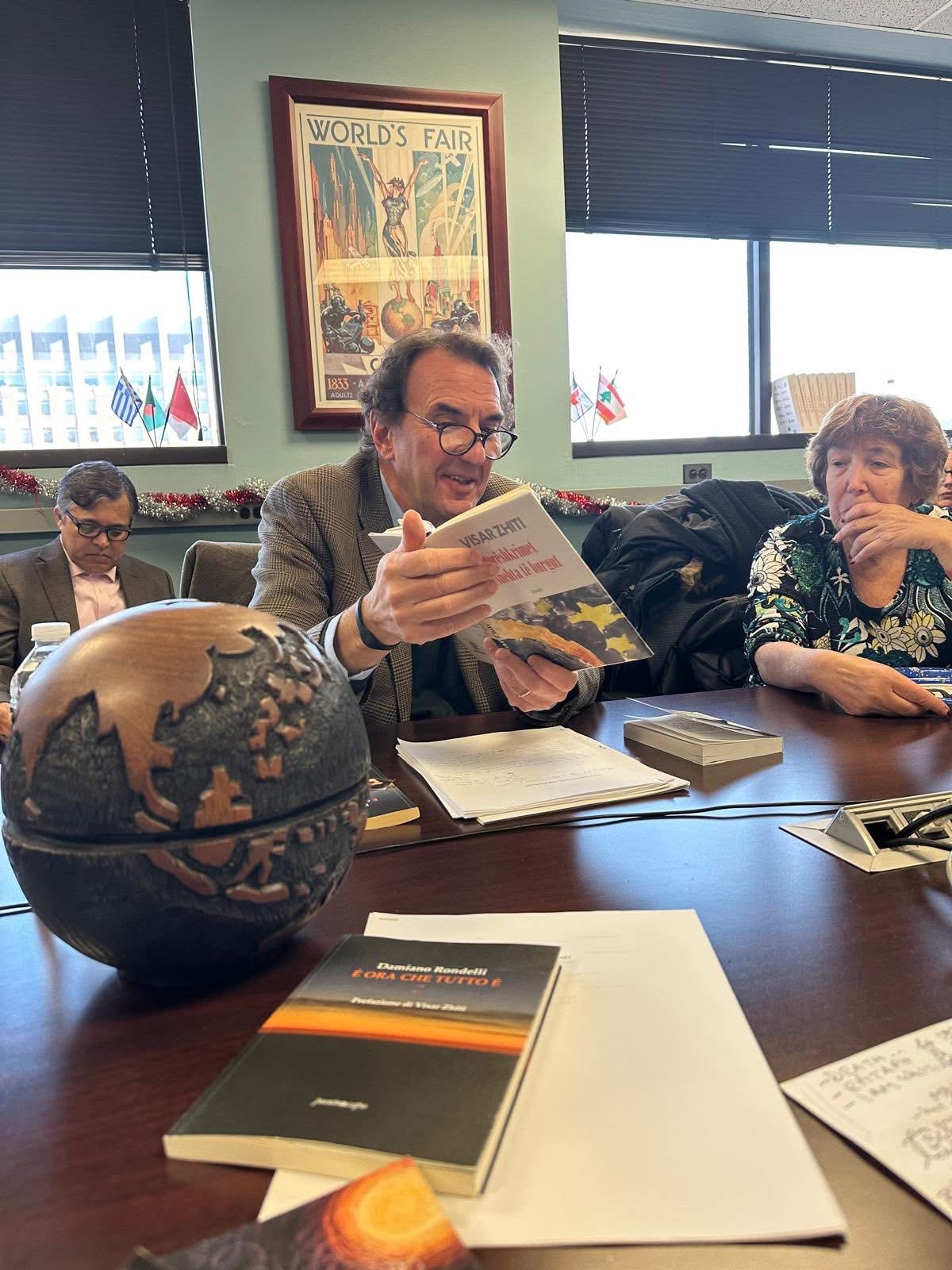
Damiano Rondelli is an Italian scientist, physician, professor, and Director of the Division of Hematology/Oncology at UIC. Dr. Rondelli recently published a collection of poetry in Italian titled “È ora che tutto È” (“It is now that everything Is”).
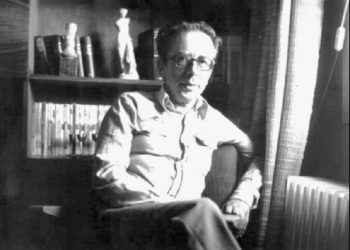
Visar Zhiti is an Albanian poet, imprisoned for his poetry in 1979 and sentenced to 10 years of imprisonment by the Albanian communist regime (1944–1991). After his release, he worked as a journalist and was appointed director of the publishing house that had initially denounced him to the regime, leading to his arrest. Later, he was employed in the administrative services of the new Albanian Parliament, and in 1996, he was elected as a Member of Parliament and became the Minister of Culture.
In 1997, he entered diplomacy, serving at the Albanian Embassy in Italy and later as the Albanian Ambassador to the Vatican (Rome). His books have been translated into many languages, and he is a winner of significant international literary awards. Zhiti lives in Chicago with his wife and continues to passionately write and publish his works. Below were these verses by Visar:
Let everyone not return to any home in the evenings…
To not have your piece of the evening,
your room not to have, nor the street, nor the return.
Terrifyingly identical let the days be,
5 times in a row Friday,
always a cursed Tuesday, never a Sunday.
To no longer have small worries
of tears or creations,
being the greatest worry in the world:
A Prisoner!
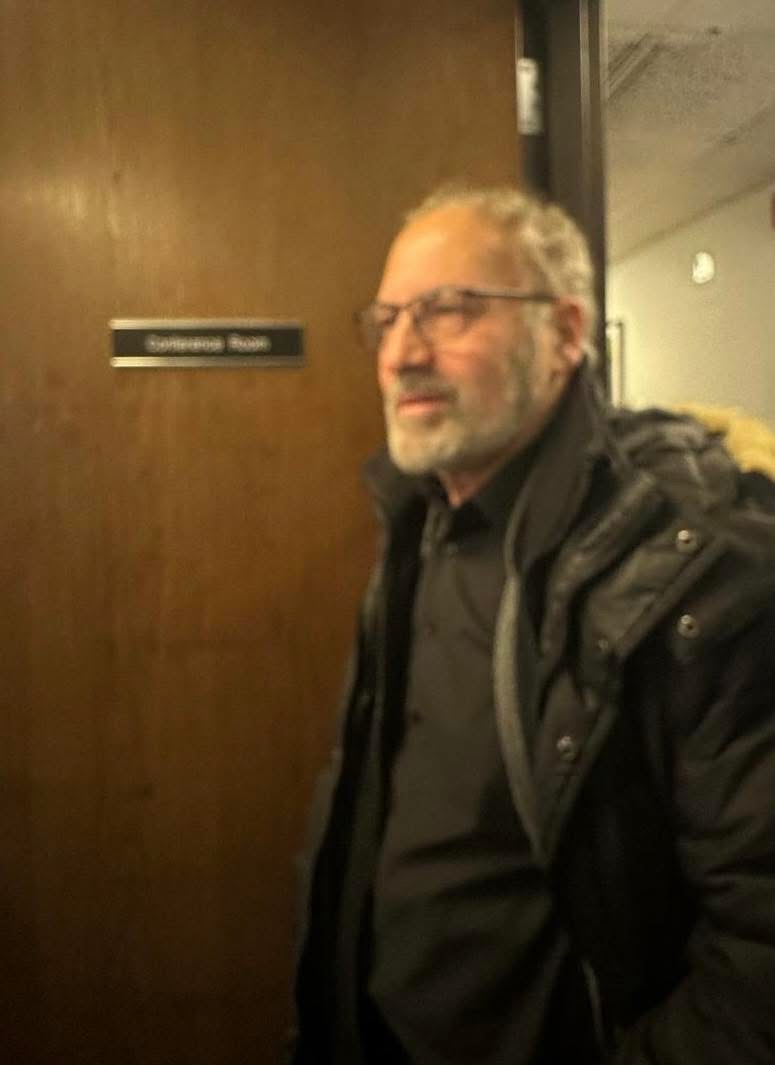
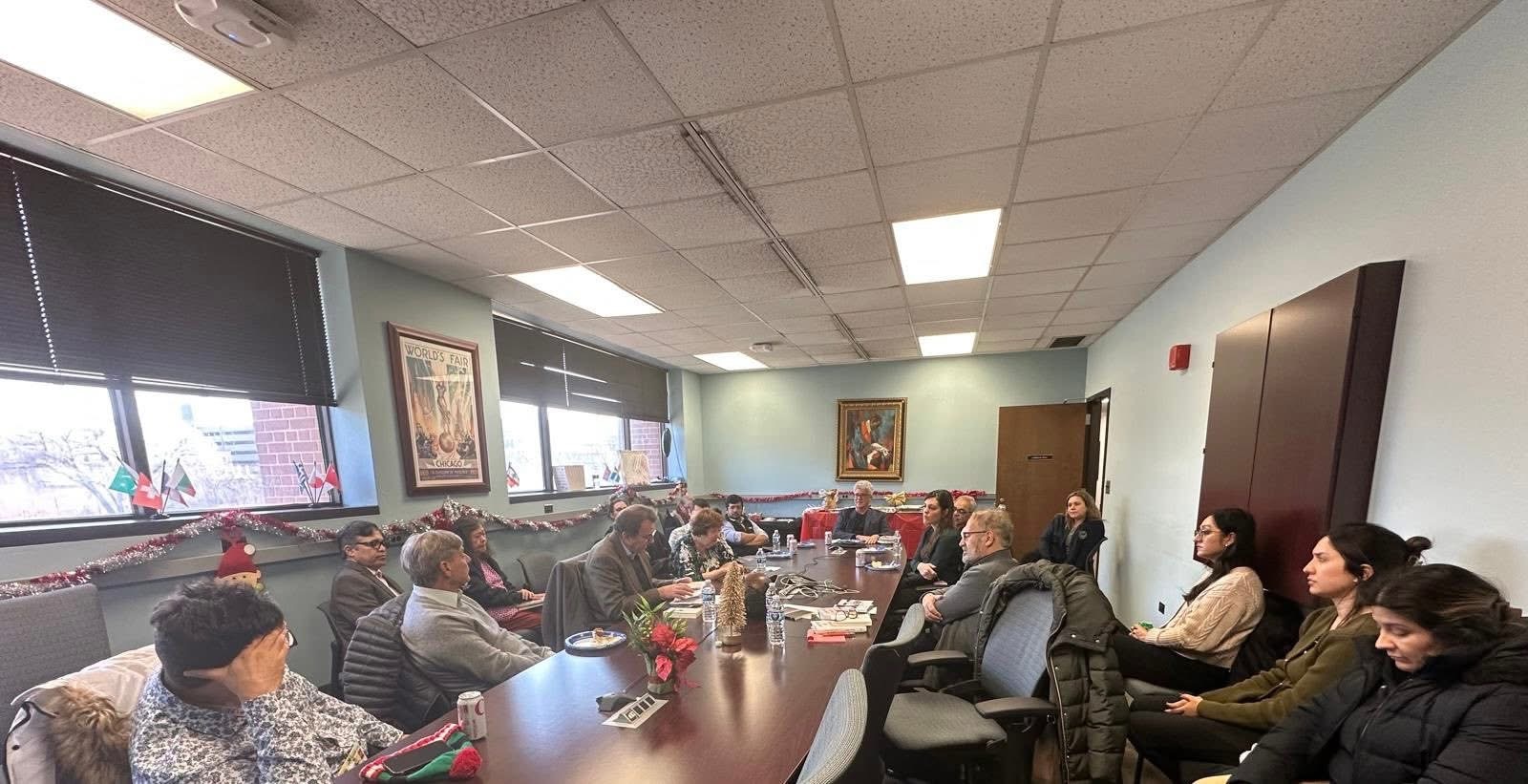
The event took place at UIC – University of Illinois, Conference Room 230, followed by a lunch.
THE POWER OF THE SPIRIT AGAINST LIFE’S ATROCITIES
– The Meeting –
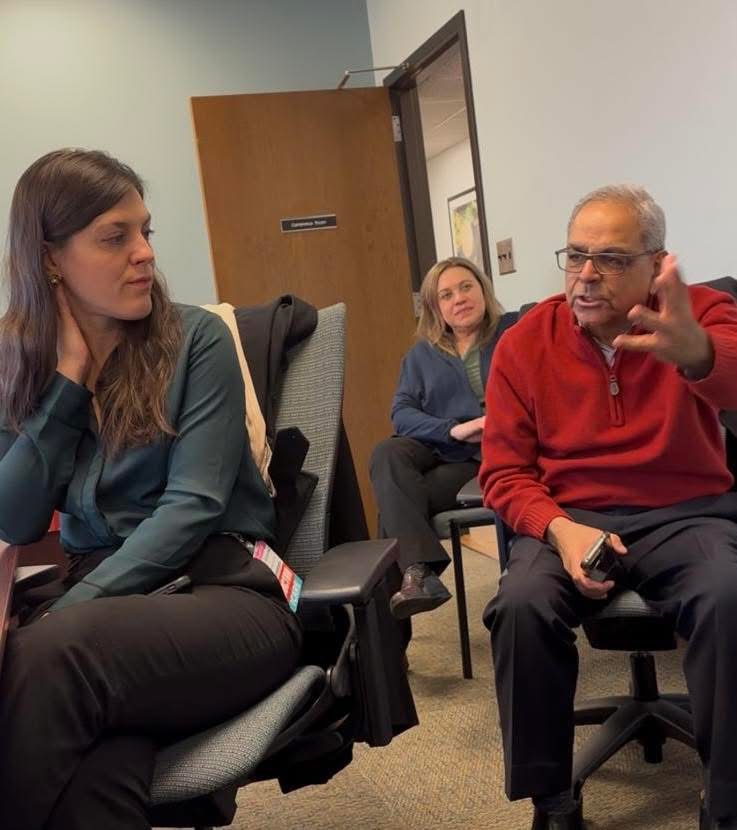
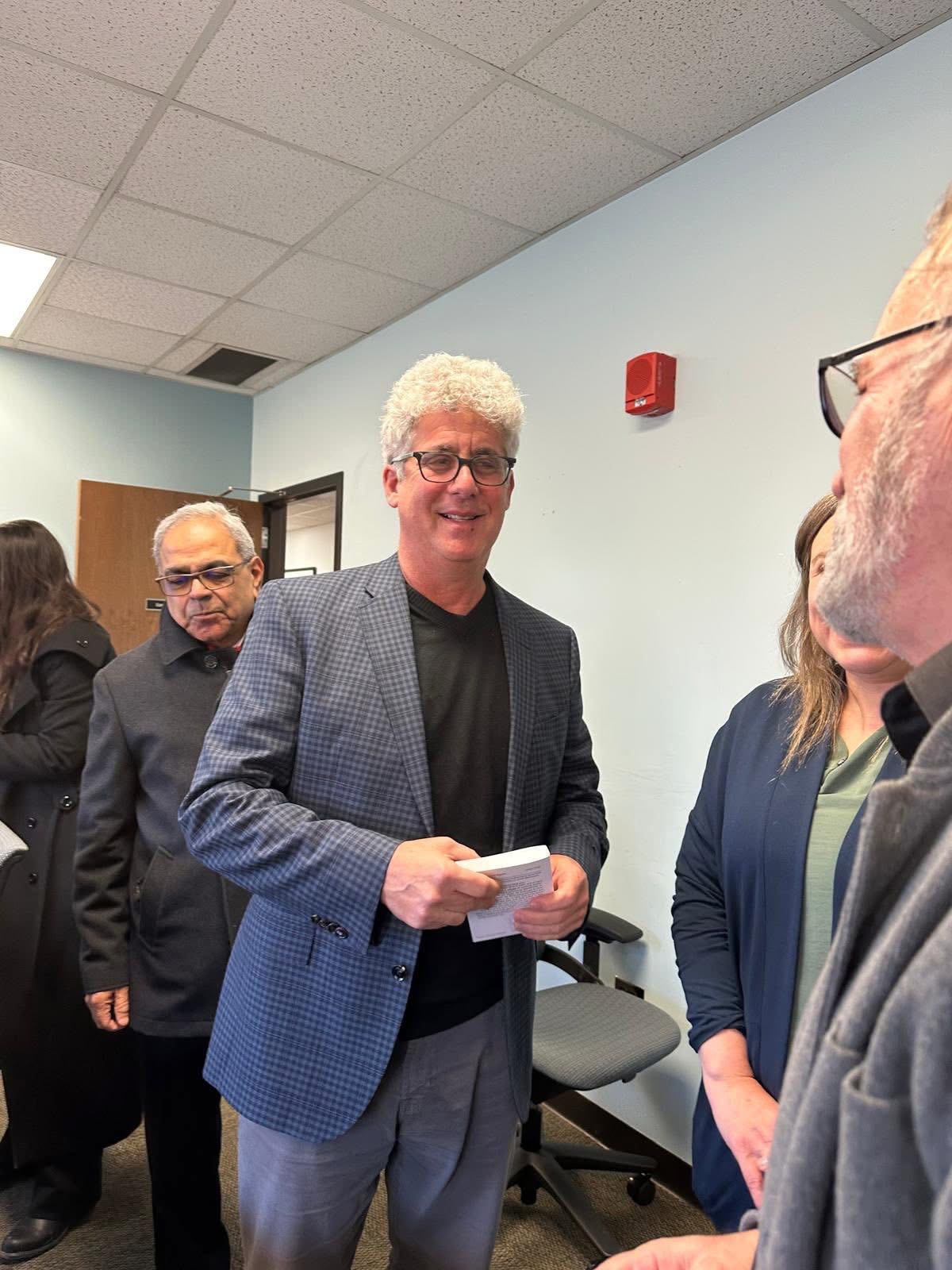
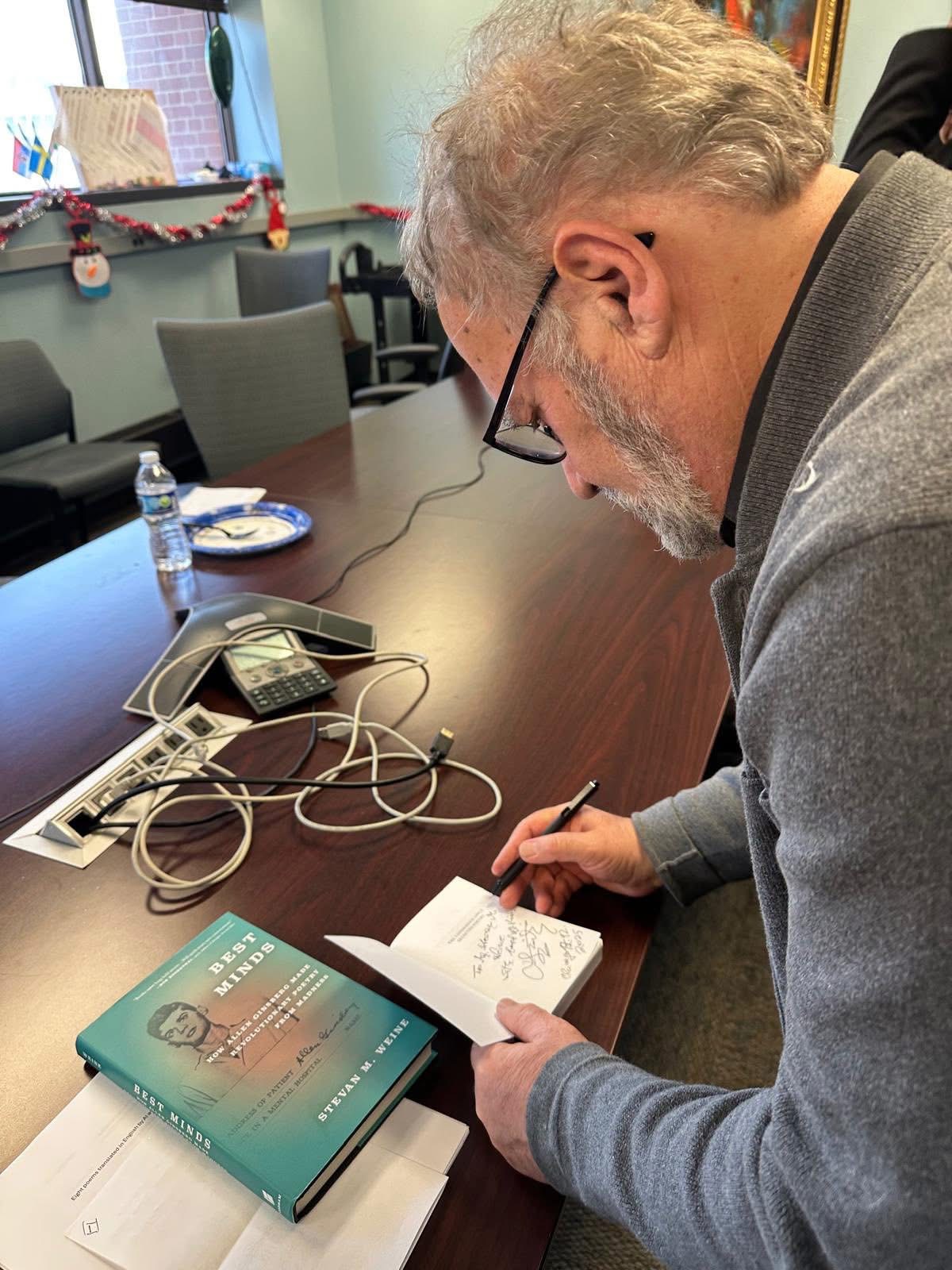
The audience was not just made up of readers or students. At the long tables sat researchers, professors, young and old alike, all devoted to literature. One Ukrainian professor there, we were told, had published three novels. Books were laid out on the tables.
The meeting was opened by the American Professor, Stevan M. Weine, a psychiatrist and internationally renowned researcher for his works on psychological trauma, violence, genocide, and the mental consequences of war. Among his publications is an important scholarly book on Allen Ginsberg, treating him not just as a poet, but as a paradigmatic case in the relationship between creativity, trauma, and the ethics of witness.
“Will this be the lens through which they view me?” Visar whispered to me in Albanian. “The Poetry Clinic,” he smiled again. After the welcome, Professor Weine cited the motto of the American poet and physician William Carlos Williams: “no ideas, but in things,” believing that poetry should be born from concrete objects and life experiences. This, the professor concluded, explained his approach to both medicine and poetry.
According to the program, Dr. Rondelli first spoke about his own book of poetry, published in Italy with a preface by Visar. “Life through poetry is the axis of the book,” he said, “and of our conversation. Life through poetry has the lenses of freedom, and when freedom is not an option—as in Visar’s past—the power of the spirit manages to endure atrocity.”
He drew an interesting parallel, starting with the year 1979, when he, a young man, had written his first poem. What was happening to Visar in his country that same year?
“Visar, before he was even 27, was imprisoned for an as-yet-unpublished book of poems. Thus, freedom was the daughter of the prison,” said Professor Damiano. He began reading parts of the expert report on Visar’s poetry, published as an afterword in the book “The Condemned Apple,” republished this year in the USA by Green Integer, translated by Albanologist Robert Elsie.
The Poetry and the Accusation: “Why do you want a second sun? Do we not have one – the Party? And you want the second sun in the shape of a heart, you enemy!” Silence filled the room.
A DIALOGUE LIKE A DRAMA
It often felt like the anxiety of the absurd, resembling dialogues by Ionesco. The audience listened intently, discerning where truth ended and violence began.
PROFESSOR DAMIANO: (Serious) …The time in interrogation… I know about Visar; I have read not only his poetry in Italian but also one of his prison books, “The Roads of Hell.” He spent 9 months locked in a cell; some so narrow you could touch the side walls with your shoulders. They would wake you at night, lying on the floor, putting a boot tip on your head to interrogate you… Like I am doing now?
VISAR: Time there was not time; I can call it anti-time. With their questions then, they were making my future – there was no present. With the questions now, we are uncovering the past.
PROFESSOR DAMIANO: In the cell, neither paper nor pen was allowed? How could you create poetry that is now in your books?
VISAR: I created them in my mind – and quite a few of them.
PROFESSOR DAMIANO: But you couldn’t reach 100, and that was your regret.
VISAR: Yes. My arrest and hunger no longer mattered; only the poems did… I had gone wonderfully mad.
Two poems created in his mind were read: “The Arrival of Pegasus in my Cell” and “At the Bars of the Small Window.” There was applause, but also a sense of grief.
PROFESSOR DAMIANO: Then they took you to the prison camp, where you worked in the mines like slaves. What happened to poetry there?
VISAR: There, people looked almost identical, dressed in dirty prison clothes, pale and thin. Ghosts… like me. Would I recognize them? One man approached me; we had been students together. He said: “Welcome.” I was shocked. How can you say “welcome” in a prison? “I knew this would be your place,” he told me. He became the patron of my poems. He surprised me by saying, as simply as if offering a cigarette: “You might be killed in the mine because you are young and don’t know the work, but your poems must survive. We will memorize them; I know brave and loyal friends here. We will hide the notebook; even you won’t know where it is!”
My friend, H.B., helped me write the poems because in prison, more than two pages were allowed if they were “denunciations” to the state. We used this opportunity. The poetry was a denunciation of evil, but we were denunciating it to ourselves.
PROFESSOR DAMIANO: And you left the prison, but what about the poems?
VISAR: I had become a “poetry smuggler” by then. I managed to sneak them out secretly, almost all of them, during meetings with my family – my mother, my brothers. I’ve told this in my book; they buried them underground to keep them safe in my sister’s garden. In prison, we hid them in the straw of mattresses, inside clogs, in dirty sacks, etc. When I was released, I met my people and my poems; they smelled of earth and the sweat of fear. They were muffled screams; they were pieces of freedom. When I wrote in prison, I was inventing my own freedom.
POETRY AS THERAPY
– Questions –
The conference turned to questions. Professor Stevan M. Weine asked: “In the Soviet Union, opposition artists were often put in mental asylums to ‘save’ them. Did the system in Albania treat opponents as insane?”
Visar: “Perhaps, but rarely. You had to have a powerful friend in the leadership for that. Usually, you were abandoned by everyone. But the reality was this: Albania itself was one big madhouse, and the ‘madest’ among them were locked in even harsher places – prisons or the grave.”
Professor Weine asked if he knew the works of Ginsberg, Akhmatova, or Mandelshtam in prison. Visar explained that pre-war educated intellectuals in prison would tell them about these authors. He shared a story about Walt Whitman: in provincial bookstores, Whitman’s “Leaves of Grass” was spared from the censors because they thought it was a book on agriculture. They placed it in the window next to books like “How to Grow Wheat” and “Corn.”
“How was freedom?” someone asked. “What was Italy to you?” “They were together,” he said. “Freedom for me until then was like the windows of a prison van – fake. They looked like windows from the outside, but inside there was nothing? I opened a window inside myself.”
“Have they apologized?” Visar mentioned that the European Association of Jurists once invited him to Rome and apologized because their colleagues in Albania had sentenced a man for his poetry.
Then came the question Visar anticipated from Prof. Weine: “Have you had troubles caused by prison trauma? PTSD? Tell us?”
The room went quiet. “My wife can answer this,” Visar said.
Eda: “I almost wanted to scream. I looked at Prof. Damiano. I had told him previously that in our first years of marriage, I would wake up at night to Visar’s loud screaming. I would wake him and calm him, while I myself was shaking. Over the years, the screaming faded; we had almost forgotten it. Now, Visar says, he prefers to scream during the day – there are plenty of reasons to do so.”
Professor Weine closed the meeting with the final report:
“We have heard the moral testimony of a poet. POETRY AND LOVE HAVE HEALED HIM.”
How beautifully those words resonated. They are for everyone, I believe, and for Albania too.