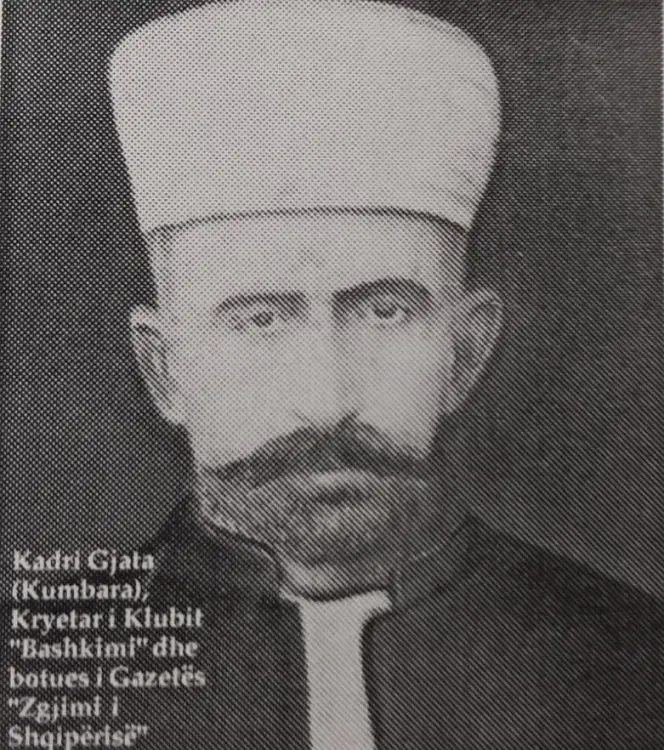


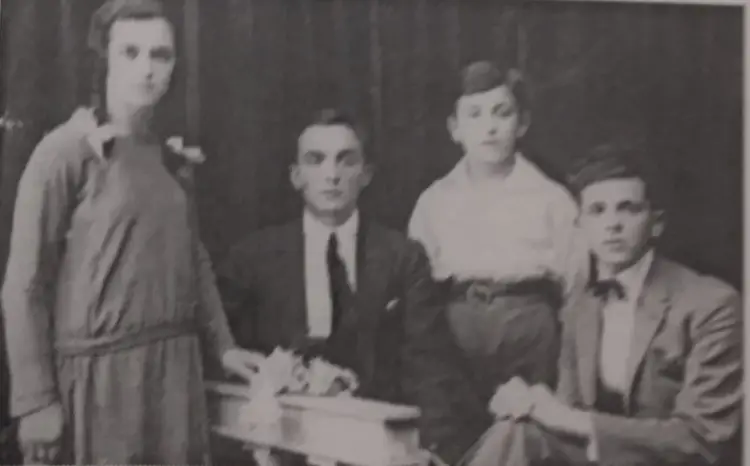
Memorie.al / Kadri Gjata (Kumbaro) was born in Libohovë in 1865, where he completed primary and civic school (Ruzhdie). In 1880, he moved to Ioannina to live with his maternal aunt to continue his secondary education at the Madrasa. After graduation, he remained in Ioannina, as his aunt adopted him, and he took over the administration of her estate. Due to the adoption, he changed his last name from Kumbaro to his aunt’s surname, Gjata. At that time, Ioannina was one of the four Turkish vilayets in Albania. In this city, during the late 19th and early 20th centuries, a patriotic movement inspired by the ideals of the National Renaissance took root. Kadri Gjata (Kumbaro) connected with this movement and over time gained a reputation among patriots conducting nationalistic activities.
The Role of “Bashkimi”
According to the newspaper Liria (No. 11-12, October 1908), in an article titled “Correspondence from Ioannina,” it states: “On the 5th of the month (September 1908), 300 people gathered to found the society… Bajo Topulli spoke… he read the regulations; the leadership of the ‘Bashkimi’ Club was elected: Zia Bey as chairman, Qerim Bey Leskoviku as vice-chairman, Kadri Gjata as treasurer, Rasim Gjirokastra as secretary, and 6 advisors.” At the time, these clubs were the main political organizations that centralized patriotic, political, cultural, and journalistic activities. They conducted legal work alongside clandestine patriotic operations. The clubs were established as organs of struggle for the unification of the Albanian people and the development of Albanian education and culture. Their activities found full support among the broad masses. In many cases, the population recognized the authority of the clubs more than that of the Turkish administration. The most significant and often leading roles in the national movement in Southern and Central Albania were played by the Manastir “Bashkimi” Club and the Ioannina Club. Kadri Gjata collaborated closely with the prominent patriot and well-known journalist Nuçi Naçi.
He was a patriotic and democratic journalist and served for a time as the director of the Ioannina Club’s newspaper, Zgjimi i Shqipërisë (The Awakening of Albania). The work of the Club was quite difficult because Ioannina had strong bases for the Greek chauvinist movement (which possessed its own clubs, press, Greek schools, funds, etc.). The Greek chauvinists in Ioannina not only viewed the Albanian club’s work with open hostility but acted actively against it. They had the full support of the Young Turk governors. As the patriotic movement gained momentum in Albania (especially with the uprisings in Northern Albania and Kosovo from 1909–1912), the Young Turk government placed more obstacles in the way of the Ioannina Club while simultaneously supporting the Greek chauvinists of the Megali Idea. The Turkish administration exerted significant pressure on the Ioannina Club, demanding its dissolution and the creation of a single club under Young Turk control.
It was precisely during this difficult phase, when relations with the Turkish government soured nationwide and Greek chauvinists became increasingly aggressive, that new leadership elections were held at the Ioannina Club. Kadri Gjata (Kumbaro) was elected as its head. Regarding this event, the club’s newspaper Zgjimi i Shqipërisë (April 5, 1910, No. 75) wrote: “The elders chose Kadri Gjata as chairman… who will not be intimidated…” They were convinced that Kadri Gjata, in his role as chairman, would not flinch or succumb to the pressure from the enemies of the fatherland. The activity of this Club has been discussed, among others, in the article: “The Activity of the ‘Bashkimi’ Society of Ioannina in the Years 1908-1912” by Ibrahim Hoxha, published in the journal Studime Historike (1974, No. 1). The goal of the Ioannina “Bashkimi” Club was patriotic propaganda, the acquisition of national rights, the spread of Albanian education, the dissemination of Albanian books and press, and linking the local patriotic movement with the Renaissance movement across the country and in the Albanian “colonies” (Egypt, Romania, etc.).
The Club’s membership included a large mass of Albanians from Ioannina: intellectuals, officials, military personnel, students from the gymnasium and Madrasa, craftsmen, apprentices, and others. The Club also established and enriched its own library with Albanian books of the time. It created a “mësonjetore” – a school – where club members and Albanian students from Ioannina’s schools learned to write in Albanian. The newspaper Zgjimi i Shqipërisë defended and spread patriotic ideas, popularizing the activities of the patriotic movement within Albania and abroad. Under the care of this club, the literary circle “Toskëria” was founded in April 1910. The Ioannina Club was closely linked with other patriotic centers, especially Preveza (led by Sabri Preveza), Chameria (with activist Musa Demi, one one of the former leaders of the Ioannina Club), as well as patriots from Leskovik, Korçë, Përmet, Gjirokastra, Libohovë, Berat, Vlorë, and others. The influence of the Club and the name of its chairman, Kadri Gjata, were felt and respected even in patriotic circles outside Albania (Romania, Egypt, Bulgaria, etc.).
The Club: Under Greek Pressure
Under the pressure of arrests and intimidation by the Young Turks from 1911 to 1912, the majority of Albanian clubs were closed, but the Ioannina Club continued its patriotic work. Seeing that Kadri Gjata was the primary figure of the club and the patriotic movement in Ioannina, official Turkish circles and Greek chauvinists sought to break him through blackmail and anonymous threatening letters. This is evidenced by the newspaper Drita, which in August 1912, in the article “He Who Loves Albania, Dies for It” – dedicated to the assassination of Kadri Gjata a few weeks prior – wrote: “In that city (Ioannina), as an Albanian of high sentiments and national zeal, he supported the club and did not fear death at all, even when threatening letters fell like hail to frighten him away from national action. But for the light-souled martyr, it was all a bluff; he paid no heed, but on the contrary, increased his resistance. His life was in danger from two sides; besides the Greeks, there were also the ‘tikatçinj’ (referring to the Young Turks).” Consequently, the enemies of our people decided to kill Kadri Gjata. On July 12, 1912, while Kadri Gjata was traveling with a relative to the village of Radhotop near Ioannina, he was ambushed and killed by gunfire. His murder was immediately understood to be a hideous political crime, following a long line of other crimes committed by Greek chauvinism in the years preceding the declaration of independence.
Retribution
It was discovered that the assassination of Kadri Gjata was carried out by a band of criminals in the service of Greek chauvinists. The gang consisted of 22 men, led by Captain Gogua and Captain Farmaku. This criminal band, organized by Greek chauvinists, circulated for several days through the villages of Chameria and Southern Albania after the crime. Indignation over this anti-Albanian political crime was immense. In Kurvelesh and Vlorë, several patriotic volunteer units were formed to pursue the gang; they surrounded them twice and nearly annihilated them in an armed clash. Captain Jani Puteci himself paid for the crime with his life (Drita newspaper, Manastir, August 1912). Regarding the assassination of Kadri Gjata by Greek andartes and the spontaneous reaction of the rural masses – who formed bands to eliminate the assassins – this folk song was created in Labëria (collected by Saliko Qani Progonati):
“In the mountain above Sarandë / They killed Captain Janë (Jani Puteci) / Mustafa with his brother / Took revenge for Kadri / Who was killed in Ioannina / Because he loved Albania / Captain Salih Smokthina / Rushed like a lightning bolt / Nearby above Mursi / He killed the twenty-two / O you unfaithful dogs / For one, twenty-five.”
Mustafa Ftera from Ftera, to avenge Kadri Gjata, along with many other villagers, surrounded the Greek andartes – Kadri’s killers – at the Inn of Çuko (Delvinë) and killed Captain Jani Puteci and his two nephews. The others who escaped the encirclement (22 men) were killed near Mursi by the band of Captain Salih Smokthina (Salih Murat Vranishti). The heads of the Greek captains were displayed in the market of Delvinë.
Echoes of Kadri Gjata’s Assassination
Many patriotic newspapers of the time published articles and poems. Among the personalities who reacted were democratic patriots and journalists such as Nuçi Naçi, Muço Qulli, Jani Vruho, Mihal Grameno, the renowned poet Asdreni, Halim Xhelo, and others. These figures were leading representatives of the most democratic and anti-feudal wing of the patriotic movement. Their testimonies and evaluations of Kadri Gjata’s political personality help illustrate the authority he enjoyed throughout the Albanian patriotic movement inside and outside the country. Regarding the Ioannina Club and the contribution of its energetic chairman, Mihal Grameno’s newspaper Koha – one of the most militant organs of the time – wrote: “One of the beloved sons of Albania was killed by the enemies of the Albanian nation. The treacherous, barbaric, and savage Greeks struck the Albanian nation by killing (Kadri Gjata)… He was the soul and heart of Albanianism in Ioannina… He fought like a dragon for the nation… When all clubs were closed, only the one in Ioannina remained open, holding the flag high. This too is owed to the immortal patriot… May his memory be immortal and remain an example.”
The newspaper Shkupi, shortly after the murder, wrote: “A martyr for Albania… The first Albanian in Ioannina; Greek propaganda killed him because he worked for Albania.” Muço Qulli’s newspaper Drita (August 9, 1912), in the editorial “Martyrs of Nationality,” wrote: “Kadri Kumbaro from Libohovë, chairman of the Ioannina club… was killed by the Greeks… Those bloodsuckers should know that if Kadri fell as a martyr, Albania lives with its honor and bravery. If one son of Albania died, that hallowed land of the Pelasgians nourishes in its bosom thousands of braves like him…” Nuçi Naçi wrote: “The Ioannina Club had in its heart a brave man and a flaming patriot whose eye did not flinch and who feared neither evil nor death. This patriot took upon himself the expenses of the Club and its organ. Kadri Gjata (Kumbaro) was a man of work and sacrifice, a fiery agitator, a supporter, and a shelterer of patriots pursued by the government. The Greeks, on the other hand, worked together with the Young Turks to destroy everything patriotic and every trace in the Vilayet of Ioannina. He was killed on July 12, 1912.” In an article published in Liria e Shqipërisë titled “The Murder of Kadri Libohova,” Jani Vruho from Egypt (Misir) wrote: “A week ago today, as I was reading a Greek newspaper from Istanbul, I saw a telegram sent from Ioannina to Istanbul regarding the murder of the late patriot Kadri Efendi Libohova.” Vruho called this news a “dark power” that “horrifies every patriotic Albanian.”
Further on, Jani Vruho warned the Greek chauvinists with great indignation that through these murders and their chauvinist policies, they would never reach their goal. The Albanian people, says J. Vruho, seek to live in friendship with neighboring peoples, but they never allow their rights to be touched and are not intimidated by threats. At that time, in the region of Labëria, a folk song was composed for Kadri Gjata (later published in the newspaper Drita of Tirana on January 27, 1937): “A black cloud has fallen / Over wretched Ioannina / They killed Kadri Gjata / They killed him and left him no more / Kadri Gjata / a young man / A brave man of Libohovë / Striving for the nation / The Striga Eteri killed him / The andartes killed him / With a bullet to the forehead / The bandits killed him / The Albanians are weeping.”
The decisive role Kadri Gjata played in the Ioannina Club is also seen in the fact that after his murder, the Turkish government succeeded in closing the Albanian Club – the only one that had remained active at the time. The magazine Ylli i Mëngjesit (Morning Star), published in Boston, USA (No. 11, 1917), discussing Themistokli Gërmenji, wrote of his relationship with Kadri Gjata (in 1911 when the Young Turks arrested Gërmenji and took him to Ioannina prison): “As they took Themistokli to Ioannina, the brilliant patriot, the late Kadri Gjata – whom the andartes killed treacherously in 1912 – exerted all his power, using not only his influence but putting up his wealth as collateral, just so Themistokli would be saved and the Committee’s plan would not be revealed before being put into action” (referring to a plan for an uprising in Southern Albania).
The memory of Kadri Gjata was also kept alive by the prominent Albanian poet Asdreni. In 1942, thirty years after Kadri’s death, Asdreni published a poem in the newspaper Tomorri (Tirana, No. 286, Nov 29, 1942) where the echo of Kadri’s martyr death is felt: “But a hero like the ancestors / Kadri Gjata in Ioannina / Who with his fire-filled ‘Zgjimi’ / Fell as a sacrifice for Albania.” Interesting evidence verifying the patriotic character of Kadri Gjata’s activity and the political nature of his murder is also found in the diplomatic reports of the Austro-Hungarian consul in Ioannina. The figure of Kadri Gjata and the activities of the “Bashkimi” Club have been studied more deeply after 1944. Particularly interesting are the 1962 testimonies of veterans like Visat Fico, Enver Çobani, and Nezir Leskoviku – members of the Ioannina Club who knew Kadri Gjata personally.
Since 1970, many journalists and writers have written about the life of Kadri Gjata (Kumbaro) and the patriotic activity of the “Bashkimi” Club in publications such as Bashkimi (1970), Mësuesi (1973), Nëntori (1973), and Studime Historike (1974). In 1979, Kadri Gjata (Kumbaro) was declared a “Martyr of the Nation.” In the book Bredhi i Gjelbër (The Green Fir) by writer Petraq Zoto (1981), the memories of the prominent patriot Themistokli Gërmenji are included: “A man dies, but his thoughts and deeds live on… How strange this world is. Until now I could protect myself, but from now on I cannot. I know they have decided and taken measures for my murder.” Whose note is this? Papa Kristo Negovani’s? Petro Nini Luarasi’s? Kadri Gjata’s?
All three shared the same fate. They are among us to this day; they lived with danger at every moment, but they never wavered in their deeds for the motherland. They knew what was being plotted against them, but did they hold out simply for bravery? No, it was something more. Take Kadri. When the Turks took me to Ioannina prison, Kadri Gjata left no stone unturned to free me, as if his own brother had fallen into prison. In closing this piece, on the 109th anniversary of the assassination, we remember with respect the figure of the patriot Kadri Gjata (Kumbaro), who at every step of his life showed a deep love for the Fatherland and a burning desire to see it free and flourishing. / Memorie.al