
By Bashkim Trenova
Part Eight
Memorie.al/ publishes the memoirs of the renowned journalist, publicist, translator, researcher, writer, playwright, and diplomat, Bashkim Trenova. After graduating from the Faculty of History and Philology at the State University of Tirana in 1966, he was appointed as a journalist at Radio Tirana in its Foreign Directorate, where he worked until 1975. He was then appointed as a journalist and head of the foreign editorial desk at the newspaper ‘Zëri i Popullit’, the organ of the Central Committee of the APL (PPSH). From 1984 to 1990, he served as the Chairman of the Publications Branch at the General Directorate of State Archives. Following the first free elections in Albania in March 1991, he was appointed to the newspaper ‘Rilindja Demokratike’, initially as deputy editor-in-chief and later as editor-in-chief until 1994, when he joined the Ministry of Foreign Affairs as Director of the Press and Ministry Spokesman. In 1997, Trenova was appointed as Albania’s Ambassador to the Kingdom of Belgium and the Grand Duchy of Luxembourg. The untold memoirs of Mr. Trenova start from the War period, his childhood, university years, and his professional career as a journalist and researcher at Radio Tirana, ‘Zëri i Popullit’, and the Central State Archive, where he served until the collapse of Enver Hoxha’s communist regime. During this period, under various circumstances, he became acquainted with several “reactionary families” and their descendants, whom he described with rare skill in a memoir published in 2012 titled ‘Enemies of the People’, now brought to the readers of Memorie.al.
Continued from the previous issue
“Enemies of the People”
Troubles for Kristo Frashëri would not end with the War. For the regime, Kristo Frashëri had shown, on more than one occasion, that he was incorrigible – that he had to be “re-educated”! He was removed from Tirana and sent to distant Përmet, in Southeastern Albania. There, for five years, he remained isolated from scientific life and contact with his friends and well-wishers. Kristo Frashëri’s troubles have not ended even to this day as I write these lines, now that he has turned 90.
Professor Kristo Frashëri, a distinguished patriot and a great rebel even in democracy
Prof. Frashëri has a scientific output covering a 70-year period. He has published research articles, historical reports, documentary volumes, and scientific monographs dealing with events, personalities, and processes of Albanian history. Despite his age, he continues to provide an active contribution to many past and current issues. In my view, he remains an outstanding historian and a great patriot. He also remains an incorrigible “rebel” even during the years of democracy.
Following the interview given by Professor Kristo Frashëri in January 2010 on the show “Opinion” on TV “Klan,” I was glad to see him demonstrate, despite his age, an enviable strength and clarity of thought. His final words saddened me. Professor Frashëri closed the interview by saying that his eyesight was failing. He still had many projects but needed someone to assist him in his work. He lived alone. With his small pension, he also paid a woman who served him. He could not share that small pension with someone who could provide assistant services for his scientific work. The Academy of Sciences used to pay someone for this purpose. Currently, it does not. This means that, objectively, he has been deprived of the right to give his incomparable and irreplaceable contribution to Albanian historiography. This is because he is always himself; he speaks with his own tongue, he does not know how to play “grand politics,” and he does not want to die as a mercenary.
Professor Frashëri has been honored with the title “Honor of the Nation” by the President of the Republic of Albania. This “Honor of the Nation,” in the TV Klan show, asks for the bare minimum: to help not him personally, but Albanian science. At the end of the show, he even worries that he might have overstepped with his request and turns to the host with the words: “If you wish, cut these last words in editing; do not broadcast them.” One day, when Professor Frashëri leaves us, surely, from the left and the right, from scientific institutions and independent associations, they will rush to show how great he was and how close they were to him. In short, the ceremonial of hypocrisy will be repeated.
In our class, we did not have any students with a “stain on their biography” or, as it was otherwise called, “affected.” In truth, during the dictatorship, no member of those known as “declassed families” had the right to pursue higher university studies. The students of the University of Tirana were chosen from families connected to the regime, families of communists, or families that had not manifested any opposition or dissatisfaction, however remote, toward the communist regime or the dictator Enver Hoxha.
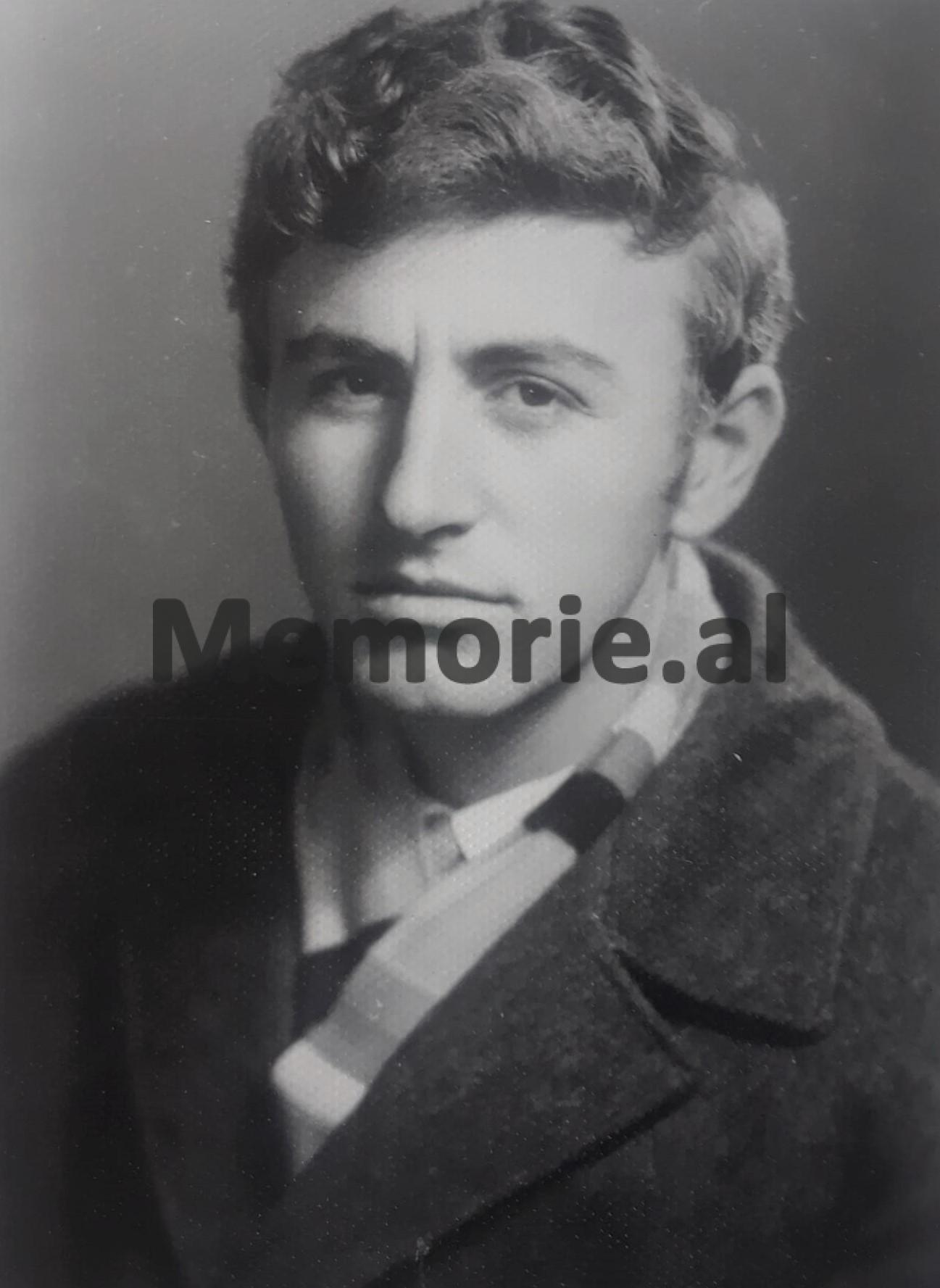
My long sideburns that became a problem at the faculty!
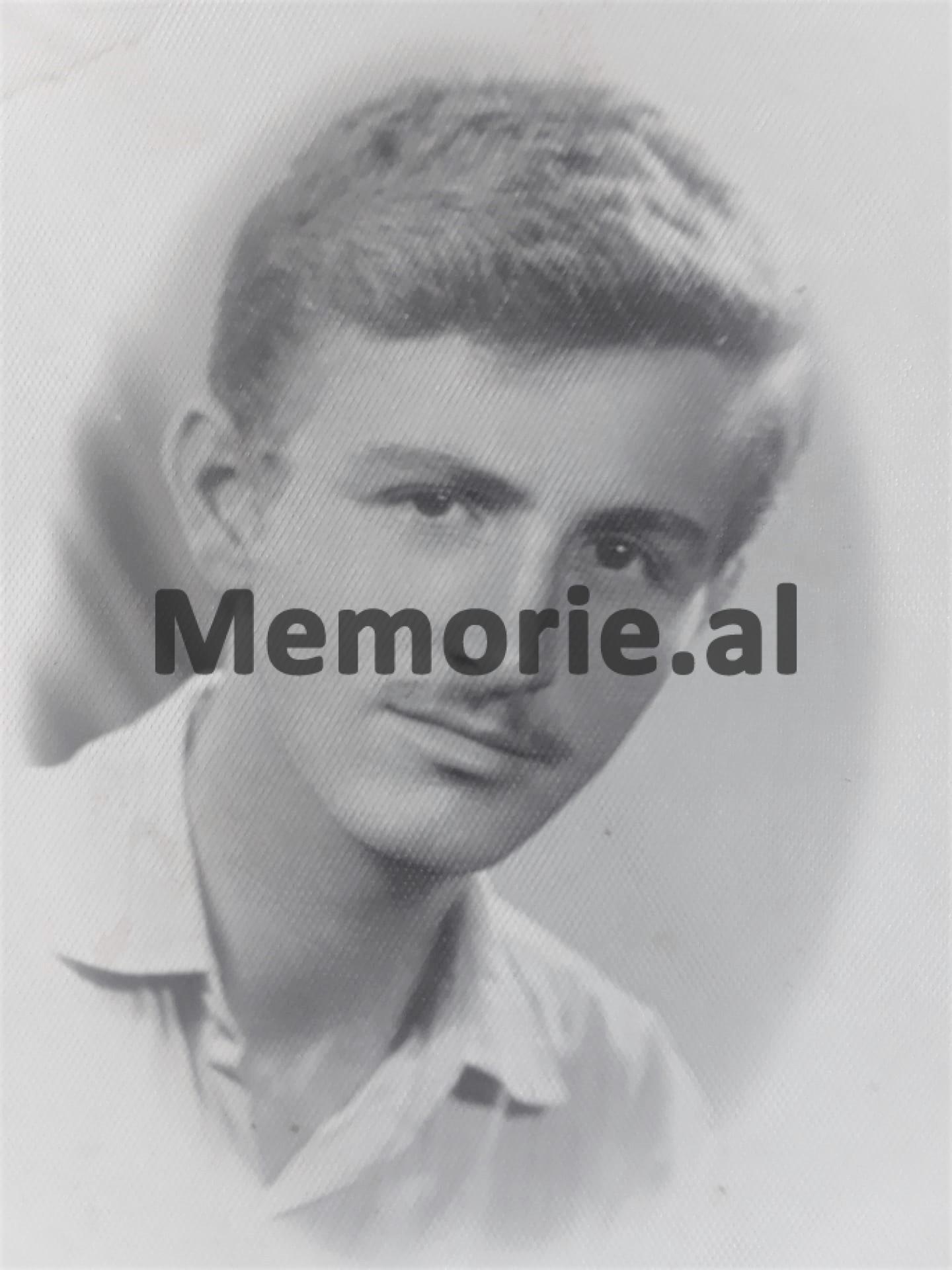
Even though there were no “enemy” students – or more accurately, those of such origin, declassed or with shadows in their biography – the class struggle was not forgotten at the University. The “enemy” was not forgotten because, as the Party said: “The most dangerous enemy is the one who is forgotten.” Thus, at the University, the “enemy” was crushed by fighting what were called “foreign bourgeois manifestations,” “foreign micro-bourgeois psychology,” “decadent fashions and tastes,” “influences of Western art and culture,” etc. I remember the professor of psychology, Thoma Miçolliu, a round, short man with hair combed to the side, Hitler-style. I was in my first or second university year. I liked to keep long sideburns. I kept them that way without a thought for the bourgeoisie or the proletariat, without caring at all whether I was reflecting a bourgeois or proletarian psychology. The Party and Thoma Miçolliu did not think so. He was one of the most active communists in the Faculty.
My sideburns had not escaped Miçolliu’s vigilance. Several times in the lecture hall, he had addressed me, as if jokingly, with the request to cut them. I would laugh off his requests. This “verbal battle” continued until the eve of the exam season. Before taking the psychology exam, Professor Miçolliu addressed me again in the lecture hall, in front of students from several classes, with the words: “Will you shorten those sideburns, or do you want to be ‘shortened’ (failed) in the exam?” I had to choose between the exam and the sideburns; I chose to shorten the sideburns.
The 30 Chinese students at the Faculty of History and Philology in Tirana
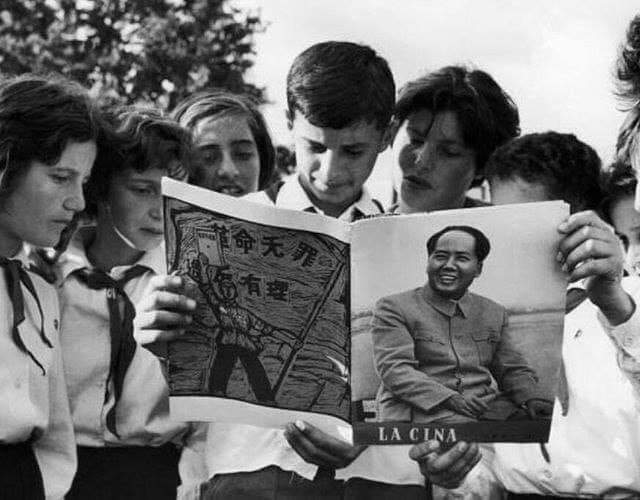
I began my studies at the Faculty of History and Philology of the University of Tirana almost immediately after the breaking of diplomatic relations between Albania and the Soviet Union. In search of allies, Albania’s communist leadership linked the country with Mao Zedong’s China. It swore before the Great Wall of China for an “eternal and unbreakable” Franco-Chinese friendship. The “eternity” lasted no more than 15-16 years and broke like a clay vase, as if it had never existed. Meanwhile, during the years of the “great Tirana-Beijing friendship,” the influence of Chinese communist thought and practice was felt significantly in Albania. Albania began to “Sinicize,” viewing with suspicion, even hostility, everything Western or interpreted as Western.
Mao Zedong’s China was imitated in the most servile manner in the Albania of those years. The sideburns or long hair of Albanian youth, trousers that ended at less than 18 centimeters or more than 22 centimeters, wide belts or those with large buckles, mustaches, and beards – everything was under the surveillance, criticism, and strict threat of the Party of Labour. It was “forgotten” that we were two peoples, two countries, that could be allies and friends, but were separated by thousands of kilometers of geographic distance, had completely different histories, psychologies, and ways of life and thought – often incomprehensible to one another. It was impossible to implant a “Little China” in Albania.
At our Faculty, 20 or 30 Chinese students were studying Albanian language and literature at that time. They were very polite, modest, and disciplined like a small military unit. Many of them also attended our class to hear Professor Kristaq Prifti’s lectures on the History of China. They also participated in the “actions” (volunteer labor) we did in the summer to open new forest roads, such as in Prat of Peshkopi, or to build terraces for citrus cultivation, such as in Jonufër of Vlora. I was friends with their leader, named Fan Jun Nan. The Chinese students said he had been a professor of classical literature at Shanghai University. Fan Jun Nan had also come, officially, to learn the Albanian language, but he rarely participated in language lectures. It was said that the reason for his absences was his poor health. My friendship with him also brought me closer to the other Chinese students, who did nothing without his prior approval.
Chinese students at my sister’s wedding and toasts to Mao and Enver
Since my childhood, at the age of 10-11, Chinese students had piqued my curiosity. I met them during summer vacations at Durrës beach. There were four or five students. They were the first Chinese to come to learn the Albanian language. One was sent back to China before finishing his studies. As his companions explained to me, he had shown signs of pessimism about the future. This was the reason for his return home. I continued to meet the others in Tirana after the holidays. The Albanian language instructors had advised them to socialize with children, as their language was purer and easier to understand. I even invited two of them to my sister’s wedding. They were interested in experiencing an Albanian wedding ceremony. I made a similar invitation about 10 years later, when my brother, Genci, got married, to Fan Jun Nan and another Chinese student named Mao. I remember they brought as a gift two portraits of Mao Zedong and a pair of beads for my brother’s wife, Xhari. At my sister’s wedding, Mao Zedong was absent. By the time my brother got married, the Great Proletarian Cultural Revolution had begun in China. This is why, I think, the beads were accompanied by the two portraits of Mao Zedong. In fact, Mao was present everywhere in China, but also in our relations with Chinese students.
I remember an evening in the student dormitories. Together with a classmate, Mehmet Kotheria, we were drinking a glass of raki. At one point, a Chinese student knocked on the door. He asked us not to make noise because the others were sleeping. We pulled him by the arms and brought him into the room where we were “celebrating.” We offered him a glass of raki. He refused to drink. Then we raised a glass to the health of Chairman Mao. What could he do? Like it or not, he couldn’t refuse. Then we raised a toast to Comrade Enver Hoxha. He couldn’t help but drink a toast to Comrade Enver, since we had drunk to Mao. Then we raised another for both our glorious leaders, then one for the great Albanian-Chinese friendship, etc., etc., until we escorted him back to his room, holding him by his arms. Fortunately, he shared a room with only one Albanian student. For him, one glass downed or several glasses downed were not a problem.
Comparing the first Chinese students who came to Albania in 1955 with those I knew during my University years, I have the impression that the latter were more politicized, more restrained in their conversations, and more schematic. In this short span of time, Chinese communist ideology and practice had done their work. This was noticeable everywhere, even though it was “justified” by the nature of the Chinese as a people.
In the box of the Opera House, near the diplomat from the French Embassy!
During my high school and university years, I often went to the Opera and Ballet Theater in Tirana. One evening, in mid-September 1964, I decided to go see Bizet’s “The Pearl Fishers.” As I was heading to buy a ticket at the counter, a blond man, about 25 years old, tall and athletic, approached me. It was immediately apparent he was a foreigner. He offered me a ticket. I wanted to pay him, but he refused. I insisted, although the ticket he offered cost 50 lek, while I wanted to buy a gallery ticket for 20 lek. He refused again. He asked if I spoke Russian. After receiving my confirmation, he continued to speak to me in Russian. He said he was waiting for a friend, but since the friend didn’t show up, he was giving me the ticket.
In the hall, I sat near him, leaving an empty seat between us. He asked me to move and sit next to him, to fill the empty space. “I,” he said, “want to talk to people, but as soon as I greet them, they leave. Are they afraid?” To show him there was no reason to think so, I moved and sat in the empty seat between us. He introduced himself as Robert Bonneau. He told me he was a translator at the French Embassy. He emphasized that he was not a diplomat. I found myself in an uncomfortable position. I knew I couldn’t stay near a foreigner, let alone near an employee of a Western embassy, who in the regime’s logic was definitely a secret service agent. At that time, there were only two Western embassies in Albania: the French and the Italian. The movements of their employees, as well as those of other embassies, were controlled and under surveillance. I didn’t want trouble with the State Security (Sigurimi), but I also didn’t want to show this diplomat that in Albania, people were afraid even of a chance contact with a foreigner.
I followed Bizet’s “The Pearl Fishers” as if sitting on thorns. During the intermission between the two acts, we talked about the performance, the artists, the stage production, the singers’ voices, etc. We were both satisfied and had more or less the same assessment. At least, so it seemed to me, judging by Mr. Bonneau’s words. He might have expressed himself differently from what he thought, simply to be polite. At the end of the performance, I hurried to part from him. Before I said “good night,” the Frenchman said he would like to meet me again if I were free. He told me he wanted to learn the Albanian language and asked if I could help him. To avoid answering, I asked him: “When are you free?” Mr. Bonneau said he was always free. My face fell; I didn’t know what to say. I hurried to whisper that I was, in fact, quite busy with my studies and that we would surely meet another time at the Opera House. For Robert Bonneau, this was the answer to the question he had asked from the beginning: “Why are Albanians afraid to talk to me?” I was afraid, and he couldn’t help but realize it. Moreover, I wasn’t the only one. Perhaps I was the only one who had dared even this much.
My refusal to meet the French diplomat again!
Before we parted, the French translator or diplomat, Robert Bonneau, gave me his office phone number at the French Embassy in Tirana. He also invited me to see a concert by a French pianist who would soon come to Tirana. I went and saw the concert. The French pianist was the first and last Western artist to come and perform a show at the Opera House in Albania during the communist dictatorship. While following the pianist’s performance, which amazed me with its virtuosity, I was constantly worried, thinking that suddenly, a State Security officer might stop me on the street and ask me to accompany him – I don’t know where – simply for some “routine questions”…! Fortunately, it didn’t happen.
Later I understood why I had escaped the usual “procedure.” Mr. Robert Bonneau had not stayed long in Albania after the concert given by the French pianist at the Opera House. From Tamara, a graceful red-haired student in the English class, I later learned by chance that he had left to perform his military service. She had this information from a classmate who, according to student rumors at the time, was a Security officer. His name was also, by coincidence, Robert.
I saw Mr. Bonneau on one other occasion, but from a distance. This happened during a visit by Chinese Premier Zhou Enlai to Tirana. We, the students of the Faculty of History and Philology, had been brought out to the street to welcome the distinguished friend from China. We were placed on the sidewalk across from the French Embassy. While waiting for Zhou Enlai, I saw Robert Bonneau sitting on the low wall of the Embassy, also waiting. I believe he didn’t notice me. I, of course, neither greeted him nor spoke to him. Even with that, I had already crossed the boundaries.
The Sigurimi, I believe, did not tolerate or “miss” the opportunity. Our meeting and conversation at the Opera House could not have escaped its vigilant eye. They simply didn’t want to act immediately, but rather to create some space to see if there would be a second or third meeting. The wait rendered their cards useless because, in the meantime, as I said, Robert Bonneau left Albania. Thus, I believe the file was closed before it was even opened. Regardless, I was lucky. When I told this “story” to my brother, Genci, he said: “That was it, they’re going to catch you!”
With Chinese students at the Opera House for “Madama Butterfly”
The meeting with the French diplomat at the Opera House came to mind while I was writing these lines about the Chinese students in Tirana. I once invited Fan Jun Nan and another Chinese student to see Puccini’s opera “Madama Butterfly.” I chose this thinking that the events took place in Japan, an Asian country, which should have many things in common with China. At the end of the performance, I asked the Chinese what they thought, what their impressions were. They told me they didn’t like Puccini’s opera. They disagreed with the treatment of the role of Benjamin Franklin Pinkerton, a US Navy lieutenant, one of the main characters. According to them, Pinkerton’s return to Japan to seek his son presented him as human. Still according to them, this character should be seen not as a man, but as a representative of American imperialism, which seeks to rule the world through wars and aggression! We in Albania also characterized what we knew as American imperialism as the international gendarme of peoples and their freedom. We, however, never made any parallelism, which would have seemed absurd to us, between the hegemonistic ambitions of this imperialism in the 20th century and the characters of an opera performed for the first time in 1904 (Note: the text says 1863, likely a historical error in the original).
Another time, I invited two Chinese students to see a historical film about the emperor of ancient Rome, Caesar. They didn’t like this either because, according to them, Caesar was glorified, whereas he had been an emperor, a conqueror. Having failed in the first two cases, I thought I would please my friends by inviting them to a performance of a Chinese play that had been staged by the Durrës Theater. Here too, I had no success. For the Chinese students, the way the piece was staged and the acting made it European—meaning it had nothing Chinese about it. It happened that a few months later, the same play that had been performed by the Durrës Theater was shown in the city’s cinemas. The Chinese had made it into a film. It was the Chinese students’ turn to invite me to see the film. We went, and at the end, they asked me what I thought of the film. I told them that I liked the stage production by the Durrës Theater better. For them, it was the opposite.
With the start of the Great Proletarian Cultural Revolution, all Chinese students returned to China. Before they left, I invited two of them for dinner at my house. They told me they had obtained permission from the Chinese Embassy to come to my place. I don’t know what their fate was. Much later, in the early 1990s, I met one of the Chinese students who had studied in Albania. He had been appointed China’s Ambassador to Tirana. One day, he hosted a banquet for representatives of the Albanian press. We sat together and talked, reminiscing about the old times, the student years. I asked about some of the Chinese students, and in every case, he repeated the same answer: “He has died.” I doubted whether his answers were a Chinese-style formula for saying he didn’t want to or couldn’t speak about them. And if that were the case, it means they didn’t have it easy with the Chinese Great Proletarian Cultural Revolution – that one or several of them were “affected” by this so-called revolution! Regardless, these are merely conjectures. Memorie.al