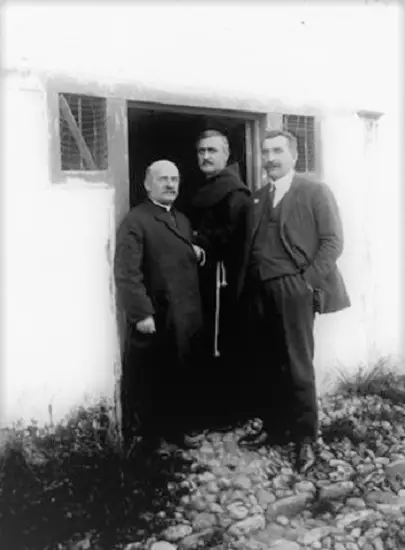
Memorie.al / “I kiss your hands with honor, as a son to a father.” This is how Professor Eqrem Çabej concludes his letter addressed to Father Gjergj Fishta (a document found in the Central State Archive, Fund 17, File 36, p. 12). We began this rebuttal to Professor Nasho Jorgaqi’s article with the stance of Professor Eqerem Çabej toward Father Gjergj Fishta, precisely so that Professor Nasho may learn that, from the very beginning, he starts his writing with a false insinuation!
Driven by the sincere desire to pass down to younger generations historical data that contains as much truth and contemporary fact as possible – facts they not only have no way of knowing but cannot even imagine (due to the distortions made to history by researchers and historians of the communist dictatorship of Enver Hoxha and his successor, Ramiz Alia) – I began my response to the so-called “analysis” of Father Gjergj Fishta’s activity by Nasho Jorgaqi, who titled his piece:
DID GJERGJ FISHTA FLIRT WITH THE FASCIST OCCUPIERS?
A little information for the reader: In the distant school year of 1948–’49, at the “29 Nëntori” High School in Shkodra (the city to which my family was relocated from Tirana as part of the class struggle), I happened to have as a classmate in a parallel class the author of the aforementioned article, Nasho Jorgaqi. He was part of the contingent of dormitory students urgently requested by the Head of the Internal Affairs Branch, Hilmi Seiti, from the Minister of Internal Affairs, Mehmet Shehu, to “subdue the dissident state of the anti-communist students of that school.”
For the sake of truth and objectivity, I cannot deny that, based on events I witnessed firsthand, Nasho Jorgaqi moved with a certain sluggishness at the time (not being a standard-bearer of cruelty) among the ranks of the dormitory students brought to the Shkodra High School with specific tasks regarding the severity that characterized their group, who were eager to implement the class struggle – the result of which was the expulsion, arrest, and imprisonment of our fellow students!
Over the years, I lost direct contact with Nasho, who devoted himself to a career in teaching and, subsequently, as a writer and analyst.
WHAT INITIALLY CAUSED MY DISAPPOINTMENT IN NASHO JORGAQI?
Reading his two-volume work, “MËRGATA E QYQEVE” (The Migration of Cuckoos)! I chose the word initially deliberately because, in later years, interviews followed where Jorgaqi emphasized how he had struggled to convince the communist leaders to approve the writing and publication of a novel whose primary source of information was a State Security (Sigurimi) mole that had infiltrated anti-communist emigrant circles for nearly ten years (Isuf Mullai).
However, without wishing to make assumptions regarding a bridge between the student Nasho Jorgaqi and the contemporary writer, I must pause to analyze the critique he levels against the prominent patriot, Father Gjergj Fishta. I ask myself: What is the origin of the path Professor Nasho Jorgaqi continues to follow in his so-called analysis published on October 2, 2016?
Undoubtedly, it is the directives given by the “COMMANDER” (Enver Hoxha) published in the Bashkimi newspaper on August 22, 1947, which I quote here verbatim from his speech:
“Friendship with the peoples of Yugoslavia could not be darkened by the servant of imperialism and Italian fascism, the chauvinist Father Gjergj Fishta, with his ‘Lahuta e Malësisë,’ where from a simple brigand work, he seeks to make an apology for the most rabid chauvinism and to raise an animosity that never existed between the northern highlands and Montenegro into a mad theory…”
It is precisely this nourishment – initially with the teachings of Enver Hoxha and later his own career – that led Professor Nasho to draft his article. Its language is superficially positive toward Father Gjergj, but in effect, it is filled with negative insinuations, surrounding Fishta’s figure with “problems” and “shadows.” The primary objective is to cloud Father Gjergj Fishta’s legacy with equivocal statements.
A major example is what Jorgaqi calls the “Fascist temptation,” referring to Fishta’s acceptance of becoming an Academic of Italy. Professor Jorgaqi brings forward a single, and according to him, highly significant fact: a letter that Father Fishta supposedly addressed (in Italian) to a HIGH-RANKING FASCIST OFFICER.
However, Professor Nasho did not consider that the first thing a common reader would ask is: To whom is this letter addressed? Furthermore, the letter is presented to the reader in a Tosk dialect where the translator has placed expressions in Father Gjergj’s mouth such as: “…I have sipped (rrufitur), in Resto del Carlino, your masterful article…”
I must add that, firstly, Father Gjergj’s letter (according to Jorgaqi) is not a response to a letter received from a high-ranking – and notably nameless – fascist officer. For the sake of truth, on June 7, 1939, Father Gjergj Fishta received a congratulatory letter from the President of the Royal Italian Academy, Luigi Federzoni, who congratulated him as follows:
“…Your appointment as an Academic of Italy, on one hand, speaks to the high consideration of the DUCE, but on the other, it is a just reward for your values, as well as a special distinction given to Albanian poetry, taking on the meaning of a perfect spiritual unification of our two peoples, whom the Adriatic Sea, with its centuries of glory, unites eternally…”
To which Father Gjergj responded via telegram on June 12, 1939:
“…Moved, I thank you for the congratulations regarding your approval, as well as that of your academic colleagues, concerning my decree as a member of the highest cultural institution of the fascist regime, as a result of the approval by the Duce, as well as the will of our Emperor, convinced that from the bosom of Italy, the ideal Albania will be reborn…”
I invite everyone to place themselves in Father Gjergj’s position and read both Federzoni’s statement and the reply with a critical eye. My view is that both are woven with diplomatic double-language and mutual respect!
Following this, I will bring two facts to Professor Nasho (unlike the letter he calls a “fact” to cast shadows on Fishta) for the reader to weigh.
Fact One: Speculating about the anti-communist feelings of Father Gjergj Fishta as a determined Franciscan cleric – feelings which coincided with the political positioning of Fascist Italy – the first step of the Italian government was to award him one of its highest decorations. Here is the key point of speculation: Jorgaqi fails to mention that not only did Father Gjergj refuse the high decoration, but he did so by stating: “THIS DECORATION IS NOT FOR ME!”
Fact Two: In the funeral mass held by Bishop Monsignor Thaçi, he told the crowd: “…two days ago, when I went to visit Father Gjergj in the hospital, with his last breaths, he managed to tell me – We all owe a debt to death, but I feel regret that I am dying leaving Albania trampled by foreign feet…” I personally learned this fact from the memoirs of Father Zef Pllumi, whom Professor Nasho mentions in principle but ignores this major statement.
In short, even if Professor Nasho Jorgaqi had only learned this one fact while reading Father Zef Pllumi, he should have hesitated with his insinuations… let alone if he had read Professor Eqrem Çabej’s letter to Father Gjergj Fishta!
Regarding the decree as an Academic of Italy: because this fact has been inflated with such malice by ideologically driven historians and “Socialist Realism” writers (driven by ego and envy toward his literary work), let us shed light on it.
At the time, the Academics of Italy, as members of an independent cultural-scientific institution, unanimously proposed Father Gjergj Fishta as a member. To discuss this with him, Professor Agostino Gemelli, a Franciscan cleric and academic, was tasked with the approach.
By this action, the Academy disregarded and mocked the Italian government, immensely raising the prestige not only of Father Gjergj but of Albania. The Academy had cast the dice. Fishta’s response was awaited. The Italian government, feigning lack of interest, waited with added spite.
The answer was delayed, but it came: Father Gjergj considered the proposal an honor and thanked the members. Here is the strength of the patriot’s character: In his first solemn conference as an academic at the “Rozafat” Cinema, to publicly position himself, he spoke of the similarity between the ancient Roman occupation of Illyria and the current fascist occupation of Albania, daring to say:
“…The resistance that the Romans encountered among the Illyrian tribes and Kingdoms all happened because the Illyrians immediately saw that the Roman troops were bringing slavery instead of freedom…”
If we focus only on this public and official statement by Father Gjergj Fishta, it is clear that the accusation of being a “servant of imperialism and Italian fascism” (by Enver Hoxha) falls apart as a malicious, divisive, and misplaced slander!
Looking back now, how should we view the title chosen by Professor Nasho Jorgaqi, where the question rests on the verb “to flirt” (të flirtosh)? I could not have imagined that the author’s insinuation would be formulated this way 69 years after the dictator called Fishta a “chauvinist and servant of fascism.” And all this, Professor Jorgaqi supports with an “eventual” letter of diplomatic language, which he calls a “fact” against Fishta!
I close these lines by reformulating the question: Were Father Gjergj Fishta’s hands to be kissed with the greatest respect, as expressed by the great Professor Eqrem Çabej, or was the figure of this great cleric, patriot, and poet to be scrutinized to see if he had “flirted” with the fascist occupier?! Memorie.al