From Sokol Parruca
Part Nine
– The rare testimonies of the well-known jurist Sokol Parruca, about the icons of Shkodra football over the years, such as; Halepiani, Hasa, Rragami, Rakiqi, Bizi, Dani, Zhega, etc., artists like Vasija, Tërshana, Aliaj, Ljarja, etc., as well as other emblematic characters of that city, etc. –
Memorie.al / It’s difficult to write about the former football players of the “Vllaznia” team of Shkodra over the years, without being a football scholar and specialist, but I am jotting down impressions about those I knew, touched, and saw, about the coaches of the age groups, without pretending to say everything they deserve. And undoubtedly, I judge that it’s impossible not to mention Ernest Halepiani. I was around 9 years old, I don’t remember which neighborhood friend I went with for the first time to the “Parku i Pionierëve” (Pioneers’ Park), near the former “11 Janari” school, to start training in the sport of football. There, the coach for children was a short man, hair with small curls, with a face that shone with kindness.
Continued from the previous issue
SOKOL MESI
We were friends from the age of 6, then in the same class. Around the age of 13, he started to grow in stature, and his body was taking on beautiful forms, with blonde hair that would scatter whenever the wind blew, and he would carefully fix it. The white, ironed shirt with a stiff collar made him seem somewhat older than his peers.
At that time, we regularly watched movies, seeing them several times, long live “Ndoci of the cinema,” who let us enter without money. Sokol and I, who knows how many times we watched the Czech film “Janoshik”; the subject and hero of the film was a handsome blonde, a wonderful rider, and surprisingly, Sokol looked a lot like him, so he adored it.
Inspired by his hero, at the age of 15, he takes a horse from those of the Zootechnics institute, mounts it at a run, and rides through the city streets like a true rider. Meanwhile, we were waiting for him where we met every day; he didn’t come; they told us he had been arrested. We thought he would be out by evening, but he didn’t come out in the evening, or the next day.
Days passed, but we didn’t see him until we found out he had been sentenced to 6 months in prison for unworthy behavior in society. An underage boy to be punished for violating social relations (!!!). What a paradox, but how was he supposed to know those rules; he didn’t even have the minimum subconscious awareness to understand that his actions were violating legal norms that regulated certain social relations.
Nevertheless, even though the Penal Procedure law favored and had leniencies for minors, like Sokol was, they still showed themselves merciless, sentencing a 15-year-old child to prison, treating him like a dangerous criminal. They sent him there with the other adult convicts, right there among them, to be “re-educated.”
Oh God! While he was just a “bird” that couldn’t be confined in a cage, he needed space to fly, to run, to ride with the breeze of the freedom of his age, wanting to unleash all his youthful vigor, and just as he was enjoying this freedom, they violently interrupted it, isolating him, re-convicting and imprisoning him for about 20 years, over 5 times, for violently resisting police officers, whom he actually hated, and whenever he got out, he would fall prey to provocations, making way for the next trial and sentencing.
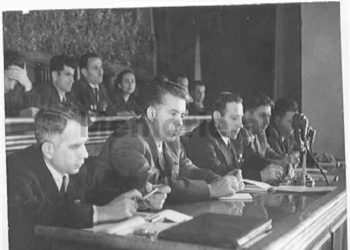
So this boy’s life went in prisons, without having any vice whatsoever. In 1984, we faced each other in court, he accused of violently resisting a police officer, me in the position of prosecutor. As soon as he saw me, he couldn’t take his eyes off me; he wasn’t paying attention to what the judge was asking him, what the witnesses were saying…!
He looked at me with those eyes that said a lot. Within that gaze were included all kinds of feelings, except that of hatred, which was nowhere to be discerned. It was the first time he felt faint, perhaps, because in the role of accuser now stood his childhood friend, with whom he had shared all the beauties and mischiefs of age, and thus, he was putting him in a difficult position. When our eyes met, they understood it was the same code, like before when they were children; that code couldn’t change even when we grew up; nothing could change that code, regardless of the extreme positions we held.
He didn’t know what I was going to say, what I was going to ask for, nor was he even interested in that. He felt deep in his soul that we continued to be friends, even though placed on benches on opposite sides. He knew that distances, positions, roles, and functions couldn’t separate us.
He was deeply immersed in childhood memories, where we played and fought, where we shared our piece of bread in half. He wasn’t paying attention, nor was he impressed by my request for his innocence and immediate release…! Memories had drowned him, and he couldn’t get out of them to understand what was happening.
Only when he saw himself free, then he felt that along with freedom, a bound friendship had been perpetuated, even before learning the ABCs, and his eyes sparkled, became emotional…!
After this, he averted his gaze from me, to leave me convinced that childhood friends are not chosen; they come to you as your lot in life; they are your blood and soul; they accompany you everywhere in the spaces of life’s paths, through memories, events, episodes, and the more years pass, the more we miss them. Memorie.al
To be continued in the next issue