By Prof. Dr. Kasem Biçoku
Part one
-The documents donated by the former German military advisor, Colonel Wolfman Hoffmann, do not prove the departure of “the last German soldier from Albania on November 29, 1944”-
Memorie.al / The ceremony organized in February 2002 by the Ministry of Defense of the Republic of Albania for the handover of photocopies of two documents regarding the date of Albania’s liberation, which Colonel Wolfman Hoffmann, former German military advisor to that ministry, together with a letter in Albanian signed by him, handed over to Major-General Pëllumb Qazimi, was an action outside the legal framework applied in our country for historical documents. Such documents are deposited in our state archives, primarily in the Central State Archive. The subsequent stances of the representatives of the Ministry of Defense have been not only political but also outside the ethics of communication with the media and researchers.
During the ceremony of donating the photocopies of the two documents by Colonel V. Hoffmann, the representatives of the Ministry of Defense rejected the journalists’ requests to obtain photocopies of them to publish in newspapers and give to television stations. Under such circumstances, when the Ministry of Defense did not allow other persons to have copies of the documents donated by Colonel V. Hoffmann, I had to follow indirect routes to get them into my hands.
Mr. Uran Butka addressed the State Archive, requesting that the legislation in force be implemented and that the Ministry of Defense be asked to hand over copies of those documents to the Archive. Meanwhile, the deputy and secretary of the Defense Commission of the Albanian Parliament, Mr. Astrit Bushati, continuously and insistently for several months, asked the Ministry of Defense to hand over copies of these documents, but he did not manage to obtain them.
Only after the repeated request of the Deputy Speaker of Parliament, Mrs. Jozefina Topalli, did the Ministry of Defense, in May 2002, give her the photocopies and deposit them in the State Archive. The secret keeping of the photocopies of these documents created the opportunity for the public opinion to be misinformed by some individuals.
The newspaper “Ushtria” (The Army), a central organ of the Ministry of Defense, on March 1, 2002, published as its lead article an interview with the donor of the photocopies of both documents: “Document: ‘The last German soldier left Albania on November 29, ’44′”. The content of this title is not reflected in the donated documents. Alongside this interview, the newspaper “Ushtria” published a facsimile of the letter that Colonel V. Hoffmann sent to Major-General Pëllumb Qazimi, as well as facsimiles of paragraphs from both documents, which are almost unreadable.
In the letter in Albanian, signed by Colonel V. Hoffmann, it is written: “The XXI Alpine Corps… on 29.11.1944, left the last major city of Albania, Shkodra. Therefore this date can be called the end of the occupation of Albania.” In the text of the interview, after repeating the above phrase, it continues: “It is written exactly like that, black on white.” For these words given above, no cited part from the document has been provided.
Also on March 1, 2002, the newspaper “Zëri i Popullit” (People’s Voice), presenting the former German advisor, Colonel V. Hoffmann, with the rank of general, published the article: “The document, a historical slap on the falsifiers.” This newspaper also published a statement by Xhemil Frashëri, as well as a photo of the photocopies of both documents, placed in a glass frame, to thus prove that there were “reasons” why the copies of these documents were not given to others.
The newspaper “Kushtrim brezash” (Call of Generations), also on March 1, 2002, gave a short notice about the handover of the two documents by Colonel V. Hoffmann. To prove that these documents supposedly verify that Shkodra was liberated on November 29, 1944, Xhelal Gjeçovi, on March 29, 2002, published an article in the newspaper “Shekulli” (The Century) titled: “The history and value of a document.” This author also did not cite any part or phrase from the two donated documents!?
In their place, Xh. Gjeçovi has brought back documents used in his previous writings (“Zëri i Popullit” 21.10.1997; ibid. 29.11.1997; “Shekulli”, 22.11.1999) and those of Xhemil Frashëri (“Zëri i Popullit” 28.11.1999; “Studime historike” 2000, no. 1-2).
These writings have been examined in detail in my book; “28 November 1944 – The Day of the Liberation of Albania” (Tirana 2001), and I have shown the inaccuracies and distortions made to the documents during the tyrannical rule of Enver Hoxha, especially by Xhemil Frashëri himself, with his writings published in the aforementioned organs.
Meanwhile, the newspaper “Ballkan” (Balkan), on April 4, 2002, published an unsigned article: “The debate returns: When was Albania liberated?” In this article, it is stated that from the content of the documents donated by Colonel V. Hoffmann, it does not appear that Shkodra was liberated on November 29.
When the Ministry of Defense handed over the photocopies of both German military documents to Mrs. Jozefina Topalli, almost at the same time – and not by chance, but in the hope that other people would not dare to deal anymore with the issue of the date of Albania’s liberation – a Ministry of Defense employee, Colonel Sali Onuzi, reacted politically to the unsigned article published two months earlier in the newspaper “Ballkan”, with the writing: “Hoffmann: German forces finally withdrew from Shkodra on November 29, 1944” (newspaper “Kushtrim brezash”, June 7, 14, and 21, 2002).
This long article of his is drafted with the anachronistic, unmasking vocabulary and style of the Enverist political commissars of the Army, who, after the bloody tyrant Enver Hoxha “discovered” enemies in its ranks from time to time, they would keep the line and continue the denunciation in various meetings, and even these very ones, with their sick imagination, would manage to “discover” other enemies. Sali Onuzi’s writing best demonstrates how far the true de-politicization of a part of our Army’s high-ranking officers is.
After having inaccurately translated the parts of the documents where Shkodra is mentioned (which also calls into question the Albanian translation of Colonel V. Hoffmann’s letter and interview), Colonel S. Onuzi has made this erroneous interpretation of their content: “So in both documents, the essence of the information is the same: it is recorded on November 30, as daily information on the activity of one day, and it is understandable that it includes November 29. On November 30, the information can no longer be called daily for November 28.” Subsequently, S. Onuzi has repeated the same documents used previously in the writings of Xhemil Frashëri and Xhelal Gjeçovi.
In their articles, which give the same things, instead of examining all the historical sources on the date of the liberation of Shkodra, they have selected a very limited number of documents, without examining their content. Their writings do not give the many documents that show that Shkodra and Albania were liberated on November 28.
They ignore such realities that in 1944, this date was celebrated throughout Albania as the day of liberation (therefore the government and other state bodies came to Tirana 11 days after its liberation, on November 28), that in the decisions taken on November 28, 1944, the high organs of communist power, as well as in the speech that E. Hoxha himself gave in Tirana on that same day, they called November 28 the date of Albania’s liberation.
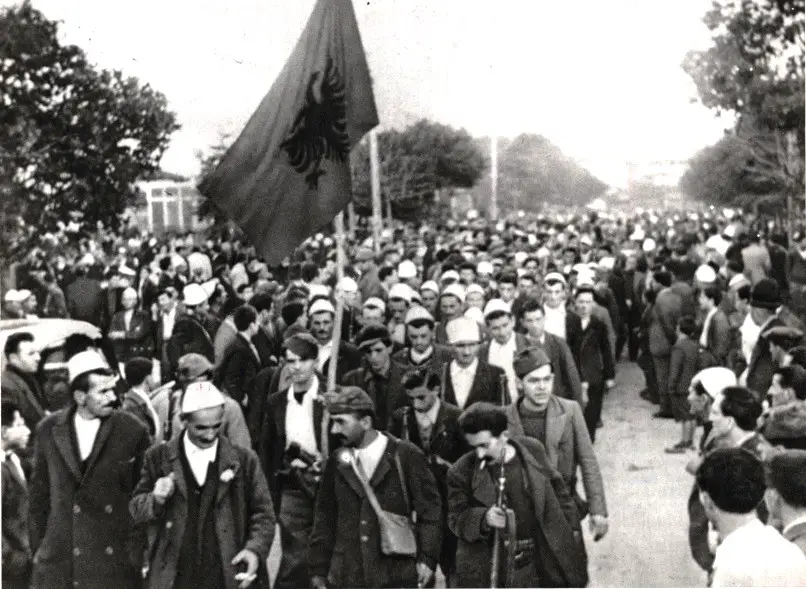
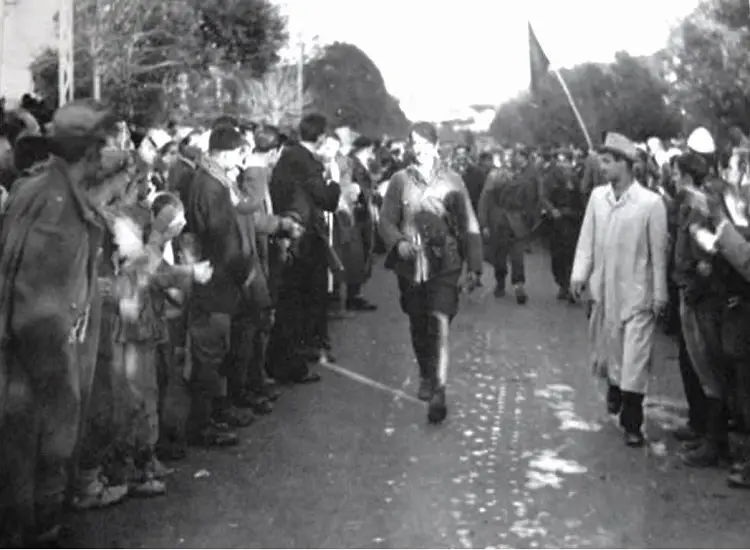
Better than anyone else, the people of Shkodra they knew the date of liberation of their city. In Shkodra, November 28 continued to be celebrated as the day of liberation even in 1945, as evidenced by the local press of the time (photo 1), articles of which for this date I have republished in my book dedicated to the date of liberation. I will not repeat what I have said in that book. Regarding the date of Albania’s liberation, the insistence of the aforementioned authors continues, who misuse historical sources and data to disinform public opinion.
Xh. Frashëri and Xh. Gjeçovi have consistently used in their writings two tracts, of November 28 and November 30, 1944; the first of the National Liberation Council of Shkodra and the second is intentionally attributed to this same Council for disinformation. The first tract is titled; “Towards liberation” and at the end bears the date “28 nanduer 1944” [Gheg for November] and has the phrase; “After the liberation of Tirana, only Shkodra remained unliberated.” (The tract is republished in full in K. Biçoku’s book, 28 November 1944… p. 65-68).
For the researcher who knows all the sources on the date of Shkodra’s liberation, the above tract does not contradict the many sources showing that Shkodra was liberated in the afternoon of November 28, because the tract must have been printed on the night of November 27-28, or at most on the morning of November 28, when the Germans had not yet left the Shkodra region. Moreover, the part of this tract: “the guard that the people themselves set up voluntarily last night in the neighborhoods, proves such a fact and shows that he was never with the occupier and his cubs,” shows that on the night of November 27-28, the rearguards of the German army had withdrawn from the city of Shkodra and were stationed on its outskirts, because the main part of the German troops had left Albania.
Even more intentional is the interpretation they have given to the tract of November 30, titled; “Shkodra was liberated” (photo 2), in which it is not said that Shkodra was liberated on November 29. This tract is written in Tosk, on paper and with different letters from those of the November 28 tract. Although it does not indicate who drafted it, in the republications made afterwards, intentionally to misinform, it has been attributed to the National Liberation Council of Shkodra.
The tract must have been printed in Tirana, because that day the press had not come out, as the celebration of Albania’s liberation continued for the third day. The falsification of the name of the entity that drafted the tract was done for the first time by the Institute of Party History at the Central Committee of the PPSH, in the volume; “Appeals and Tracts of the Communist Party of Albania 1941-1944” (Tirana 1962, pp. 607-608).
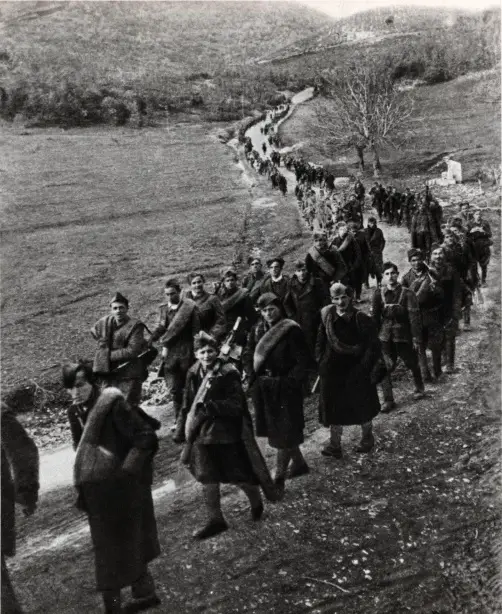
In the writings of the aforementioned authors, several German military documents have also been selected for misinterpretation. These documents are generally very brief notes in diary form of the higher commands of the German army, drafted far from Albanian lands and usually several months after the information received from subordinate military commands. Therefore, as I have written before, they give different dates for the liberation of Shkodra: 28, 29, and 30 November, even December 4.
One of these documents, used by all the aforementioned authors, is: “29.11. The bridges crossing the Buna and Drin rivers at Shkodra were destroyed. The rearguard is located in Koplik.” According to this document, Koplik on November 29 continued to be under German occupation. This is not true and demonstrates the chronological inaccuracies that German military documents have.
The aforementioned and other authors, besides misusing historical documents on the date of Albania’s liberation, have acted in the same way regarding the reflection of well-known historical events, such as, for example, the national holiday of Yugoslavia, November 29.
I have pointed out several times that, within the framework of E. Hoxha’s anti-national policy for the unification of Albania with Yugoslavia, November 29 became an official holiday of Albania (contrary to historical truth and the criteria used for determining national and state holiday dates), to be celebrated on the same day as the national holiday of Yugoslavia, which commemorates November 29, 1943, the date when the Second Session of the Anti-Fascist National Liberation Council of Yugoslavia (AVNOJ) was held in Jajce, as a marked date when the organizational foundations of the Titoist communist state were laid.
The decisions of AVNOJ were imitated after a few months, on May 24, 1944, by E. Hoxha, at the Congress of Përmet. The aforementioned authors have been joined by Ana Lalaj. They have several times pronounced on the issue of this date, distorting the truth. A. Lalaj wrote in 1997 that November 29 was supposedly “the date of the liberation of Belgrade” (“Gazeta Shqiptare”, October 31, 1997). This city was liberated on October 20, 1944 (“Enciklopedia Jugosllavie, l, Zagreb, 1955”, p. 447). In the television broadcast on the morning of November 29, 2001, on “Vizion +”, Ana Lalaj declared another untruth: “November 29 as a holiday of Yugoslavia was established in 1946, while ours in 1945.”
The truth is different. I have written several times that November 29, 1943, as a national holiday of Yugoslavia, was celebrated from the very beginning, as given also by a chronicle published in the newspaper “Bashkimi” (Unity), on November 30, 1945, which describes its celebration in Tirana by the Yugoslav Legation (photo 3).
Whereas the decision to celebrate November 29 as the liberation holiday of Albania was taken by the Presidency of the Anti-Fascist National Liberation Council on November 9, 1945 (some members of this Presidency opposed November 29 and voted against it) and was published in the “Official Gazette” on November 30, 1945, therefore officially it began to be celebrated in Albania in 1946, because in Article 8 of the decision it is written: “This law enters into force on the day of its publication in the ‘Official Gazette’.” (The minutes of the meeting of November 9 of the Presidency of the Anti-Fascist National Liberation Council was published for the first time in full by K. Biçoku, 28 November 1944…, pp. 71-77). For this reason, in 1945, the Presidency of the Anti-Fascist National Liberation Council, not on the occasion of November 29, but “on the occasion of November 28”, announced “the pardon and reduction of sentences for those convicted as war criminals and enemies of the people” (Newspaper “Bashkimi” 28.11.1945; “Official Gazette”, no. 76, 1.12.1945).
The noise and misuse made with the two German military documents, whose photocopies Colonel V. Hoffmann donated to Major-General Pëllumb Qazimi, forces me to dwell on their content. The translation of the documents into Albanian was done by two German scholars, and their translation has significant differences from those made of the documents in the unsigned article of the newspaper “Ballkan” and in the article of Colonel S. Onuzi. Memorie.al
To be continued in the next issue