

By DASHNOR KALOÇI
Memorie.al / From 1945 until his death in ’85, for 40 consecutive years, the life of the primary leader of communist Albania, dictator Enver Hoxha, was never once endangered by an assassination attempt, plot, coup d’état, or anything else, as happened with many of his “counterparts” in the Communist East or the West, etc. And this was due to the savage terror he exercised over his people for 40 years. The “assassination attempts” against Enver Hoxha, from 1945 until he was alive, were nothing more than a fruit of the imagination of the State Security (Sigurimi) and its investigators, who fabricated them to gain fame – claiming they had “saved the Commander’s life,” “saved the Party from a plot,” etc. – extracting depositions from detainees under torture or various machinations. And such instances were not few! One of the first accusations made against detainees – “that they had wanted to assassinate the Commander” – was made as early as 1947 with the investigative and judicial process of the “Group of Deputies”!
In addition to many testimonies made by the defendants of that trial (always referring to the judicial file in question), showing their connections and anti-communist activity to overthrow the communist regime, one of the most interesting testimonies in that trial is the one made by Tefik Deliallisi. He speaks of a conversation held at the house of Ymer Keçi in Tirana, where Ymer assigned Hamdi Kacolle (the man serving near Myslym Peza) the assassination of General-Colonel Enver Hoxha and Koçi Xoxe, during the visit they were to make to Peza.
Another “hostile group” accused of planning to assassinate Enver Hoxha was that of 1963, in the trial held in November-December of that year against the defendants: Vangjel Lezho, Fadil Kokomani, Robert Vullkani, Trifon Xhagjika, Thoma Rafaeli, Franko Sara, and Stavri Rafaeli – all high-ranking cadres graduated from universities and military academies of the Soviet Union and other Eastern European countries, as artists, engineers, military personnel, journalists, etc.
According to the investigative file found in the Archive of the Ministry of Internal Affairs and the information from the Supreme Court addressed to the Central Committee of the APL (PPSH) after the trial, their entire “anti-party and hostile” activity began with agitation and propaganda, espionage activity with the Soviet lieutenant Valentin Zhenj during their meetings at Robert Vullkani’s house and the Durrës beach, the failed plan and attempt to assassinate Enver Hoxha at the leadership’s ‘Bllok’ establishment and later the Minister of the Interior, Kadri Hazbiu, near the Tirana Maternity Hospital, where he often went driving his own car, and finally the attempted escape initially via the Buna River and later through Lake Pogradec, etc.
Specifically regarding the assassination attempt on Enver Hoxha, the indictment of the Chairman of the Supreme Court of the People’s Republic of Albania, presided over by Shuaip Panariti, stated among other things: “To achieve this goal, from the course of the trial, it emerged that they made these preparations:
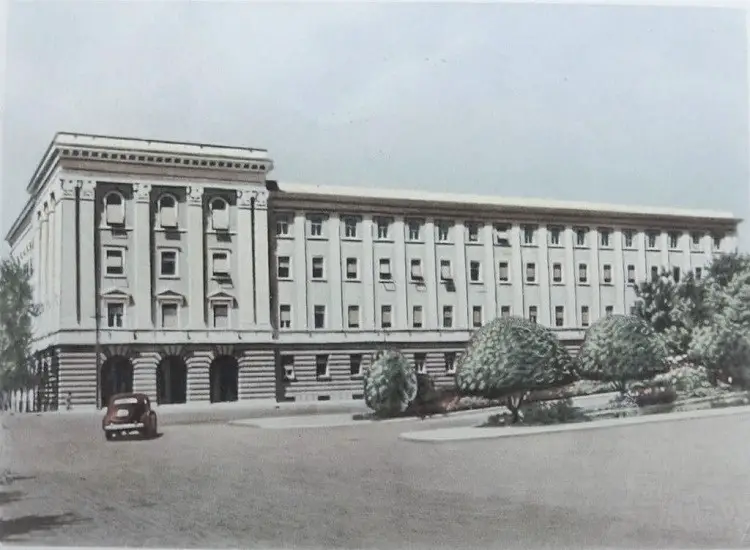
Initially, they planned to carry out the act of terror against the leader of the party, comrade Enver Hoxha. For this, the defendants Fadil Kokomani, Vangjel Lezho, and Trifon Xhagjika confessed that they went near the Central Committee building to observe the time of arrival and departure from the office of comrade Enver. They testified that they had seen at what time comrade Enver went to the office and left, and from which direction he arrived and departed, but they had found it difficult to carry out the assassination against his life due to the good protection provided to him.
Nevertheless, being consistent in their activity, these defendants reached the conclusion to kill other leaders. Thus, the defendants Fadil Kokomani, Vangjel Lezho, and Trifon Xhagjika admitted before the Court – as also emerges from the investigative material – that they intended to kill comrade Kadri Hazbiu and several other employees of the State Security. Captain Xhagjika admitted in court that they had a special hatred for the Security employees and to vent this hatred, they wanted to kill the Minister of Internal Affairs.
The place where they would carry out the assassination against comrade Kadri’s life was determined at the Maternity Hospital of the city of Tirana, as according to them, they had seen that comrade Kadri had come several times toward the Maternity Hospital. They had judged this act as convenient to perform, also taking cue from the fact that they had seen comrade Kadri driving his car himself without being accompanied by any other person. Later they confessed they had given up on performing the assassination at this place and had reached the conclusion to perform this act outside the city of Tirana.
The acts of terror were planned to be carried out with firearms, or even cold weapons. Weapons including both revolvers and knives resulted to have been secured by the above defendants. The defendants confessed that to achieve the above goal, several times they had practiced regarding the use of weapons and especially the use of the knife, training to strike from long distances. These tools were seized from the defendants and presented before the court as evidence of their guilt, regarding the acts of terror they were preparing to carry out against our Party and State.”
Even though some of the defendants, both during the investigation and the trial, “confessed” that they had wanted to assassinate Enver Hoxha, that was a machination of the State Security – a fact confirmed publicly after the 90s by Stavri Rafaeli and Robert Vullkani, two of the survivors of that “hostile group” who suffered long years of political imprisonment.
Another “hostile group” accused of “planning to assassinate Enver Hoxha” was that of 1982, which included: Namik Luci, Estref Kelmendi, Selim Kelmendi, Shefqet Kelmendi, Piro Prifti, and Sejfulla Teta, where the first four were intellectuals originally from Kosovo who had arrived as political immigrants to Albania since the early 60s. Regarding this, in an interview we conducted a few years ago, Sejfulla Teta testified: “After they arrested me on September 29, 1982, they immediately sent me to the Internal Branch of Kruja, where the deputy chief investigator of the district and party secretary, Nexhat Selimi, told me: ‘We have arrested you because you wanted to assassinate the primary leader of the party and the people.’ I asked him: ‘Who? Since there are 12 primary leaders?’
He replied full of anger: ‘I am telling you the primary leader of the Party and the people.’ Utterly surprised by what he was telling me, instinctively I asked again: ‘Who, Enver Hoxha?!’ Before I could even finish the word, in a peak of nerves, Nexhat Selimi said to me: ‘don’t mention his name, you piece of dung, you filth,’ and raised the rubber baton to hit me. I did not hold back and told him: ‘A filthy person is you, with all that…’ From that moment, until I regained consciousness hours later, I remember nothing, as I had been unconscious from the beatings they gave me with rubber batons.
Yes, Nexhat Selimi told me: ‘You together with another group that we have arrested, wanted to kill the primary leader of the Party and besides this you also planted dynamite in Mamurras and the Yugoslav embassy, but we don’t need those now. Our concern is the assassination you wanted to carry out against the primary leader of the Party when he was to visit the ‘Skënderbej’ Museum in Kruja. You planned to throw grenades during the rally when he met with the people, and in case you couldn’t achieve that, then Selim Kelmendi would come out in Krasta of Kruja and carry out the assassination with a pistol. As a reserve variant to carry out this criminal act, if you couldn’t achieve it, there would be Namik Luci in Laç, Shefqet Kelmendi in Lezhë, and Estref Kelmendi in Shkodër’.”
After 27 months of horrific investigation in the cells of Kruja and those of Tirana, on November 24, 1984, the “Hostile group that was to assassinate Enver Hoxha” went to trial, which was held at the Court of Tirana, with prosecutor Loni Mosko and presiding judge Tamara Malaj from Tropoja. During the court sessions that continued for eight consecutive days (the entire trial was filmed with television cameras), even though none of the defendants accepted the charge of assassination against Enver Hoxha, they were sentenced to 25 years in prison, while Shefqet Kelmendi, who took all the charges upon himself, was sentenced to death.
But was there truly ever an attempt to kill Enver Hoxha? In 1975, Beshir Tartar Nevraj, aged 34, originally from Tërbaç of Vlora and residing in the city of Fier, at the time working on the Fier-Ballsh railway, went to the Central Committee attempting to meet with Enver Hoxha, but he was arrested there, as he had soaked his clothes in gasoline! But who was this person, from what family circle did he come, and did he personally or his family and tribe have problems with the “people’s power”? Why did he undertake that dangerous adventure and what was his fate afterwards? Regarding this, we will dwell in another writing in the coming days, whereas in the writing below we are publishing the archival document (extracted from the Archive of the Ministry of Internal Affairs), published for the first time and with the respective facsimiles from Memorie.al.
ARCHIVAL DOCUMENT WITH THE SECRET OPERATIVE COMMUNIQUÉ OF THE MINISTRY OF INTERNAL AFFAIRS DATED MAY 8, 1975, REFLECTING THE EVENT OF BESHIR TARTAR NEVRAJ
PEOPLE’S REPUBLIC OF ALBANIA SECRET
MINISTRY OF INTERNAL AFFAIRS Copy No. 1
DIRECTORATE OF ADMIN. AND STUDIES Tirana, 8.5.1975
OPERATIVE COMMUNIQUÉ No. 106
T I R A N A
On 7.5.1975, Beshir Tartar Nevraj was detained, aged 34, born in Tërbaç, Vlora, and resident in Fier, worker at the Fier-Ballsh Railway, for the reason that at 13:00 on the above date, he went to the Central Committee and requested a meeting with the primary leader. It was discovered that he had soaked his clothes in gasoline. / Memorie.al
D I R E C T O R
Seen PILO SHANTO
Hysni Kapo
8.5.1975