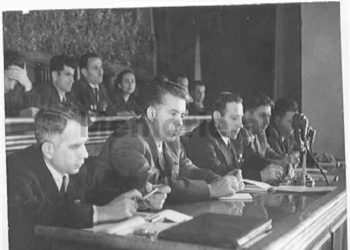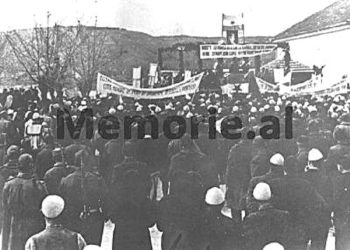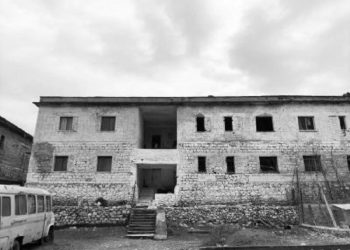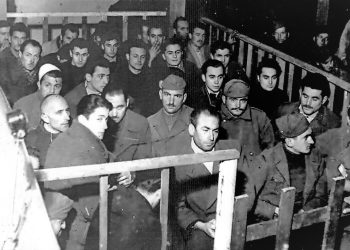
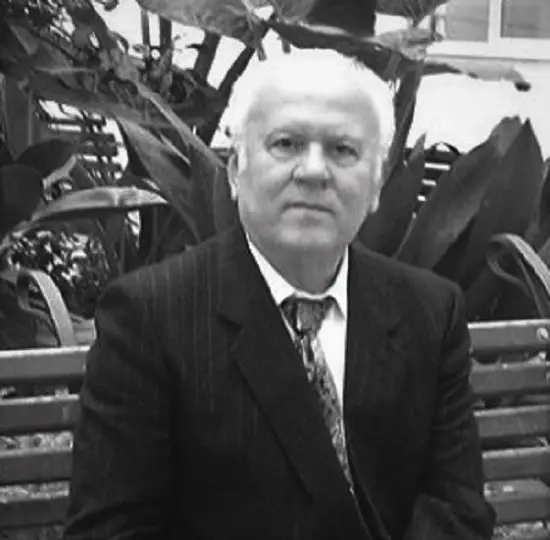

Memorie.al /The war against the kulaks in Albania, which lasted for more than 40 years, constitute one of the darkest chapters in the history of the Albanian state since 1912. The only one who, to date, has taken the responsibility to study this inhumane massacre is the passionate and serious researcher Xhafer Sadiku, through his published articles and books. Albanian communism was merely a more brutal and barbaric copy of Russian communism. For nearly half a century, the communist state and regime robbed the so-called kulaks of their property, elementary human rights, freedom, and, for most of them, their very history. The kulaks, or “enemies of the people,” remained under permanent pursuit through intelligence processing, postal and telephone surveillance, and the “verification of guilt” in their quest for freedom; leading to escapes, evictions, and internments.
The “Title” of Kulak was inherited
The title of kulak was not applied only to the head of the family, but to the entire family, including women and children. In 1951, alongside other coercive measures, “it was decided that the title of kulak would be inherited by other family members, not only upon the death of the title-holding head of the family but also in cases where family members separated.” (Apostol Kotani, “On the Policy of the A.L.P. for the Liquidation of Kulaks as a Class”)
For example, in Lepenica, Vlora, the list of kulaks includes Veziko Çarçan Veshaj, the wife of Veledin Veshi, who died from torture in the cells of the State Security (Sigurimi). Similarly, Shyqyre Hazbi Hysaj, the wife of Hysni Lepenica (who was killed on September 14, 1943), was also listed as a kulak.
But the sons of these heroic women, Kujtim and Leka, would also be designated as kulaks – thus, the title was inherited! Due to heavy taxation, poverty, and imprisonment, there were numerous deaths among kulak families. Many families split into smaller units, under the illusion that they would escape the class struggle. But the communists made no concessions. When a kulak patriarch died, the family remained kulaks under the name of whoever became the new head of the household!
By December 1968, in the Vlora district, there were about 4,000 young people excluded from the youth organization because they were children of kulak families. The struggle against kulaks included banning marriages with kulak families and isolating them during funeral ceremonies. When they or their family members passed away, they were buried only by their own relatives. The lives of kulak families were monitored by the State Security and its collaborators. (Xhafer Sadiku, “Genocide over the Kulaks in Communist Albania 1948 – 1990”)
The Kulaks of Lepenica
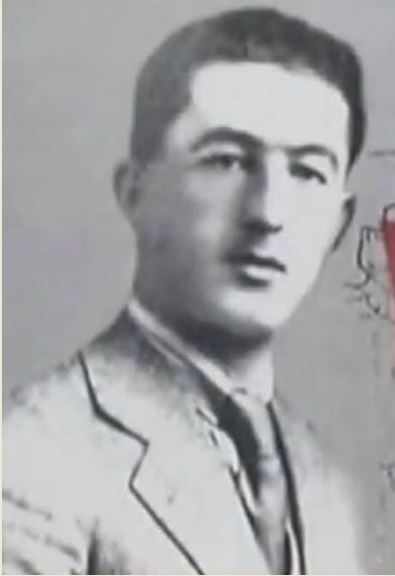
Kujtim Veshaj had just married when, on January 5, 1956, at the age of 20, he was declared an “enemy of the people” and a kulak, along with Lekë Hysaj, the only child of Hysni Lepenica. Until 1990, both remained “enemies of the people,” suffering violence, terror, contempt, discrimination, and the denial of basic human rights.
The declaration of these young men as kulaks was conducted through state terror. Kujtim, then the village youth secretary, was summoned along with the village to the courtyard of Jaho Lame’s house. Muharrem Rrapi, a Party Committee instructor, and Rexhep Osmëni, the local Party secretary, led the meeting.
They told the village: “Kujtim Veshaj and Lekë Hysaj are declared enemies of the people, kulaks, and from this day forward, no villager shall have any connection with them – no giving or taking, no entering or leaving their homes.” Some men dared to ask: “These are just kids, is this how the village measures itself?” The answer was always: “The Party knows best…” The village women, whose tears from the burning of the village in 1943 by Hysni Kapo had not yet dried, left weeping for the disaster striking their village again.
That same year, the Agricultural Cooperative was formed; Kujtim and Lekë Hysaj were refused entry as “enemies of the people,” yet their land and livestock were seized anyway. They were stripped of 70 dynyms of fertile land and left with only 4 dynyms of barren soil. In 1985, the scenario of the 1951 arrest of Kujtim’s father was repeated, but this time Kujtim was publicly “denounced” before the village. “Stand up,” they told Kujtim, “we give you our word to defend yourself, but you may speak for only one minute!”
“My mouth,” Kujtim said, “has been locked by your fear, not by my conscience, and therefore I have not spoken; thus, I owe you nothing, you owe me.” After him, Tefide Ngucaj, a brave woman, stood up and shouted at the presidium: “Shame on you for doing this to Kujtim Veshi!” before bursting into tears and leaving the hall. That cry was the village’s cry for justice.
The Party further intensified the class struggle: Kujtim was fired from the mountain sawmills, his son was removed from his job as a shepherd, his brother Lavdosh was removed from carpentry, and Kujtim’s wife and children were sent to the most grueling labor.
The 1960 “Inventory” of Vlora’s Kulaks
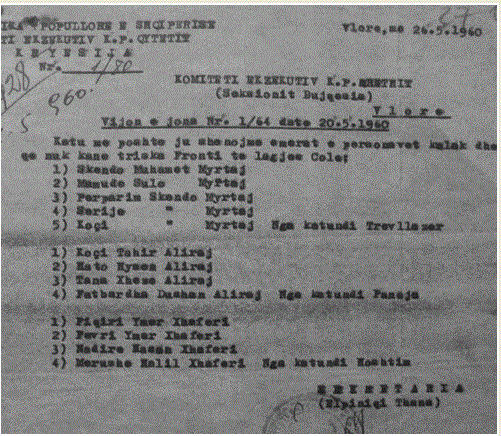
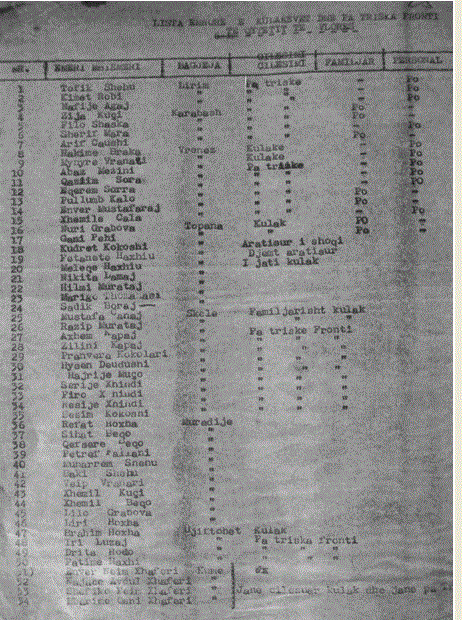
In 1960, the Party conducted an “inventory” of Vlora’s kulaks to ensure none were “lost” or had escaped. The Executive Committee of the District People’s Council, via document no. 1/359 dated May 10, 1960, requested the name list of kulaks from the City Committee. The City Committee responded by listing 84 kulak families in the city, organized by neighborhood:
- Lirim (3 families): Tofik Shehu, Kimet Robi, Nafije Agaj.
- Karabash (3 families): Zija Kuçi, Filo Shaska, Sherif Mara.
- Vrenes (9 families): Arif Çaushi, Hakim Braka, Mynyre Vranari, Abaz Mezini, Qazim Sora, Eqerem Sorra, Pullumb Kalo, Enver Mustafaraj, Xhemile Çala.
- Tophana (9 families): Nuri Grabova, Gani Pehi, Kudret Kokoshi, Fetanete Haxhiu, Meleqe Haxhiu, Nikit Lamaj, Hilmi Murataj, Marigo Thomanasi, Sadik Boraj.
- Skelë (11 families): Mustafa Canaj, Razip Murataj, Axhem Kapa, Zilini Kapaj, Pranvera Kokolari, Hysen Dudushi, Hajrije Muço, Serije Xhindi, Piro Xhindi, Nesije Xhindi, Besim Kokoshi.
- Muradije (11 families): Refat Hoxha, Sihat Beqo, Qefsere Beqo, Petref Fallani, Muharrem Shehu, Baki Shehu, Veip Vranari, Xhemil Kuçi, Xhemil Beqo, Lilo Grabova, Liri Hoxha.
- Lagjia e Re (17 families): Taifur Musa Shehu, Ëngjëll Taifur Shehu, Isak Mete Dulaj, Hetem Kadri Dulaj, Sabadire Meçorrapaj, Nazmije Beqir Shehu, Samine Leskaj, Shano Çobaj, Kujtim Muço Meçorrapaj, Miri Xhafer Meço, Myrdije Teki Meço, Avduraman Hysen Meço, Skënder Shaqo Shehu, Batije Muharrem Shehu, Qefalete Sabri Shehu, Marije Shaqo Shehu, Skënder Qerim Gumbardhi.
- Çole (13 families): From Tre-vëllazëri: Skëndo, Mamude, Përparim, Serije, and Koçi Myrtaj. From Panaja: Koçi, Mato, Tana, and Fatbardha Aliraj. From Oshtima: Fiqiri, Fevri, Nadire, and Merushe Xhaferi.
- Kume (4 families): Enver, Kajaçe, Shefiko, and Mbarime Xhaferi.
- Uji i Ftohtë (4 families): Brahim Hoxha, Tri Luzaj, Drita Hodo, Fatime Haxhi.
Kulak Families in Vlora Villages (84 Families Identified):
The Executive Committee also identified 84 families in the surrounding villages, including:
- Kanina (9): Bonjaku, Luzaj, Xhindi, Vranari, Hoxha families.
- Narta (4): Nako Qirko, Jani Andrea, Vangjel Papa, Vasil Papa.
- Dukat (18): Jazaj, Çeloaliaj, Mëhilli, Hamiti, Haskaj, Nelaj, Koshena, Notaj families.
- Himara (7): Katina Kaçelako, Stefo Goro, Kaliro Goro, Milto Rexho, Koço Llazari, Grigor Bollano, Kozma Kallushi.
- Dhërmi (6): Vangjel Dhima, Milo Goreci, Foto Martino, Kleantho Gjikuria, Stefo Duni, Thanas Duni.
- Others: Lepenicë (Leke Hysaj, Kujtim Veshaj), Gjormi, Matogjin, Mavrovë, Velçë, Kuçi, Kallarat, etc.
Source: AQSH (Central State Archive), F. 1 V. 1960, D. 294, pp. 1–6. / Memorie.al