Dashnor Kaloçi
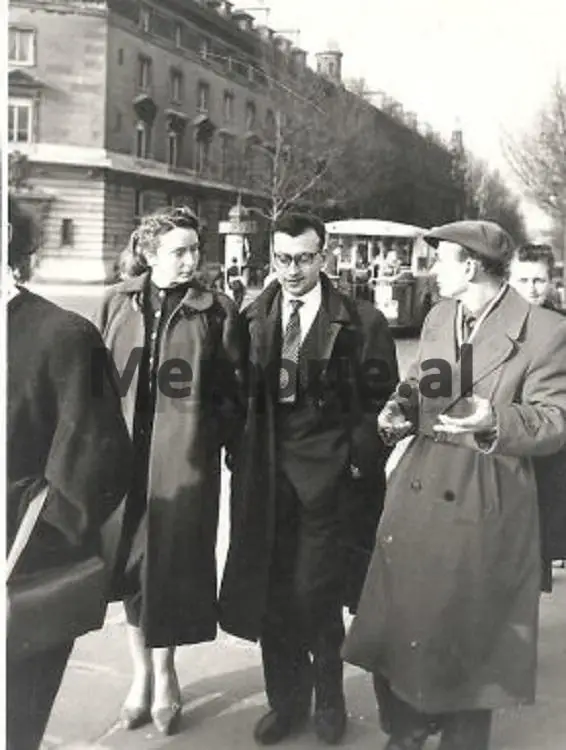
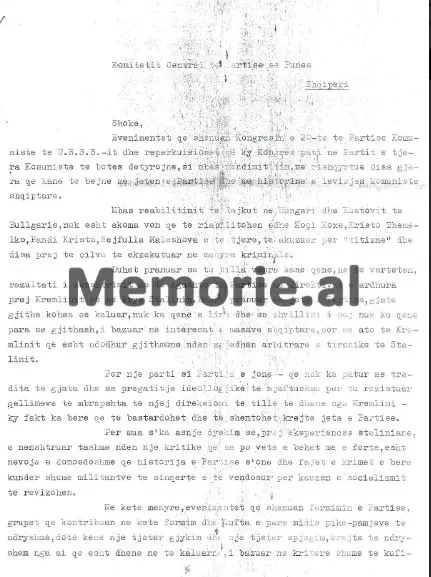
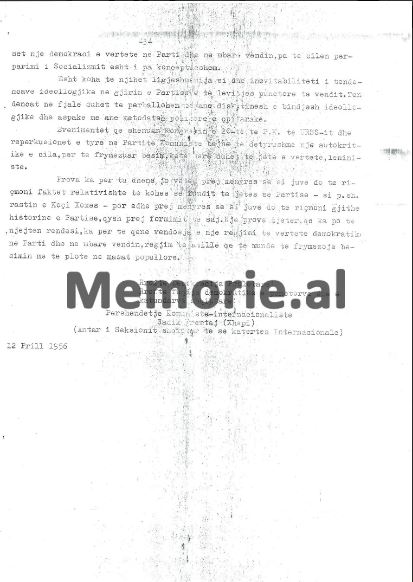
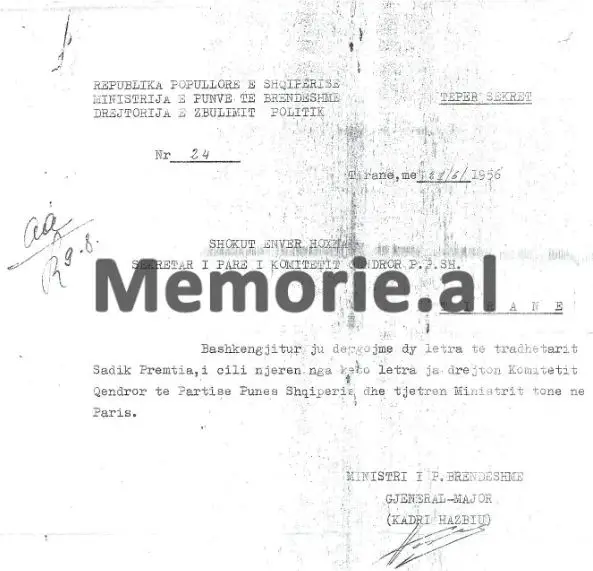
Memorie.al/The letter we are publishing was authored by Sadik Premte, and we believe it is one of the most interesting documents, as it best demonstrates the political stance and position he had taken toward the communist regime in Albania and its primary leadership, headed by Enver Hoxha. The document in question dates to April 12, 1956. Through it, the first letter that Sadik Premte – from exile in the French capital, Paris – sent to the Political Bureau and the Central Committee of the Labor Party of Albania (PPSH) is made public. It concerns the sudden and extraordinary developments that had occurred about two months prior at the 20th Congress of the Communist Party of the Soviet Union – otherwise known as the Congress that led to the final break from Stalinist methods in the Soviet Union and some other Eastern communist countries.
The period when this letter was drafted coincides with the start of the Tirana Party Conference, where for an entire week, Enver Hoxha, along with other high-ranking exponents of the Political Bureau, would face successive accusations from some rank-and-file members of the PPSH regarding the crimes and repression carried out in Albania from 1944 up to the days of that conference. Furthermore, this Conference would witness harsh criticism of the luxurious and expensive lifestyle of government members compared to other PPSH members and ordinary people across the country. This is the context for Sadik Premte’s letter; influenced by the large-scale liberalization movements in the East, he hoped that Enver Hoxha would implement similar reforms in Albania.
In this letter, Premte demands that the members of the Central Committee and the Political Bureau immediately begin the rehabilitation process for all high-ranking communist hierarchies executed or sentenced by Hoxha since 1945, such as Koçi Xoxe, Sejfulla Malëshova, Kristo Themelko, Pandi Kristo, etc. He even includes his close former comrades from the founding meeting of the Albanian Communist Party and the Vlora Communist District, such as Anastas Lula, Neki Ymeri, and Xhemil Çakërri, just as other Central and Eastern European countries were doing. Perhaps in this way, he hoped that the Albanian regime and his personal adversary, Enver Hoxha – who until then had instigated two failed assassination attempts against him – might forgive him and grant amnesty for his return to Albania.
Unfortunately, this would not happen. The Tirana Party Conference failed; Enver Hoxha personally attacked all the “rebels” of that meeting, demonstratively arresting some within the hall itself. About 50 people, mostly well-known officials and communists in Tirana – such as Iljaz Ahmeti, Pajo Islamaj, Vehip Demi, Hulusi Spahiu, Pëllumb Vinçani, Taho Sejko, etc. – were dismissed, arrested, imprisoned, or interned; some were later physically eliminated under mysterious circumstances. This would be the clearest “message” Enver Hoxha would reserve for any form of opposition within Albania and abroad. The last chance for a type of liberalism in Albania – born from the blow to Stalin’s cult and the liberalizing views of Nikita Khrushchev – had practically come to an end.
To the Central Committee of the Labor Party of Albania
Comrades,
The events that marked the 20th Congress of the Communist Party of the USSR and the repercussions this congress had on other communist parties in the world make it necessary, in my opinion, to re-examine several matters concerning the life of the Party and the history of the Albanian communist movement. Following the rehabilitation of Rajk in Hungary and Kostov in Bulgaria, it is not yet too late to also rehabilitate Koçi Xoxe, Kristo Themelko, Pandi Kristo, Sejfulla Malëshova, etc., accused of “Titoism” and some of whom were criminally executed. It must be admitted that such acts were, in truth, the result of the Party’s narrowest submission to directives coming from the Kremlin under Stalin. It must be admitted that the life of the Party throughout the past has not been free and its development was not primarily based on the interests of the Albanian masses, but on those of the Kremlin, which was always under the arbitrary and tyrannical yoke of Stalin.
For a Party like ours, which lacked both long traditions and sufficient ideological preparation to resist the perverse goals of such a direction given by the Kremlin, this fact led to the bastardization and disfigurement of the Party’s entire life? For me, there is no doubt that from the Stalinist experience – now subjected to a critique that is becoming increasingly stronger – it is an absolute necessity that the history of our Party and the mistakes and crimes committed against many sincere militants devoted to the cause of socialism be revised. In this way, the events that marked the formation of the Party, the groups that contributed to this formation and the early struggle between different viewpoints will receive a different judgment and a different explanation, entirely different from the one given in the past based on very limited, false, and slanderous criteria.
All those who were accused as Trotskyists, fascist agents, etc., and as such were expelled from the Party or even executed – such as Anastas Lulo, Neki Ymeri, Xhemil Çakërri, etc. – were in truth determined fighters for the cause of the Revolution and Socialism in Albania, for which their rehabilitation is necessary. These militants belong to the ranks of the pioneers of socialism in Albania and the formation of the Albanian Communist Party. They all had exemplary revolutionary lives, and the proletariat, sooner or later, will honor their memory. Based on the viewpoint that aligns with the true interests of the Albanian communist movement and the regime established after the previous feudal-bourgeois system, my personal role in the Albanian communist movement must and will be re-evaluated.
The accusations launched against me both inside and outside the country are nothing but a result of a bureaucratic and police-like conception of internal life and the divergences within the labor movement, which were rooted in a mechanical and bureaucratic manner through the brutal, criminal methods of Stalin. You know very well that despite all the accusations and slanders, and despite the assassination attempt made against me in Paris on May 6, 1951, I have not ceased for a single moment to defend the ideas of Communism and the Revolution, and to be for the unconditional defense of the current social regime of Albania against Albanian reaction and imperialism. I made my position clear in a letter I sent to the Albanian Legation in Paris in 1953, a copy of which I am attaching.
There is still time, before the development of events forces the history of the Party, to rehabilitate the memory of those who were victims of methods that have nothing to do with the labor movement, and to establish a true democracy in the Party and throughout the country, without which the progress of Socialism is inconceivable. It is time to recognize legality as well as ideological tendencies within the Party and the labor movement of the country. The events that marked the 20th Congress of the CPSU and their repercussions in the Communist Party make a self-criticism inspired by Leninist faith mandatory. The proof must be given not only by the way you re-evaluate recent facts in the Party’s life, such as the case of Koçi Xoxe, but also by the way you re-evaluate the entire history of the Party since its formation. Another proof of equal importance will be the establishment of a true democratic regime in the Party and throughout the country – a regime that can inspire confidence in the popular masses.
Long live Proletarian Democracy! Long live the democratic power of the Albanian workers and peasants!
Internationalist greetings,
Sadik Premte (Xhepi)
Member of the Albanian Section of the Fourth International