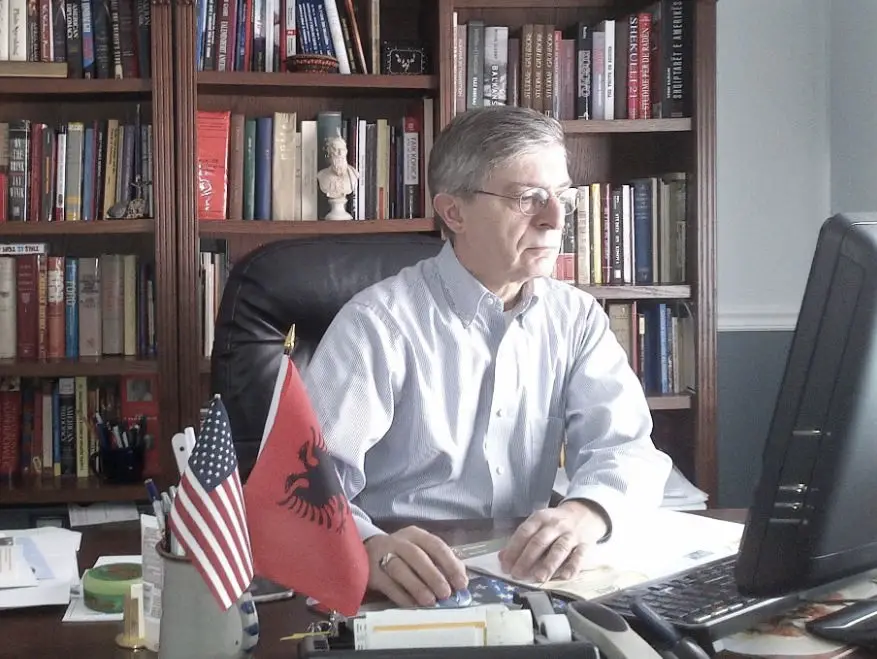

Memorie.al / At a time when words often lose their weight under the clamor of daily interests, when freedom is misused and truth is relativized, the name of Frank Shkreli rises as a living reminder of the true mission of journalism: to serve as the public conscience, the voice of reason, and the unwavering defender of democratic values. For decades, this Albanian journalist, publicist, and intellectual have kept the light of free speech burning across Albanian lands and beyond. His works, especially the three-volume book ‘Democracy Does Not Wait,’ represent not only a summary of professional experience but also a moral testament for generations to come.
Frank Shkreli is a son of Shkreli in Malësia e Madhe, a region where the sense of dignity and the love for freedom are as deep as the roots of the mountain oaks. He was formed in an environment where the word carried weight, where human rights were not guaranteed, and where the desire to be heard was an act of courage.
The young Shkreli, equipped with this inner sense of liberty, left his homeland for the West in search of a space where words could be spoken without fear. Fate led him to the United States of America, where he would begin a new chapter in his life – that of a professional journalist in service of the truth. In Washington D.C., he joined the editorial staff of ‘Voice of America’ (VOA), an institution that for many Albanians had been the only window to the free world.
Within this temple of independent journalism, Shkreli found not just his profession, but his life’s mission. For over thirty years, he worked with dedication to convey news, commentaries, and analyses that maintained a high ethical standard and an incomparable intellectual honesty. From that microphone, which for decades echoed in Albanian homes, Shkreli’s work became synonymous with trust, prudence, and professionalism.
Following the conclusion of his career at ‘Voice of America,’ Frank Shkreli did not view retirement as a stopping point, but as an opportunity to express himself more freely and deeply. He began writing for Albanian media and the diaspora, including magazines, portals, and newspapers that valued independent thought.
His writings are the mirror of a sharp and fair observer, who does not stop at reflecting events but penetrates their moral and political significance. In every line, the reader finds an effort to return to the essence: to the human being, freedom, responsibility, and truth.
Thus was born the idea to summarize a portion of these writings into three volumes: ‘Democracy Does Not Wait.’ The title itself is a declaration, a rallying cry. It expresses the moral urgency of our time – that democracy is not a museum exhibit, nor a decoration placed in political programs; it is a process that requires immediate action, daily responsibility, and civic courage.
This book is a synthesis of the author’s intellectual and spiritual experience. It includes articles, commentaries, and reflections that form a mosaic of his thoughts on the political, moral, and cultural developments of the Albanian world. At the core of every page lies a clear message: democracy is a project that requires participation, not just observation. Freedom is not a right won once and for all; it must be defended, strengthened, and exercised every day.
Shkreli views democracy not as a perfect system, but as a process that functions only when citizens do not abandon it. He warns of the danger brought by indifference, of institutional ossification, and of the moral crisis that often erodes society from within. In this sense, ‘Democracy Does Not Wait’ is not merely a political book, but an ethical one. It is not addressed only to politicians, but to every citizen who believes their country deserves more than a facade of pluralism.
Frank Shkreli’s style is measured and lucid. He does not rush to conclusions but builds his argument carefully, with a clarity rarely found in modern publicism. His writings carry the elegance of the refined word, but also a sincere honesty that stems from experience. He does not speak as an ideologue, but as a citizen. He does not preach, but encourages reflection. And this is precisely the secret of his influence. On every page, the reader feels that Shkreli writes not to convince, but to awaken the conscience.
He treats the reader as a conversationalist, not as a follower. This makes his work honest and human. In an environment where public discourse often falls into vulgarity or empty rhetoric, Shkreli’s writing is an intellectual breath of fresh air: he reminds us that journalism is also a form of education, a moral mission, a duty to the truth.
One of Shkreli’s greatest merits is the way he treats democracy not simply as a political system, but as a civic culture. For him, democracy is defined not by elections, but by the way a society deals with truth, responsibility, and the law. He believes there can be no strong institutions without honest citizens, nor sustainable freedom without public morality. In this context, his book is an invitation for national self-analysis: a call to look in the mirror and ask ourselves not what we lack, but what we fail to do.
In many of his writings, Shkreli uses the American experience as a point of comparison — not to idealize it, but to show that democracy is not a gift, but the result of daily work, of an unceasing commitment to law and institutions. Through this approach, he places the Albanian debate in a universal context: the struggle for freedom and justice is the same everywhere, though dressed in the colors of time and place.
Throughout all his works, Shkreli maintains a high professional standard, supported by three pillars: honesty, respect, and responsibility. He is among those journalists who have never accepted a compromise with the truth, nor with personal gain. In his career, he has followed no political group, no interest other than that of the reader and the public. This has made his figure credible and respected, even by those who do not share the same views.
Therefore, Shkreli’s journalism is a journalism that seeks height, not sensation. He believes the word should elevate the human being, not lower them. In this sense, he is a continuer of a genuine tradition of Albanian critical thought, ranging from Faik Konica to Sami Repishti, from Ernest Koliqi to Martin Camaj – a line of thinkers who saw the word as a moral responsibility, not as a tool of power.
Today, when politics often intervenes in every space of public life and when journalism often loses its critical function, the figure of Frank Shkreli remains necessary. He reminds us that the true journalist is not the one who follows the event, but the one who understands it. Shkreli has always done this: he has looked beyond the news of the day, sought the meaning behind the facts, and marked the trends and dangers that others often ignore. But above all, he has preserved hope.
Even when he criticizes, he does not fall into pessimism. Even when he denounces, he does not deny the possibility of improvement. In every analysis, one feels that he still believes in the individual, in society, and in the power of the word. This makes ‘Democracy Does Not Wait’ an optimistic work, despite the sharp criticism it contains. Ultimately, it is a call for love for the country – not in a sentimental sense, but in an ethical one: love as responsibility.
If the Albanian journalism of tomorrow seeks models, it finds them in people like Frank Shkreli. He represents the type of journalist who knows that his profession is more than a craft – it is a public service. He reminds us that the journalist’s role is not to take sides, but to defend everyone’s right to know. In this sense, his work is a school for the younger generations: a reminder that ethics and professionalism never go out of style.
Thus, the book ‘Democracy Does Not Wait’ is, in essence, a manual for civic responsibility. It reminds us that democracy does not walk on its own, that it requires people to keep it alive through deeds, words, and courage. And in this long journey, Frank Shkreli’s voice remains a compass that always points in the right direction: toward freedom, toward dignity, toward the truth.
In the often foggy horizon of the Albanian public word, Frank Shkreli is a light that does not fade. He is not only a witness to his time but also an active participant in the moral construction of society. His works are a call not to wait – because as the title of his book reminds us, democracy does not wait. It requires that each of us participates, speaks, opposes, and builds.
It requires the courage not to remain silent, not to reconcile with injustice, not to let freedom go to waste. Frank Shkreli has done this his whole life: with his pen, with his voice, with conviction. And for this reason, his name will not remain simply on the pages of newspapers, but in the memory of a nation that still seeks to learn how to live with dignity in freedom. / Memorie.al
(Original Title by the Author: FRANK SHKRELI, THE VOICE OF ALBANIAN CONSCIENCE, IN DEFENSE OF DEMOCRACY)
The three volumes (I, II, III) ‘Democracy Does Not Wait’ – by the author Frank Shkreli
Prof. Dr. Gjekë Marinaj, (right) and Frank Shkreli