Part Two
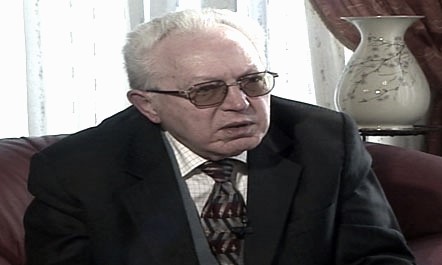
Memorie.al / In an exclusive interview for the author of this article, Academician Ylli Popa speaks about the piece “In Search of Lost Time,” published on April 27-28, 1990. He describes how in Albania, following Enver Hoxha’s death in 1985, the people sought changes from the new head of state, Ramiz Alia. However, he was not making these changes and, as history has shown, Albanians are always late in determining their future. Professor Popa affirms that Teodor Keko had asked him for an article for the newspaper “Drita”, but after reading it, he suggested publishing it in the Party of Labour’s newspaper, “Zëri i Popullit”. Popa then recounts the ordeals that followed the publication of the April 1990 article. Regarding this and other events from that period, Mr. Popa acquaints us in this writing.
Continued from the previous issue
Mr. Popa, did you complain about such a thing? That is, if permission had been obtained from the People’s Assembly – where you were a deputy – to be surveilled and followed by the secret services of that time, such as the State Security (Sigurimi)?
Ylli Popa: Not much time passed from the news I received, and I thought to myself that I should no longer play the fool – acting as if nothing had happened. Therefore, I told Sihat Tozaj, then Secretary of the People’s Assembly. He should have known such a thing, namely if Ramiz [Alia] had made this decision. Sihat received me in his office; it was a rainy day. To avoid revealing the source from which I had received the news, I told him: “I found an anonymous letter in my office telling me that I am being followed by the State Security.”
About a week and a little more had passed since the article, but does such a rule still exist – that if a deputy is followed by the secret service, a decision must be made in the Assembly? “Yes, that rule exists, and the decision must be made by Ramiz Alia,” Sihat told me. (At that time, I had Ramiz as a patient; I was treating him for his heart.) Regarding the letter, Sihat told me: “Perhaps it is some kind of joke”?!
Then I turned to him and said: “Comrade Sihat, I want Ramiz Alia to know that I am aware that the Sigurimi is following me and that a decision is needed for this. I want to know if Ramiz knows about this matter – whether it was done with his consent or not?” Sihat told me he would convey these words to Ramiz himself.
Another week passed, and I called Sihat again, who asked me to go to his office. When we met, he told me that he had told Ramiz all my words, but he had given no answer. “How, he didn’t say a single word?!” I asked. “Yes,” he replied, “he listened to me attentively and said nothing. He has given the order to follow you.”
Were there other reactions regarding the article?
Ylli Popa: Yes, there were reactions that I learned about later. One of our ministers, after a meeting with the people in Gjirokastër, was asked by the participants during the conversation: “What is the story with that article?!” She replied: “I have told Comrade Nexhmije [Hoxha] that it is useless to keep him there, because his wife is Romanian – they are revisionists!”
Ramiz also spoke about the piece in similar meetings, such as in Korçë and Gjirokastër. When they asked him about the article, he told them: “That article is for right here,” putting his hand under the table and pointing a piece of paper toward the trash bin.
Can a person who has not written before produce such an article that disturbs the entire Politburo?
Ylli Popa: No, that is not true. I had another piece in 1988, but as a doctor. In the medical staff, there were those who wrote from time to time – Sali [Berisha] and others. Whereas the 1988 piece came about quite differently. We were strictly required to perform an analysis of the clinics, even though such a thing had already been done once.
The hospital director, Luftulla Peza, gathered us and said that every chief had to analyze their own clinic and that the Chairman of Region No. 1 would attend this analysis; later we were notified that Politburo member Manush Myftiu would also attend, and he called me on the phone for this. I did not accept, but he insisted.
Then, throughout the night, I wrote the article about cardiology and some other things. They put me on the podium, and I read the article I had written. There was a break, and after they gathered again, everyone told me the analysis was good. The idea of that piece was that politics keeps those with “party-mindedness” close, rather than the capable ones. Someone told me I would make many enemies with this idea I had proposed. I said: “Don’t worry, because with this article, the capable will be pleased, while the incapable won’t even realize they are incapable.”
The journalist Musa Ulqini was there; he was young then and worked at “Zëri i Popullit”. He pleaded with me to give him the article for publication, and I gave it to him. After it was published, I was asked to have it translated into English and French to be published in “Albanie Nouvelle”, because they said that foreigners should also find out what was happening here. The article was translated and published. Regarding the article, Jani Polena called me to the Central Committee and congratulated me. After the 1988 writing, they made me a “Hero of Socialist Labour” and also gave me the high medal “The Red Star.”
Excerpts from the article “In Search of Lost Time” by Prof. Dr. Ylli Popa
We are republishing here a part of the writing “In Search of Lost Time” by Professor Ylli Popa, published in two issues of the newspaper “Zëri i Popullit”, specifically on April 27 and 28, 1990, on its third page. The article, which was placed under the banner “Reflections” and in the column “The Time and the Intellectual,” is based on Professor Popa’s reflections, not only on the last two plenums of the Party of Labour (the 9th and 10th) but also on the necessity of speaking one’s mind openly. Professor Popa concludes with the saying: “Each of us, a healthy cell of the nation, has something to tear down and something better to build.”
I was talking one day with a student from the Faculty of Economics. For a long time, he had been admitting and re-admitting his mother to the hospital due to a chronic heart disease. In such cases, between the doctor and the patient, or their relatives, a state of tension and irritation is often created. One day, the student said to me:
– “Doctor, I have the impression that medicine has not yet emerged as an exact science, as long as it still does not cure many diseases.”
– “No,” I told him, “medicine is more than just science. It is science in diagnosing, art in treating, and psycho-diplomacy in relations with the patient and their relatives. However, medicine as a science has its own limitations and, among other things, depends heavily on the economy.
A strong economy means a better life for the people, balanced nutrition for pregnant women and young mothers during the lactation period, abundant proteins for young children when their thinking organ is being formed, clean environments in many homes, and certainly, a more developed medicine. Therefore, do not blame only us doctors.” I continued, to provoke him: “This means that economics is also not an exact science.”
– “No,” the student said firmly and somewhat irritated, “economics is a true and dynamic science that does not let you mock its laws, which does not tolerate acting with the outdated methods of 30 years ago, which in the science of economics have the same value that camphor oil has in today’s medicine.” He was inclined to continue further, but I did not have much free time; therefore, standing up, I told him that sound concepts and courage constitute an indispensable binomial when it comes to undertaking very important actions!
After the student left, I remembered a passage I had underlined from Ramiz Alia’s speech at the 9th Plenum of the Central Committee of the PLA. I reread it later and am reproducing it here: “For the phase of intensive developments taking place, now dominant in our economy, when priority is given to quality, yield, effectiveness, technical and scientific progress, it becomes necessary to further perfect the constituent elements of our economic mechanism. This must be liberated without losing time from outdated elements, from some inefficient borrowed practices; alongside this, it is necessary to correct the weaknesses and flaws that are proven, etc.”
Naturally, this is a difficult matter. From our experience and the practices of others, we have learned how we should not act, whereas to determine how we should take new steps, deep studies and reflections are required.” These were some fresh thoughts from Comrade Ramiz Alia, which task our economists (but not only them) with new and bold duties. By probing these thoughts as deeply as possible, one naturally reaches the conclusion that this analysis should also be transposed into other fields of our social activity, such as: education, culture, science, technology, medicine, etc.
Because these sectors, not just the economy, are subject to intensive developments; in these, too, “priority is given to quality, yield, effectiveness, and scientific progress.” Therefore, these sectors must also be liberated without losing time from outdated elements, from some inefficient borrowed practices, to further correct weaknesses and flaws.”
– I would like not to be a locomotive sliding on smooth rails, but an eagle of great heights, looking at the entire fauna of life as it truly is – with its goods, its bads, and its surprises…! It has never happened before that a discussion has been so massive and with such interest as after these twin plenums.
On the other hand, by entering as deeply as possible into their meaning and requirements, the fact becomes increasingly clear that their success is guaranteed only if all people speak quite freely and without hesitation what they think. The further development of democracy is one of their fundamental requirements. In truth, these ideas have existed for a long time in the hearts and minds of many people.
But not infrequently, because of epithets, labels, and the pressure of “isms,” thought – word and action – are severed from one another. (Thought is an ocean – the word is a stream.) A good thought is only that which serves the development of the nation and the rapid improvement of the people’s well-being. This kind of thought (economic, technical, scientific, artistic, literary, philosophical, etc.) needs to be cultivated with great care. We search in vain for oil and mineral riches in the depths of the earth.
Let us probe more into the depth of thought and find there treasures never before discovered. Let us study more carefully the experience of those countries that, even though they are poor in raw materials, are today at the vanguard of the world economy. Perhaps they realized in time that the most important “raw material” of a nation is the brain, and its greatest wealth is the emancipated and progressive thought of its people…!
In this wonderful time we live in, when the history of Europe has accelerated its pace, we too, as a permanent and inseparable part of it, have many things to do. Each of us, a healthy cell of the nation, has something to tear down and something better to build./Memorie.al