
Part six
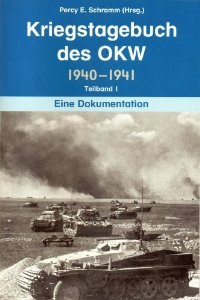
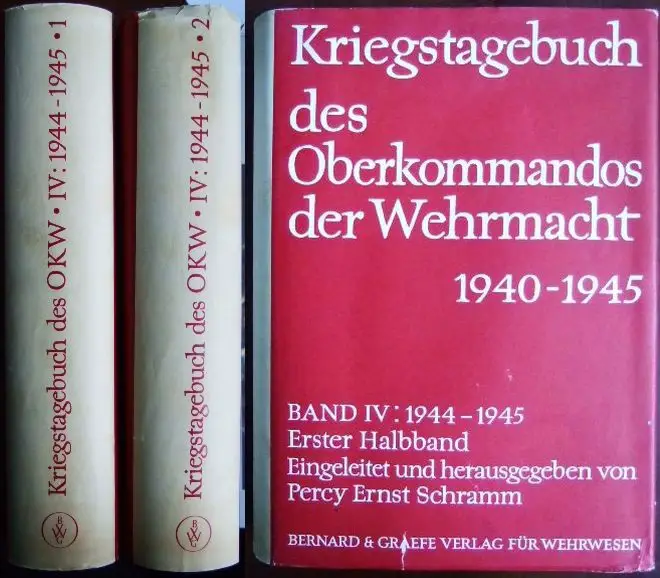
Memorie.al / The war diaries of the Supreme Command of the German Armed Forces (Kriegstagebuch des Oberkommandos der Wehrmacht, KTB OKW), during the years 1940–1945, were maintained by the National Defense Office within the Operations Staff of the German Military Forces (Abteilung Landesverteidigung im Wehrmachtführungsstabamt). These war diaries describe the strategies, battles, troop movements, front lines, objectives, operational decisions, and war plans, as well as the assessment of combat situations, by the highest leadership of the German military forces. The Secretary of the War Diaries at the Supreme Command of the German Armed Forces was Helmuth Greiner until March 1943, and then Percy Ernst Schramm. In the years 1961–1965, the war diaries were compiled by historians and published by the publishing house Bernard & Graefe Verlag für 1Wehrwesen, Frankfurt am Main. The main historian was Percy Ernst Schramm, and his assistant historians, 2according to the volumes, were as follows:
Another significant danger, as emphasized by the Southeast Command, was the preparations for a communist offensive in the direction of Southern Serbia or in the Kosovo area, with the center of gravity in the Berani-Bjelopolje region, which was confirmed by the measures taken by the communists in the area of Southeast Serbia.
Operations in Greece and the Balkans (July-August 1944)
Page 675-676. The Southeast High Command reiterated the request [on 17.07.1944] to send the 1st Mountain Division to Montenegro, emphasizing its psychological impact in a battle for Sofia. For Western Greece, it requested the release from reserve in Thessaly of the 4th SS Motorized Police Division, which, along with other units of Army Group ‘E’, could be used against both communist and Zervas forces, or at least be used in the event of an Allied landing in the Ioannina region.
Page 677. …. c) EDES and ELAS in Northwest Greece: The deployment of the 4th SS Motorized Police Division on the west coast of Greece began on 27.07.1944 (Situation Book 28.07.1944). Meanwhile, a new situation arose, as presented in a notification from the Southeast High Command. Zervas’ forces halted their attacks, so it seems possible to resume negotiations with them. The Southeast High Command requested that this stance be pursued, which is related to the situation in Greece, especially in Athens, where nationalist circles are ready to make agreements with the occupying power [German] and it is not considered impossible for Zervas to accept German demands (withdrawal from the coast and the port of Parga, the fight against communist forces, etc.). On the other hand, the situation has worsened in Southern Epirus due to the actions of seven communist Brigades. The goal of this group was possibly the occupation of the coastal strip; Preveza-Missolonghi.
Therefore, the Southeast High Command, in agreement with Army Group ‘E’, drafted the operation “Kreuzotter,” by which the 4th SS Motorized Police Division and units of the 104th Infantry Division would attack in the southern direction from Ioannina over Arta; at the same time, ELAS forces would be attacked in Boeotia and south of the Pindus Mountains. The impression that German successes in these battles would leave would perhaps influence Zervas to accept the German demands; otherwise, after the conclusion of Operation “Kreuzotter,” the released forces would attack the region held by him.
The Impact of the Turning Point (August-September 1944)
Page 680-681. …. d) The Influences of the Turning Point (August-September 1944): ….. When the commander of the Southeast High Command, the envoy Herman Neubacher, the Foreign Minister [Joachim von Ribbentrop], the SS Commander-in-Chief [Heinrich Himmler], etc., gathered on 22.08.1944 at Hitler’s headquarters, a new instruction for the development of operations in the s3outheastern direction had been prepared (22.08.1944). It was not signed because the next day, a completely new situation occurred in Romania [Soviet forces broke the front in Romania, Romania switched to the Soviet side – Ed. Note].
Thus, the wavering of Turkey and the change of stance in Bulgaria [Bulgaria was declared neutral on 26.08.1944 and demanded the departure of German troops – Ed. Note], brought about the change in the southeastern region. The previous German position in this region could no longer be maintained: on 26.08.1944, the Southeast High Command received the order to prepare for the withdrawal of all troops and equipment south of the line; Corfu-Ioannina-Kalabaka-Olympus, thus the abandonment of the Aegean Sea and Greece began.
Page 681. …. e) Tito’s third case in Serbia (July-August 1944): ….. Operation “Draufgänger” of the SS Mountain Division “Skanderbeg” on the Montenegrin-Albanian border (Berane), drew numerous enemy troops into combat, but could not stop the offensive of the 1st and 2nd Communist Corps toward Serbia.
Page 682. The assembly of the 1st Mountain Division was delayed because its transfer had not been planned. On 03.08.1944, the railway near Mitrovica was cut, while the arriving parts of the Division were forced to engage in fighting around the Pejë region. (Situation Book 04.08.1944).
Page 685. In the SS Mountain Division “Skanderbeg,” repeated instances of desertion and disintegration were noted at the beginning of September, so its disbandment was ordered.
German Withdrawal from Albania and the Balkans
Page 690. (This section writes about the withdrawal of German troops from the Balkans, a withdrawal which began in October 1944 – Translator’s note.) …. The withdrawal from the coastal areas of Montenegro and Albania was carried out slightly slower, which was closely linked to the withdrawal of Army Group ‘E’ (Durrës, 12.01.1945, Cetinje, 17.01.1945, Kotor, 21.01.1945, etc.).
Page 699. Until the first week of October 1944, the goal of the German command was that with Army Group ‘E’ (which received the order on 03.10.1944 to withdraw from Greece, Southern Albania, and Southern Macedonia), located on the “Blue Line”; Shkodra-Skopje-Këlcyrë [in Northern Greece – Ed. Note] and with Army Group “Serbia,” located on the line; Negotin-Danube (as of 01.10.1944) and that; Vlasotince-Bela Palanka-Zaječar-D. Milanovac (as of 05.10.1944), to hold the Croatian-Montenegrin-Northern Albanian and Serbian area. But it was soon seen that most of Serbia was lost. On 10.10.1944, the order was given to retreat beyond the Morava [River].
Page 701. In the first week of November, the intentions of the Soviet leadership became fully clear: Soviet Armies had begun the offensive in Hungary, and the task of the Bulgarians and Tito’s units was the destruction of German positions in the Croatian-Montenegrin-Northern Albanian area, and in that way, to bring the western part of the Balkan Peninsula under Soviet control, roughly above the Shkodra-Velesh [in Macedonia – Ed. Note] line, in accordance with the zone division in Moscow.
Political and Supply Issues
Page 704. The Albanian communist movement, which apparently might have started on local initiative, became a stable part of Tito’s organization during the summer [1944] as the “Central Staff for Albania.” The impression is created that for some time, there also existed the plan to incorporate Albania into the Yugoslav federation (Situation Book 25.07.1944).
Page 706. Pending a general and quite threatening Allied offensive, the increase in insurgent actions in the regions of Southeast Europe still under German control, and the failure to establish governments in Montenegro and Albania, re-raised the question: whether at least the Serbian volunteer organizations and the political movements behind them, by receiving more help in armaments and supplies, could become an auxiliary combat force for the German army and create a secure zone for everyone?!
Page 707. The special envoy for the southeastern area, Hermann Neubacher, was in the central headquarters of the leadership for some time in April 1944 to discuss current issues. Among other things: ….. d) The provision of 120 trucks, which, as previously mentioned, had been requested earlier to avert supply problems for the population in Albania and Montenegro, where famine threatened. This was important because the increase in bandit activity was also linked to the lack of food. With these measures, the special envoy hoped to organize the Albanian national forces, aiming to reach a number of about 20,000 men.
For that, he needed submachine guns for 10-15,000 men and the integration of small German units with grenade launchers into the Albanian national forces. Besides, the special envoy, Hermann Neubacher, also had to discuss the issue of financing the German army in Greece and Albania at the central headquarters of the German leadership, as the complete bankruptcy of local currencies seemed inevitable.
Page 708. …… At the same time, January 1944, the newly established government bodies in Albania were disbanded. Reliable members of the disbanded hunter battalions were regrouped into the Albanian SS Division, “Skanderbeg.”
Troop Movements and Retreats (October-November 1944)
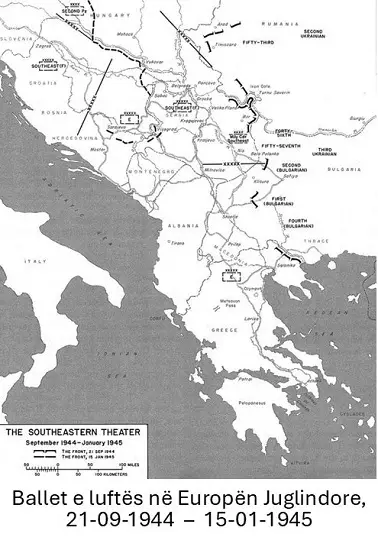
Page 720. The Southeast Command, noting the threat to the railway in Macedonia, the severe transport situation, and the lack of coal due to sabotage, repeatedly requested a decision regarding Greece, until on 03.10.1944, it received the order to withdraw from Greece, Southern Albania, and Southern Macedonia. …… On 16.10.1944, they withdrew from [the Greek cities of] Thebes and Itea; simultaneously, the withdrawal from the island of Lemnos began. On 21.10.1944, the German rearguard was on the line; Larissa-Metsovo Pass; on 23.10.1944, a blocking line was established on both sides of Korçë. Two days earlier, they withdrew from Volos, the last important port south of Thessaloniki. On 25.10.1944, the front crossed the lakes of Southern Albania.
Page 721. In Albania, the Durrës-Elbasan line continued to be held. On the night of November 1st to 2nd, 1944, the rearguard of Army Group ‘E’ crossed the Greek-Macedonian border, without any significant enemy pressure. The departure from Greece had been completed.
Page 723. With the fall of the city of Niš, Army Group ‘E’ lost the railway connection. But the Russian offensive in Southern Serbia and that of the Bulgarians in the south and southwest of Niš were also threatening the last important marching route from Skopje, through Mitrovica, Kraljevo, Užice, to reach Sarajevo. Crossing through the highlands of Eastern Albania and east of Montenegro would be the end of a unified retreat for Army Group ‘E’.
Page 724. … At the same time, the Bulgarians launched a large-scale offensive against Skopje, thus increasing the risk of fragmentation for Army Group ‘E’… The 11th Air Corps Division withdrew north and east of Pristina, where it created an arc-shaped front.….. The battles on 02.11.1944 and the advance of three Bulgarian Divisions and a tank brigade north of Podujevo caused the breach of the front at the Merdare Pass and threatened the road junction in Pristina. ….A planned withdrawal from Macedonia was drafted. On 06.11.1944, Strumica was liberated; on 07.11.1944, the rearguard of the XXth Army Corps was in Skopje. On 11.11.1944, Veles was abandoned, and on the night of 13/14.11.1944, Skopje was liberated. Fierce battles are taking place with the Bulgarians in Pristina.
Page 725. In the retreat of Army Group ‘E’, the withdrawal of the XXIst Army Corps (181st, 297th Infantry Divisions, Fortress Brigades, etc.) from Albania holds a special place. The withdrawal was initially planned to go through Nikšić [in Montenegro] and Trebinje [in Southern Bosnia] to reach Mostar, which became impossible after the enemy occupied the mouth of the Neretva River into the Adriatic. Thus, the troops’ path of retreat was cut, and they would have to try to break through a mountain range in the north-eastern direction controlled by Tito’s forces.
After the departure from Tirana, on 17.11.1944, a military unit gathered in Podgorica to attack Nikšić, an attack that failed. On 22.11.1944, the Commander-in-Chief of the Southeast troops flew to Albania himself to assess the possibility of a breakthrough for this military unit. It was decided that the unit should turn from Podgorica to Prijepolje, through Kolašin and Bijelo Polje, and join the troops retreating from Macedonia there.
On 29.11.1944, the rearguards of this corps left Shkodra, but positions further north were held for some time longer. The 181st Infantry Division had left Kotor on 21.11.1944. The march continued, accompanied by fierce fighting with Tito’s forces and was further complicated by snowfall and a major flood that occurred on 11.12.1944, which destroyed all important bridges.
Final Events and Reflections
Page 821. …..German troops left Vlora on 12.10.1944 and Thessaloniki on 31.10.1944. The rearguards crossed the Greek-Macedonian border on 1-2.11.1944. But in Albania, a new front was created on the Durrës–Elbasan line.
Page 822. To defend the valley of the Ibër River [in Northern Kosovo – Ed. Note] from the Bulgarians approaching from the south, through the highlands of Kopaonik, Army Group ‘E’ gathered Albanian national forces, which, under German leadership, waged an exemplary fight.
….. From October to mid-November 1944, the enemy advanced with extraordinary losses in personnel against our retreating and defending forces. A unique situation was created on 02.11.1944 and in the days following, when three enemy Divisions and a tank Brigade attacked north of Podujevo and broke through at the Merdare Pass. The important road junction of Pristina was significantly endangered. Nevertheless, by using the last reserves, it was possible to stop the advance and further enemy attacks by the evening of the same day.
Page 822-823. The decisions of the Southeast High Command for the withdrawal of Army Group ‘E’ occurred at the time when the 2nd Tank Army was attacking in Drina and Syrmia. The rearguard withdrew from Southern Macedonia; Veles was abandoned on 11.11.1944, Skopje on the night of 13/14.11.1944, the Bulgarians furiously counterattacked north of Pristina on 20.11.1944.
Page 823… The withdrawal of German troops to the north was delayed by at least 10 days due to numerous bandit actions in the Tirana area. Therefore, German troops left Tirana on 17.11.1944. On 20.11.1944, a strong corps gathered in Podgorica, which could dare to attack Nikšić. But this attack failed and showed that even by bringing in other parts of the XXIst Army Corps, it would be very difficult to break the front there.
Page 824. The breakthrough of the XXIst Army Corps seems very difficult. After a powerful attack, the bridge in Bioče [northeast, above Podgorica] was captured on 28.11.1944, which also had to be repaired under very difficult conditions, under enemy aircraft fire, in order to enable the departure of the majority of troops from Albania. The departure from Shkodra was only possible on 30.11.1944. Further on, they had to fight for every kilometer, not only against the treacherous enemy but also against the forces of nature.
On 12.12.1944, a great flood occurred which destroyed all the newly rebuilt bridges and thus delayed the withdrawal process. The British, who were cooperating with the bands, exploited this opportunity to pursue the troops along the withdrawal route, managing to inflict noticeable damage, especially to vehicles, on the marching columns, as they were waiting in open terrain.
The Enemy’s War to Prevent the Exploitation of Mineral Wealth and Other Raw Materials!
Page 936. …… 5. Another needed metal was chromium. The increasing demand for it could be met better and better after the German army occupied the Balkans. Because in that way, the possibility of exploiting the mines in Greece, Bulgaria, Serbia, and after the capitulation of Italy, even in Albania, was created.
Situation Books (01.01.1945 – 20.04.1945)
Page 1013 – 14.01.1945. Enemy situation in Croatia: Albanian units remained behind. The opponent is trying to send Serbian units in the north-eastern direction, to the area south of Syrmia, bypassing Slavonia [in Croatia].
Page 1184 – 19.03.1945. Politics: A British envoy has arrived in Albania, and the British have asked Tito to withdraw his troops.
Notes of General Alfred Jodl in Nuremberg Prison, regarding Hitler’s Influence on the Conduct of the War
Page 1719. ……British tanks pushed the Italian troops of General Rodolfo Graziani to the borders of Cyrenaica [Eastern Libya region], and instead of Italy achieving a swift victory in Greece, it was also risking the loss of Albania. In that situation in Rome, the feeling of defeat overcame pride and calls for help reached Berlin. In that situation, Hitler decided: Under the conditions of modern air warfare, the war had to be kept as far away from Germany’s borders as possible. He did not want a confrontation with Greece, and therefore refused to help Italy in Albania. Memorie.al