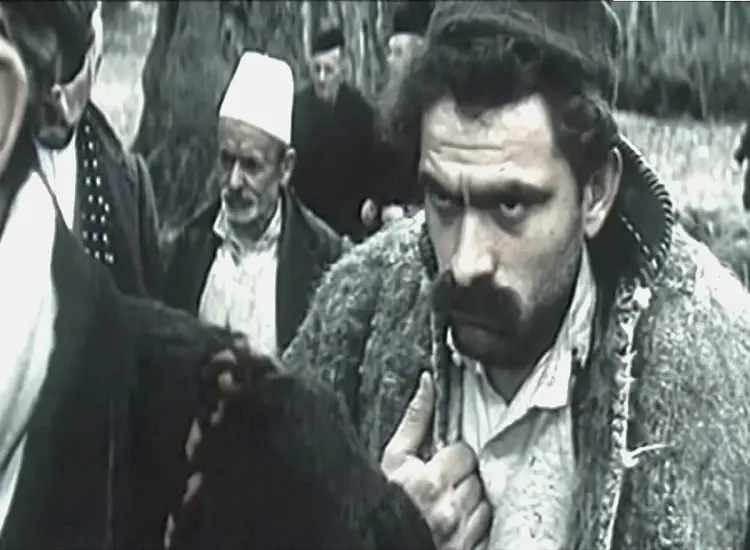

Memorie.al / Every time I watch the film “The Man with the Cannon” (Njeriu me Top), with a screenplay based on Dritëro Agolli’s novel, I am reminded of the Italian we kept in our home in Qafë e Skraparit during the War. Surprisingly, what the film portrays, I found in the stories told by my grandfather, Rushan.
Our Italian was named Mario, and he was from Northern Italy. My grandfather, it seemed, had loved him dearly, as he spoke of him with passion, praising his human qualities: above all, that he was “gentle as a lamb” and very hardworking. It annoyed my grandfather that, despite asking every day, he could never remember the complicated name of the place Mario came from. Together with Mario, Rushan cleared a new field, about 4-5 acres, which we called “Pusez.”
Although my grandfather would tell the Italian to rest when he came to the house for lunch, he never sat down. The poor soul worked like a slave and slept at night in the straw barn, as we had no house – the Germans had burned it down. From Mario, our village – and especially our home located at an altitude of 900 meters above sea level – had a lasting memory: he had planted tomatoes for the first time. Everyone had said the “land wouldn’t grow them,” but he succeeded. Since then, our tomatoes – especially the autumn “ox-heart” (zemër-kau) variety – became famous.
When it was time to leave, Mario threw his arms around my grandfather’s neck and cried like a child. Rushan, who boasted he had never cried in his life, could not contain himself either; that “rogue” had made him shed tears. To justify that moment of weakness, he often said: “He was truly a golden boy; he was worth the tears I shed for him!”
THE END OF THE WAR: SEPTEMBER 8, 1943
“General Eisenhower speaking! The Italian government has surrendered unconditionally to our armed forces… as of today, hostilities between the United Nations forces and those of Italy cease immediately…!” The waves of Radio Algiers spread the news of Fascist Italy’s capitulation and the end of its alliance with Nazi Germany across the world that day.
In fact, the capitulation had occurred on September 3, five days earlier, with the signing of the armistice between Marshal Badoglio and General Eisenhower in Southern Italy. This collapse had shown signs a month and a half prior, on July 25, 1943, when the King of Italy, Victor Emmanuel III, under heavy pressure from the Gran Consilio del Fascismo, dismissed Mussolini and replaced him with Marshal Pietro Badoglio.
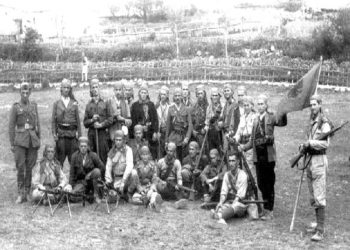
Following the capitulation of Fascist Italy, Albania was occupied by the German army, the Wehrmacht. 90,000 Italians were taken prisoner by the Germans, while about 45,000 scattered across the country. British officers and communist leaders tried to convince the Italians to hand over their weapons to the partisans. Success was found only with the “Firence” division, from which about 1,500 – 2,200 men joined the National Liberation War, creating the “Antonio Gramshi” battalion. Other Italian units tried to reach the Albanian coast to return to Italy. Other units surrendered neither to the Germans nor the partisans but created their own resistance centers against the Germans. By the end of the war in Albania, about 20,000 Italian soldiers remained.
THE KING FLEES IN THE DARKEST HOUR!
Immediately after the capitulation, the government and the King himself, feeling unsafe there, fled South to Brindisi and later to Salerno, leaving the North at the mercy of fate in the hands of the German Nazis, who within a month deployed 17 divisions and over 150,000 other men outside the military ranks. Even in the South, despite the Allied landing, continuous efforts were needed between Allied and Nazi forces for that part to be free. By the end of 1943, Southern Italy, where the government and Allies were concentrated, was under control. The new government declared war on Germany and was recognized by the Allies as a co-belligerent.
ON THE BRINK OF ANOTHER WAR, NOW A CIVIL WAR
By late 1943, anti-fascist parties organized and created the “National Alliance Committee” (CLN), joined by many loyalists of the Savoy Monarchy and former regular army officers, who had a negative influence on later developments. The situation was entirely different in Central and Northern Italy, where Nazi Germans enforced the law.
On September 11, they freed Mussolini from prison and formed a puppet government with him, filled with fascist extremists who acted with cruelty and beastliness across the territory they ruled. The episodes in Northern Italy were each more tragic than the last until full liberation. Entire villages were leveled; no life was spared, including the elderly and children, by the retreating Nazis.
The configuration of Italy’s leadership after the war was another struggle, nearly on the brink of civil war, where forces that joined fascism were in complete antagonism with those that joined the partisans and brought true liberation, laying – in cooperation with the Allies – the democratic foundations of the country. Just as happened with Greece after the war, where others enjoyed the fruits – those who not only did not contribute but collaborated with the enemy – in Italy too, right-wing forces took political power. Regardless, Italy learned its lessons; all sides paid for what happened in 1943, and all sides threw themselves into the recovery of the country.
WARS, A HEAVY PRICE FOR PEOPLES
The participation and combat activity, the struggle, and the self-sacrifice of foreign fighters – or the formations they created within the National Liberation Army (UNÇ) in the interest of the Albanian people’s freedom – were paid for with the price of blood. But, undoubtedly, this participation was the message and the bridge built for the union between the Italian and Albanian people, which was proven later.
ITALIANS IN ALBANIAN PARTISAN FORMATIONS
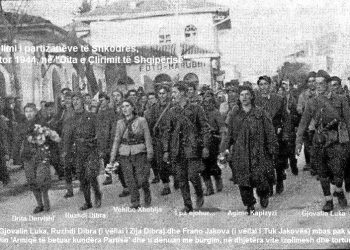
The participation of Italian soldiers in partisan formations was a highly interesting phenomenon, an outstanding internationalist and idealistic act in the struggle against a common enemy of humanity, such as fascism, which they had served until just a few days prior.
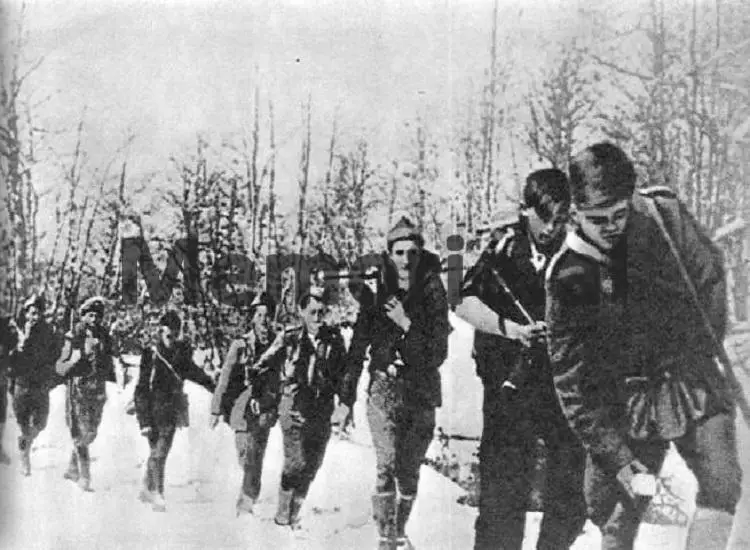
Many Italian soldiers and officers with communist ideas who hated fascism had begun deserting even before Italy capitulated to join the partisan ranks and fight against the now common Nazi enemies. Their arrival had happened early, with the beginnings of the National Liberation War (LANÇ) in Albania, back in the time of the çetas (units), when the Albanian National Liberation Army had not yet been formed.
According to data, their number before the capitulation of the Italian fascist army was about 120-130 people. Later, this turned into a phenomenon of larger, more visible proportions until September 8, 1943, when Fascist Italy surrendered unconditionally and the army was no longer commanded from the center, from Italy.
According to data from that time, a significant mass of nearly 15,000 military personnel – mainly soldiers but also many non-commissioned officers and officers – surrendered to partisan forces and local commands. From the mass of 15,000 who surrendered to partisan formations, only the most determined – a number of 2,150 military personnel – joined the UNÇ formations. According to data from that time, it was found that from the above number, 472 Italians were enlisted in assault brigades, 401 others entered rear-guard service, while the remaining part of 1,277 people were engaged with local commands.
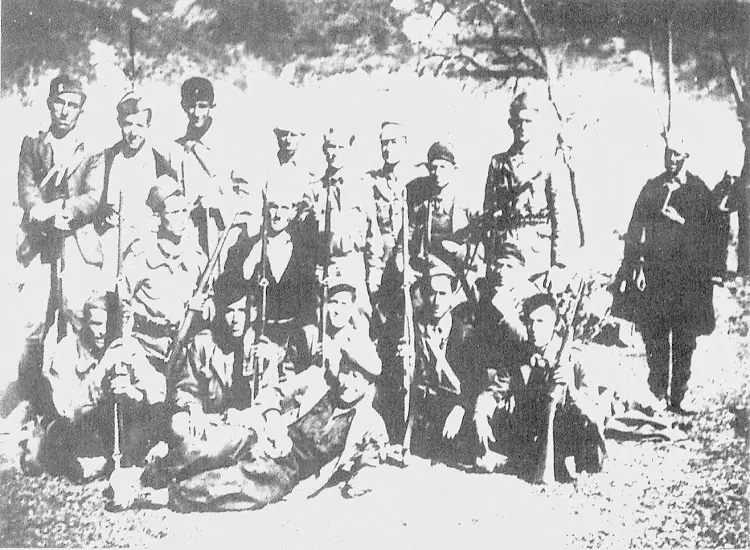
These formations, with their often prominent and specialized combat activity, earned the honor and respect of the Albanian people, against whom their fascist regimes had sent them to fight. From their ranks, 73 fighters fell during combat actions against Nazi occupiers and were declared “Martyrs of Albania.” When conditions ripened, these forces went further, toward creating tactical-level combat formations and their leadership bodies within the Albanian UNÇ. The most typical case was when Italian military personnel decided to create a separate battalion within the First Assault Brigade, an idea liked and approved by the former Italian military personnel who had joined the brigade.
THE “ANTONIO GRAMSHI” PARTISAN BATTALION
On October 9, 1943, the battalion named after the Italian communist leader of Albanian origin, “Antonio Gramshi,” was created. The leaders of the new battalion were Italian officers themselves: Battalion Commander, Non-commissioned Officer Tercilio Cardinali; Political Commissar, Alfredo D’Angelo; Vice-commander, Giuseppe Monti; Deputy Commissar, Domenico Bogatai, etc. The daily and combat activity of the battalion was led by its staff, which consisted of 5 members.
With the full liberation of Albania, the General Command of the UNÇ ordered that, based on the “Antonio Gramshi” battalion, former Italian military personnel scattered throughout Albania be called and organized around this core. Thus, the “Antonio Gramshi” brigade was born. A short time later, this brigade was transformed into a division, which bore the same name. In May 1945, finally, this military unit of Italian nationality – under the care and interest of the General Command of the UNÇSH and the Albanian government, in agreement with the post-war Italian government – was repatriated to Italy, sent off with a special ceremony.
Following the example of the “Antonio Gramshi” battalion, other formations composed of former Italian military personnel were formed and operated within several UNÇ assault brigades. Among them was the III Assault Brigade, within which a platoon of 27 fighters was organized under the Italian name “Mateotti.”
A small sub-unit named “Giacomo Matteotti” was formed within Group IV, named “Çamëria,” of the First Operational Zone Vlorë-Gjirokastër-Mallakastër. In December 1944, during the time it operated in the Kosovo region, during a reorganization carried out there on November 24, 1944, the VI Battalion with 200 former Italian military personnel was inaugurated within the V Assault Brigade. Ernesto Kebastura was appointed Battalion Commander, and Giorgio Gluo as Political Commissar.
ANTONIO GRAMSCI, COMMUNIST OF THE ENTIRE WORLD, BUT NOT OF ALBANIA
During socialism, guided by the spirit of proletarian internationalism, some memories and names of prominent communist personalities were kept alive, while for Antonio Gramsci, nothing was done. No Street, no school, no factory, no institution, no hydropower plant was named after him, except for the name of a partisan formation during the LANÇ with the remaining anti-fascist Italians.
And that was all. We do not have the proper information, but we judge that the reasons for the silence regarding Antonio Gramsci in Albania should be looked for in the former Soviet Union. After the breakdown of state and party relations with the Soviet Union, the political leadership of the Italian Communist Party, and especially Palmiro Togliatti, aligned more with Nikita Khrushchev and almost broke off relations with us./ Memorie.al