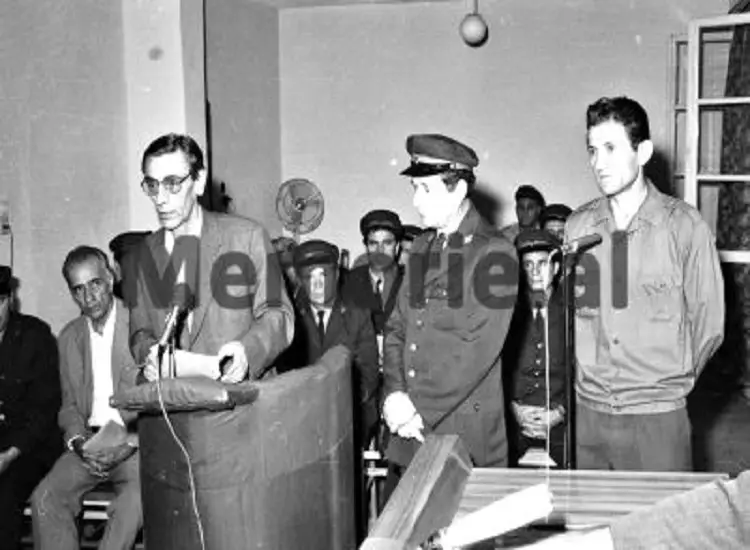

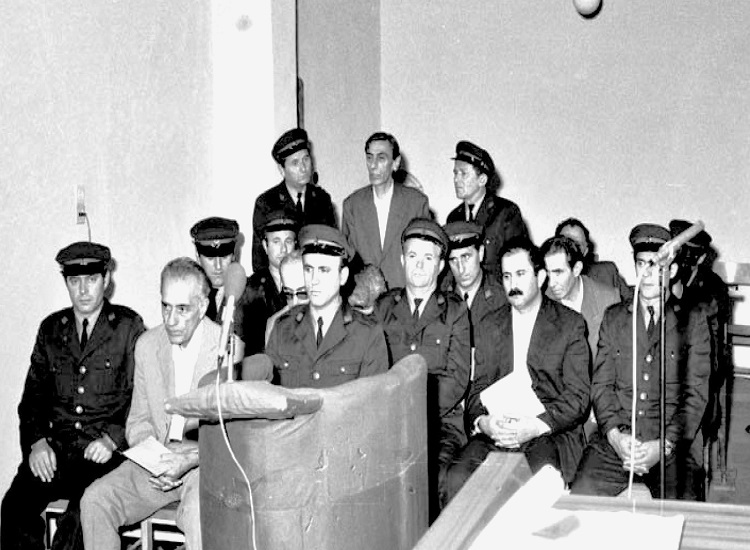
By AGRON ARANITASI
Part Thirteen
– THE TRUTHS I BELIEVE, THE FRENCH AGENT –
Introduction
Memorie.al / When I started writing the book The Truths I Believe (PAPIRUS Publishing House), I had not intended to write about myself. The initial impetus came when I became acquainted with the State Security files concerning the surveillance of Citizen Agron Hajdar Aranitasi. Those files are yet another testimony of how one could be persecuted – someone who, at a certain moment, was placed among the enemies of the people’s power. No account was taken of anything: neither how he had worked, nor how he had behaved, nor how he had lived. No account was taken of the stance of his parents, brothers, and numerous cousins, who were automatically subjected to brutal blows and suffered consequences without having any fault.
Continued from the previous issue
My misfortune and my family’s….!
Introduction
I had not thought of turning to the Authority for Information on the Documents of the Former State Security (AIDSSH) to inquire whether there were Security files for the surveillance of me and my family. I had heard that in 1990, about 10,000 files of political internees had been burned. Sometime ago, my friend Leka Ndoja suggested I inquire at AIDSSH. I did. It turned out that for the citizen Agron Hajdar Aranitasi, there was an active processing file, category 2/A. The file bore the number 1122. And on its cover was written the label “The Coward”!
It contained about 250 pages (220 typewritten and 30 handwritten). Later, two other files would also be discovered: the centralized file of the problem “Fox” and the centralized file of the problem “Spider,” which were full of secret documents concerning the surveillance of Agron Aranitasi. Ridiculous! The State Security organs had “fabricated” yet another enemy…!
The events that radically changed my life occurred in October 1982. That month, the Eighth Congress of the Albanian Labour Youth Union was held (October 3–7, 1982). During the last two weeks of September, Albanian Radio and Television was busy with preparations for the congress. It was to be held in the “Partizani” Handball Sports Palace (today “Asllan Rusi”).
Those days, I was especially involved with the room where Enver Hoxha would rest between congress sessions. A special (orthopedic) bed had been placed there. In front of the bed stood a large color monitor. Every day I would turn on the monitor and ensure that the signal appeared on its screen. When I entered the room, I was struck by the fact that no officer from the Ministry of Internal Affairs accompanied me. They left me there alone, which did not “align” with the procedures followed in such cases.
It turned out I was wasting my time. Enver did not come to the congress any day, except on the final afternoon (September 7), at its closing. He was not in good health. In fact, even when he came into the hall, he was supported by two young delegates.
That same evening, I went to the villa where Kadri Hazbiu resided. I thought he was ill, since he had been absent from the session when Enver came. But that was not the case. Lena (Hazbiu), the only one I met, told me that her father “was awaiting the judgment of the Party.” I had heard words – or rather rumors – about his flight, but I did not believe them, especially since I saw him constantly. He himself gave no sign of worry. In fact, once, when I mentioned the rumors to him, he replied: “Words spread by the Yugoslavs.” But this time it wasn’t so. The rumors were being spread by the Party itself…! I met with Kadri on October 8, 1982, when he returned from the Politburo meeting. He told me everything. I understood – the end had come!
On October 9, I went to work only to announce that I would be starting my regular leave. It had been approved some time earlier by the personnel department. There was no problem. No one knew what was happening. I went to my office, took some technical books, and put them in a mesh bag. As I was leaving the TVSH building, I ran into a person. Later I would learn that he was one of the State Security’s main collaborators in the institution. I had had good relations with him, even though we did not work in the same department. We had also been abroad together. Certainly he was not there by accident. He was on a mission. This was the first “hyena”!
On October 10 (it was a Sunday), I was informed that Marash Hajati was looking for me. He received me in the program control room. Çajup Rusmajli was also there. Only Marash spoke. He “clarified” that Kadri was an enemy and that I should not trust him. He told me I must help the Party (!). He spoke at length. He was trying to convince me to cooperate in exposing him. Çajup remained silent. I answered Marash: “My life belongs to the Party, but regarding the betrayal of Kadri Hazbiu, I have known nothing and know nothing.” We went on like this for minutes on end. He stepped out. He came back about ten minutes later. “Look,” he said, “things are not going well for you. You have taken secret documents from the television. You have torn up materials and contracts!” – “I had no secret television documents in my office. I tore up a text I was writing about integrated logic circuits. You know this, because the wastebaskets in my office were empty” (they had emptied them), I replied. He went out again. He was going to report to Ramiz Alia. I learned this when the “Coward” file fell into my hands.
During his absence, Çajup grabbed my hand. – “Be careful, always remain loyal to the Party and comrade Enver!” I smiled at him. We had a very good relationship. He understood: no harm would come from me. Marash came back in. He started again, telling me that Kadri was an enemy, that I should not trust him and should expose him. I had to help the Party and cooperate with the Security organs! He was the first to make such a proposal to me. I looked him in the eye and repeated: “I know nothing about the hostile activity of Kadri Hazbiu. He always told me: where Enver Hoxha sets his foot, we must lay our heads.” Those were my last words. He left, annoyed. This was the other “hyena” of the institution (this is part of the “Coward” file).
The meeting of the TVSH collegium, October 12, 1982
On October 11, I was informed that on Tuesday (October 12) I had to attend the meeting of the television collegium. At 11:00 I was at the director’s office. I entered. Serious faces on all sides. Marash chaired the meeting. Çajup was there, as was the secretary of the television party bureau (Andon Rudha). All members of the collegium, heads of editorial offices, and heads of support sectors were present. Vladimir Shpuza and Virgjil Kule (Rita Marko’s son-in-law) had also come. These were not members of the collegium, but within days they would be catapulted to the top of the institution. Virgjil would even surpass Ylli Pepo, whose brother-in-law, Thoma Dine, former first secretary of the Puka district, had just been arrested.
Naturally, no one spoke in my defense. That was understandable. Throughout the meeting, only Marash spoke, accusing me of having defended problematic people in television, of not having properly performed my assigned duty, of not having placed my abilities in the service of modernizing Albanian television (the purchase of all TVSH equipment, worth 5 million dollars, had just been completed, and all the negotiations and contracts with foreign companies had been done and signed by me). Shpuza and Kule attacked me in particular. Vladimir Shpuza even addressed me with the words: “Well, why are you so worried, as if you had shaken Kadri Hazbiu’s hand?!” Virgjil Kule also made such insinuations and supported Marash Hajati’s words. Several others spoke. They said all kinds of things! They were not bothered by what came out of their mouths. Now I was nobody!
The work file
My personal (work) file was given to me, as is the rule, when I retired in 2016. It had been “thinned out” a lot compared to what it had looked like in October 1982. Many documents had been removed, mainly work evaluations, which at that time were done annually and signed by the head of the institution. The annual personnel evaluations were also signed by the secretaries of the television’s basic party organization. For Agron Aranitasi, they had been among the best. Until October 1982, I had been decorated twice by the Presidium of the People’s Assembly (with the “Medal of Labor” and the “Order of Labor” third class), and I had just been proposed for a third decoration (for the contribution made during the transition to color technology).
Since proposals for decorations were made by the heads of the institution, it is clear who was most interested in their disappearance. Until October 1982, I was considered one of the most capable, most hardworking, most principled engineers, with very good results at work, distinguished as an activist in the Trade Union organization (I was its vice-chairman at TVSH), and so on, and so on. In this regard, a meeting of the television’s basic party organization, published somewhere by journalist Dashnor Kaloçi, also speaks. At that meeting, all the engineers of TVSH were criticized, even the chief specialist himself, Vullnet Musaraj. The only exception was Agron Aranitasi – the best words were said about him!
A few good evaluations survived. One was from 1977, signed by chief specialist Vullnet Musaraj: “…Agroni has sufficient knowledge of the theoretical foundations of Marxism-Leninism, knows the history of the Party of Labour of Albania. He has knowledge of the main issues of socialist construction and the development of the revolution…! He constantly works to improve his ideological-political level. He constantly studies the materials of the PLA and comrade Enver…! Agroni shows initiative in carrying out assigned tasks on time and with good quality. He contributes maximally in his work front, has a developed spirit of sacrifice, and in every case places the general interests of the Party and the people above personal ones.
Agroni has shown passion in his work. Together with his comrades, he has worked for the radical transformation of the videotape recorder sector, which is the sector that handles a great deal of work in television recordings and broadcasts…! He is close to his comrades, helps them and learns from them. He openly criticizes their shortcomings and practices self-criticism for his own shortcomings and mistakes. He is well liked by his comrades and enjoys their respect. He is demanding of himself and strikes mercilessly against those who are incorrigible and socially dangerous.” Another evaluation from the same year was made by the secretary of the TVSH basic party organization and the Director of TVSH (respectively Kozma Skarço and Marash Hajati):
“Throughout the time he has worked in television, he has shown passion for work, persistence in fulfilling the tasks assigned to him as well as possible. He has contributed to the development and improvement of the sector he leads and has achieved good results. His work has helped increase the safety and quality of recording and broadcasting programs on television. Agroni participates actively in discussing and solving all the technical problems that have confronted television. He is a studio engineer who works steadily to raise his political and technical level. He helps his comrades. He knows three foreign languages (Russian, French, and Italian). During his work in television, he has also distinguished himself as an activist in mass organizations and has been elected several times to their leadership bodies. He is polite and well-liked by his comrades, correct and principled.”
The same evaluation was repeated in 1978, signed by the basic party organization secretary, Arqile Nika. The same evaluation was signed by Arqile in mid‑1979, when Agron Aranitasi was proposed to go for nine‑month specialization in France. On September 15, 1981, another evaluation was made, similar to the previous ones, when Agron Aranitasi was proposed for decoration with the “Order of Labor” third class. It was signed by the basic party organization secretary, Andon Rudha. Here the good evaluations stop. The evaluation made on the occasion of Agron Aranitasi’s appointment as chief specialist of TVSH has been removed. To be selected for this position, the approval of the Party’s Central Committee was required, and the proposal was signed by the head of the institution and the secretary of the party’s coordinating bureau at RTSH (respectively Çajup Rusmajli and Marash Hajati).
No trace remains of the evaluation of Agron Aranitasi’s work during 1981–82, especially of his contribution to the purchase of color technology. In the work file, the evaluation dated October 12, 1982, after the meeting of the TVSH Collegium, was not missing (how could it be otherwise!). After speaking about my parents and brothers, the evaluation continues: “…One of his mother’s brothers, Vllas Arapi, deserted from the ranks of the National Liberation Army, sided with ‘Balli’ and was killed as a political fugitive in 1946 (such a thing had never been mentioned before, although it had never been absent from any of my autobiographies (CVs).
Agroni is married to Mimoza Kadri Hazbiu, an English language teacher (in fact, French language). For the last two years, he performed the duty of chief specialist of the technical sector of television. In general, his work in that sector was assessed as good. But, on October 9, 1982, when he learned that his father‑in‑law, Kadri Hazbiu, was condemned by the Party, he committed an unacceptable act, contrary to Party norms and state laws. He abandoned his duty, making handovers arbitrarily, without notifying the nomenclature that had appointed him to this position, nor the party organization, nor the Television Directorate. He left work without permission, taking with him technical books and diagrams belonging to the institution (!), and in the corridors he uttered expressions of dissatisfaction (!), which show his ideological and political immaturity and which make him unworthy, not only for the position of chief specialist, but also to remain in Television.
On other occasions he had been criticized by the basic party organization (never!), by the Television Directorate and the General Directorate (never!), as well as in the collective for weaknesses in directing and organizing work (never!), for arrogance and self‑complacency (never!), for unjustly defending people who broke work discipline and were criticized by the Directorate (never!). He was criticized for not participating in collegium and collective meetings (never!). For the serious fault committed on October 9, 1982, the Television Collegium, in a special meeting on October 12, severely criticized him, demanded that he reflect on his faults, and proposed that he be dismissed from his position and removed from Television.”
What is written in the evaluation is entirely false, except for the fact that my dismissal and removal from Television were proposed. I never abandoned my duty for a single moment. The Television Directorate had planned that my regular leave would start on October 8, 1982, immediately after the conclusion of the 8th Congress of the ALYU. This is best proven by the fact that, despite the measure taken to suspend me from work, I was paid for another 15 days, that is, until October 22 of that year. How can you state at the beginning of the evaluation that I had performed my work generally well, and then list all those accusations?! The books I had taken from my office had not been bought with state money, as Marash Hajati claimed!
I was a specialist on a UNESCO scholarship (a United Nations institution), while during my specialization the state paid me 80 percent of my salary, which was contrary to the rules of the organization that had granted me the scholarship. The scholarship granted by UNESCO was about 900 dollars a month (3,500 French francs). I bought nearly forty books in my profession, which was unjustly taken from me and whose whereabouts are unknown. When I returned to RTSH, I looked for them in the institution’s library, but found nothing. The man who replaced me, Vladimir Shpuza, found in my desk drawers a Texas Instruments calculator and some other personal items of mine (among them 8 cassettes of songs, mostly French), which he did not have the decency to return to me. Such a calculator cost about 400 dollars, which was no small sum at that time. / Memorie.al
To be continued in the next issue