From Ali Buzra
Part Twenty-Three
– LIFE UNDER PRESSURE AND SUFFERING –
(ASSESSMENTS, COMMENTS, NARRATIVES)
Memorie.al / At the request and wish of the author, Ali Buzra, as his first editor and reader, I will briefly share with you what I experienced in this encounter with this book, which is his second (after the book “Gizaveshi in the years”) and which naturally continues his writing style. The sincerity and frankness of the narrative, the simple and unmodified language, the accuracy and precision of the episodes, or the absence of a refining imagination, intentionally applied later, or its non-utilization, I believe have served the author positively, who comes to the reader in his original form, inviting us to at least get to know unknown human fates and pains, whether by chance or not, leaving us to reflect as a starting point for raising awareness towards a catharsis so necessary for the Albanian conscience.
Bedri Kaza
Continued from the previous issue
It was around the year 1981 or 1982. I was working as an instructor at the District Youth Committee. Almost every month, in cooperation with youth organizations in the field, we would compile lists of young people who would participate in local and national volunteer actions. These actions had become common during the dictatorship, and inevitably almost all the young men and women of the village would go through these voluntary work actions. In these circumstances, the national action was preferred more, not only because it lasted one month, but because it took place outside the district, mainly in Vlorë and Sarandë, for terracing the coastal hills that were planted with citrus trees.
While the local action, at that time, was carried out for two months on the hills of the village of Spathar. In the morning, in front of the building of the social organizations (Youth, Women’s, Front, and Trade Unions), where the seat of the District Democratic Party is today, the young men and women who were going to the national action in Sarandë would present themselves. The bus that would take them was also there.
I was assigned to accompany the volunteers to their destination and then return with the bus. The names were read one by one, and whoever heard their name got on the bus. I don’t know how it happened, but just as we were about to leave, one of the cadres from the District Party Committee appeared and ordered that the bus not depart. Meanwhile, he went into the offices upstairs on the second floor.
I didn’t see who he talked to, but two district leaders came up to the bus door and asked for the names to be read again. While reading them, they stopped at the name of a girl with the surname Alla. I don’t remember her first name. The leader told her that a mistake had been made and that she had to get off the bus, as she would not be going to the national action. The girl’s face flushed, and she wouldn’t get off.
They insisted she get off and went towards her to force her. Most of the young women had come accompanied by their parents or relatives because coming from the villages to Librazhd was mainly done on foot. The girl didn’t speak, but meanwhile, she refused to get off the bus.
At that moment, a middle-aged man who looked to be over 40 got on the bus. It was Sehit Alla, whom I not only didn’t know, but at that time, swollen with communist disinformation propaganda, there was no question of knowing anything about any camp in Tepelena. The man intervened, saying: “Why are you making my daughter getting off, what has she done?”
– “She’s not meant for Sarandë, if she wants, she can stay for the local action here in Librazhd,” said one of them. – “No,” he reacted angrily. “You yourselves appointed her, you asked us to bring her here today, and I brought her.” He said these words and went over to the girl, who was somewhere near the back of the bus. Someone started to pull her to get her off, but he strongly opposed.
At these moments, I pulled aside the First Secretary of the District Youth Committee and told him that she had been appointed by the Zgosht youth organization. – “Ali,” he told me, “she is the daughter of Sehit Alla, who is the nephew of Isak Alla. The Party Committee has been informed, and there’s nothing we can do.” I felt very sorry for the girl. It was something painful.
I had hoped I could do something with the Youth leader; he was a good man, but the attitude of the Party Committee apparatus worker seemed final, that the girl should not go. Meanwhile, as the debate continued there between Sehit Alla and the Party Committee leader, I was asked to go to the office.
I don’t think it was related to the event, but I was told that I would not accompany the volunteers but would go immediately to the Rrajca area to carry out another task. I left immediately for there, and I don’t know if Sehit Alla’s daughter was allowed to go to the national action in Sarandë or not. So, in one way or another, the families of Sehit and Faik Alla felt the weight of differentiation, at work, in the cooperative, at school, and everywhere.
While Sehit and Faik Alla worked and lived in their village, Isak Alla’s two sons, together with their mother, as well as Kamber Alla’s wife, were transferred to Savër, Lushnjë, where they stayed until 1990. This last one was young. She married Kamber a few months before his escape. Isak’s eldest son, Haki, after being released from prison, married a girl from Berat, who was also interned, while the second son, Azis, married a girl who came from a family of beys from Lushnjë.
They stayed there, in difficult conditions, which I have described for Ilir Biçak’s family from Letmi. The passports of the members of these families were white, without the right to leave Lushnjë. After 1980, they were allowed to come on some occasions for social visits to the village, to their relatives. I haven’t been able to contact Isak’s sons. They have passed away. As far as I am informed, they lived for several years after the fall of the dictatorship, while their sons live abroad today.
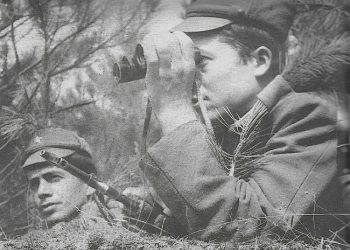
Isak Alla is and will remain a symbol of anti-communist resistance for the village of Zgosht and beyond. Although uneducated, he was a skilled military commander. In defense of his village from the surprise attack of the Second Partisan Brigade, leading the Zgosht band, he destroyed the Brigade’s units without losses in his own ranks. Isak Alla put up a determined resistance, fighting bravely against the Pursuit Forces in the years 1945-1947, in the area of Zgosht – Letmi Field – Steblevë, etc.
During the war period, he worked and fought in defense of his village, while after the war, pursued step by step by the Army and State Security forces, he remained undefeated in the cliffs of the highlands and the caves of the mountains of Librazhd. Isaku did not marry again in exile. He himself, his brothers, and his family sacrificed themselves in the fight against the communist regime established in Albania. He passed away in 1966 in the United States of America, honored and respected by many friends and fellow patriots of the Albanian diaspora.
THE DRAMA OF THE FAMILY OF EMIN AND KAPO BIÇAKU IN QARRISHTË
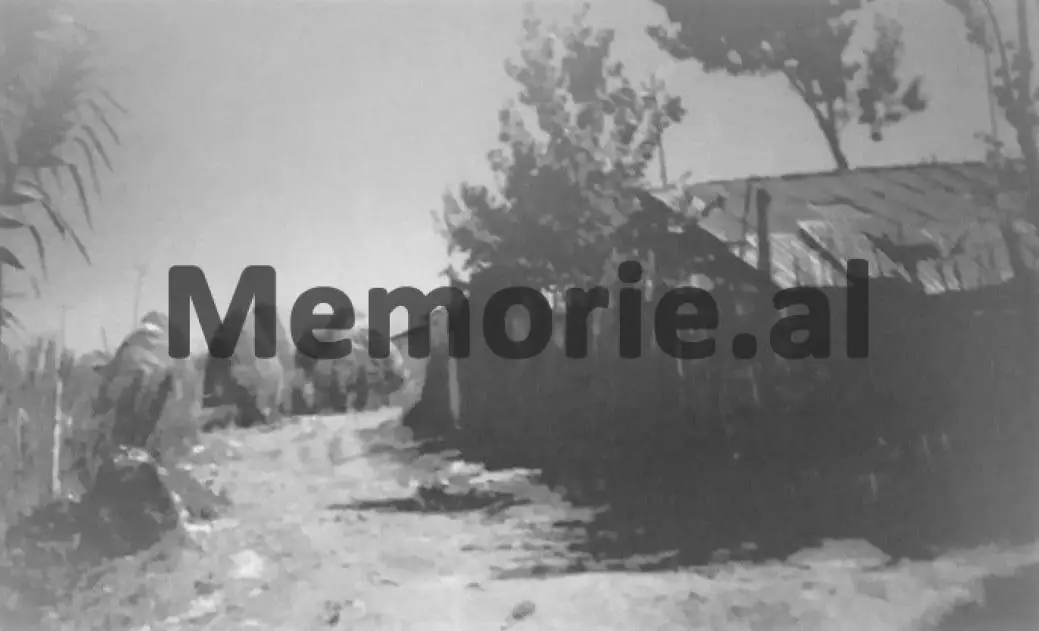
Qarrishta, a mountain village, 1,200 meters above sea level, is located in the north-east of the district, about 40 km away from the city of Librazhd, on the border with Macedonia. Inhabited for over 200 years, it stretches on both sides of the Zall (torrent) with the same name, which is a swift mountain stream fed by pure springs descending from the slopes of mountains clothed with beech, fir, and pine forests. Two clans live in Qarrishte; Biçaku and Hasa, who arrived there in the early 18th century.
On the northern slope of the village, the residential houses are placed one behind another at the foot of the forest, with oak and beech trees. This mountain slope culminates in rocky heights over 1,500 meters high, called “Stopone”. This entire mountainside is considered by the locals as “Itifag,” meaning an area forbidden for timber cutting. In this territory, the village inhabitants did not cut wood, because it was at risk from erosion and avalanches during the winter months.
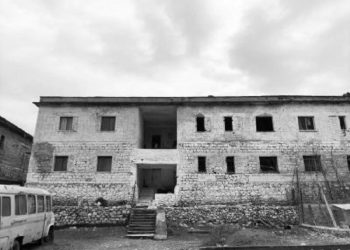
The buildings are mainly two and three-story stone towers, with stone walls and pitched roofs covered with wooden planks (shingles). The entrance doors of the dwellings are mostly arched, carved by local master stone-cutters. Even the small windows have stone pillars and shutters, where the loopholes left intentionally for self-defense catch the eye. Below the houses stretch the small, sloping plots of arable land, terraced and divided by retaining walls, with pathways leading to the houses above them.
On the other side, on the southern and eastern slopes, the residential houses are more dispersed and placed on meadows. These latter, divided by boundaries for each family group, after being mown, serve as good pasture for sheep and cattle. Above the settlements are vast expanses of beech forests, which at the dominant heights are mixed with pine and fir trees. To the west of the village lies the neighborhood called “Qytezë” (Little Town), spread on a flat relief and surrounded by beech and pine forest.
The motor road to Qarrishte passes through the Qafa e Shapkës (Shapka Pass), 1,462 meters above sea level. A few meters after passing the place called “Liqeni” (The Lake), this typical mountain village appears before your eyes, with stunning nature. Unfortunately, today, it has somewhat lost its former appearance, as many families have left, and as a result, the beautiful characteristic old buildings are gradually falling into ruin.
The inhabitants of the village of Qarrishtë have traditionally been mainly engaged in livestock farming and a little in agriculture. In the past, the entire village, during the summer months, would move up to the mountain with all its livestock. Today, this tradition is preserved only by a few families, who spend the summer with their livestock in mountain pastures. Agricultural land is limited to a few slopes, where mainly potatoes, beans, and corn are cultivated. From almost all sides of the village, pure water sources flow, enabling the growth of dense and diverse vegetation.
5.1 Emin and Kapo Biçaku, heirs of a noble family, with capable and hardworking people
It was precisely in this mountain village, with a wonderful natural complex, where winters are cold and harsh, while summers are cool and green, that the family of Veli Biçaku the Elder lived. Veliu had 5 sons: Emin, Kapo, Sheme, Mahmut, and Sadik. As early as Zog’s time, the aforementioned brothers separated into several families, settling on their own properties.
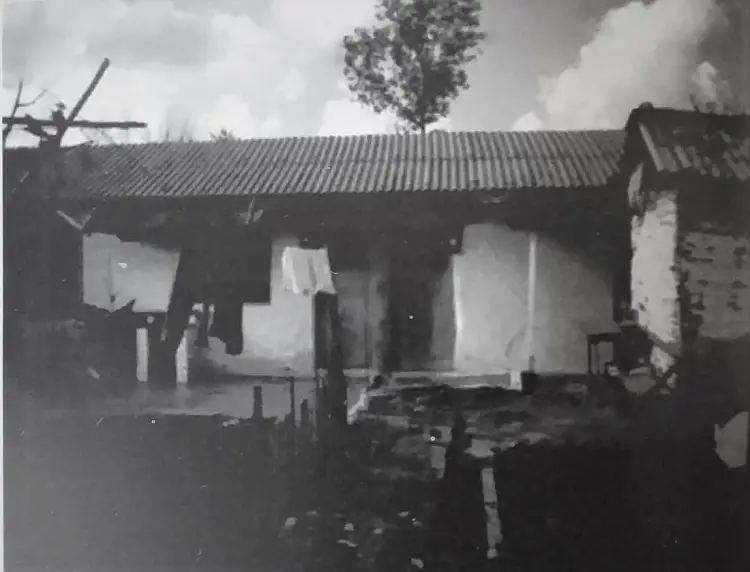
Thus, Shemja settled in Qytezë, Mahmuti east and south of the meadows, while Sadiku, beyond the Peshkorr stream, in a place called “Bunga”. Emini and Kapo lived together. They stayed in the three-story tower, built with stone walls and worked with lime mortar. It was a true fortress, with 9 rooms, entrance areas, and antechambers, situated on a rock at the highest edge of the neighborhood. The doors and windows with carved limestone gave it a majestic appearance.
Personally, I saw the building in question undamaged in 1976, when I was working as a teacher in Qarrishtë. At that time, the offices of the agricultural cooperative of the sector were there, as the family members had been forcibly evicted from the house. At first glance, it gave the impression that a noble family with capable and hardworking people had lived there. The family of Emin and Kapo Biçaku, since Zog’s time, and even before, had become economically strong.
They were mainly engaged in livestock farming, and a little in agriculture, as the land surface in Qarrishtë is limited. Emini had 9 sons and 6 daughters. His sons were: Rrahim, Nexhip, Veliu, Shekri, Isa, Eshref, Haki, Kadri, and Saip. Kapua had 6 daughters and 1 son, Ilmiu. Their family had many friends. Particularly, they maintained friendly relations across the border, in Struga, Ohrid, and Albanian villages of Macedonia on the border side.
Almost every night they would receive guests arriving from different regions; from Elbasan, the lowland areas, Golloborda, Dibra, Macedonia, etc. There were quite a few cases where even two tables of bread would be laid out in the guest room. It happened, on special occasions, that criminal elements from Albania would cross the border, robbing flocks of sheep, horses, etc., in the villages of Macedonia. Those who had been raided would come and ask for help precisely from the family of Emin Biçaku, given that the only crossing route was through Qarrishta.
Emin Biçaku was a prudent, loyal, brave, generous, and hospitable man. He was distinguished by the traits of a dignified highlander, who sought to keep the image of the village pure. He did the impossible to find the tracks of the plunderers and, in many cases, made it possible by forcing the culprits, who had passed through Qarrishtë, to return the stolen livestock and items. There is plenty of evidence saying that Emini, after identifying the culprits, would saddle his horse and set off for them.
There he would sit cross-legged with the elders and the village leaders, telling them; “I am neither the state nor a kadi (judge), but I am a Qarrishtar, and through the pathways of my village have passed your people with stolen livestock and goods. I am responsible for my territories, therefore I ask you to return the taken goods.” Their family also became a shelter for those fleeing persecution for various reasons. In one instance, two priests from Zagorçani, pursued by the Macedonian state authorities, came and sought refuge with Emin Biçaku’s family.
They took shelter and stayed there for two years. When the political situation in Macedonia changed, they returned to Zagorçan, thanking Emin’s family with gratitude and deep respect for the help given. In this generous and hospitable family environment, the sons of the Biçaku family grew up and were educated, listening in the guest room to the conversations of distinguished men who came from different regions, inside and outside the country.
The 12 men of the large family of Emin and Kapo Biçaku contributed to strengthening the family’s economy. According to age, inclinations, and abilities, they performed various jobs, being skilled shepherds, farmers, dairymen, builders, and traders. The women of the family were engaged in small agricultural tasks, weaving and wool work, cutting and sewing clothes for family members, preparing and maintaining dairy products, etc. The family had two housewives who cooked.
In 1937, they built and opened a shop in Librazhd. They traded mixed articles there, various kinds of cloth and homespun woolen fabric, and calico. Their goods came mainly from Italy, but they also maintained connections with trading centers in Struga, Ohrid, Bitola, and Debar (North Macedonia). Nexhip and Veliu served in the shop. During the war, their family did not get involved in politics, but when the opportunity arose, they helped the partisans. One of Emin’s sons, Eshref, was a participant in partisan formations.
It is said that it was Emin Biçaku, together with some other men from Qarrishtë, who oriented Mehmet Shehu and the First Brigade to follow the itinerary towards the Lespriska Pass, as the most suitable route to Fushë-Studa. Like many other Qarrishtar people, their family supplied bread and food to the partisans passing through. On the eve of the country’s liberation, the large patriarchal family of Emin and Kapo Biçaku, consisting of over 50 members, counted over 500 sheep, 200 goats, over 10 cows, two mules, two oxen for plowing, and a considerable quantity of goods in the shop. / Memorie.al
Continued in the next issue