

From SAMI REPISHTI
Part Eighteen
Sami Repishti: – “In Albania, the communist crime of the past has not been documented or punished; there has been no ‘spiritual cleansing’, no conscientious confession and denunciation of ordinary communist criminals!” –
‘Under the Shadow of Rozafa’
Memorie.al – During the 1930s and 1940s of the last century, as the unstoppable fascist and communist storm descended upon Europe, sooner or later over the entire world, “fate” also seized the Albanian nation by the throat. Like all young people, I too found myself at a crossroads where a stance had to be taken, even at the risk of one’s life. Then I said “no” to dictatorship, and took the road that had no end, a sailor in a vast sea without shores. The rebellious act that almost killed me simultaneously set me free. I am an eyewitness to life in the fascist and communist hell in Albania, not as a “politician”, a “personality” of Albanian macro-politics, but as a student, as a young man who became aware of my role, in that time and in that place, out of love for the homeland and the desire for freedom; simply, as a young man with a pronounced sensitivity, faithful to myself, to a life of dignity.
Continued from the previous issue
XIV
I did not feel well in health. I had a high fever, I breathed with difficulty, and my cough gave me piercing pains in my back that wrenched my lungs. The food was poor, but I was unable to eat, even water and bread. I stayed in bed all the time; my roommates did the impossible to ease my pains. At night I couldn’t sleep, and the insomnia exhausted me even more. The pharmacist‑nurse, who cared for me, Elezi, an angel on earth, and a prisoner together with me, was one of my closest comrades. After two days of observation, he reported that I was suffering from dry pleurisy, which risked worsening quickly. The director sent me to the prison hospital, a narrow room, the window with thick bars overlooking the hospital courtyard, and two beds. A guard stood at the entrance.
On the second day, the doctor examined me, ordered radioscopy, put me on a course of medication, and left without saying a word. Behind the door, he said something to the guard, but I understood nothing. Two hours later, the prison director came into the room and greeted me kindly. I did not speak, but when I saw his face, I immediately recognized that beneath the officer’s uniform was my elementary school friend, a former partisan who lived near my house. Involuntarily, I smiled. He asked about my health, but I was unable to answer. “Don’t speak!” he told me, “now we will send you for radioscopy,” and he left the room. When he returned, he was accompanied by a nurse I did not know well and an armed guard. Held by both arms, I entered the radiology room. When I returned, the nurse whispered to me that her husband, Ndoci, my former colleague, who had helped the escapees with food, had died before he could be arrested.
“Better that way,” she added, Matilda, and left. I did not answer. On the third day, the guard brought me food from my family, as a supplement to the ration the hospital gave me. In bed I began to sleep more peacefully, and with the improved food, I gained energy. Little by little, I got out of bed and began to walk around the room. The guard looked at me through the small window from time to time and did not speak. Occasionally I approached the window from which I could see nothing, and I listened to the voices of passersby. The news of Ndoci’s death caused me a depression. He worked as a technical draftsman at the Reconstruction Office, with me and with Qamili, another workmate, loyal, mature, and imprisoned together with me. Ndoci was ill with tuberculosis and lived from one day to the next. His wife, a nurse, had not given birth to children, and their love had been for each other. But he was determined to become active in the resistance.
His participation in our group was conscientious and enthusiastic. He did much to collect aid for the “escapees”, as the freedom fighters were officially called, and to maintain constant contacts. Calm by nature, frail in health, and uncompromisingly loyal, he was convinced that he was living the last days of his life, and he would not waste a single minute without doing something. He often was absent from the office, and his wife would inform us that he was in bed. We did not visit him at home so as not to arouse suspicion. But when the others were arrested, he was spiritually crushed, no longer went to the office, and died within two weeks.
His health condition was so poor that the Security Service did not arrest him but isolated him with a guard at his bedside. The news of his death brought back to me, forcefully once again, the memories of the comrades who were sentenced to death. One of them, Fahriu, whom we respected for his intelligence and determination in organizing the “anti-communist resistance”, as he put it, pained me the most. Still young, newly graduated from Italian universities, he worked as a forest engineer with the enthusiasm of a young man who believed he was invincible. The poverty he witnessed in the mountainous areas of the country, and especially the brutality of the executions of that population by the Security Pursuit Forces, had revolted him to such an extent that he threw himself into the arms of the organized movement against the communist regime.
Simple, idealistic, he viewed everything with an optimistic eye. In the spring of 1946, Fahriu returned from Tirana with the news that a national anti‑communist movement was beginning, and that he would join them. Our group respected his opinions, and without properly weighing the weight of our own act, we accepted his leadership and the line of action he advised us. In this situation, it was imperative to extend our activity inside and outside the city: with the youth, mainly students, and with the “escapees” whom we called “freedom fighters”. It was the summer of 1946. It was during this period that the expansion that became the “Postribë Movement” occurred, for which we bore no responsibility. In Shkodër, mass arrests began. One of those arrested had served as a liaison for our leader with the Tirana group. Torture did its work, and our group ended up in prison.
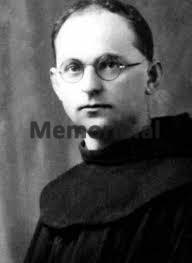
Fahriu, the idealist, was arrested, tortured, sentenced to death, and executed! His execution took place at the same time as that of a Franciscan friar, whom I had happened to meet in the Security cells only a few months earlier. He was accused of keeping weapons in the Church. This accusation tormented the conscience of this minister greatly, because of the damage the Church might suffer. The truth, as this son of Saint Francis told me in the most critical moments of his life, before death, was that he had fallen victim to a poorly thought‑out act, a banal incident: four weapons left there by an Austrian seminarian, a German soldier, waiting for the chance to throw them out without noise. The unfortunate friar had been denounced by an expelled seminarian for violating the rules of the Assembly. The Security Service exploited this case with a mendacious propaganda that crossed the borders of our country, claiming the preparation of an organized uprising by the Albanian Catholic Clergy.
After a shameful and organized official unmasking, four high Franciscan clerics were executed, and about thirty others were sentenced to heavy imprisonment. The “power” had found a very convenient opportunity to eliminate the Catholic Clergy in Albania, the strongest and most prepared anti‑communist center. “What worries me immensely,” the friar told me before death, “is the deception of the people, and I am afraid that there are even some who believe it…”! After the “confession”, the friar addressed me with a plea that tore my soul: “You are young,” he said, “and one day you will be released. I beg you, whenever you are freed, tell the truth. This is my last wish…! The people must know that we are not guilty. I beg you!” he repeated.
Moved deeply, I embraced this victim of ill fate, who was not afraid of death but was horrified by the great lie that the “power” was spreading against the Albanian Catholic Church. “Pater Cyprian!” I said in a half‑voice but with determination, “if I get out alive, I will tell the truth!” And embracing him with tears, I added: “Pater, there is a chance you might not be executed!” He smiled and added: “My son, by killing me, the communists want to kill the truth!” The names and faces of those who met death under torture and were sentenced to death began to appear before me, like living figures demanding an explanation.
Lying in the hospital bed, they asked me: Why?! Why did this insane and uncontrollable wave of terror cover our country?! Why this great thirst for the blood of innocent Albanians, why this endless sadism filling the hearts and minds of the rulers?! Why did our people, facing such a moral and political catastrophe, not find the courage to revolt in masse?! In every corner of Albania, in the prisons and torture centers called “interrogation”, we were being crushed with rough clubs, the bodies of innocent Albanian brothers and sisters, all those who sought freedom for themselves and for others. Where were the tomorrows promised with so much enthusiasm and youthful vigor, for years on end?!
The conflict between my memories of the nineteen‑year‑old cousin executed in the Nazi camps, of the idealistic spirit that pervaded those years, with thousands of Albanian young men and women, on the one hand, and, on the other hand, the daily reality we lived, and especially the great lie served without any scruple to our people by the “political leaders”, kept me frozen in place, paralyzed by the monstrous scale of this conflict and the devastating consequences it brought to my country. It was hard to believe that even my cousin, sacrificed on the altar of the fight for freedom against the occupier and for a better future for all, would have accepted the reality created in our country. I had known him well, and his sincerity in thought and action had never caused any doubt. He was intelligent, and little by little he had dictated a similar distinction between the propaganda open to all and the covert actions within groups of trusted elements, and his initial faith had wavered.
What would my cousin have said if he had lived through the terror inflicted upon this people, whom he adored in his youthful imagination, if he had visited the interrogation centers and prisons, if he had witnessed the brutality of torture on the arrested, if he had counted the graves of the executed, often for the capriciousness of ignorant Security officers, personal vendettas, religious contempt, or regional prejudices?! What would my cousin have said if he had seen the people living on insufficient rations of cornbread, the peasant stripped of the land he worked, the worker in the factory and workplace who was transformed more and more each day into a robot, discontented, and the students who suffered under the unbearable pressure against a regime that had them by the throat and hindered their free breathing, while teachers and professors were the main objects of suspicion and police surveillance?
What would my cousin have said if he had seen that in my country, the “Yugoslav comrades” of the war ruled like modern pashas, and the leadership had turned into a faithful servant that carried out orders “from above” without asking, without discussion, without hesitation and without reservation, and they called this state of complete slavery a “fraternal bond”?! Our last conversation now came back to me as a living memory. He had understood something, had fallen prey to the worm of doubt, and had begun to think for himself. In this fluid state, he struggled to find certain coexistence between the idealism offered by Marxism and the Stalinist practice exercised by the party leadership circles in the city, and he could not find it! He was tired from this internal struggle, unsure of his path, and at the same time incapable of leaving, let alone taking an opposing stance. Where would my cousin be today? Certainly not among the party leaders, who had been completely stripped of any human and national feeling and served the interests of the Yugoslav Communist Party with fanaticism and by any means: harsh, violent, with blood.
Where would my cousin be today?! In prison with me?! Perhaps even further! Because the hatred of the rulers was more pronounced toward those who had been disillusioned by the “experiment” and sought to regain freedom. My cousin would have been arrested, tortured, imprisoned, or executed by the very comrades of the Movement for which he gave his life. Of this, I had no doubt! Slowly I was going mad: alone, sick, sentenced to fifteen years in prison, at the age of twenty‑two. Alone in that small hospital room, thought allowed me to break the bars and walls that surrounded me and to plunge without restraint into the free sky of speculation, where the mind seeks unceasingly, in search of the unknown truth and of perfect beauty. Oh human mind! You are the fearless eagle that rises into the infinite heights of the sky, what is most sacred resting in our human hearts; you represent the majesty of the divine presence within us and the desire for unlimited freedom!
At lunchtime, the guard allowed me the food my mother brought. The first time I heard her voice, it sounded so sweet, so close, that it brought tears to my eyes. Mother was there, in front of the door, unable to enter, but the sound of her voice reached me unobstructed. I stood up out of the desire to be as close to her as possible, to hear her better, and in the hope that I might see her, even from a distance. From the window, only the wall of a building opposite and a patch of sky were visible. She asked the guard endless questions about my health and received simple answers without any elaboration. Then silence! She seemed to hope to hear my voice by chance. The meeting was forbidden! – “How is his health? Is he improving?” – “Yes!” – “Does he eat his food?” – “Yes!” – “Does he need other food?” – “No!” – “Does he get out of bed?” – “Yes!” Mother fell silent, as if she wanted to find new questions. – “Is it possible to see him?” – “No!” – “Why?!” – “I have orders!”
Again silence! Then the guard would order her to leave, and the old woman would take the road home, with slow steps and a broken heart. I remembered a childhood scene when I had cried with emotion, so much so that I wanted to myself. Often later, my memory brought me back to that weeping, which with every wipe seemed to have eased a part of the pain, so much so that it gave me a feeling of release. That day, I thought that I no longer even had the right to tears, because I am not a child, I am a man. I sought with my soul for the tears that flow, like a lingering suffering that drains, but could not find them. That day, no tear flowed to bring relief! One month after coming to the hospital, I asked the guard about the monthly meeting, but he cut me short: “There’s no meeting this month. Orders from the director!”
This “order” from the director confused me, because he was the one who had shown some pity for my condition and allowed food from the family. What had happened?! Why was he denying me a right guaranteed by “law” and enjoyed by other prisoners?! My suspicion grew when the director’s visits stopped completely! During my stay in the cells of the Kuvend (Assembly) prison, I had been able to hear, several times, the political conferences held by the police officers. The sound came weakly from below, but the words were clearly understood whenever there was complete silence. The content of the reports that were read was monotonous, like the daily news of the government papers, stale and false. But the tone given to such worthless materials, and the language used during the discussions, especially when it came to the prisoners, was of an unbelievable vulgarity.
Every foul word of street slang was repeated and repeated without end, so much so that it became the main element of the conference. The speakers rose in an unbridled competition of filthy insults against the prisoners, not sparing even our mothers, wives, and sisters. The spirit of revenge expressed and applauded in that hall frightened me more than the inevitable disgust caused by the policemen’s vocabulary. Threats and again threats against the “enemies of the people”, as if they were preparing the ground for new truncheons wielded by the interrogating officers, which fell mercilessly upon our backs. Down there, in that conference hall, something dangerous was being cooked. Down there was a “factory” that stripped the policeman of everything except his captive, and fabricated trained robots to cause suffering and humiliation.
I could not foresee a normal future for my people. The fear that others, many others after me, would pass through the Calvary I was living, tore my heart. Every word from below, every shout, every clap came to me like one more club, one more kick, a tumble down the concrete stairs, because I had no doubt that the new monstrous faces being prepared in the “factory” of party propaganda would seek other blood, other torn bodies, other victims, to satisfy their needs artificially created for torture, to extinguish their fire skillfully kindled by professionals for bestial revenge. Who else would shed blood in the future, in the fight against the red dragon, except those who dreamed of a just, open, unhindered, and free world for themselves and for others?
XV
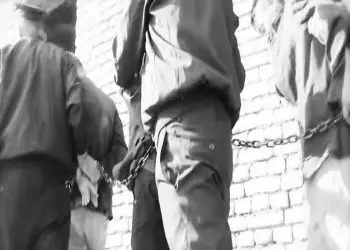
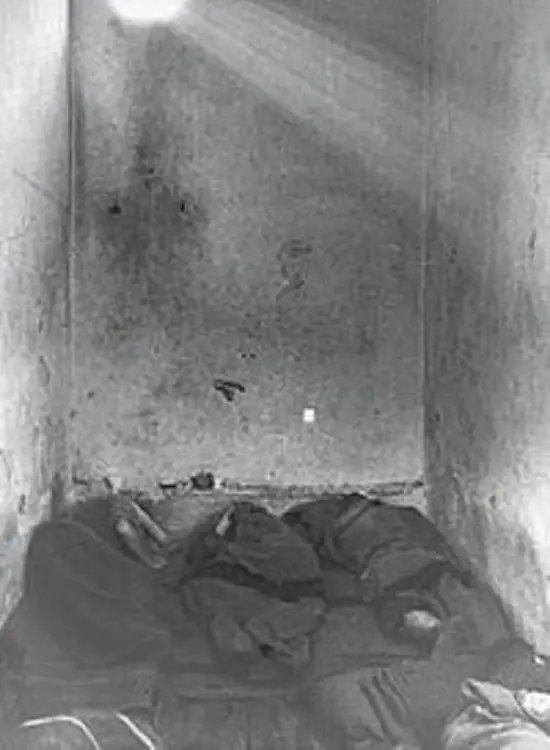
One morning, the guard entered the room without any warning, handcuffed me, and without allowing me to take my belongings, escorted me to the “Big Prison”. After a thorough search, they placed me in room no. 9. Again endless questions and a desire to know everything I had seen and heard during the two months in the hospital, as if I had been on vacation. Prison life! The next day, I began to get familiar with everyone. Peasants, highlanders, administrative clerks, and an officer: generally, this heterogeneous mass deserved pity and support. Many of them were completely innocent and naïve, to the point that they still did not understand why they were in prison! On the bunk opposite me, two highlanders from Luma had taken their place together, one old and the other a young man with his left hand destroyed by a bullet. They were quiet people, and spent the whole day with a tobacco pipe, often empty.
Sentenced to long years of imprisonment for armed resistance against partisan brigades, they awaited every day for “pardon” or another miracle that would get them out of prison, with a disconcerting simplicity. Their outward calm amazed me, patience without complaint, a stoicism seen only in convinced believers. Food from the family was rare, and the prison gave nothing other than the ration of cornbread and water, like in the middle Ages. Their health worsened daily, but their stance was unwavering. They looked, they kept silent, and they endured with dignity. The beatings of prisoners in the Shkodër prison began after ten in the evening… in the darkness! Everyone went to bed on order at nine o’clock, and total silence fell over the room, broken only by the noise of the guards or of tortured prisoners. The first night, an old man of seventy from the city was punished for having given two onions to a highlander from Mirdita. For this violation of the rules, he was sent to the cold cell, forced to undress naked, wetted with cold water on that February night, and in the damp cell beaten with a club until he was unable to speak. The old man’s screams filled the prison, and the thud of the club on the victim’s back could be heard clearly.
After such a punishment, he was allowed to return to the room, wet, frozen, black‑and‑blue on his face and body. To make the humiliation complete, the guards did not allow him to dress until he got into bed! None of us dared to get up and help. By the door, the guard stood with his club. The old man came into the room trembling, and naked got into bed to warm up as quickly as possible. From time to time, the grinding of teeth and groans he could not contain were heard. Our room was dead. I covered my head in shame. With a feeling of weakness at the lack of due courage, I remembered the scene of Gethsemane and began to understand the spiritual state of the “disciples”, frightened when their “Teacher” was beaten with a whip, innocent. None of the “disciples” had the courage to protest. Even worse! Even the best among them denied the “Teacher” three times, though he never forgot him and loved him without limit his whole life! Memorie.al
To be continued in the next issue