
By Ali Buzra
Part Nineteen
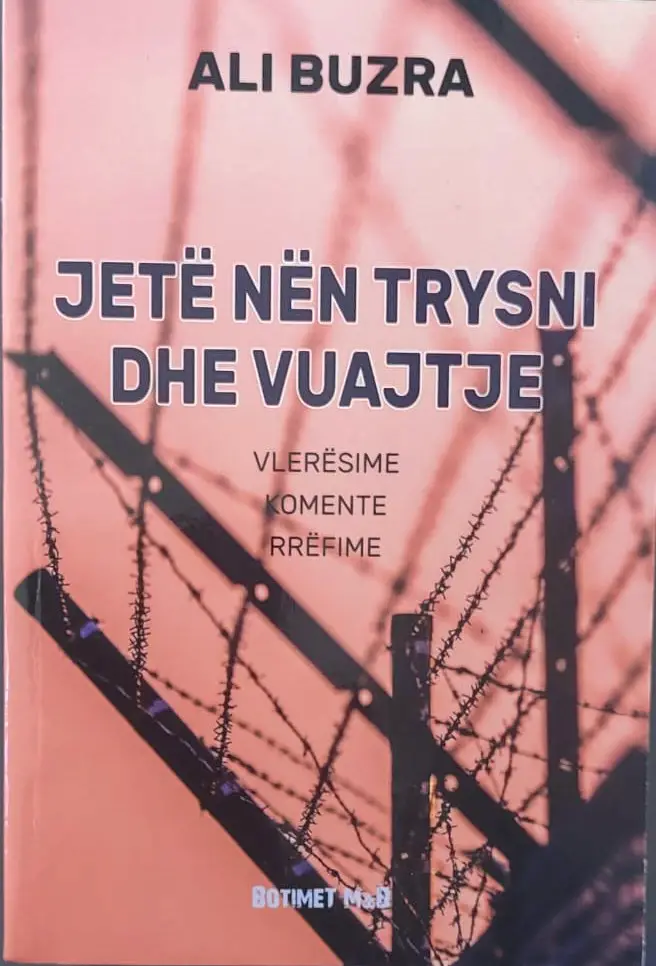
LIFE UNDER PRESSURE AND SUFFERING
ASSESSMENTS, COMMENTS, NARRATIVES
Memorie.al / At the request and wish of the author, Ali Buzra, as his first editor and reader, I will briefly share with you what I experienced in this encounter with this book, which is his second (after the book “Gizaveshi në vite”) and which naturally continues his writing style. The sincerity and frankness of the narrative, the simple and unmodified language, the accuracy and precision of the episodes, or the lack of a refining imagination, whether intentional or unused, I believe have served the author positively. He comes to the reader in his original form, inviting us to at least get to know unknown human fates and pains, whether by chance or not, leaving us to reflect as a starting point for raising awareness towards a catharsis so necessary for the Albanian conscience.
Bedri Kaza
Continued from the previous issue
From the window, he saw his mother opposing those heartless beasts that were entering and leaving the house. About this, Shefqet writes in his book: “I only thought about my family; these things had devastated me spiritually, but I didn’t want to show my weakness in front of them. What mother went through when we were the age of my children, now Bukuria will suffer it! Cursed be you, miserable life, and you, o delirious society that only knows how to cheer and hate us, without knowing why. …I was leaving home, my mother, wife, and children; they didn’t let us live our life, even as they have created it for us.
They didn’t let mother end her old age without pain; would she have the strength to withstand this last blow? I never knew my father; I don’t know how to imagine him…! But mother will also end her old age without me. Mother cries for her son; my helpless children cry for their father; my wife, around whom the children huddle like birds whose nest has been destroyed, cries for all the troubles that befell her at a young age. I cry, not for the joys I leave behind, because I never had them, but I cry for the sufferings, the poverty, the sighs I left them with.”
At the investigation, they asked him to cooperate with them, promising to make things easier for him. Shefqet Dobra, 36 years old, stood manfully before those who had no manhood; he endured the most cruel tortures, losing consciousness several times, and not only did he refuse to cooperate with them, but he also refused all the charges brought against him. In January 1980, after nearly three months of investigation, they brought him to trial. That day, his wife and children also came there. Despite her insistence to hear her husband’s trial, she was not allowed.
The false witnesses were brought in one by one to testify. One of them said that Shefqet was dissatisfied with the Party, an enemy, etc., but he couldn’t remember what had been written during the testimony taken earlier. The judge would read it to him, while he repeated those same words. When the judge asked Shefqet, as the defendant, if he had anything to say regarding the witness, according to the procedure, the latter replied that the witness doesn’t remember what is written in the file and what he was instructed to say against him.
In the next session, the witness, apparently “hardened” (made ready for anything), testified that Shefqet had been absent from work, with the aim of unfairly lowering the quota, and also to leave the pigs unfed. Since this witness could not provide facts against the defendant, the judge finally threatened him, saying they would discredit him before the people. A woman, who was the secretary of the youth organization, testified that Shefqet had been assigned to read the newspaper because he read better. They asked him to go get the men where they worked so that the brochure for Comrade Enver’s birthday could be read, but he allegedly didn’t go. Another testified that he had asked Shefqet who would be elected in place of Hysni Kapo, and he had replied that there were plenty like him there. When given the floor regarding this last point, Shefqet asked him: “Have we ever worked together?”
“No,” he replied. “So, we don’t visit each other, nothing connects us.” “No, I’m uneducated, you are educated…!” “You had school right at your doorstep; am I to blame for that? Since we had no connection, why did you take the trouble to come to my house to ask who would be elected in place of Hysni Kapo? Why didn’t you ask the party secretary, who was closer to you?” “Just for fun, for no reason,” says the witness. “Does one go for fun to someone you don’t talk to? Did you think of it yourself, or were you instructed?” This was the witness whom the investigator, during a confrontation with Shefqet two months earlier, had thrown out of the office after he had admitted that to go to Shefqet’s, he had received orders from the area operative.
Trials with political motives have usually been staged, but nevertheless there were plenty of cases where the individuals on trial had actually spoken against the communist regime in conversations with others, expressing dissatisfaction with it. Whereas the trial organized against Shefqet Dobra was entirely manipulated; it was merely a formality, since Shefqet, knowing the circumstances his family had gone through and was going through, was extremely cautious in conversations with anyone. At the conclusion of the trial, the district prosecutor stated in his demand: “The accused has carried out hostile activities, to undermine and overthrow the people’s power, in his most hostile ways… and I request the judicial body to sentence him to 10 years of imprisonment.”
Finally, the court upheld the prosecutor’s proposal of 10 years in prison. They put him in irons and took him out of the hall, while outside the door were his brother, Muhamet, his wife, Bukuria, with their four children, waiting to see him. Before even stepping outside, Shefqet asked the judge to at least let him see the children, but he did not allow it. As he was leaving, he heard Bukuria’s voice telling the judge they should meet, but he told her: “You mind your own business! The enemy didn’t think about his children.” This was done in many cases, with the aim of destroying families. Shefqet served his sentence in the brutal prisons of Spaç and Qafë Bar. In Spaç, his mother, who was already in her eighties, went to see him once.
She went with Muhamet and Shefqet’s little daughter, whom he initially did not recognize. They had also walked a long way. “I came this time,” his mother tells him, “because I’m old and you never know, will you find me here when you’re released or not”! His mother’s words broke her son’s heart, and he addressed her: “Forgive me, mother, for causing you trouble at this age.” “No, mother’s son, you are not to blame.” They couldn’t express themselves longer, as the meeting took place in the presence of the guards. He parted from his mother with tears in his eyes. A few months later, she became paralyzed, something Shefqet never found out about while in prison. In Spaç, on one occasion in December, Bukuria also went there with his nephew’s son. The meeting took place at nine o’clock in the evening. Bukuria was a courageous woman. She never complained to him, but told him they were fine, while advising him to take care of himself.
The meeting lasted an hour. She slept with the children in a room there on the concrete floor, while Shefqet at ten o’clock left for work on the night shift. It took an hour to get to the work front in the gallery. “We had left our work clothes wet,” he recounts, “and we put them on soaking wet when we went. In the underground galleries where they worked, temperatures reached nearly 40 degrees Celsius, while when they took the wagons outside in winter, the temperature went down to minus 20 or 25 degrees. As soon as they went outside, the wet clothes would start to freeze. The wagon had to be pushed with arm strength non-stop, because if it stopped, it would freeze to the rails and work would be suspended. Whoever this happened to would be penalized as the cause of the work stoppage and could be re-sentenced for sabotage.
In Qafë-Bar, Shefqet recounts, they had a brigade leader, not a prisoner, named Flori. He was a very good man and never set the prisoners against the guards. They, in turn, spared no effort for everything he told them. In one of the furnaces, a prisoner had been killed by a collapse, and they couldn’t pull him out alive. A lot of ore had fallen on his body from a height of 50 meters. The guy, named Malo, was awaiting release, as he only had a few days left. But it wasn’t meant for him to see his parents again, nor even to be buried. It is said that Commissar Selaudini apparently felt some regret and made a request to Ramiz Alia for those few days of prison left after his death to be forgiven. This, perhaps, would enable the family to receive his body. The request was not accepted. After five days, four workers escorted by two guards took Malo to the cemetery, while the other prisoners followed him with their eyes until the bend.
Shefqet and several others were sent to the place where the accident happened, as some equipment was broken and needed repair. Right there, Shefqet had an accident; the cable with a plank spun around and threw him to the ground, leaving him unconscious. His comrades, witnessing the horror, thought he wouldn’t survive, but fate wished for him to live. After a few days, Bukuria came with his sister and son. He was completely shattered, but he didn’t show it in front of them. There he learned that his eldest son, who had just turned 14, had left school to work. The brigade leader, Riza Gradeci, was a good man. He had kept the boy, giving him non-strenuous work.
Later, brigade leader Sul Saliasi also acted this way with the young lad,” the family members recount. There are good people too. Shefqet’s eldest daughter also finished the first year of high school, but then went out to work. During the time Shefqet was serving his sentence, the leaders of the council and the party in the sector organized a people’s meeting specifically to discredit his brother, Muhamet, who had had jaundice and had been discharged from the hospital without being cured. In that poor state of health, they summoned him to the people’s meeting in the sector.
Muhamet was about 48 years old, but the illness had overcome him. With great difficulty, he made the journey from the camp to the sector. The meeting was led by the secretary of the party bureau of the agricultural enterprise. They brought Muhamet forward, telling him to stand in the corner of the large cultural hall. The party secretary first spoke about the political situation, emphasizing that the party had uncovered and punished the enemies, no matter how hidden they were. A woman from the front row of those present, who were sitting on benches, stood up and shouted: “Long live the Party.” The hall applauded. Then, the secretary addressed Muhamet, saying:
“Do you see this one here? Right here among you, he has engaged in hostile activities. He didn’t heed that his brother was sentenced to 10 years as an enemy. They want to destroy your happiness, the future of your children, but we won’t allow it, because we have the Party… etc., etc.” Two men from a village in Çermenika, who were not from the internment camp but residents of the sector, stood up one after the other, saying that Muhamet is the son of the officer who fought against the people’s power, and he, like his father and his brother, continues likewise…!
“Well! What do you say to your patriot?” the secretary says to Muhamet. “At that time, I was little and don’t know anything, but even if it were true, I cannot account for that,” replied Muhamet, who could barely stand. Two or three other people also spoke, perhaps also instructed to incriminate him further. The only one whom the family members remember with respect was Riza Gradeci, who stated that; “Muhamet and the entire Dobra family are very regular with their work, and he didn’t believe that Muhamet had engaged in hostile activities.”
The surname Gradeci intimidated the secretary, and he didn’t oppose him but told him; “Alright Riza, sit down.” (Sulo Gradeci was a companion of the dictator Enver Hoxha). Finally, another young man, also from Librazhd, whose names Shefqet has made known in his book, stood up, incriminating Muhamet even further. Finally, the secretary spoke, who also closed the meeting organized against Muhamet Dobra. He was the last to leave the hall. Some young people, educated with a sense of hatred, had been instructed to beat him on the way home.
Hasan Lika noticed this, spoke to them, and accompanied Muhamet to near his house. After the “discrediting” of Muhamet, the whole family was on edge. Shefqet’s son, Islam, was transferred to another brigade. There they began to treat him very badly, also mentioning the name he bore. They didn’t pay him for the work done and often reminded him that he was the son of an enemy.
“The first days of January 1987,” Shefqet recounts, “they didn’t put him in the gallery anymore, but he did work inside the camp. On the evening of January 26, Lek Miraka together with Dine Dine treated the prisoners who came to congratulate Shefqet on his release with cigarettes and candies. With him was also a very good young man, from a village in Çermenika, named Qemal Meta. He had been returned from Yugoslavia, where he had escaped; he was the son of a martyr and had been sentenced to 14 years in prison. The next day, Shefqet was released. Out of ten years, he served eight. He arrives near the house, where everyone was waiting for him. One of the children saw him and ran quickly to Muhamet’s house. Everyone came out to greet him. Bukuria was holding his mother by the arm; she had suffered two strokes.
“Thank God you came, mother’s son; the soil wouldn’t have rotted me, but if you hadn’t found me alive, you could bury me with your own hands,” were her words, which tore the soul of her son, who had longed for home for so many years. They spent that night with mother, brother, sister, and children, staying up late. The stresses in the Dobra family were not over. A few days later, the elections were to be held. The court decision, made years earlier, did not provide for the removal of electoral rights, so Shefqet had to go vote. When he went to the voting center, he saw people lined up. “Musicians,” Shefqet remembers, “moved around the sector with tambourines and clarinets, making merry, expressing ‘the people’s love for the party’. The loudspeakers were buzzing, showing the percentages of voters in the districts.
After the number of people decreased, Shefqet and his whole family went in. He takes the ballot paper, which has known in the time of the dictatorship had no alternative and was simply to be dropped into the box. It had become customary that before dropping it in the box, people would say: “Long live the Party”! What was Shefqet to do; he had been sentenced as an “enemy of the party”! Even if he said the word, who would believe it; the next day they would say that even the enemy said; “long live the party”; if he didn’t speak, they would say that; “he was an enemy and remained an enemy”.
Thus, in dilemma, he approached the ballot box. He had decided not to speak; meanwhile, he hears a woman’s voice telling him: “Here,” pointing with her finger to the slot of the ballot box. He recognized her as his former brigade leader, before he was imprisoned, who was now eight years older. About this, Shefqet writes: “Although a communist, for the time I had her as brigade leader, I kept the best regard for her behavior and the treatment she gave me. … I looked at her, she had her eyes fixed on me; in her I saw neither hatred nor fear, like in so many others…”! Shefqet started work, now not in Sulzotaj, but in the Çerma sector. After a year, his mother passed away.
She lived with the hope that one day she would see her heart’s man, her husband, Islam. It often happened that she remembered him, saying; “hopefully he got married and has children, so he doesn’t live his life gloomy and alone.” From testimonies taken from Sadik Dobra, their cousin who escaped in 1953, it appears that Islam Dobra managed to go from Yugoslavia to America. There was special surveillance on him by the State Security, to eliminate him, as has happened with other anti-communist exponents. Under these circumstances, he changed his identity there, in order to avoid harm. There he married and had two daughters.
It was the beginning of the democratic movements in Albania. A few months earlier, Shefqet had been accepted into the organization of the Democratic Front, given the membership card after 45 years. This happened now that the Front was coming to an end. Admissions to the Party of Labor began easily. The student demonstrations of December 1990 led to the massification of anti-communist protests, which culminated in the toppling of the monument of the dictator Enver Hoxha. In 1993, Shefqet was proposed to become an officer, since he had finished high school.
Certain individuals proposed that he be appointed commander of the police post in Çerma and that, having him there, they could straighten out some men there who had scorned the persecuted. In contact with them, he states: “No, I would never do it. True, we must not forget the bitter past, but we who know hatred must not hate; with our good behavior, we kill them more. It is not noble to use the position for revenge; I have turned my back on the past; I want them to understand that we are not as the Party told them.” / Memorie.al
To be continued in the next issue