
From SAMI REPISHTI
Part Twenty‑Six
Sami Repishti: – In Albania, the communist crime of the past has not been documented and punished, no “spiritual cleansing” has been done, no conscious confession and denunciation of ordinary communist criminals! –
‘In the Shadow of Rozafa’
Memorie.al / During the 1930s and 1940s of the last century, with the unstoppable downpour of fascist and communist storms over Europe, sooner or later over the whole world, “fate” also seized the Albanian nation by the throat. Like all the young, I too found myself at a crossroads where a stance had to be taken, even at the risk of life. Then I said “no” to dictatorship, I took the road that had no end, a sailor on the wide sea without shores. The rebellious act that almost killed me liberated me at the same time. I am an eyewitness to life in the fascist and communist hell in Albania, not as a “politician”, a “personality” of Albanian macro‑politics, but as a student, as a young man who became aware of my role, in that time and in that place, out of love for homeland and desire for freedom; simply, as a young man with a marked sensibility, faithful to myself, to a life with dignity.
Continued from the previous issue
XXV
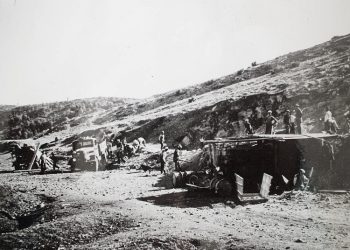
In the summer of 1955, we were transferred to the Rinas camp, not far from the capital. The new airport would be larger than the one at Ura Vajgurore, and would serve both civilian and military purposes at the same time. In Rinas, the camp barracks were surrounded by planks. Inside the camp, the prisoners built narrow roads paved with gravel and sewers, to prevent flooding of the camp and winter mud. Water was sufficient, and for the first time, the opportunity for better cleaning of body and clothes was given. It was a special pleasure. The camp command paid 10% of the monetary value of the norm, with an account kept at a shop inside the camp. With the accumulated money, it became possible to buy some food items. The pay for one week of work provided us with approximately one kilogram of sugar. The new method served as an incentive to work. Among us, there were many who fulfilled two norms per day.
The work area was a degenerate forest, covered with thorns and small trees. Deep digging of the earth began, to bring out all the roots and destroy any vegetation that could endanger the concreting. All around were numerous guards, with rifles, automatic weapons, and machine guns. One day, something truly tragic and revealing of the condition in which we lived occurred. A former soldier, imprisoned because he had attempted to cross into Yugoslavia, newly sentenced and brought to our camp, attempted to escape. He was about twenty‑two years old, calm and very humane. He had no friends, he stayed alone, and in his military clothes he looked out of place among us. Desperate from imprisonment and suffering, he lowered his shovel to the ground and began walking towards the outer guards, with a steady step. The guard aimed his rifle. The victim did not stop. He had decided to die.
We all stopped work and anxiously followed the development of this drama, which would end in tragedy. We heard the voice of Aspirant Refat, commander of the outer guards, shouting: “Don’t shoot!” “Don’t shoot!” as he ran towards the soldier, who continued walking away with steady steps, without saying a word. Aspirant Refat approached, grabbed the prisoner by the scruff of the neck, hit him on the head with a stick, until the victim fell to the ground. The aspirant vented his rage, cursed, kicked the prone, half‑dead body. Then, he looked around, found a large stone, picked it up, approached the prone body again, and raising it with both powerful arms, he threw it with force onto the head of the unconscious ex‑soldier. From the camp, a powerful cry rose to the sky. Then, complete silence fell. No one spoke! No one moved!
“Uncle Refat”, as the guards called him, looked at the dead man for a moment, kicked the corpse, made sure he had given up his spirit, and turning to us shouted: “Work, you pigs, and what are you looking at?” I closed my eyes and covered my ears with my hands, lowering my head before this horrific scene. I wanted to go into the ground alive. The gesture of “Uncle Refat” came before me powerfully, and the sharp cry of my comrades would not leave my mind. A tomb‑like silence, like that which perhaps the world experienced after the biblical cataclysm, covered everything. When I opened my eyes, the camp’s engine worked as before, with its heavy and weary noise, as if wanting to tell the workers frozen in place that nothing had changed…!
Exhausted by the terror we had witnessed, we heard again, coming from the hell created by the will of the heartless man, a familiar voice, torn, broken, and harsh, that we knew well. With a stick shaped like a crook, held high as a trophy of victory, “Uncle Refat” shouted with the devilish joy of a bloodthirsty man: “This is the dictatorship of the proletariat”! In that moment, nothing else lived, moved, or drew my mind and heart away from that body that had just died. That being, now a corpse, for a moment was my whole world, my being body and soul! Oh, how strongly I wished I had the necessary courage to say something, to do something, to condemn my silence, perhaps to squeeze powerfully and to the end the arteries of my throat, to the end. How low man falls…! The hangman’s expression defined the situation. Although familiar to all, it shook me from the numbness, from the paralysis of the tragic minute.
The life that had stopped for a moment resumed under the unfortunate omen of the death threat hanging over our heads. The guards also began shouting, and for those who could not find the strength to work, the stick began – the camp’s executioners, half‑confused, used it to free them from a devil that tormented them inside. The brutality of the guards continued uninterrupted until evening. No one spoke. Only after work, when we were returning to the camp to spend the night, the stories of the scene we had followed with wide‑open eyes made me even more aware. Before me appeared the heavy stone that the red executioner had raised with both arms and thrown with spite onto the head of the young victim. Simple explanations did not work, like hammer blows on the anvils of the head, which now boiled like a cauldron from the super‑terrestrial impressions of that day. “Uncle Refat” was a “desperado”.
Those who knew him well told me more: he had killed his cousin in order to take his wife. Having joined the partisan bands during the War, he had volunteered for actions that gave him the opportunity to torture the peasants of the Kolonja area, where his partisan unit was stationed. After “liberation”, he was charged with direct supervision of the prison cells in Tirana, and as keeper of the special section for tortures against political arrestees. In the camp, he walked with a stick in his hand. His usual behaviour was to curse God, perhaps because, unable to remove Him, from the impossibility of torturing God, to hit Him with a stick, just as he did to us! Several times, he shouted loudly, as if to defend himself from an inner feeling that followed him step by step, like his own shadow.
“Hey, you priest, if I had your God here now, I would break his ribs with this oak stick, you hear me?” The guards laughed. The priest, to whom he was speaking, worked without speaking. The next day, Uncle Refat was at the head of the column of prisoners, as always, with the crook‑shaped stick, as always, and with a steady walk, as always. Nothing had changed in this monster that killed a young man yesterday and laughed today. With his gestures, he seemed to say: “I am your master here. Do you hear? Your life is in my hands”! The criminal act undoubtedly leaves a deep mark on the life of the criminal, because he breaks the moral rules of society. Nevertheless, Uncle Refat seemed driven by the logic of events and of the act itself, without thinking, and remained faithful to the path of crime. Now he no longer feared deserved punishment; the system that had spawned him protected him. There was no doubt that he lived in the sea of perpetual lies and denial.
Perhaps, in moments of clarity, he too felt a burden of conscience that tormented him incessantly! In a place without moral law, like Albania under communism, that burden might be the most merciless punishment that crime deserved: the justice of conscience. Because even Uncle Refat must have had a lamp where the voice of a clean conscience hid. At least, that is what I wanted to believe! That is what the friar in prison had told me as well. But in the camp, nothing had changed! The camp command was not troubled by the massacre of a young man, as if the life of an Albanian citizen protected by laws were nothing, as if the life of an individual – whose well‑being should have been the centre of attention in revolutionary thought and action – had been definitively annihilated. The monstrous act of this red criminal was the absolute negation of every humanist principle, was the most brutal trampling of every ideal, was the most convincing proof of communist degeneration in Albania, where the life and dignity of Albanian citizens were despised without any scruple and to the very end.
Above us, a plane flew noisily over the old Tirana airport. We saw it three times a week; it was the Tirana‑Budapest‑Moscow line. It transported Party hierarchs who were being educated in the Soviet Union and returned as “experts” in dictatorial repression. Others were indoctrinated with the principles of the Soviet economy, forced collectivisation, and the killing of individual initiative. Everything of the state, everything for the state, which took care of the daily bread of the regimented masses. Another plane flew higher, and every time it passed over us, it reflected the rays of the sun’s brilliance off its white aluminium. From a distance, its noise was faint. As if it did not want to weigh down even more our suffocating atmosphere. I called it indifference! It flew towards the West, like a vision that left behind the constant memory of a passing moment, like the tail of a bright comet. What happens here on the earth inhabited by suffering people, the plane that glides smoothly over the rarefied air of the heights, does not know. It seemed not even wanting to know, this untiring companion of the white clouds in the blue expanse.
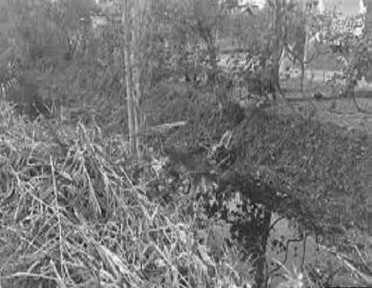
Nevertheless, on this earth shaken by the sweeping away of victims, there lived noble beings who accepted death, but not the regime that caused it. Perhaps in that plane there were individuals who knew no other life but goods and pleasures, who enjoyed the temporary sweetness of debauchery. In the mud of the side ditch where I was working, I could not get rid of the idea of such a fundamental difference between my world and that of a young traveller in that plane. After a bitter smile at the irony of my fate and that of my comrades, a powerful rise of morale threw me into the sphere of still youthful idealism. It drove me to despise the “indifference” of the plane full of carefree individuals, and to embrace with the fire of one condemned to death the life that was being extinguished in prisons and labour camps for long years, always full of the conviction that I was defending the free human being and his dignity.
Oh, keep for yourselves, you carefree travellers of the passing plane, the mad company after earthly goods, the trips to exotic places, the non‑stop vacations on magnificent beaches and Swiss ski resorts! With the carefree life you lead, the excess food you eat, you have asphyxiated your minds and paralysed your consciences! You do not know what life is, beyond night‑time amusements and daytime sleep! You do not know what it means to fight with nails, day and night, in swamp and mud, to preserve one’s moral and spiritual integrity even when the body is broken with sticks every day, or when it ceases to be from a hot bullet… or from a large stone thrown with force onto the head…! Carefree travellers of the passing plane that lands in the West: you do not understand our language! It is the language of the hell we live in, which you do not know, you who are drunk with the security of life in a world without fear! The communist society being built in my country has condemned us without a present, without a future.
But in this earthly hell that Albania is today, we have found our glory, by refusing to become part of the game of this bankrupt society, and embracing, on the contrary, our lonely life in our private “cell”. In this state imposed by the oppressor, we have trampled on his society, and in our protective “cell” we pass through a process of spiritual purification. We are determined not to betray the “human being” locked in this “cell”! This awareness – perhaps a blindness of ours before the oppressing reality, this conscious enclosure within walls built for the purpose of salvation – allowed us to protect our inner life, and ensured the possibility to follow, undisturbed, our dreams that never parted from us…!
In the camp, work continued at a fast pace. The order from above was to finish the airport as soon as possible. We worked without rest. In our free time in the camp, we read materials that comrades from the Tirana prison had brought with them. After work, cleaning, and dinner, small groups of young people gathered head‑to‑head and carefully read selected passages from texts in foreign languages. I also benefited from an English volume by the British Labour leader, Harold Lasky. For the first time, I was reading a treatise that dealt with the most current and vital themes for the moment we were living in. The revelation of the progressive ideas of the English Labourites came with an extraordinary attractive power. From the earliest days of youth, the social ideas of the 19th century were absorbed with enthusiasm by all our contemporaries. Who would not want to feed the hungry, to provide work for the poor, medical care for workers and their families, and free education for all?!
In our country, “politics” has always been understood as war, hot or cold, between the political forces of the country, and between personalities, with tragic consequences for the defeated. The presentation of problems with skill and their solution with professionalism was something that did not take first place. Always the political personalities, always the political parties…! Now, in this enlightened text, I, the inexperienced young man, intellectually unprepared, found the map that showed me the right path for the creation of a society that, without sacrificing political freedoms, would bring social justice. Every day after work, I carefully read two‑three pages of the English book. There I also learned some expressions of political language and their meaning in context. There I understood the extraordinary importance of British trade unions in the political life of the country, and how important legislation and the role of a socially‑inclined government were in building a fairer, more promising, and more engaged life in the functioning of the state and British society.
For me and my comrades, that text opened a large window without bars, looking out onto a world full of problems, but with the prospect of a happy future. It was a great step forward in the process of my political maturation. Every new thing I learned I shared with my closest comrades, especially with Toma and Et’hem, two young men thirsty for new knowledge, and the discussion was serious, albeit at a beginner level. We were all pleased with such a simple gift that, under normal conditions, would have passed without fanfare. But in our situation, the book became a source of knowledge and political maturity. The “socialism” that prisons and concentration camps represented, and everything else inhuman for us, began to take on a new colour. The humanist spirit of the Labour author won us over, enthused us. All‑round progress without dictatorship was possible!
Work continued regularly. The visits of “leaders” from Tirana were now frequent, and we understood their appreciation for our work from the behaviour of the guards the next day: they left us in peace, or intervened with sticks for the slightest reason. With the start of concrete production, teams were assigned to each concrete mixer. For my misfortune, Sergeant Ismaili from Lushnja, a malicious short man, chose me for the shovel part, the hardest work. Soon, my hands were covered with water blisters that grew, burst, and dried without any treatment. Sergeant Ismaili developed a pathological hatred for me after the escape from the camp of four comrades from Vlora and Tepelena, two of whom slept near me. The command suspected that I had prior knowledge, and decided to take revenge at work. It was winter months, and the work area at the concrete mixer was in water. The old shoes did not protect. When a light rain fell, work was not interrupted. Not even when it was cold. Everything depended on the concrete.
We were insignificant. When the low temperature risked freezing the concrete, we did terrain clearing. We dressed in layer upon layer for warmth, and covered our heads with cement bags; the camp looked like a small town full of scarecrows wandering up and down like beggars…! The New Year 1956, we celebrated with wishes for a quick release, and in low voices, with wishes for the overthrow of the “power”. For me, this was the last year, after the sentence was reduced to ten years, and I hoped that I would be allowed to return to my family. Opposite cases were frequent. Prisoners were called to the command on the day of release and informed that the “People’s Court” had decided to extend the sentence by further years in “deportation camps”, usually in Myzeqe, or again in prison. But I had another concern. It was Sergeant Ismaili, who was on my back, determined to kill me in the camp. Every morning, he loaded me with various tasks until concrete production began.
All day long he hovered around me, stood over my head. On his satanic face, hatred and the great desire to punish were clearly visible. He cursed me, threatened me, kicked me during work, but I did not answer. It was important to complete the sentence, to get out of the camp, and to rejoin my family. With the beginning of the new year, the command formed a group of about fifty people, from among those who would complete their sentence within six months. I was among them. The diabolical plans of the Command became clear when the new group started working also on Sundays, and remained in the field even when others returned to camp. The guards were few, and it seemed the command believed that, as the release day approached, none of us would attempt to escape. Overtime work and lack of rest were the final nails in my coffin. I did not have enough time for the company of my comrades, or for reading books.
From work, straight to the food cauldron, and after a quick wash, I would lie down on my bed, half dead, until I got up in the morning for work. With the improvement of the weather, the concreting of the runway accelerated. The trucks loaded with cement usually came after the workers had returned to camp, to prevent contact with the drivers. Then the “Group of 50” waited outside, and escorted by two guards, went to the trucks and began unloading, sack after sack, into the “depot” of each concrete mixer. The cement acid peeled the skin from our hands. Without gloves, without any protective equipment, loading and unloading not only filled our lungs with dust, but also crushed our backs, half‑exposed from our unbuttoned shirts.
Hundreds of sacks were unloaded for each truck. Often, when the work was done and we were heading towards the camp, a second truck would arrive. The command would turn us back, we would unload the truck, and exhausted to the point that our legs could not hold us, we would enter the camp at night. Such a profound change in the life of the camp, and the fear that I would be physically destroyed to the point of leaving the camp as an invalid, unable to earn a living for myself and my family, threw me into a state of nihilistic pessimism, so much so that I no longer desired the usual meetings with my fellow sufferers. /Memorie.al
To be continued in the next issue